Direct answer: Run an intent data proof of concept as a bounded buyer-side procurement test with a frozen cohort, baseline, treatment workflow, commercial acceptance thresholds, data-rights review, and a pre-agreed go, revise, or reject decision. Test more than signal accuracy: verify relevant coverage, freshness, identity, activation reliability, user adoption, integration effort, and downstream economic value. A demo, sample report, or short agency discovery pilot can help design the test, but none is equivalent to a platform POC or proof that a purchase will succeed.
Who this is for: Buyers shortlisting intent-data platforms or agency infrastructure, plus agencies helping clients evaluate them. This is not a generic agency-service pilot and not a narrow false-positive exercise; the outcome must support a credible commercial purchase, expansion, or rejection decision.
BrandWell update, September 2026: MarketPulse intent data starts at $250/month within BrandWell’s complete growth automation software. AIMEE, the agent-powered desktop app, helps connect buyer signals with research, content, and campaign work. Access to the broader tools depends on your package.
What an intent data POC must decide
The POC should answer one commercial question: “For this defined market and workflow, does this configured solution create enough reliable, timely, governable, and actionable evidence to justify the proposed contract and operating cost?” It should not try to prove every possible use case or make a revenue guarantee from a small sample.
Start with the decision date, candidate commercial scope, buyer, and rejection authority. Then write the claim being tested. For example: a configured signal and identity workflow will identify eligible accounts early enough for a named team to review them, will pass agreed quality and privacy gates, and will improve a defined downstream rate versus business as usual at an acceptable cost. Every word needs an observable test.
A vendor demo shows a prepared path. A trial shows that users can access some functions. A data sample shows what selected records look like. An agency pilot can reveal topic and client fit. A buyer-side platform proof of concept is different: it uses representative data, constrained production-like activation, agreed acceptance criteria, and a commercial decision gate. Keep those artifacts separate so enthusiasm for an attractive report does not become unearned purchase validation.
Write the commercial acceptance contract before testing
The buyer, vendor, operators, analytics owner, security or privacy reviewer, and procurement stakeholder should approve a one-page POC charter before configuration begins. It should freeze scope while still allowing defects to be corrected transparently.
| Acceptance area | Example test design | Decision evidence |
|---|---|---|
| Relevant coverage | Measure eligible accounts receiving usable signals within the chosen market, not global headline coverage | Pass band, denominator, excluded segments, and confidence interval |
| Freshness | Compare observation, delivery, review, and action times; expire late events | Distribution of elapsed time and percentage inside the action window |
| Identity quality | Blind known-company truth where possible; inspect domains, locations, duplicates, roles, and corrections | Match, correction, ambiguity, and stale-contact rates |
| Activation reliability | Send only approved test records through a reversible sandbox or labeled CRM path | Delivery success, duplicate rate, owner acceptance, rollback result |
| Governance | Verify provenance, permitted use, retention, deletion, suppression, access, and regional handling | Reviewed data-flow map, contract exceptions, and unresolved risks |
| Commercial value | Compare treatment with a frozen baseline using accepted signals, speed, qualified opportunities, and cost | Pre-agreed go, revise, or reject threshold with limitations |
Do not copy the sample thresholds from another company. A low-volume enterprise market may need qualitative review plus a longer observation window, while a high-volume motion may support statistical comparisons. Define the minimum sample, confidence needs, decision owner, and treatment of inconclusive results before seeing the output. Otherwise the threshold will move to rescue a favored vendor.
Specify the negative controls
Include accounts that should not qualify: wrong geography, excluded industries, customers, partners, employees, tiny domains, irrelevant topics, stale research, and suppressed entities. Negative controls expose indiscriminate coverage and bad identity resolution more clearly than a showcase of obvious target accounts. Also record pre-existing opportunities and recent campaign exposure so the POC does not claim activity it did not create.
Intent data proof of concept workflow
- Freeze the cohort and baseline. Export the eligible account universe, document business-as-usual prioritization, and mark existing demand before the vendor scores anything.
- Limit the test to one primary decision. Choose seller review, advertising eligibility, nurture prioritization, or agency client reporting. Multiple simultaneous treatments make attribution ambiguous.
- Map each data element. Record source class, unit, observation time, delivery time, score definition, identity method, confidence, allowed use, retention, and deletion path.
- Connect a reversible route. Use a sandbox, shadow table, labeled CRM object, or approval queue. Prove deduplication, permissions, error handling, rollback, and audit logging before production writes.
- Train operators without coaching the answer. Give users the evidence card, approved choices, and prohibited claims. Capture accept, defer, correct, suppress, and reason codes.
- Run baseline and treatment consistently. Protect the frozen cohort, assignment logic, observation window, and downstream definitions. Log exceptions rather than silently changing eligibility.
- Review quality and governance separately from revenue. A signal can be commercially promising but legally or contractually unusable. A clean data feed can still fail because nobody acts.
- Calculate configured TCO. Include contract scope, credits, integration, services, media, operations, governance, reporting, and exit work – not only a trial fee.
- Hold the decision meeting. Score every acceptance area, disclose sample limitations, list unresolved conditions, and select go, revise with a bounded retest, or reject.
The implementation team should include an executive buyer, RevOps or data owner, channel operator, analyst, security or privacy reviewer, procurement or finance representative, and vendor implementation owner. An agency can coordinate the work, but the buyer must retain authority over data, systems, acceptable risk, and the purchase decision.
Five platforms to include in an intent data POC shortlist
Disclosure and method: BrandWell publishes this guide and appears first in the shortlist. It occupies the owned first slot because this article evaluates agency-reseller infrastructure, not because an independent reviewer ranked it first or because it is universally best. We use the approved sequence and the same six visible criteria for all five options. The images are unlinked homepage references, not demonstrations or claim evidence.
The scopes are materially different. BrandWell is assessed as a white-label agency sales-and-delivery engine; 6sense and Demandbase cover broad enterprise GTM and ABM operating models; Bombora supplies specialized account-level off-site topic intent; and ZoomInfo combines commercial data with revenue workflows and optional intent. A valid POC narrows each candidate to the same required outcome rather than comparing feature counts.
BrandWell: MarketPulse intent data and connected growth automation
Best fit: growth teams and agencies that want intent data connected to day-to-day execution. BrandWell is complete growth automation software that connects MarketPulse intent data, TrafficID website visitor identification, content, outreach, and campaign workflows. AIMEE, its agent-powered desktop app, helps turn those signals into research, prepared assets, and approved actions.
For growth teams, the useful result is a current audience and a clear next action. MarketPulse connects topic selection and ICP filtering with audience review, export, scheduling, and a handoff to AIMEE.
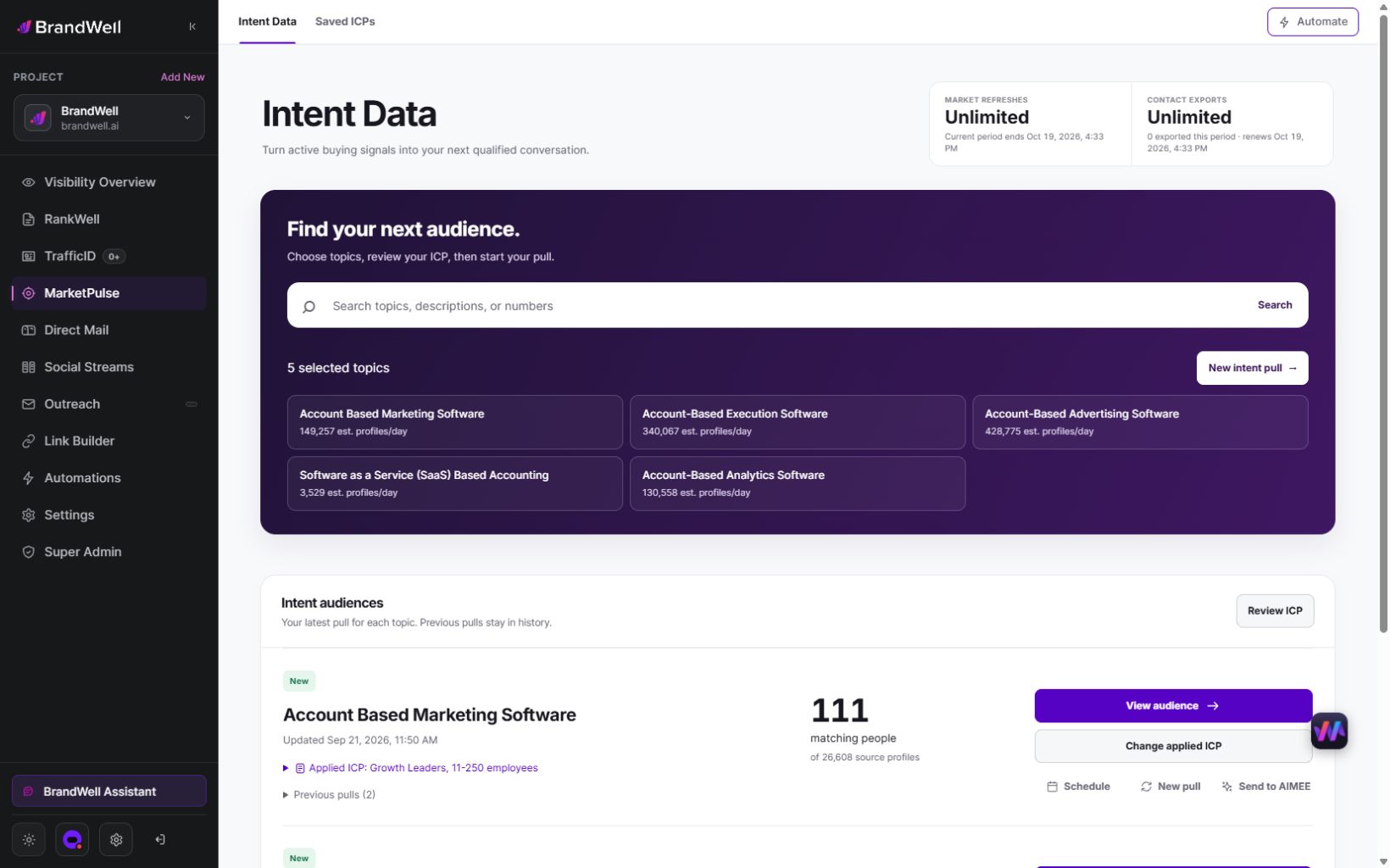
How the software connects the work:
- Find and qualify demand: MarketPulse brings topic-based intent into a reviewable audience with saved ICPs and scheduled pulls. TrafficID adds website visitor identification to the growth workflow.
- Prepare the next campaign: Outreach and Direct Mail provide execution workspaces; Social Streams adds relevant social activity. Use the tools and destinations configured for your project.
- Build demand as well as capture it: RankWell, Visibility Overview, and Link Builder connect content and visibility work with the same growth operation.
AIMEE helps carry the work forward
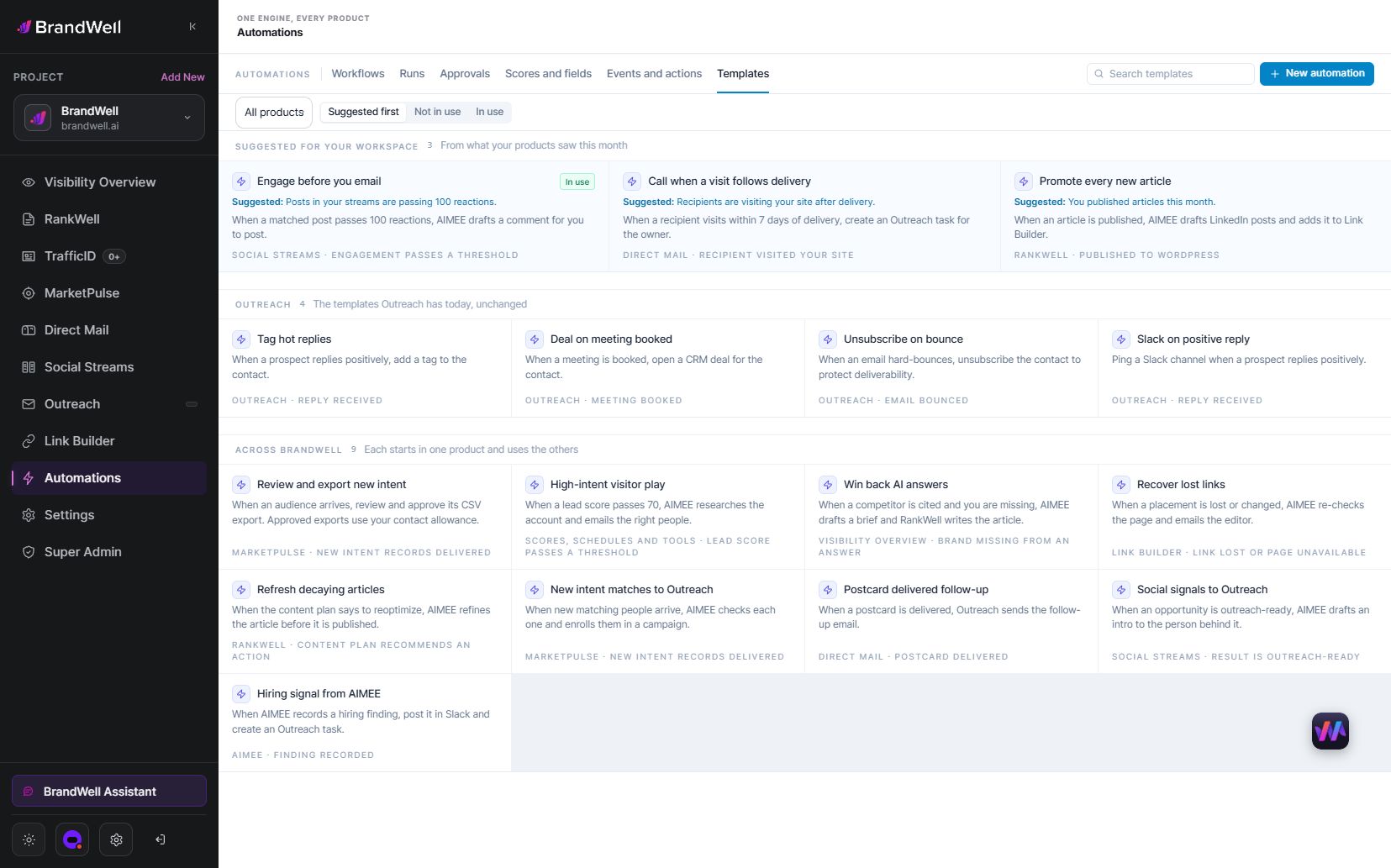
AIMEE is BrandWell’s agent-powered desktop app. It helps research accounts, prepare content and messages, and carry out assigned work through connected tools. BrandWell’s Automations workspace connects product events to workflow steps, with owners, approvals, and run history. You choose the connections, allowed actions, and budgets.
BrandWell MarketPulse intent-data plans start at $250/month. Your selected package determines topic coverage, contact allowances, refresh cadence, AIMEE access, and other growth tools. Channel usage, media, and fulfillment costs depend on the campaign.
What to evaluate: topic relevance, usable audience coverage, ICP fit, and the time it takes to turn an accepted signal into completed work. An intent signal helps prioritize an opportunity; it does not guarantee a purchase or establish permission for every channel. If your main requirement is a specialist data feed or an established enterprise ABM program, compare that specific scope with the alternatives below.
6sense
Best fit: Mature mid-market or enterprise revenue organizations evaluating predictive account stages, intent, sales intelligence, and coordinated ABM activation as one operating system.
Signal and data approach: Retained documentation describes a combined model drawing on CRM, marketing automation, web, keyword, and third-party intent inputs. The POC should identify which inputs are available, how much history is required, and whether external intent adds value beyond existing first-party data.
Activation and implementation: Test account-universe configuration, profile and keyword design, integration latency, model explanation, credit administration, stage-to-action rules, operator adoption, and downstream writeback. A shadow queue can establish behavior before changing production priorities.
Pricing and total cost: Request a current written quote for your configuration. Compare data coverage, users, topics, credits, modules, integrations, implementation, services, contract term, and renewal conditions. Include the team and campaign costs needed to use the platform.
Meaningful limitation: Historical-data needs, integration work, credits, modules, administration, and services can make a broad predictive-platform test heavier than a narrow signal-feed POC.
Verification note: Secure a configuration-specific test plan and quote covering data inputs, model availability, POC limitations, credits, implementation labor, users, services, initial and renewal terms, data return, and success evidence. The hero image proves none of these.
Demandbase
Best fit: Enterprise B2B teams testing an integrated ABM and GTM stack across account identification, intent, advertising, sales intelligence, orchestration, and measurement.
Signal and data approach: Retained materials describe first- and third-party data used with scoring and activation. A useful POC separates raw and modeled signals, makes the unit and freshness inspectable, and tests incremental value against the buyer’s own engagement data.
Activation and implementation: Scope the account set, users, keywords, CRM and marketing connections, buying groups, audience activation, permissions, and reporting. If advertising is included, report software, data, and media results separately so spend does not blur platform performance.
Pricing and total cost: Request a current written quote for your configuration. Compare data coverage, users, topics, credits, modules, integrations, implementation, services, contract term, and renewal conditions. Include the team and campaign costs needed to use the platform.
Meaningful limitation: A multi-module POC can become difficult to interpret, and an incomplete TCO that omits data, media, services, users, or support can make the later commercial decision unreliable.
Verification note: Require an itemized POC and production scope, account volume, signal definitions, connector work, media treatment, support, initial term, renewal language, data disposition, and written pricing. Homepage art is identification context only.
Bombora
Best fit: Buyers testing whether specialized off-site, account-level B2B topic-research intensity improves a prioritization process they already operate in another system.
Signal and data approach: Bombora describes Company Surge as company-level topic research derived from a B2B data cooperative. The POC should validate source relevance, account mapping, topic selection, normal baseline, surge threshold, geography, and delivery freshness on the frozen cohort.
Activation and implementation: Deliver the feed into a labeled warehouse, CRM, ABM, advertising, or partner path; then apply separate contact enrichment, fit filters, expiry, governance, and human-reviewed action rules. Never treat company research as named-person behavior.
Pricing and total cost: Request a current written quote for your configuration. Compare data coverage, users, topics, credits, modules, integrations, implementation, services, contract term, and renewal conditions. Include the team and campaign costs needed to use the platform.
Meaningful limitation: A specialized account signal generally requires additional identity, activation, reporting, and measurement components, so feed accuracy alone cannot establish all-in usefulness.
Verification note: Put cohort coverage, company resolution, topics, baseline method, freshness, test delivery, API and export rights, service obligations, term, production quote, and deletion process into the POC contract. The capture is not validation.
ZoomInfo
Best fit: Revenue organizations considering intent inside a broader company, contact, enrichment, and workflow data stack for sales, marketing, operations, or recruiting.
Signal and data approach: Product bundle and add-ons determine the available records and signals. The POC needs to isolate the exact external-intent component from general company and contact coverage, then inspect its source, unit, matching, age, and licensed uses.
Activation and implementation: Configure test seats, credits or records, CRM objects, enrichment behavior, routing, filters, permissions, suppression, and export. Run in a reversible labeled path and audit credit use, duplicates, updates, and rejected identities.
Pricing and total cost: Request a current written quote for your configuration. Compare data coverage, users, topics, credits, modules, integrations, implementation, services, contract term, and renewal conditions. Include the team and campaign costs needed to use the platform.
Meaningful limitation: Bundle breadth and credit mechanics can obscure the intent component’s marginal value and produce a production commitment very different from a limited test environment.
Verification note: Match the POC to a bundle-, seat-, credit-, intent-, integration-, data-rights-, and term-specific production proposal. Include access loss, exports, corrections, deletions, and test-to-contract conversion; do not rely on the homepage capture.
POC budget, pricing, and total cost
A proof of concept can have no separate fee and still be expensive. Budget internal data preparation, security and legal review, implementation, sandbox or CRM engineering, analyst design, operator training, vendor services, media, enrichment, reporting, and decision meetings. Then model the proposed production commitment, minimum usage, credits, client capacity, renewal, support, and exit costs.
BrandWell MarketPulse intent-data plans start at $250/month. Your selected package determines topic coverage, contact allowances, refresh cadence, AIMEE access, and other growth tools. Channel usage, media, and fulfillment costs depend on the campaign. Compare total cost for the same audience, tools, implementation, and campaign scope; starting prices alone do not establish the lowest-cost provider.
Use three budget scenarios: successful adoption at planned volume, partial adoption with fixed commitments, and rejection after the POC. Ask whether test access converts automatically, whether test data may be retained or exported, which implementation work carries forward, who owns integrations, and what happens if the acceptance threshold is missed. Never turn annual competitor procurement medians into monthly billing claims.
Measurement and the go, revise, or reject scorecard
Score five layers separately. First, coverage and identity: eligible coverage, wrong-company rate, duplicate rate, stale role rate, and corrected-record rate. Second, freshness and operations: observation-to-delivery time, delivery-to-review time, routing success, owner acceptance, and expired signals. Third, governance: provenance completeness, allowed-use exceptions, suppressions, deletions, access control, and unresolved regional issues.
Fourth, assess downstream behavior: reviewed records, approved actions, qualified conversations, sales-accepted opportunities, stage movement, and gross profit. Fifth, assess economics and adoption: configured TCO, cost per accepted signal and opportunity, active users, time spent per review, integration defects, and support dependence. Report counts and denominators, not isolated percentages.
A holdout is valuable but not always sufficient. Freeze assignment before scores are revealed, balance account fit and existing engagement, exclude or label pre-existing opportunities, and keep treatment consistent. If sample size is too small, state that the result is directional and require a longer bounded retest rather than declaring victory. “Influenced pipeline” shows association; a purchase case requires a credible counterfactual plus an honest uncertainty range.
The final decision memo should make conditions explicit:
- Go only if mandatory data-rights, quality, activation, adoption, and economic gates pass and the production quote fits the business case.
- Revise only when a specific correctable defect has an owner, bounded retest, unchanged decision standard, and deadline.
- Reject when provenance or rights are unacceptable, the signal misses the eligible market, operators do not act, integration cost breaks TCO, or commercial thresholds fail.
- Inconclusive is a valid result when the sample or time window cannot support a decision; do not silently convert it into “go.”
Best-fit and poor-fit POC scenarios
A platform POC is most useful when the buyer has a defined ICP, sufficient account volume, reliable CRM outcomes, an executable activation channel, and a material contract decision. It also fits agencies evaluating repeatable infrastructure for several clients, provided each client’s data and rights remain isolated and the buyer-side acceptance criteria are explicit.
A POC is premature when the team cannot define the market, has no baseline, lacks an operator, cannot access outcome data, or has not resolved security and privacy prerequisites. A manual sample may be better for a tiny named-account market. A point tool may be easier when one signal and one route are needed. A broad enterprise suite fits when cross-channel orchestration is the decision. Building in-house can fit teams with durable engineering capacity, lawful source access, and enough differentiated requirements to justify maintenance.
Do not let a vendor’s available trial determine architecture. Begin with the commercial decision, then choose the smallest candidate configuration that can disprove or support it.
Data-quality, privacy, and legal controls
Major POC failures include selecting only known winners, changing thresholds after seeing results, confusing account with person behavior, testing old data as though it were fresh, letting vendor staff classify ambiguous outcomes, ignoring non-users, and measuring meetings without quality or cost. A false positive is not merely a wrong topic; it can be a correct account with unusable timing, identity, rights, or activation.
Intent data remains probabilistic. It is not consent or purchase proof, and it is not legal permission to contact a person. Review collection roles, permitted purpose, geography, retention, deletion, correction, access, security, client responsibilities, and channel-specific requirements. The NIST Privacy Framework can structure risk discussion, but the buyer should obtain qualified legal, privacy, and security review for its actual data flows, jurisdictions, contracts, and outreach. This is not legal advice.
Agent-ready POC instructions
AIMEE is the agent-powered desktop app in BrandWell’s growth workflow. Assign work through the tools connected to your workspace and choose which actions can run automatically or require approval. Desktop availability, account permissions, and the configured workflow determine what can execute.
The agency role and BrandWell’s pre-POC discovery pilot
An agency can run cohort definition, topic design, data mapping, activation setup, operator enablement, QA, measurement, and the decision meeting as a paid service. It should charge for disciplined evaluation and ongoing operations, not guarantee a positive POC or vendor purchase. Client agreements must identify decision rights, data roles, system access, retail scope, and who approves each consequential action.
BrandWell’s scoped MarketPulse evaluation with branded topic reports is a pre-POC discovery artifact. It can show an agency and prospective client whether topics, accounts, presentation, and operating cadence deserve a formal evaluation. It is not equivalent proof, purchase validation, a platform acceptance test, or evidence of long-term revenue lift. If both parties proceed, begin a new buyer-side POC charter with representative data, baseline, treatment, commercial thresholds, and the client’s go/no-go authority.
To inspect a branded discovery output while preserving that boundary, request an agency intent report. A responsible next step is not “buy because the sample looks promising”; it is “use the sample to decide whether a governed commercial POC is worth running.”
Final POC checklist
Do not start until the buyer has a charter, frozen cohort, baseline, negative controls, minimum sample, configured candidate, data-flow map, allowed-use decision, reversible activation, trained operators, acceptance thresholds, itemized production quote, and named go/no-go owner. Do not finish until all exceptions, changes, defects, unresolved risks, and uncertainty are visible in the decision memo.
A successful intent data proof of concept is not one that makes the vendor look good. It is one that lets the buyer confidently purchase, narrowly retest, or walk away without confusing activity with proof.