On this page
- Current MarketPulse research workflow
- Turn signals into neutral questions
- Confirm the prospect problem before proposing
- Assign research, call and delivery owners
- Maintain evidence labels and a question planner
- Compare discovery and proposal approaches
- Count all preparation and acquisition work
- Measure process before commercial outcomes
- Qualify the prospect and service fit
- Separate observation, inference and confirmation
- Review privacy and false personalization
- Scope the service around confirmed needs
- Copyable assistant discovery brief
- Use research to ask a better question
- Worked example: count briefs that never become calls
- Frequently asked questions
Direct answer: Use prospect intent to decide which questions deserve more attention, not to tell the prospect what they supposedly did online. Treat every signal as a hypothesis. Confirm the business problem in the call, ask permission before going deeper, and record what the prospect says as the authoritative source for the opportunity.
Current MarketPulse offer: intent-data plans start at $500/mo. See the product, demo, and current plans. Updated October 3, 2026.
In plain terms, use prospect intent in agency discovery calls as preparation context, then let the conversation confirm or reject the hypothesis.
The goal is a more relevant conversation. Intent-informed discovery does not guarantee a signed client, shorter sales cycle, cost recovery, profit, pipeline, revenue, data volume, search ranking, or AI citation.
Who this is for: Agency owners and new-business teams preparing discovery calls, pilots, proposals, and recurring buyer-intent offers.
Current MarketPulse research workflow
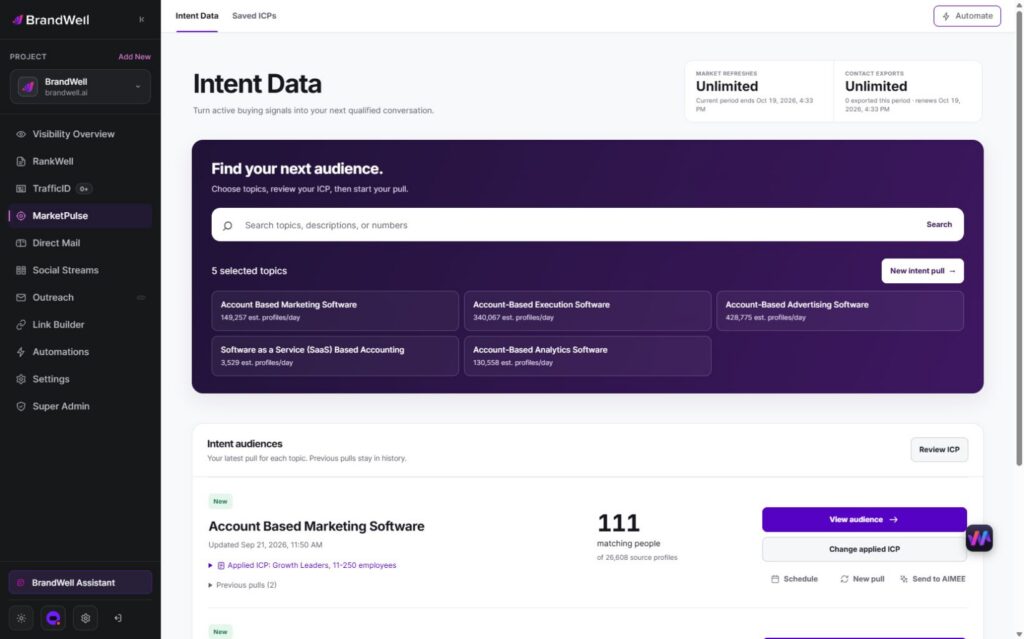
BrandWell MarketPulse: intent data starting at $500/mo. Find people researching topics relevant to what you sell, apply saved ICP filters, and review available contact details before taking action.
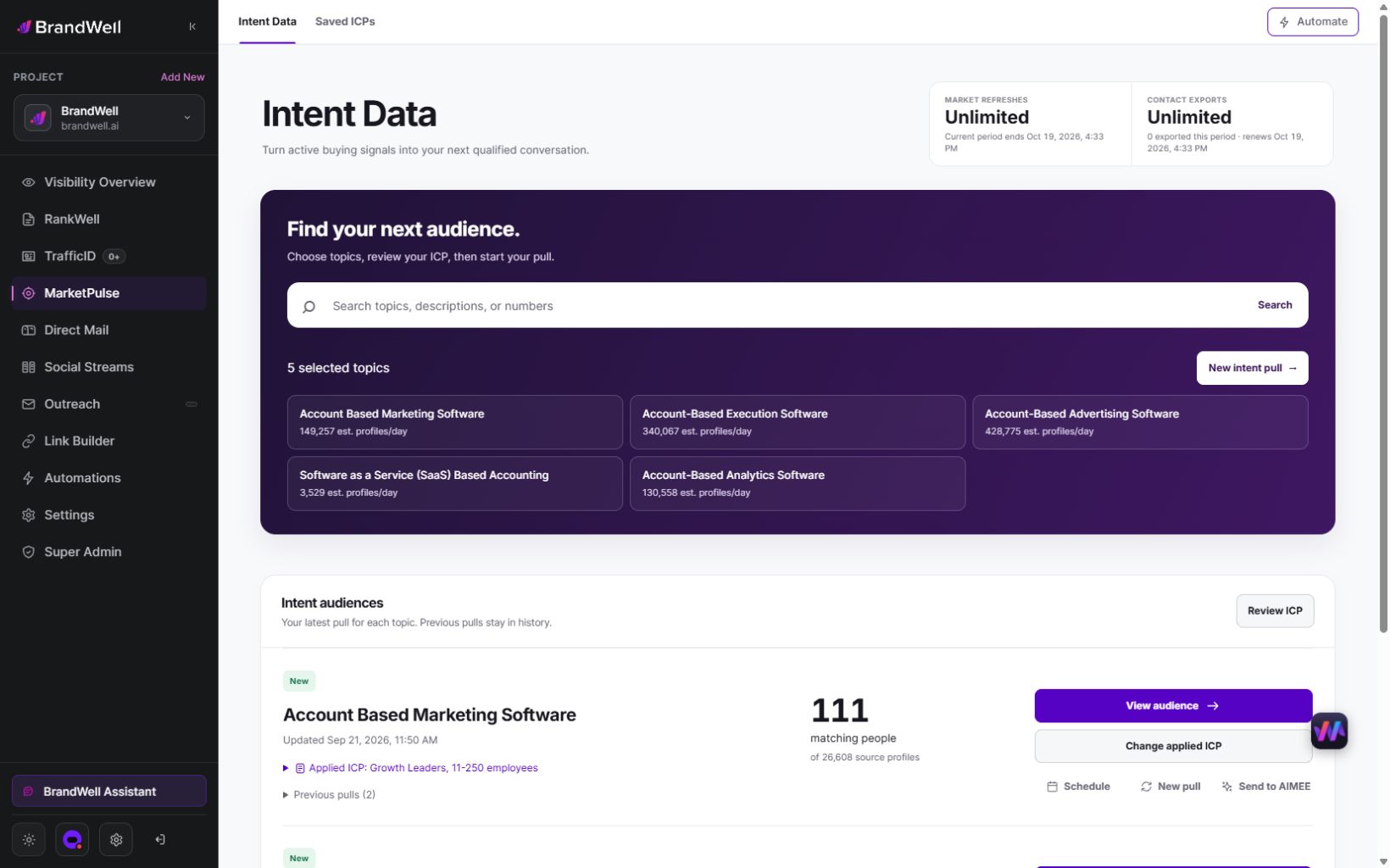
MarketPulse plans are starting at $500/mo. Verify current package scope and offers on the product page.
| Plan | Topics and refreshes | Monthly exports |
|---|---|---|
| Starter | 1 topic, weekly | 25,000 contacts |
| Growth | 3 topics, daily | 100,000 contacts |
| Scale | 10 topics, daily | Unlimited contacts |
Swipe the table to see all columns.
A pull retrieves available data from the previous 24 hours for one topic. Daily use across all included topics provides 90 Growth pulls or 300 Scale pulls in a 30-day month. Weekly Starter pulls vary by calendar month. Available audience size and contact fields vary, and audiences may overlap. Refreshes stop at the plan limit without overage charges.
- Find and qualify: search the topic catalog, save your ICP, and review the people and companies that match.
- Act on the research: export qualified contacts or prepare an Outreach or Direct Mail workflow. Connected products, channel usage, and fulfillment may cost extra.
- Get help from AIMEE: Growth and Scale include AIMEE for the initial user to research accounts and prepare the next step through connected tools.
Agencies and other service businesses can build client deliverables around their available Intent Scans and exports. Keep each client’s scope, permissions, and service fees clear. A subscription is not a promise of a white-label platform or exclusive access to a market.
Explore MarketPulse and watch the demo or compare plans starting at $500/mo. Any early-access discount is a separate, time-limited offer shown to an eligible recipient.
Turn signals into neutral questions
A pre-call brief should convert observed signals into neutral questions. It should never convert an inference into a personal claim. Use the matrix to decide what to explore, which evidence to bring, and what not to mention.
| Observed input | Working hypothesis | Neutral discovery question | Do not say |
|---|---|---|---|
| Research around a service category | The company may be reviewing a priority or vendor | What changed internally that made this problem worth discussing now? | We know you are buying this category |
| Repeated visits to a relevant page | Someone at the account may need more detail | Which parts of the current approach are hardest to evaluate? | We watched you visit this page several times |
| Hiring, product, or market context | Capacity or go-to-market motion may be changing | How is the team adapting its process as the business changes? | Your hiring proves you need our service |
| CRM history or prior conversation | A known objection may still matter | Has anything changed since the last evaluation? | Our system says your team rejected this before |
| No reliable signal | The account may still be relevant by fit | What would make this conversation useful for you? | Absence of data means absence of need |
Swipe the table to see all columns.
The matrix keeps the call human. It also makes preparation reviewable: a manager can see whether a question follows from a reasonable hypothesis without exposing unnecessary data or implying certainty.
Confirm the prospect problem before proposing
Improve relevance before trying to improve persuasion. Select one or two signal themes that connect to the agency’s capability and the prospect’s likely operating decision. Prepare an open question, one follow-up, one useful artifact, and one falsifying question for each theme. A falsifying question gives the prospect room to say the issue is not important or the inference is wrong.
During the call, begin with the prospect’s stated goal. Use signal-informed questions only when they fit the conversation. Listen for decision ownership, urgency, current workflow, evidence, constraints, and consequences. If the prospect corrects the hypothesis, update the record. Do not defend the data.
After the call, build the proposal from confirmed needs, not the original signal. The signal helped choose a path into the conversation; the prospect’s words and approved operating facts should determine scope. This discipline can reduce irrelevant discovery, but no responsible agency should claim a guaranteed win-rate or cycle-time improvement without a defined study.
Assign research, call and delivery owners
Assign four roles even if one person holds more than one. A research owner prepares the brief. A call owner runs discovery. An operations owner confirms that the proposed service can be delivered. A reviewer handles sensitive data-use, contract, or public-claim questions. The CRM should distinguish observed input, agency inference, prospect-confirmed fact, unresolved question, and rejected hypothesis.
Use a simple preparation and follow-up cadence:
- Before the call: review fit, current context, permitted signals, identity confidence, and prior interactions.
- Prepare: write two hypotheses, neutral questions, falsifiers, and one useful artifact.
- During the call: ask, listen, confirm, and obtain permission before deeper diagnostic questions.
- Immediately after: label confirmed facts, assumptions, owners, risks, and next decision.
- Before a proposal: validate scope, economics, rights, and delivery capacity with operations.
The process should connect with the intent-data prospect qualification guide so the call does not move a poor-fit account into a pilot simply because the conversation was positive.
Maintain evidence labels and a question planner
The best working stack has five functions: a permitted signal source, an identity and fit check, a pre-call research brief, a CRM with evidence labels, and a call-note or decision record. Add a proposal template only after the call. A recording or transcript tool may help when the participants have received the required notice or consent for the situation, but it should not become an excuse to retain everything indefinitely.
Fit and signal brief
Account profile, source type, identity state, recency, known limitations, and two hypotheses.
Question planner
Open question, follow-up, falsifier, evidence to bring, and phrases to avoid.
CRM evidence fields
Observed, inferred, prospect-confirmed, disputed, unknown, owner, and next review.
Decision recap
Problem, current process, cost of inaction, constraints, decision group, next step, and permission.
A platform should make those functions easier without forcing the team to reveal every underlying signal. Choose based on data rights, identity clarity, workflow fit, access control, integrations, retention, and total operating cost. Do not rank tools using unverified match-rate or win-rate claims.
Compare discovery and proposal approaches
An intent-informed call begins with a hypothesis and uses discovery to validate it. A generic capability call begins with the agency’s menu and asks the prospect to find relevance. A proposal-first call assumes enough is known to scope and price. Each has a place, but they solve different problems.
Use intent-informed discovery when the account fits, the signals are permitted and relevant, and the decision still needs diagnosis. Use a short capability overview when the buyer is early, several services may fit, or no trustworthy signal exists. Use a proposal-first motion only when the need, scope, owners, constraints, and commercial process are already confirmed, such as a well-defined expansion with an existing client.
The fairest comparison includes preparation time, relevance, trust risk, information gained, operational validation, and proposal rework. Intent research adds cost before the call. It earns that cost only when it changes the questions or the decision, not when it merely personalizes the opening sentence.
Count all preparation and acquisition work
Model the cost per qualified conversation, not only the software subscription. Include data and platform cost, research time, brief review, seller preparation, operations consultation, call time, follow-up, proposal work, and the share of briefs that never reach a qualified call. Add privacy, security, and training work where the signal or identity depth requires it.
Copyable discovery economics model
Prepared-account cost = data allocation + research time + review time + seller preparation
Qualified-call preparation cost = sum of preparation costs for all accounts in the cohort / qualified calls actually held
Proposal-stage cost per proposal = all cohort preparation, held-call and follow-up costs / proposals issued, plus per-proposal operations validation and proposal labor
Contribution view = collected gross profit from won work - acquisition and proposal cost
Compare = intent-informed cohort versus a defined baseline, with sample and other changes disclosed
Do not backsolve a budget from an assumed win-rate lift. Run a bounded test, preserve the baseline, and count all labor. A higher preparation cost can be rational if it reduces poor-fit proposals or improves scope quality, even when the sample is too small to claim a conversion effect.
Measure process before commercial outcomes
Start with process quality: brief completion, hypothesis correction, relevant-question rate, prospect-confirmed problems, next-step acceptance, operations rework, and poor-fit exits. Commercial measures include qualified-call-to-proposal rate, proposal-to-decision time, discounting, collected contribution, expansion, and retention of the work sold. Track objections and lost reasons, not only wins.
Use a cohort design if volume allows. Define what counts as intent-informed, keep the baseline comparable, record material differences, and avoid changing definitions after seeing results. A small sample can guide the next experiment without supporting a public claim.
Downstream revenue belongs in the CRM with source limitations. The research signal may have influenced preparation, while the call, offer, relationship, budget, timing, and sales execution also contributed. Use “associated with” unless the attribution method supports something stronger.
Qualify the prospect and service fit
This approach fits agencies selling considered B2B services where account fit matters, the buying group has multiple concerns, and the scope benefits from diagnosis. It is especially useful for existing-client expansion, warm inbound, target-account outreach with legitimate research, and prospects evaluating an intent-data service.
It is a weak fit for low-consideration transactions, accounts with no plausible service match, contexts where identity confidence is poor, or teams that cannot maintain data-use and call-note discipline. It is also weak when the seller wants a script that treats the signal as proof. A generic discovery framework is safer than false personalization.
Stage matters. Early research should shape broad questions. Active evaluation can support detailed workflow and procurement questions. Late-stage conversations should focus on confirmed scope, decision criteria, implementation, and commercial terms rather than introducing unexplained tracking data.
Separate observation, inference and confirmation
Possible inputs include first-party site behavior, account-level topic research, prior CRM interactions, referral context, and public company information. Keep their meaning separate. Account-level research does not prove which person acted. A site visit does not prove buying readiness. A public event does not prove budget. Identity resolution should be labeled by level and confidence, with unresolved records excluded from personal claims.
The activation workflow is research, review, question planning, human call, prospect confirmation, CRM labeling, and approved next step. Do not automate a personal accusation from an inferred signal. Suppress sensitive, irrelevant, or prohibited uses and provide a path to correct records.
Outcome evidence includes a confirmed problem, decision criterion, next meeting, pilot request, proposal request, signed scope, or explicit no-fit decision. Each is useful. None should be manufactured or treated as guaranteed revenue.
Review privacy and false personalization
The fastest way to lose trust is to sound as if the agency is monitoring an individual. Do not expose a source merely to prove preparation. Ask a relevant question and let the prospect decide what to share. Avoid sensitive inferences, hidden recordings, unnecessary data, indefinite retention, and broad access to call research.
Operationally, protect against stale signals, identity confusion, cherry-picked research, biased qualification, seller embellishment, and proposal scope built from an unconfirmed hypothesis. Give managers a way to review briefs and correct misuse. Keep access limited to people who need the information, and delete what no longer serves the approved purpose.
Review actual source rights, purpose, fields, access, retention and permitted preparation or follow-up. A research signal does not establish an individual identity, consent or an opportunity fact. Keep the prospect-confirmed account record separate from the agency hypothesis.
Scope the service around confirmed needs
The best bridge is a confirmed operating problem, not a surprise product pitch. If the prospect says the team struggles to identify timely accounts, prioritize follow-up, or explain signal quality, summarize that need and propose a bounded service test. Show the signal-to-action workflow, owners, report, limitations, and next decision.
AIMEE can help draft a brief from approved research through configured connected tools. Preserve observed input, hypothesis and missing evidence. Human owners choose questions, conduct discovery and approve CRM updates and actual follow-up.
Start with supported MarketPulse research starting at $500/mo and preserve the actual topic, available fields and pull window. AIMEE can help organize an approved brief through configured tools. The agency owns its separate discovery work, proposal and client agreement.
Turn confirmed discovery into an explicit document using the intent-data service proposal template. If the prospect needs a bounded evaluation first, use the paid intent-data pilot guide rather than promising an outcome.
Copyable assistant discovery brief
Use only information approved for the sales workflow. Remove unnecessary personal data and credentials. Require a human to choose the questions, conduct the call, update the CRM, and approve any follow-up.
Prepare an intent-informed agency discovery brief.

Inputs:
- prospect's confirmed role and company fit
- permitted account-level and first-party signals with identity state
- prior CRM facts and public context
- agency capabilities and exclusions
- approved data-use, retention, and outreach rules

Return:
1. two working hypotheses, each labeled as unconfirmed
2. one neutral opening question and two follow-ups for each hypothesis
3. one falsifying question that makes it easy to correct us
4. a short list of phrases that would overstate identity or buying readiness
5. a call plan focused on problem, current workflow, decision, constraints, ownership, and next step
6. CRM fields separated into observed, inferred, prospect-confirmed, disputed, and unknown

Do not invent intent, identity, quotes, outcomes, urgency, budget, or legal conclusions.
Use research to ask a better question
Before the next discovery call, turn one signal into a neutral hypothesis, one falsifier, and one useful artifact. If the question would feel intrusive when spoken aloud, rewrite it before the meeting.
Evaluate MarketPulse with a representative topic and a defined ICP. Review the matching audience, prepare one useful action with BrandWell’s connected tools and AIMEE, and measure the operating effort. MarketPulse plans are starting at $500/mo; agree on the package, evaluation period, and success criteria before expanding.
Worked example: count briefs that never become calls
Suppose a fictional agency prepares 20 account briefs at $50 each: $1,000. Eight qualified calls actually happen, so preparation costs $125 per held qualified call, not $50. Each held call and its follow-up adds one hour at $100, bringing cohort acquisition work to $1,800. Four proposals are issued; another $200 of work per proposal brings the cohort total to $2,600. That is $650 per proposal, including the preparation for accounts that never reached a call.
If two contracts are won, the modeled acquisition cost is $1,300 per win. Suppose each collects $3,000 and costs $1,800 to deliver, leaving $1,200 before acquisition. The two wins produce $2,400 of delivery contribution; after this cohort’s $2,600 acquisition work, the remainder is negative $200 before overhead, tax and financing. Define the same cohort and time horizon, count costs once and do not substitute uncollected contract value for receipts. These are invented planning inputs, not typical win rates or BrandWell service prices.
Ask for an example that can disconfirm the hypothesis
A fictional research brief suggests a company may be reviewing its account-prioritization process. Instead of saying, “We know you’re buying intent data,” ask, “How does your team decide which accounts deserve attention today?” Follow with a request for a recent example. Record a correction or no-fit answer rather than forcing the prospect into the original hypothesis.
GOV.UK’s interview guidance recommends open, neutral questions and concrete examples. This user-research technique can inform discovery preparation; it is not evidence of a sales conversion improvement.
Prepare the brief in the current product
Review an available MarketPulse topic with the saved ICP and preserve the actual preceding-24-hour window and available identity fields. AIMEE can help organize an approved account brief through configured tools. Label every inference, retain source limits and let the prospect’s actual answers determine the proposal. Human owners approve any further contact and separately scoped agency service.
Frequently asked questions
Does a topic signal establish the prospect’s problem?
No. Confirm the need in the conversation.
Should preparation for no-shows be excluded from cost?
No. Count all scoped cohort work once.
Does a better question prove a higher win rate?
No. That requires a suitable comparison and enough evidence.
Should the proposal follow an unconfirmed hypothesis?
No. Build scope from confirmed needs and approved operating facts.
Review the supported research product: explore MarketPulse and current plans.
Reviewed and updated October 3, 2026.

Written by