On this page
- Who this is for
- A seven-stage discovery call worksheet
- Make discovery a repeatable decision record
- Prepare evidence and document the handoff
- Choose a usable system and qualified reviewers
- Choose the right discovery format
- Budget the cost of qualification
- Review sales and delivery quality
- Check readiness before the call
- Separate signal sources and entity levels
- Protect sensitive context and avoid unsupported promises
- Connect the buyer’s problem to the proposed service
- BrandWell: MarketPulse intent data and connected growth automation
- How BrandWell fits the discovery motion
- A reviewable AI call-planning brief
- The close is a decision, not a calendar link
- Ask neutral questions about actual experience
- A fictional service discovery example
- Frequently asked questions
Direct answer: The best agency discovery questions move from an observed change to business consequence, decision process, evidence standard, safe data use, and a mutual next step. A buying-intent signal is a hypothesis worth testing, not proof that a company or person is ready to buy. Use the call to diagnose fit and disqualify weak opportunities, then preserve the reasoning in the CRM.
Current MarketPulse offer: intent-data plans start at $500/mo. See the product, demo, and current plans. Updated October 3, 2026.
An evidence-led discovery call is different from reading a qualification script. The script creates consistency. Evidence and follow-up questions reveal whether the buyer has a real problem, an accountable owner, a credible decision path, and an appropriate way to use intent data.
A seven-stage discovery call worksheet
Copy this framework into the call record. It gives the conversation structure without turning it into an interrogation. Ask fewer questions when the buyer has already supplied the answer. Probe only where the answer affects fit, scope, risk, price, or the next decision.
- Pre-call hypothesis: Write the observed company-level signal, its source category, its limits, and one alternative explanation. Record what is known, inferred, and unknown.
- Permission and agenda: Confirm the purpose of the conversation, time available, desired outcome, and whether the prospect wants to add an issue.
- Change and trigger: Ask what changed, why it matters now, who noticed first, and what happens if the organization does nothing.
- Current operating reality: Map the existing workflow, owners, volume, bottleneck, failed attempts, dependencies, and how the team currently measures the problem.
- Buying path: Identify decision criteria, economic owner, operators, security or privacy reviewers, procurement steps, budget route, alternatives, and decision timing.
- Signal and activation fit: Test which topics, entities, destinations, exclusions, and approvals would make an intent-data service useful and responsible.
- Evidence and next step: Recap in the buyer’s words, list unresolved assumptions, agree on the next decision and owner, and send a dated follow-up task without promising an outcome.
Useful prompts include: “What event made this worth discussing?” “How would your team act differently if this information were useful?” “Which false positive would be most damaging?” “Who can approve the proposed data use?” “What evidence would justify continuing after a pilot?” and “What would make us stop?” Treat the answers as evidence to explore rather than a validated buying-intent score.
Make discovery a repeatable decision record
Treat discovery as a repeatable decision asset rather than founder intuition. The call should capture why the account fits, what the buyer believes, which promise was made, what data use was discussed, and what must happen next. That record reduces dependence on one charismatic seller and makes handoff, forecasting, renewal, and future diligence more coherent. It can strengthen continuity, but it does not guarantee enterprise value.
Protect trust by saying how the agency formed its hypothesis. If an account-level research signal informed outreach, describe it at the appropriate level instead of implying personal observation. Ask permission before exploring sensitive context. Separate discovery notes from unsupported conclusions. A durable sales process records disqualification as carefully as enthusiasm, because poor-fit revenue can create delivery strain, concentration, refunds, and reputation risk.
Prepare evidence and document the handoff
Prepare a one-page hypothesis with the prospect’s business model, likely use case, public evidence, relevant account-level signals, source limitations, and open questions. Bring the agency’s qualification rules, permitted-use boundary, sample deliverable, data dictionary, measurement definitions, pricing inputs, and next-step options. Do not bring a hidden dossier of personal information or expose raw data that the team is not authorized to share.
During the call, document exact buyer language, stakeholders, decision criteria, scope assumptions, requested proof, risks, exclusions, and commitments by each party. Afterward, send a factual recap and ask for corrections. For transition into delivery, require an accepted problem statement, named client owner, intended activation, approved topic scope, access plan, baseline measurement, and a clear unresolved-items list. The intent-data client onboarding checklist can carry the accepted discovery record into operations.
Choose a usable system and qualified reviewers
The useful system is the one that preserves decisions and can be adopted by the team. Minimum capabilities are a CRM with structured fields, a call-note template, a qualification scorecard, a secure evidence repository, follow-up task ownership, proposal version history, and a handoff checklist. An intent-data portal can support the hypothesis, but it should not replace conversation or qualification.
Use qualified legal, privacy, security, finance, or transaction advisors when their judgment is actually required. An AI assistant can summarize approved notes and flag missing fields, but it cannot determine legal permission, certify security, value the agency, or decide whether a prospect told the truth. Avoid tools that reward note volume instead of decision quality. A concise, auditable record of problem, fit, evidence, risk, and next action is more valuable than a transcript no one reviews.
Choose the right discovery format
A generic qualification script is fast and teachable, but it can produce rehearsed answers and template leakage. An evidence-led diagnostic conversation starts with a bounded hypothesis, encourages deeper follow-up, and usually requires more preparation. A proposal-first call may fit a tightly standardized, low-risk purchase, but it skips problem discovery and can create scope errors. A paid diagnostic workshop fits complex buying groups that need alignment before a proposal. A referral fits opportunities outside the agency’s expertise or risk tolerance.
Choose based on deal complexity, data sensitivity, stakeholder count, decision cost, and service variability. For a recurring intent-data offer, combine a light qualification gate with evidence-led discovery. Move to a workshop when several teams must define topics, permissions, activation, and success evidence. Do not force every buyer through the longest path.
Budget the cost of qualification
Model seller preparation, call time, research review, note cleanup, solution design, technical validation, privacy or security review, proposal revision, data sample work, stakeholder meetings, and handoff. Add software, data, call-recording, CRM, and secure-storage costs where applicable. Opportunity cost includes senior time spent on a poor-fit prospect and delivery capacity reserved for an unqualified deal.
Use a simple cost-to-qualify worksheet: role, minutes, loaded hourly cost, outside-advisor cost, tool or data cost, and expected rework. Compare that total with the contribution expected from the scoped engagement, using conservative assumptions. A discovery fee or paid workshop may be appropriate when the output has stand-alone value. Do not label every sales call billable, and do not assume a high contract value automatically makes unlimited presales work rational.
Review sales and delivery quality
Track qualification-to-next-step rate, time between accepted steps, proposal rate, loss reason completeness, sales-cycle duration, forecast movement, average delivery complexity, expected and realized contribution margin, renewal state, expansion, client concentration, payment behavior, scope-change frequency, and founder involvement. Segment by use case and fit tier. A blended win rate can hide a segment that wins often but consumes unpriced labor.
For transferability, review how many deals have a complete decision record, whether another seller can understand the account, whether promises map to current terms, and whether delivery can accept the handoff without a private founder briefing. These metrics are diagnostic. There is no universal benchmark that proves quality. Use the agency’s own cohorts and definitions, disclose small samples, and avoid presenting correlation as causation or valuation.
Check readiness before the call
They are appropriate when the agency has a plausible B2B problem hypothesis and needs to learn whether a recurring service could change an operating decision. Readiness means the seller understands the offer, can distinguish signal from proof, knows the allowed use cases, can explain the data at the right entity level, has a qualification rubric, and can state what the agency will not do.
Pause if the seller cannot explain the source category, plans to surprise the prospect with sensitive information, lacks a valid next-step option, or is under pressure to promise results. Also pause when the agency has no delivery capacity, no measurement plan, or no owner for security and privacy questions. Better discovery cannot repair an incoherent offer. For a service design foundation, use the agency intent-data service models guide.
Separate signal sources and entity levels
Start with source category and entity level. First-party website activity, third-party topic research, CRM history, event engagement, and public company change signals mean different things. Record recency, topic or action, account or person resolution, uncertainty, and permitted use. Identity checks should test domain, company, role, duplicate records, conflict, and suppression. Do not upgrade an account signal into a personal claim.
During discovery, ask how a credible signal would change action. Would the client prioritize an account, tailor a report, build an audience, or trigger human review? Map the approved activation, owner, destination, timing, and exclusion rules. Outcome evidence may include accepted accounts, sales adoption, responses, meetings, opportunities, and pipeline, but the report must define association and influence. Incremental impact needs a credible comparison, not a touched-deal story.
Protect sensitive context and avoid unsupported promises
Risks include revealing sensitive data, overstating identity, storing unnecessary notes, recording without valid notice or permission, sharing information with an unapproved tool, discriminatory or prohibited use, seller improvisation, contradictory promises, vendor dependency, and a handoff that loses critical context. Manage them with minimum-necessary fields, role-based access, an approved call policy, clear retention, a promise ledger, and escalation to qualified reviewers.
Use approved notes, necessary fields, controlled access and defined retention. Review recording, sharing, confidentiality and applicable requirements with qualified reviewers. A voluntary checklist or general framework does not establish legal permission or compliance.
Connect the buyer’s problem to the proposed service
A defensible record connects the buyer’s stated problem to a contracted service and repeatable delivery. Capture the accepted topic scope, permitted signals, identity rule, activation route, client responsibilities, reporting definitions, baseline, delivery cadence, price basis, renewal condition, and reasons the buyer selected the service. Preserve signed terms, approved change orders, delivery evidence, usage or adoption, exception history, invoices, collection state, and renewal decisions.
During diligence, this shows how revenue is sold and serviced without implying future performance. Strong evidence distinguishes contracted recurring fees from usage, pass-through cost, projects, and discretionary work. It also reveals concentration and founder dependency. Use the intent-led outbound service guide to connect discovery evidence with a governed activation workflow, rather than leaving the signal as a sales talking point.
BrandWell: MarketPulse intent data and connected growth automation
BrandWell MarketPulse: intent data starting at $500/mo. Find people researching topics relevant to what you sell, apply saved ICP filters, and review available contact details before taking action.
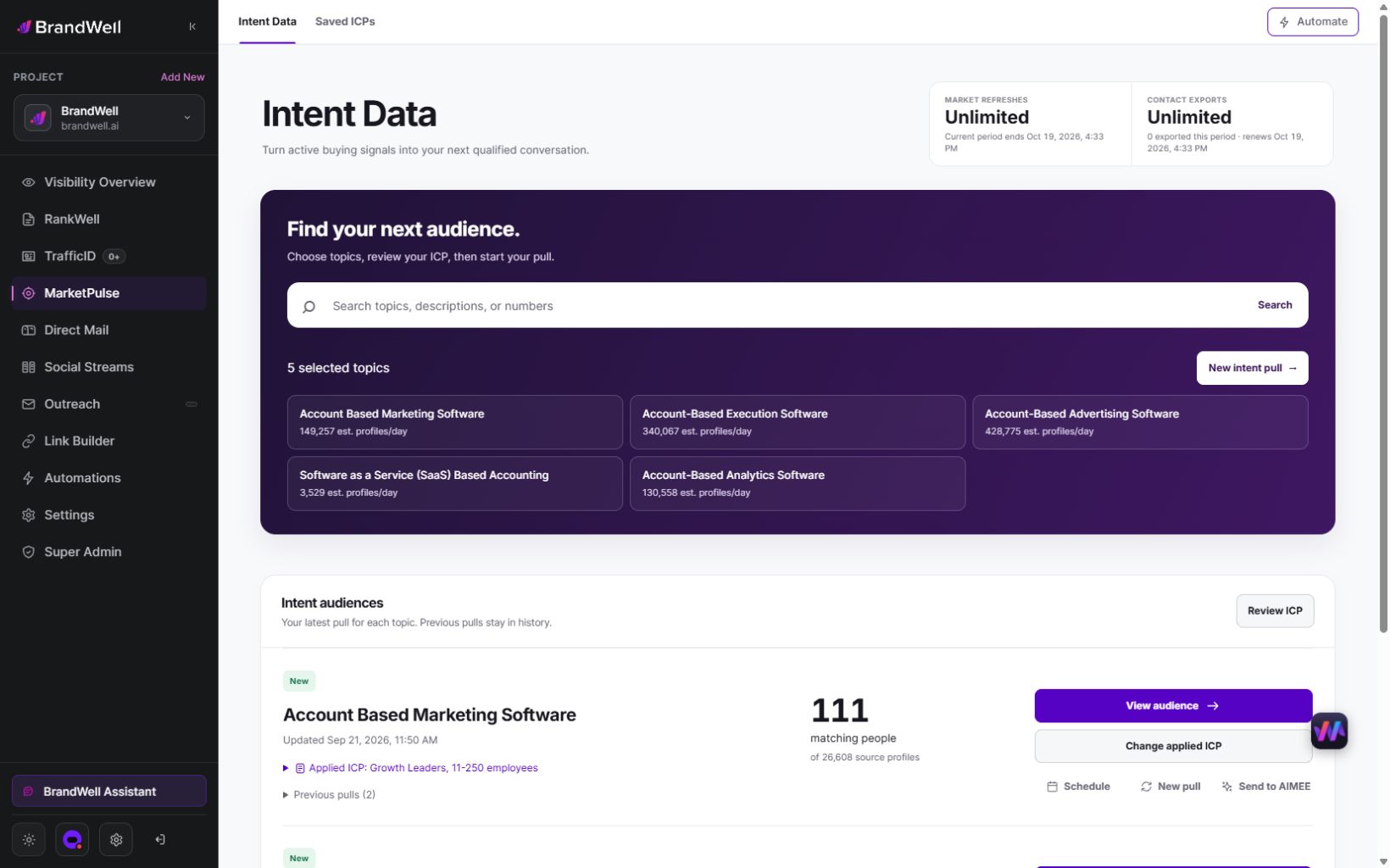
MarketPulse plans are starting at $500/mo. Verify current package scope and offers on the product page.
| Plan | Topics and refreshes | Monthly exports |
|---|---|---|
| Starter | 1 topic, weekly | 25,000 contacts |
| Growth | 3 topics, daily | 100,000 contacts |
| Scale | 10 topics, daily | Unlimited contacts |
Swipe the table to see all columns.
A pull retrieves available data from the previous 24 hours for one topic. Daily use across all included topics provides 90 Growth pulls or 300 Scale pulls in a 30-day month. Weekly Starter pulls vary by calendar month. Available audience size and contact fields vary, and audiences may overlap. Refreshes stop at the plan limit without overage charges.
- Find and qualify: search the topic catalog, save your ICP, and review the people and companies that match.
- Act on the research: export qualified contacts or prepare an Outreach or Direct Mail workflow. Connected products, channel usage, and fulfillment may cost extra.
- Get help from AIMEE: Growth and Scale include AIMEE for the initial user to research accounts and prepare the next step through connected tools.
Agencies and other service businesses can build client deliverables around their available Intent Scans and exports. Keep each client’s scope, permissions, and service fees clear. A subscription is not a promise of a white-label platform or exclusive access to a market.
Explore MarketPulse and watch the demo or compare plans starting at $500/mo. Any early-access discount is a separate, time-limited offer shown to an eligible recipient.
How BrandWell fits the discovery motion
AIMEE can prepare an account-research or call-planning brief through configured connected tools. Give it approved evidence, the offer scope and the questions to resolve. A human seller must review facts, claims and commitments. Verify actual integrations and access before asking it to write to another system.
Review the relevant MarketPulse topic and defined ICP before the call. Available matching people and company fields provide context, not proof that the prospect personally researched a topic. Scope agency services, client permissions and additional connected tools separately.
MarketPulse plans are starting at $500/mo. Starter includes 1 topic, weekly refreshes, and 25,000 exportable contacts per month. Growth includes 3 topics, daily refreshes, and 100,000 exportable contacts. Scale includes 10 topics, daily refreshes, and unlimited contact exports. AIMEE for the initial user is included with Growth and Scale. Compare MarketPulse plans and current offers.
A reviewable AI call-planning brief
Give an assistant only approved business context. Remove unnecessary personal data and confidential details. Require a human seller to approve questions and the final CRM record.
Act as an agency discovery-call copilot. I will provide an approved account-level
hypothesis, offer scope, qualification rubric, and permitted-use rules.
Create a short call plan with: opening permission, change questions, current-state
questions, consequence questions, buying-path questions, signal-use questions,
risk questions, and a mutual next-step close. After I provide notes, return facts,
buyer statements, seller inferences, unresolved assumptions, risks, disqualifiers,
and commitments in separate fields.
Never claim that an intent signal proves personal interest or purchase readiness.
Do not infer protected or sensitive traits. Do not invent budget, urgency, identity,
legal permission, pricing, metrics, or outcomes. Flag privacy, security, contract,
and identity questions for qualified human review.
Review the assistant’s output against the approved notes and current terms. Separate buyer statements from seller inferences, retain corrections and require a named owner for the next decision.
The close is a decision, not a calendar link
Before closing the CRM record, use a four-column evidence matrix: buyer statement, supporting observation, seller inference, and validation needed. For example, “the team misses target accounts” is a buyer statement. A low accepted-account rate may support it. “The cause is weak intent data” is still an inference until workflow, targeting, and follow-up are examined. The last column names the artifact or stakeholder that can validate the inference.
This matrix prevents confident notes from hardening into invented facts. It also gives the next seller or delivery lead a compact map of what to trust, what to test, and what could disqualify the opportunity. Review the matrix before drafting a proposal so scope follows evidence instead of sales momentum.
End with one of four states: proceed to a named next decision, run a bounded diagnostic, nurture around an explicit future trigger, or disqualify. Record why. Agency discovery calls uncover buying intent when they reveal whether the buyer has a consequential problem, a workable decision path, and a responsible way to use the service. They fail when a seller treats curiosity, a signal, or a polite meeting as proof of demand.
Ask neutral questions about actual experience
GOV.UK’s interview guidance recommends open, neutral questions, follow-ups and real examples. Its user-research context is distinct from sales qualification.
Apply that interviewing discipline without turning discovery into a leading pitch. Instead of “Would better intent data solve your pipeline problem?” ask “Walk me through the last account your team prioritized. What information did you use, and what happened next?”
Then ask what was missing, who owns the decision and which evidence they would need before changing the workflow. Avoid suggesting the answer, filling silence with a product claim, or translating interest in an example into an approved budget.
A fictional service discovery example
A marketing agency says its team spends too long researching target accounts. Record that as the buyer’s statement. Ask for a recent example, the steps involved and where time is recorded. “External research will remove the bottleneck” remains a seller hypothesis until the workflow and evidence are examined.
- What task takes the most time today?
- Who decides that an account is worth pursuing?
- Which fields would materially change that decision?
- What would make a topic match irrelevant?
- Who owns permitted use and the next client action?
- What comparison would make a bounded evaluation useful?
- Which costs and service responsibilities need separate approval?
- What is the next decision, and who owns it?
Suppose preparation takes 90 minutes, the call 30 minutes and follow-up 30 minutes. At an assumed loaded labor cost of $80/hour, 2.5 hours costs $200. Add $50 of allocated tools and the illustrative qualification cost is $250. This is a planning example, not a BrandWell fee or proof of expected pipeline.
End with an agreed artifact, such as the client’s current qualification checklist, before offering a diagnostic. An agreed next meeting is a process step rather than a sale.
Frequently asked questions
Does a topic match mean the prospect is ready to buy?
No. Use it as bounded research context and validate fit, need, decision path and permitted next action.
Should every prospect answer every worksheet question?
No. Ask what changes a decision and follow up on unresolved points. Avoid repeating answers already supplied.
Can AI decide whether the buyer’s claims are true?
No. It can organize approved notes and flag inconsistencies. Validate material claims with appropriate evidence and people.
What should be recorded at the end?
Buyer statements, observations, seller inferences, unresolved assumptions, commitments, next decision and owner. Keep sensitive information only when necessary and permitted.
Reviewed and updated October 3, 2026.

Written by