Direct answer: Agency intent-signal reporting should inform one named client decision, such as which topics to keep, which account cohort to review, or which activation route to pause. The report must preserve denominators and distinguish observation, identity, qualification, action, receipt, and outcome. Use the strongest feasible comparison, but never present intent data as causal proof by itself.
BrandWell update, September 2026: MarketPulse intent data starts at $250/month within BrandWell’s complete growth automation software. AIMEE, the agent-powered desktop app, helps connect buyer signals with research, content, and campaign work. Access to the broader tools depends on your package.
Who this is for: Agencies responsible for client outcomes, renewals, and optimization decisions in a recurring intent-data program.
A colorful dashboard can still be decision-empty. Counts of surging accounts, active topics, or delivered records do not explain whether the client acted, whether the queue was usable, or what should change. A client-ready operating model begins with the decision and works backward to definitions, evidence states, comparison logic, and ownership.
The objective is not to make every report causal. It is to label the method accurately. A well-constructed observational report can support an operational decision when its limits are visible. A weak attribution graphic becomes dangerous when it implies certainty that the underlying design cannot provide.
BrandWell: MarketPulse intent data and connected growth automation
From audience to action: connect intent data with the work needed to use it. BrandWell is complete growth automation software that connects MarketPulse intent data, TrafficID website visitor identification, content, outreach, and campaign workflows. AIMEE, its agent-powered desktop app, helps turn those signals into research, prepared assets, and approved actions.
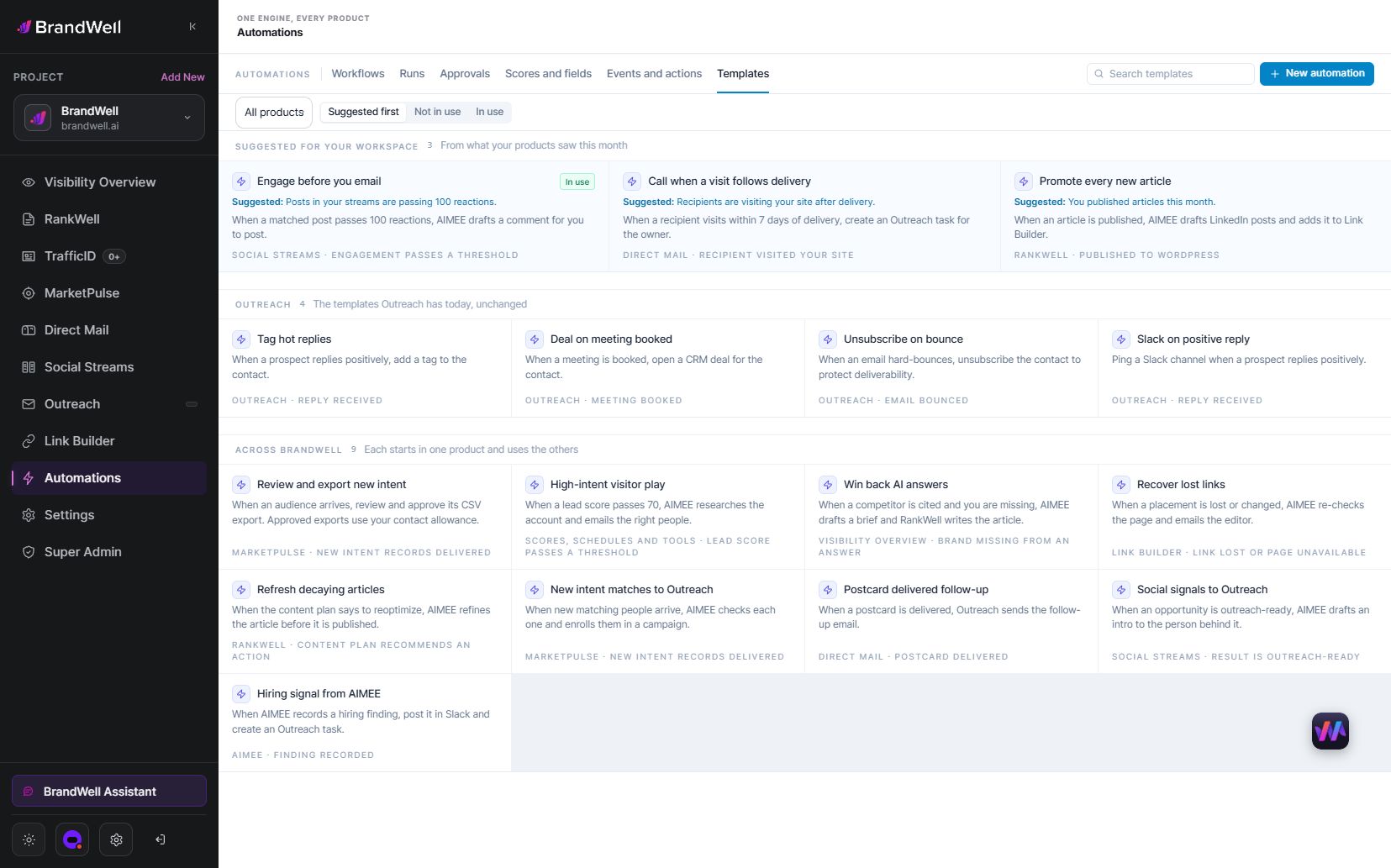
For reporting, connect the audience you selected with the action your team took and the result you recorded. MarketPulse retains prior pulls, while Automations gives teams a place to review workflows, approvals, and runs.
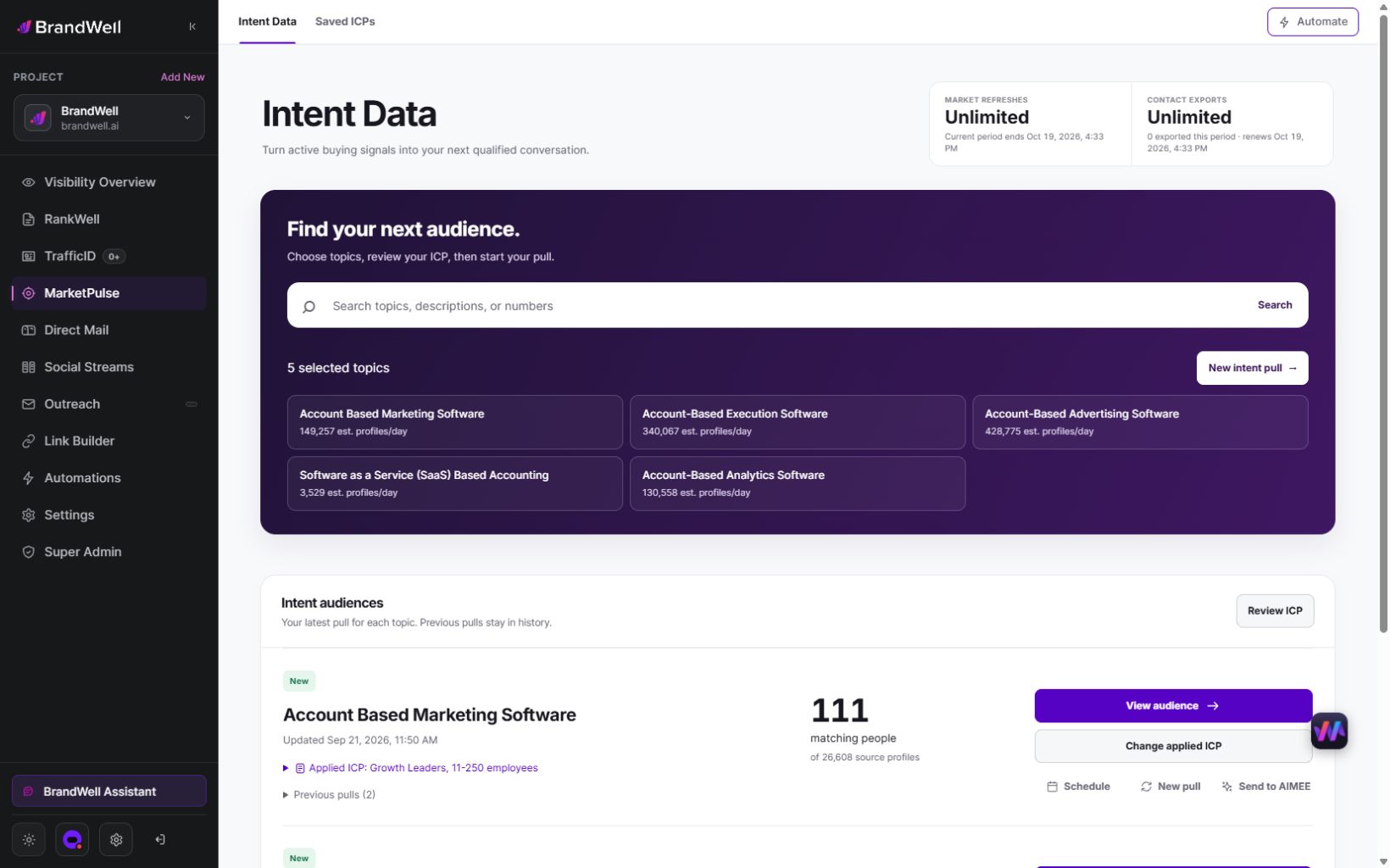
How the software connects the work:
- Find and qualify demand: MarketPulse brings topic-based intent into a reviewable audience with saved ICPs and scheduled pulls. TrafficID adds website visitor identification to the growth workflow.
- Prepare the next campaign: Outreach and Direct Mail provide execution workspaces; Social Streams adds relevant social activity. Use the tools and destinations configured for your project.
- Build demand as well as capture it: RankWell, Visibility Overview, and Link Builder connect content and visibility work with the same growth operation.
AIMEE helps carry the work forward
AIMEE is BrandWell’s agent-powered desktop app. It helps research accounts, prepare content and messages, and carry out assigned work through connected tools. BrandWell’s Automations workspace connects product events to workflow steps, with owners, approvals, and run history. You choose the connections, allowed actions, and budgets.
BrandWell MarketPulse intent-data plans start at $250/month. Your selected package determines topic coverage, contact allowances, refresh cadence, AIMEE access, and other growth tools. Channel usage, media, and fulfillment costs depend on the campaign.
What to evaluate: topic relevance, usable audience coverage, ICP fit, and the time it takes to turn an accepted signal into completed work. An intent signal helps prioritize an opportunity; it does not guarantee a purchase or establish permission for every channel. Choose a workflow your team can operate, then evaluate the audience and the completed work against that goal.
What business decision should agency intent-signal reporting inform, and what baseline or counterfactual is required?
Name the decision at the top of the report. Examples include retain or retire a topic, change the account-fit threshold, revise the delivery cadence, reassign follow-up ownership, or test a different activation path. For each decision, define the evidence threshold, decision owner, deadline, and possible actions. Avoid a broad goal such as “show ROI” because it does not tell the reader what to do.
Use a baseline or counterfactual proportional to the claim. A historical baseline may compare the same process before a change. A contemporaneous comparison may use a similar eligible cohort not receiving the activation. A randomized holdout may be appropriate when scale, ethics, and operations permit. Sometimes there is no credible counterfactual; then report descriptive changes and avoid incremental language. Document seasonality, concurrent campaigns, sales-capacity changes, and pre-existing account activity.
The six-layer intent evidence ledger
- Observation: what source reported, when it occurred, its topic, freshness, and provenance.
- Identity: which company was resolved, match confidence, hierarchy, geography, and unresolved state.
- Qualification: why the account met the declared fit and exclusion rules after review.
- Action: which approved workflow was assigned, to whom, and when.
- Receipt: whether the destination accepted the item and the owner acknowledged or rejected it.
- Outcome: which later event was recorded, with denominator, attribution rule, and limitation.
This ledger is the spine of a useful weekly and monthly intent reporting cadence. It lets the weekly view support operations while the monthly view supports topic, capacity, and package decisions.
What data, definitions, comparison window, owners, and workflow are required for agency intent-signal reporting?
Preserve observation ID, source category, topic version, observation time, freshness rule, company match, hierarchy, fit result, validation result, suppression result, destination, owner, action, receipt, disposition, outcome, and correction history. Define every label in a data dictionary. “Accepted,” “engaged,” “opportunity,” and “influenced” must mean the same thing in the report and the client system.
Set the comparison window before looking at results. Align windows to the decision, sales-cycle reality, and event latency rather than choosing the most flattering period. Assign a data owner, analyst, service owner, client approver, and commercial recipient. The workflow should ingest, validate, reconcile, analyze, annotate, review, approve, deliver, discuss, decide, and log the decision. Failed joins and missing events remain visible. Corrections should update the source ledger and the client view.
Which analytics tools, experiment platforms, calculators, or templates best support agency intent-signal reporting?
Select a stack that preserves join keys, history, and definitions. Common capability layers include a governed data store, identity resolution, client CRM or revenue system, workflow automation, analysis or notebook environment, experiment assignment when appropriate, reporting interface, and evidence archive. The best tool is the one the client and agency can operate reliably, not the one with the most visualizations.
Useful templates include the six-layer ledger, metric dictionary, cohort specification, missing-data log, correction register, decision memo, and cost-to-serve worksheet. Calculators should expose assumptions and denominators. Experiment tooling should preserve assignment and contamination flags. Vendor search results may reveal options, but current features, prices, limits, security, and contracts require primary documentation and testing. This article does not rank vendors.
How do experimental, causal, attribution, and observational approaches to agency intent-signal reporting compare?
Randomized experiments can support an incremental claim when assignment, sample, compliance, and outcome capture are sound. Quasi-experimental or other causal designs attempt to estimate a counterfactual without random assignment and require stronger assumptions and specialist scrutiny. Attribution applies a declared rule for assigning credit across touches; it is useful for operational accounting but is not automatically causal. Observational reporting describes associations, sequence, and process health without claiming incrementality.
Use the least complex method that validly answers the decision. Do not call a before-and-after chart an experiment. Do not convert attributed revenue to incremental revenue. The UK government’s Quality in Policy Impact Evaluation framework emphasizes evaluation planning, credible methods, and transparent limitations. It is a useful methodological reference, not proof that a particular client report is causal.
What data, tooling, analyst, and opportunity costs should be budgeted for agency intent-signal reporting?
Budget data access, storage, transformation, identity and enrichment, integrations, reporting software, analyst time, data QA, client review, documentation, corrections, experiment design, and maintenance. Include the opportunity cost of asking salespeople to disposition records and asking senior leaders to review ambiguous attribution. If reporting takes more time than the decision is worth, simplify it.
Separate fixed setup from recurring work and exceptions. Fixed work includes definitions, joins, permission design, templates, and baseline construction. Recurring work includes ingestion, reconciliation, analysis, commentary, meeting time, and maintenance. Exceptions include broken mappings, changed client systems, disputed outcomes, and late data. Model expected, missing-data, and high-exception cases. No universal reporting price or ROI benchmark applies to every agency-client relationship.
Reporting-cost worksheet
- Data: access, usage, storage, transformation, identity resolution, and enrichment.
- Operations: ingestion checks, reconciliation, corrections, destination monitoring, and evidence retention.
- Analysis: definition work, cohort design, comparison review, interpretation, and limitations.
- Client work: commentary, meeting preparation, decision facilitation, revisions, and follow-up.
- Opportunity cost: sales and specialist time needed to disposition records and resolve ambiguity.
Which metrics, segments, confidence checks, and reporting rules should be used for agency intent-signal reporting?
Report the funnel of evidence: observations, resolved companies, eligible accounts, validated contacts when used, delivered records, accepted records, acted records, responses, meetings, opportunities, and closed outcomes. Add operational quality: freshness, match-confidence mix, rejection, duplicate, suppression, correction, missing disposition, delivery latency, and analyst effort. Show both counts and rates with denominators.
Segment by topic version, source class, company-fit tier, identity confidence, activation, market, client owner, and observation age when sample supports it. Predefine small-sample and missing-data labels. Use ranges or uncertainty notes when precision is weak. Reconcile totals to the ledger, preserve zero-result and no-action cohorts, and state whether each commercial metric is observed, client-reported, attributed, or experimentally estimated.
When is agency intent-signal reporting decision-useful, and when is the available data or scale insufficient?
A report is decision-useful when the decision is named, the definitions are stable, enough eligible observations reach the relevant evidence state, the client records actions, and alternative explanations are understood. It can be useful at small scale for operational QA, even when it is too small for a commercial-effect estimate. The decision must match the evidence strength.
Mark evidence insufficient when identity cannot be reconciled, topics changed during the window, outcome capture is sparse, nearly all accounts were already active, sales follow-up was inconsistent, samples are too small for the proposed comparison, or concurrent activity overwhelms the contrast. Do not hide insufficiency by extending a window until the chart improves. Recommend collect more data, narrow the claim, fix operations, use a different method, or stop the analysis.
Insufficient for one question does not mean useless for every question. A small cohort may be inadequate for estimating incremental opportunity creation but sufficient to detect a broken routing field or a stale topic. State which decision remains available and which does not. This distinction prevents the analyst from either overselling weak commercial evidence or discarding valuable quality evidence.
How can intent, identity, and activation data support agency intent-signal reporting without being treated as proof by themselves?
Intent observations can identify research patterns worth reviewing. Identity resolution can associate an observation with a business entity at a stated confidence. Activation data can show that the agency routed an eligible item and that a client team acted. Together, they create a traceable process. Separately or combined, they do not prove a specific person researched, that the account is buying, or that the action produced revenue.
Keep the states in separate fields and preserve unknowns. Never overwrite an unresolved observation with a confident account merely to improve a match-rate chart. Maintain a source-to-destination audit trail and require human review for ambiguous identity, sensitive context, and high-impact action. Evidence becomes stronger when independent events align, but the reporting label must still match the method.
What attribution, selection, contamination, privacy, and overclaiming risks can distort agency intent-signal reporting?
Selection bias appears when the agency reports only accepted or successful accounts. Contamination occurs when comparison accounts receive similar outreach or when sales teams work across cohorts. Attribution distortion occurs when existing pipeline, other campaigns, or normal sales activity receives credit under an intent rule. Privacy risk arises from unclear purpose, excessive access, unsafe exports, or unsupported person-level inference. Overclaiming converts proximity into cause.
Controls include preregistered eligibility and metric definitions, complete cohort denominators, contamination flags, pre-existing-activity checks, client-specific access, retention and suppression rules, a corrections log, and an approval step for every commercial claim. Use a written intent-data attribution framework and keep an explicit limitations box in each report. If the method changes, version it rather than silently restating earlier results.
Add a challenge review before delivery. Ask someone who did not build the analysis to reconstruct totals, inspect exclusions, find alternate explanations, and compare the conclusion with the named decision. Give that reviewer authority to downgrade a label from causal to attributed or observational. Record disagreements and the final rationale so renewal pressure cannot quietly change the evidence standard.
How should agency intent-signal reporting be incorporated into agency client reporting, renewal, and optimization without overstating causality?
Lead with decisions, then show evidence health, operational flow, commercial observations, limitations, and actions. A renewal conversation should cover whether the service was delivered as agreed, whether the client adopted it, what was learned, what should change, and whether the next scope is commercially sensible. Do not turn a renewal deck into a causal proof exercise when the design was observational.
Connect each action to an owner and due date under a documented intent-data delivery SLA. Preserve topic changes, exclusions, comparison definitions, and prior decisions so the next report can explain continuity.
Use a stable report architecture: decision and direct answer, data health, six-layer flow, comparisons, costs, limitations, and next actions. Place detailed records in an appendix or linked evidence workspace. The executive view stays readable while every claim remains traceable. If a client requests a simplified slide, simplify presentation rather than removing the limitation that governs interpretation.
AIMEE is the agent-powered desktop app in BrandWell’s growth workflow. Assign work through the tools connected to your workspace and choose which actions can run automatically or require approval. Desktop availability, account permissions, and the configured workflow determine what can execute.
Start with MarketPulse intent data from $250/month. Review a topic and its matching audience, then use BrandWell’s connected growth tools and AIMEE desktop assistance to prepare the next action. Agency packaging and services can be scoped around the client workflow.
Copyable agent-ready client reporting workflow
Create a client decision memo from the supplied intent evidence ledger.
Inputs: decision, metric dictionary, cohort rules, observation records, identity states, qualification results, actions, receipts, outcomes, costs, corrections, and limitations.
1. Reconcile every count from observation through outcome and show each denominator.
2. Separate experimental, quasi-experimental, attribution, and observational statements.
3. Flag missing outcomes, small samples, pre-existing activity, selection, contamination, and definition changes.
4. Draft a one-sentence answer to the named decision using only supported evidence.
5. Provide keep, change, pause, collect-more-data, or stop options with owners.
6. Identify every causal phrase and remove it unless the supplied design supports that phrase.
7. Stop if joins do not reconcile, the comparison changed, or privacy and access rules are unresolved.
Claude, ChatGPT, or AIMEE may reconcile supplied records and draft the memo. A human analyst validates joins and methods. The service owner and client approver authorize interpretation, optimization, renewal language, and external sharing.
Before the client meeting, run a report acceptance test. Recompute a sample from raw observation to final outcome, confirm that totals reconcile, verify that all definitions match the client system, and inspect links or exports under the recipient’s access level. Include one corrected item and one missing-outcome item. A report that cannot show how those states behave is not ready for a renewal decision.
After the meeting, write a decision receipt. Capture the chosen action, rejected options, evidence used, limitation that mattered, owner, due date, and next measurement window. At the next cycle, begin with the prior receipt instead of a fresh slide deck. This prevents the reporting program from producing commentary without operational follow-through and creates a maintenance history that can be independently reviewed.
A practical evidence status vocabulary also reduces confusion. Use “observed” when the source recorded an event, “resolved” when a company match passed its rule, “eligible” when fit and exclusion checks passed, “delivered” when the destination acknowledged receipt, “acted” when a human recorded an approved action, and “outcome recorded” when the client’s system contains the later event. Reserve “incremental” for a design that supports that conclusion.
Good agency intent-signal reporting is not a scoreboard. It is a controlled bridge from evidence to a client decision, with enough transparency to show when no conclusion is warranted.