On this page
- Current MarketPulse workflow
- Choose the model by operating responsibility
- Define the ownership ladder and acceptance
- Choose portable designs or operating controls
- Compare consulting, managed and hybrid delivery
- Price bounded projects and recurring work
- Measure acceptance, delivery and client action
- Match the model to client readiness
- Preserve evidence through activation
- Control scope, dependencies and transfer risks
- Maintain the agency service package
- Make knowledge transfer an accepted deliverable
- Worked example: separate project and recurring economics
- Frequently asked questions
Direct answer: Choose intent-data consulting when the client will own implementation and ongoing decisions. Choose a managed service when the agency will operate a recurring signal-to-action cadence. Use a hybrid when ownership should move from the agency to the client by defined milestones. The right model is determined by responsibility, not by how strategic the work sounds.
Current MarketPulse offer: intent-data plans start at $500/mo. See the product, demo, and current plans. Updated October 3, 2026.
Do not sell a consulting project and quietly operate it forever, or sell a managed service that depends on the client to perform every important step. Make ownership, inputs, outputs, service clock, evidence, and exit conditions visible before pricing.
Who this is for: Agency founders and GTM, RevOps, lead generation, or demand generation leaders deciding whether intent data should become a project, retainer, or staged service. It is especially useful when clients have different levels of operational maturity.
Current MarketPulse workflow
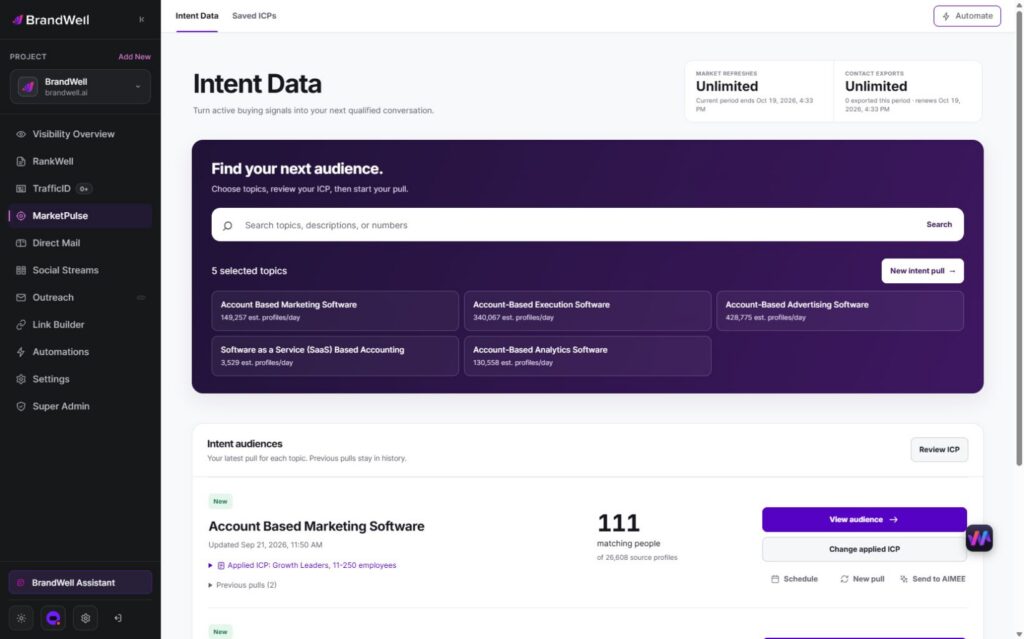
BrandWell MarketPulse: intent data starting at $500/mo. Find people researching topics relevant to what you sell, apply saved ICP filters, and review available contact details before taking action.
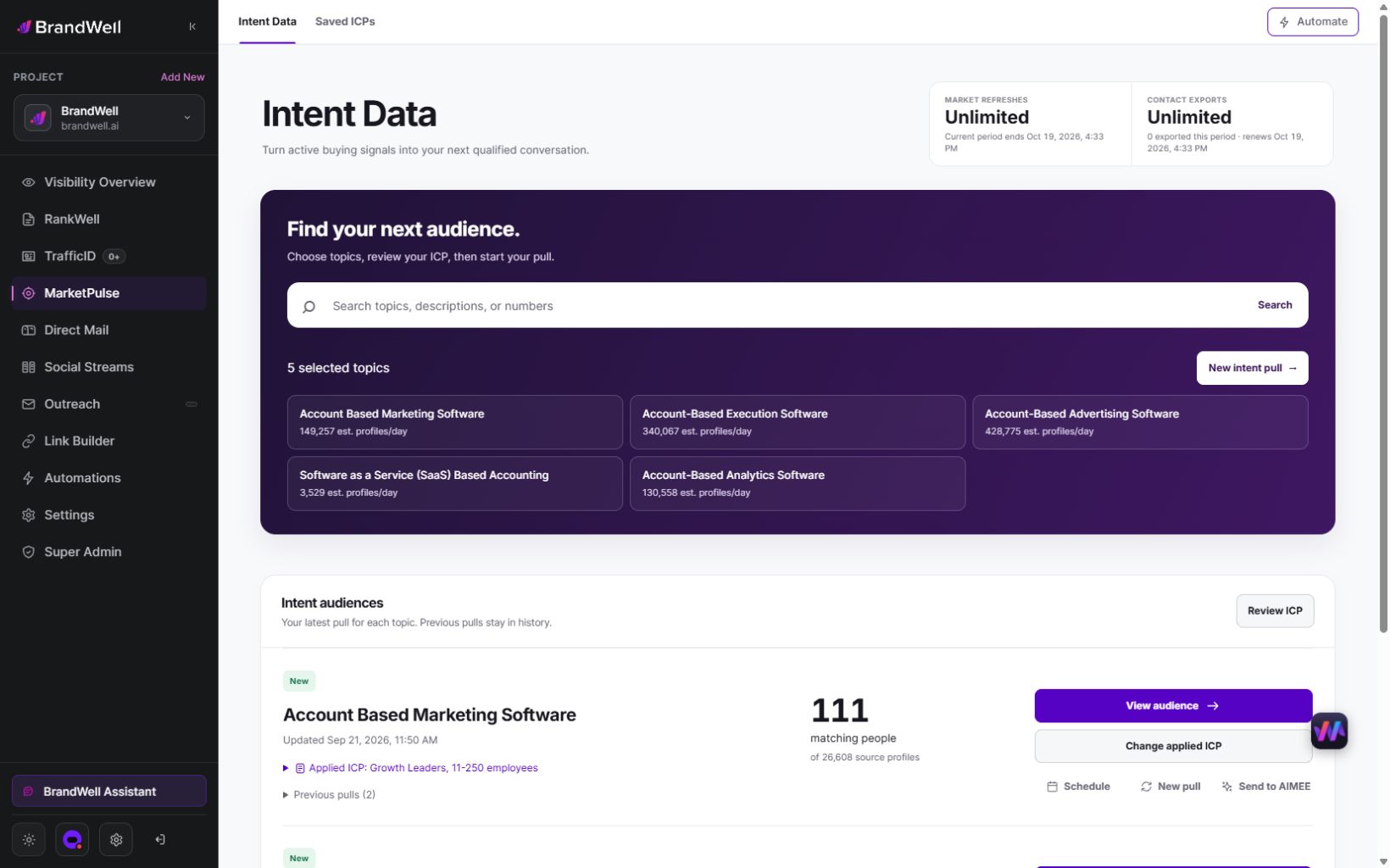
MarketPulse plans are starting at $500/mo. Verify current package scope and offers on the product page.
| Plan | Topics and refreshes | Monthly exports |
|---|---|---|
| Starter | 1 topic, weekly | 25,000 contacts |
| Growth | 3 topics, daily | 100,000 contacts |
| Scale | 10 topics, daily | Unlimited contacts |
Swipe the table to see all columns.
A pull retrieves available data from the previous 24 hours for one topic. Daily use across all included topics provides 90 Growth pulls or 300 Scale pulls in a 30-day month. Weekly Starter pulls vary by calendar month. Available audience size and contact fields vary, and audiences may overlap. Refreshes stop at the plan limit without overage charges.
- Find and qualify: search the topic catalog, save your ICP, and review the people and companies that match.
- Act on the research: export qualified contacts or prepare an Outreach or Direct Mail workflow. Connected products, channel usage, and fulfillment may cost extra.
- Get help from AIMEE: Growth and Scale include AIMEE for the initial user to research accounts and prepare the next step through connected tools.
Agencies and other service businesses can build client deliverables around their available Intent Scans and exports. Keep each client’s scope, permissions, and service fees clear. A subscription is not a promise of a white-label platform or exclusive access to a market.
Explore MarketPulse and watch the demo or compare plans starting at $500/mo. Any early-access discount is a separate, time-limited offer shown to an eligible recipient.
Choose the model by operating responsibility
Start with the decision the client needs to improve and name who will operate the answer after delivery. Consulting works when the buyer needs diagnosis, topic design, data evaluation, workflow architecture, enablement, or a remediation plan, and already has a capable owner. A managed service works when the client wants an agency to maintain topics, qualify signals, prepare reports, route approved records, monitor exceptions, and run a review cadence.
Define time to value differently for each model. For consulting, it may be an approved blueprint, a configured pilot, or a trained client owner who can run the workflow. For managed service, it may be the first accepted recurring delivery with evidence and a working feedback loop. Neither definition should be a guaranteed meeting, opportunity, or revenue event.
Use an ownership ladder instead of a binary label. A client can begin with diagnosis and design, move into a co-run period, then choose agency-managed operations or transfer the system in-house. Each rung needs an observable completion test. This keeps a hybrid from becoming an indefinite collection of meetings with no clear operator.
Run three counterfactual tests. If the agency stopped after presenting the design, could the client operate it next week? If the client’s day-to-day owner went on leave, could the agency still meet the managed service promise without inventing business decisions? If the contract ended, could both parties explain what gets exported, revoked, retained, or transferred? Weak answers reveal that the stated model and the real responsibility do not match.
Also distinguish expertise from labor. A consultant can provide deep expertise without owning the queue. A managed operator can provide recurring labor without being authorized to change strategy. Package both when needed, but show the client which hours produce a decision, which run the service, and which are available only through a change request.
Define the ownership ladder and acceptance
The six-rung service ownership ladder
- Diagnose: document business decision, current process, data readiness, owners, risks, and the smallest useful outcome.
- Design: define topics, fit, identity states, qualification, action plays, evidence, governance, and commercial scope.
- Enable: configure tools, test handoffs, create templates, train owners, and obtain approval.
- Co-run: the agency operates while the client observes, responds, and proves its side of the workflow.
- Manage: the agency owns the agreed recurring cadence, maintenance, QA, reporting, and support.
- Transfer or renew: hand over with acceptance evidence or renew a clearly bounded managed package.
For consulting, the statement of work should identify decisions, deliverables, workshops, dependencies, revision limits, acceptance, and transfer. For managed service, define the recurring calendar, queue owners, response and correction clocks, maintenance, support boundaries, change allowance, and client obligations. A practical intent-service discovery process should expose missing ownership before a proposal is issued.
Quality checks also differ. Consulting QA asks whether the design is complete, testable, understood, and accepted. Managed QA asks whether each delivery is current, correctly scoped, traceable, routed, and reconciled. A handoff is not complete because a file was sent. It is complete when the named owner accepts it or a destination records receipt.
Choose portable designs or operating controls
Consulting needs tools that make decisions portable: discovery worksheet, topic charter, data-source evaluation, workflow map, responsibility matrix, test plan, governance register, training guide, and acceptance record. The client should be able to understand what was decided and operate the design without guessing what the consultant meant.
A managed service needs an operating layer: signal ingestion, identity-state preservation, qualification rules, human review queues, client-scoped destinations, branded reporting, exception tracking, outcome reconciliation, and service evidence. A portal is valuable when it presents the client’s work, status, and decisions. It is not a substitute for back-office controls.
- For consulting: favor explainability, exports, versioned designs, client access, and transferability.
- For managed delivery: favor tenant controls, recurring jobs, approvals, monitoring, receipts, and support evidence.
- For a hybrid: require both. Avoid a platform the agency can operate but the client cannot understand, or a document set that cannot support recurring delivery.
Test integrations according to ownership. If the agency manages the connector, it needs monitoring and recovery authority. If the client owns it, the contract should name the client administrator, escalation path, and paused-SLA state. Ambiguous integration ownership becomes unpriced support.
Compare consulting, managed and hybrid delivery
Manual work is appropriate for discovery because an experienced operator can notice ambiguity before rules are stable. Automation is appropriate for repeated, testable steps such as normalizing records, checking required fields, applying approved rules, preparing drafts, or recording receipts. White-label delivery is appropriate when the agency wants a consistent branded experience and repeatable reseller economics.
| Model | Client owns | Agency owns | Best automation boundary |
|---|---|---|---|
| Consulting | Implementation and ongoing operation | Diagnosis, design, enablement, and acceptance support | Analysis support and draft artifacts |
| Managed service | Business purpose, approvals, sales action, and feedback | Recurring configured delivery, QA, maintenance, and reporting | Stable handoffs under monitored rules |
| Hybrid | Defined responsibilities that expand by milestone | Temporary operation plus structured transfer | Automate only after the joint process passes tests |
Swipe the table to see all columns.
Do not use automation to conceal an ownership gap. An agent may draft a report, classify an exception, or prepare an outreach option, but a human should approve interpretations, pricing, configuration changes, external messages, and sensitive uses. The white-label surface changes who the client sees, not who is accountable.
Price bounded projects and recurring work
Price consulting around the bounded work required to reach acceptance: discovery, analysis, architecture, configuration, testing, documentation, training, revisions, and project management. Add charges for extra systems, stakeholder groups, workshops, data sources, or transfer requirements. The client is buying a defined change and usable artifacts, not an unlimited access pass to the agency.
Price a managed service around recurring cost drivers: platform allocation, topic and audience maintenance, review volume, exception rate, delivery frequency, destinations, reporting depth, support, change allowance, and governance. A setup fee should recover chartering, configuration, branding, integration, testing, and training that will not recur at the same level.
Make client dependencies visible in the estimate. Delayed approvals, inaccessible systems, incomplete account lists, and inconsistent stage definitions create work even when the agency is waiting. State when the project clock or SLA pauses, how many review rounds are included, and what triggers re-scoping. This protects the client from surprise invoices and the agency from absorbing an undefined implementation.
Ownership-based pricing check
Consulting estimate = scoped project hours + specialist review + tools + contingency + target contribution.
Managed monthly cost = platform allocation + routine operations + exception work + reporting + support + maintenance + risk reserve.
Hybrid price = bounded design and enablement fee + time-limited co-run fee + agreed managed or transfer option.
Measure acceptance, delivery and client action
For consulting, track discovery completion, decision latency, approved topics, test coverage, handoff acceptance, trained owners, unresolved dependencies, and the client’s ability to run a test cycle. A project can be high quality even before downstream revenue exists, provided the accepted operating capability is real.
For managed service, track first accepted delivery, delivery timeliness, required-field completeness, validation, exception aging, correction rate, destination receipt, client adoption, and approved actions. Then track replies, meetings, opportunities, and revenue as downstream outcomes with the client’s definitions and attribution limits.
Measure ownership health in both models. Count overdue client dependencies, decisions without an owner, work performed outside scope, changes without acceptance, and repeated questions the documentation should answer. Those indicators often reveal model mismatch earlier than a renewal conversation.
Review the metrics by responsibility. When delivery is late, identify whether the delay occurred in agency review, client approval, or a client-owned destination. When adoption is low, separate an unusable delivery from a client capacity problem. The purpose is not to assign blame. It is to change the model, scope, cadence, or ownership before the same failure repeats.
Match the model to client readiness
A mature client with reliable RevOps ownership, clean routing, documented lifecycle stages, and enough operator capacity can benefit from consulting and enablement. A client with strategic intent but no person available to maintain topics or review outputs is a stronger managed-service candidate. A client with neither clear ownership nor a usable action path should begin with a narrow diagnostic, not a large platform deployment.
Stack maturity matters less than operating maturity. A sophisticated CRM does not create accountable follow-up. A simple spreadsheet can support a disciplined first report if purpose, states, ownership, feedback, and retention are clear. Expand the technical package only when the client has adopted the current decision loop.
Create good-fit, conditional-fit, and not-now criteria. Include executive sponsor, day-to-day owner, supported use case, data destination, ability to act, legal and policy review, and realistic expectations. Sell the model that matches the client, even when the more expensive model would be easier to propose.
Preserve evidence through activation
A consulting engagement should help the client decide which third-party topic activity, first-party website activity, company enrichment, contact validation, and internal CRM evidence belong in its operating model. It should define identity states and permissible actions so the client does not treat every signal as a named buyer.
A managed service must operate those definitions repeatedly. It should preserve source and freshness, apply account-fit rules, validate required contact fields when relevant, route ambiguity for review, and deliver only to approved destinations. The agency should show the client how signals become a report, account alert, audience review, research task, or outreach draft.
Outcome evidence must follow the same ownership map. The agency can record delivery and activation evidence. The client usually owns sales-stage accuracy, opportunity decisions, and revenue records. Reconciliation should distinguish sourced, influenced, and merely correlated activity rather than forcing a single flattering number.
Control scope, dependencies and transfer risks
Consulting risks include an ambiguous deliverable, inaccessible recommendations, undocumented assumptions, missing client dependencies, and no transfer owner. Managed-service risks include unbounded custom work, cross-client data exposure, stale rules, unsupported identity claims, destination failures, excessive retention, and an implied outcome guarantee.
Contract and operating documents should agree on purpose, data sources, identity meaning, security roles, access, retention, incident handling, subprocessors where applicable, integrations, service clocks, client dependencies, acceptance, changes, and termination. Engage qualified legal and privacy professionals for jurisdiction-specific advice. An agency playbook is not legal advice.
Agent-ready service model classifier
Role: Recommend consulting, managed service, or hybrid from approved discovery evidence.
Inputs: business decision, client owner, operator capacity, stack readiness, urgency, recurring tasks, exceptions, destinations, governance, budget assumptions, and exit preference.
Tasks: score ownership readiness; list dependencies; draft a responsibility map; propose the smallest accepted outcome; identify pricing drivers and risks.
Never: invent capabilities, set final pricing, promise outcomes, deploy, contact prospects, or approve data use.
Stop when: the client owner is missing, purpose is unclear, responsibilities conflict, required evidence is absent, or a sensitive use needs review.
Output: draft recommendation with assumptions and an alternative model.
Human approval: required before proposal, contract, configuration, external action, or transfer.
Maintain the agency service package
A recurring white-label service needs a clear agency promise, responsibility map, branded client surface, client-specific configuration, module entitlements, maintained topics and rules, recurring QA, approved activations, support boundaries, service evidence, commercial reporting, and renewal or transfer criteria. Review the broader agency intent-data service models before combining consulting and operations in one package.
AIMEE can help prepare research, a draft responsibility map or a reviewed handoff through configured connected tools. The designated owner approves configuration changes, external actions and transfers.
MarketPulse supplies topic audiences and saved ICP filtering starting at $500/mo. Build appropriately scoped client deliverables around available pulls and exports. A custom portal, recurring operating service or client integration requires separately confirmed capability, implementation, access and rights.
Record the model decision and the evidence that supported it. Revisit that decision when client staffing, systems, urgency, or ownership changes. Keep the rationale in the client record.
Decide ownership before naming the package
Take one proposed client, map every recurring task to either the agency or the client, and define the accepted end state. If ownership cannot be named, the model is not ready to price.
Make knowledge transfer an accepted deliverable
The UK government’s Consultancy Playbook treats knowledge and skills transfer as part of obtaining value from consultants. It concerns public-sector commissioning, not a rule that governs every agency contract. A practical agency application is to test what the client can actually operate at handoff.
Assign a client owner a synthetic test case. Ask them to identify the topic window, apply approved fit and exclusion rules, explain an uncertain identity, prepare a report and route an exception. Record the documentation needed, observed result and unresolved dependency. Sending a slide deck is not the same as demonstrated operating capability.
Worked example: separate project and recurring economics
Suppose a fictional consulting project requires 20 hours at a fully loaded $100/hour, plus $250 in tools and $250 in defined contingency. Planned cost is $2,500. A $4,000 project fee leaves $1,500, or 37.5% of fees, before excluded acquisition, general overhead, tax and financing costs. Eight extra unpriced hours add $800, leaving $700, or 17.5%.
A separate managed-service estimate includes $500 in software, $600 in routine operations and $150 in reporting and support each month. Defined monthly cost is $1,250. A $2,000 monthly fee leaves $750, or 37.5%, before the same exclusions. Eight extra support hours at $100 add $800, making defined cost $2,050 and the remainder negative $50. These inputs are invented, not typical performance or a BrandWell agency quote.
The comparison does not prove that one model is inherently more profitable. It shows why recurring responsibilities, client dependencies and change limits must be priced. Recover one-time setup separately or explicitly amortize it; do not silently omit it from the monthly model.
Use BrandWell in a defined client test
Review an available MarketPulse topic and audience, apply the saved ICP and preserve the actual preceding-24-hour pull window. AIMEE can help draft the account brief through configured tools. Test a supported export or handoff and obtain the owner’s acceptance. A weekly pull is not a seven-day historical catch-up.
Frequently asked questions
When does consulting fit?
When the client needs a bounded design or change and has a capable owner for ongoing operation.
When does a managed service fit?
When the agency will perform a defined recurring workload with named approvals, dependencies and support boundaries.
What makes a hybrid practical?
Milestones that specify which responsibilities transfer, how acceptance is tested and when the co-run period ends.
Does a topic subscription include an agency operating service?
No. MarketPulse’s stated audience and export allowances are separate from agency labor, custom portals and integrations.
Evaluate the topic-data input: explore MarketPulse and current plans.
Reviewed and updated October 3, 2026.

Written by