On this page
- Current MarketPulse workflow
- Define the service unit before its price
- Assign cost inputs and approval limits
- Keep a traceable pricing worksheet
- Choose a model that exposes cost drivers
- Separate implementation and recurring costs
- Track price realization and delivery actuals
- Match contracts to client and delivery fit
- Price the work that makes data usable
- Control billing, scope and trust risks
- Review the recurring package
- Separate setup, monthly costs and break-even
- Worked example: margin is different from markup
- Frequently asked questions
Direct answer: Build intent service pricing from a controlled unit-economics model, not from a desired markup or a copied market rate. Define the client outcome and service boundary first. Then price the exact modules, expected usage, agency labor, support, exceptions, tooling, overhead, capacity, and contingency required to deliver it. Use approval limits for unusual scope, review actuals on a fixed cadence, and change the package when assumptions no longer hold.
Current MarketPulse offer: intent-data plans start at $500/mo. See the product, demo, and current plans. Updated October 3, 2026.
Who this is for: Agency owners, founders, GTM consultants, RevOps consultants, demand generation leaders, and lead generation leaders who want a repeatable buyer-intent offer without hiding delivery risk inside a flat fee.
A practical pricing model should help the agency make a sound decision before a proposal is sent. It should also help delivery and finance explain why a client is inside or outside the standard package. This is not a promise of a particular margin. It is a method for making assumptions visible, testing them, and correcting them before exceptions become the operating model.
Current MarketPulse workflow
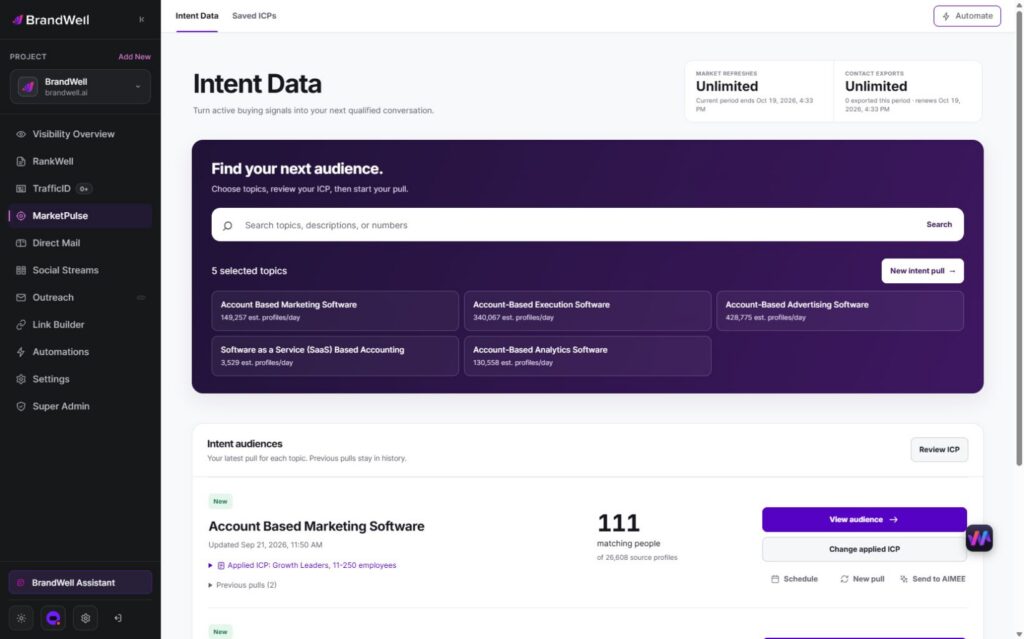
BrandWell MarketPulse: intent data starting at $500/mo. Find people researching topics relevant to what you sell, apply saved ICP filters, and review available contact details before taking action.
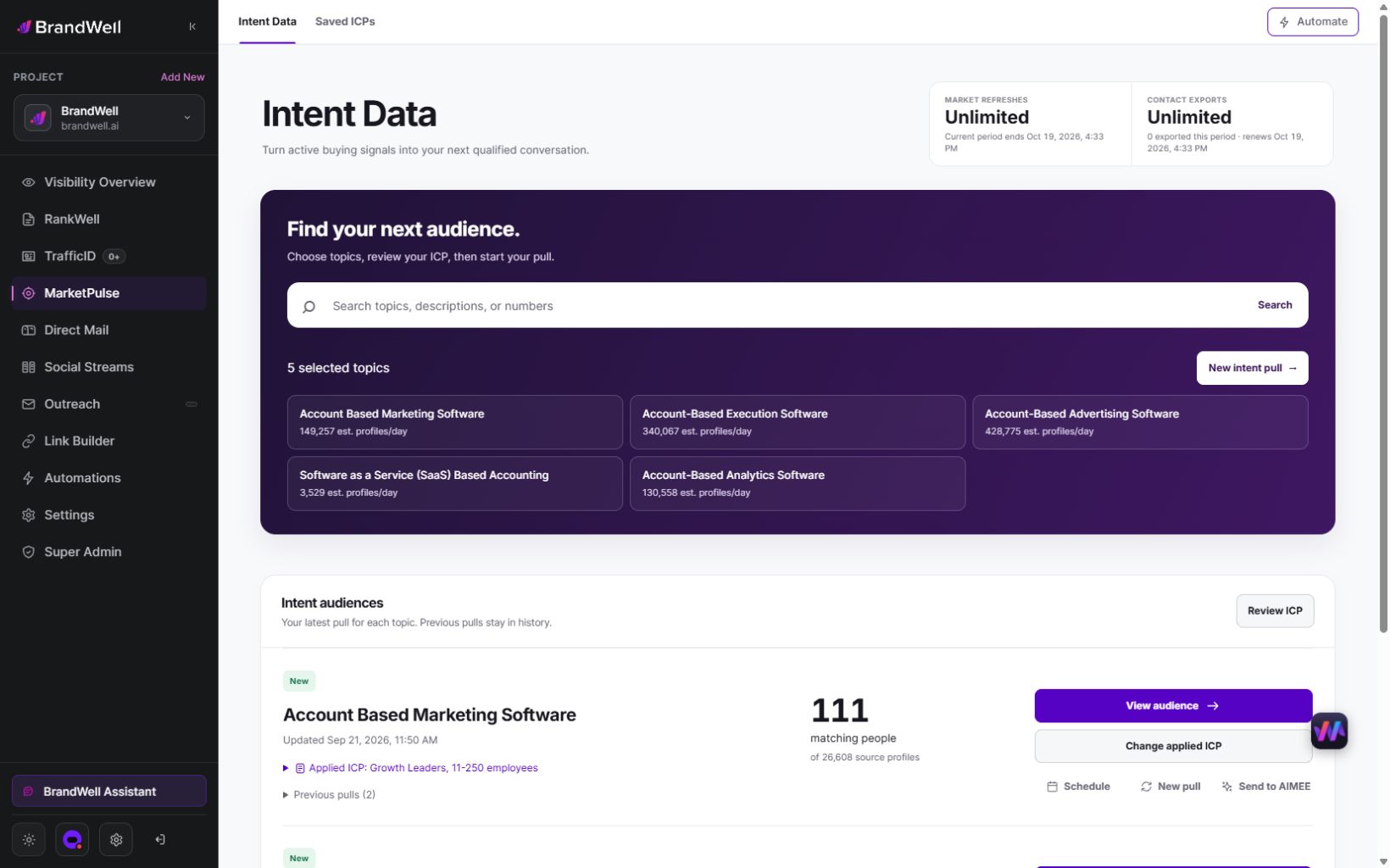
MarketPulse plans are starting at $500/mo. Verify current package scope and offers on the product page.
| Plan | Topics and refreshes | Monthly exports |
|---|---|---|
| Starter | 1 topic, weekly | 25,000 contacts |
| Growth | 3 topics, daily | 100,000 contacts |
| Scale | 10 topics, daily | Unlimited contacts |
Swipe the table to see all columns.
A pull retrieves available data from the previous 24 hours for one topic. Daily use across all included topics provides 90 Growth pulls or 300 Scale pulls in a 30-day month. Weekly Starter pulls vary by calendar month. Available audience size and contact fields vary, and audiences may overlap. Refreshes stop at the plan limit without overage charges.
- Find and qualify: search the topic catalog, save your ICP, and review the people and companies that match.
- Act on the research: export qualified contacts or prepare an Outreach or Direct Mail workflow. Connected products, channel usage, and fulfillment may cost extra.
- Get help from AIMEE: Growth and Scale include AIMEE for the initial user to research accounts and prepare the next step through connected tools.
Agencies and other service businesses can build client deliverables around their available Intent Scans and exports. Keep each client’s scope, permissions, and service fees clear. A subscription is not a promise of a white-label platform or exclusive access to a market.
Explore MarketPulse and watch the demo or compare plans starting at $500/mo. Any early-access discount is a separate, time-limited offer shown to an eligible recipient.
Define the service unit before its price
Start with a service unit that both sales and delivery can recognize. A unit might be one client workspace with a defined topic set, one reporting cadence, a named activation workflow, and a bounded level of support. Do not begin with a price and work backward. Begin with what is included, what changes with usage, what requires human attention, and what happens when the client asks for more.
Separate three layers. The first is the data and platform layer, including enabled modules and contract-governed usage. The second is the delivery layer, including configuration, quality review, reporting, client meetings, and approved activation. The third is the risk layer, including exception handling, rework, support peaks, and contingency. Gross margin becomes an output of those inputs rather than a slogan.
Set a capacity band for standard work and identify the hours each account consumes. Price custom requests separately or decline them when they displace committed delivery. A new sale must fit both the cost model and available capacity.
Assign cost inputs and approval limits
The required inputs are the client scope, topic count, expected usage, enabled modules, reporting rhythm, activation choices, implementation effort, recurring labor, support load, exception rate, tooling, overhead allocation, and contingency. Each input needs an owner and an evidence source. If an estimate is unavailable, label it unknown and use a bounded scenario. Do not convert an unknown into a precise forecast.
Set rules before sellers encounter pressure. Define which discounts are allowed, how long a proposal remains valid, which scope changes trigger repricing, who can approve nonstandard payment terms, and which requests require delivery review. A useful approval ladder distinguishes standard, configurable, custom, and out-of-scope work. The person approving a discount should also see the capacity or scope consequence.
Review at three levels. The account owner checks usage and exceptions during delivery. Operations reviews labor, support, and capacity across accounts. Leadership reviews price realization, contribution, renewal health, and concentration. Monthly can be a useful operational rhythm, but the right cadence depends on billing and delivery. Trigger an immediate review when usage, scope, service level, or contract terms cross a documented boundary.
Keep a traceable pricing worksheet
The most useful system is a linked set of simple records rather than a single magical calculator. Use a scope sheet, cost model, capacity model, approval log, account actuals view, and renewal decision record. A spreadsheet can be sufficient when version control and ownership are clear. A pricing application may help at scale, but it does not replace accurate operating inputs.
Build internal benchmarks from your own delivered work. Compare planned versus actual labor, module and usage costs, exception frequency, support time, price realization, and capacity consumption. External benchmarks can prompt questions, but they cannot establish a realistic margin for a service with different data, labor, risk, and contract conditions. Treat any market comparison as context, not a price instruction.
Copyable PRICED worksheet
- P, Promise: State the client decision or workflow the service supports, plus every explicit exclusion.
- R, Recurring inputs: List module, usage, labor, tooling, support, overhead, and quality-control costs.
- I, Implementation: Estimate configuration, onboarding, training, integration, and launch review separately.
- C, Capacity: Record the delivery hours and attention the account consumes inside a normal operating band.
- E, Exceptions: Identify custom reports, extra meetings, unusual data handling, and rework that require approval.
- D, Decision: Compare scoped price, expected contribution, risk band, approval status, and review trigger.
This intent service pricing template is useful because it produces a traceable decision. It is also a checklist for proposal review and a planning guide for delivery. Keep assumptions, input sources, owner names, and version history with the worksheet.
Choose a model that exposes cost drivers
A fixed recurring package is simple for the client and supports predictable operations when scope and usage are stable. Its risk rises when the package hides variable usage, custom activation, or unlimited support. A usage-linked model aligns part of the bill with consumption, but requires transparent measurement and can make budgeting harder. A hybrid model combines a base service fee with defined usage or activation bands. It is often easier to govern, though it needs more careful billing communication.
A project fee fits setup, migration, or a time-bounded implementation. It is weaker for ongoing monitoring and maintenance unless followed by a recurring agreement. Performance-linked pricing may appear aligned, but attribution, client execution, sales-cycle timing, and control over outcomes make it difficult to administer responsibly. Do not tie the agency’s economics to an outcome it cannot fully control.
The decision guide is straightforward: favor the simplest model that still exposes the material cost driver. If labor is stable but usage varies, separate usage. If usage is stable but activation work varies, create an activation allowance and overage rule. If nearly every account requires a different workflow, the agency does not yet have a standard package. Fix the service design before using price to disguise that variability.
Separate implementation and recurring costs
Use contract-backed wholesale module and usage costs, then add direct labor by role. Include topic configuration, identity and enrichment review, quality assurance, reporting, activation preparation, client communication, support, and renewal work. Add tooling that exists only because the account exists. Allocate overhead consistently rather than selectively. Include a contingency band for known variability, but do not turn it into an unexplained padding line.
Model setup and recurring delivery separately. Implementation may include discovery, permissions, configuration, CRM mapping, testing, training, and launch approval. Recurring work may include monitoring, suppression, signal review, reporting, approved workflow operation, exceptions, and optimization. Billing terms, collection timing, taxes where applicable, and third-party commitments can affect cash flow even when the service appears profitable on paper.
Use low, expected, and high operating scenarios. The point is not to predict perfectly. It is to see which assumption can break the package. A useful cost model shows the breakpoints for topic count, usage, support, client meetings, custom reporting, and activation volume. If the expected case only works when every assumption is favorable, the price is not protected.
Track price realization and delivery actuals
Track price realization, recurring revenue mix, direct contribution, gross margin using the agency’s defined accounting method, implementation variance, labor variance, support hours, exception rate, usage variance, capacity utilization, days to collect, expansion, contraction, renewal, and churn. Pair every financial metric with scope data so leadership can distinguish a pricing problem from a delivery or qualification problem.
Revenue quality improves when standard work becomes easier to forecast and exceptions become explicit. Watch the share of accounts inside the standard capacity band, the share of proposals approved without escalation, and the amount of uncompensated custom work. A higher top-line price is not automatically better if it creates more exceptions, delayed collection, or an unserviceable promise.
For client-facing ROI discussion, separate observed activity from attributable outcome. Report the signals delivered, identities reviewed, approved actions launched, client follow-up completed, and outcomes observed within an agreed window. Do not turn association into causation. No intent service pricing benchmark can guarantee profit or recovery of costs.
Match contracts to client and delivery fit
The best fit is a client with a defined market, meaningful topic hypotheses, an owner for follow-up, accessible systems, clear data-use permissions, and willingness to review evidence. Recurring agreements fit ongoing monitoring and optimization. A paid implementation plus recurring service fits accounts that need integration and process design. A bounded project fits an assessment or setup that will be handed off.
Poor-fit clients expect a fixed fee to cover undefined markets, unlimited topics, unlimited custom reporting, or guaranteed sales outcomes. Pause when nobody owns activation, the client cannot approve data handling, or the CRM cannot support basic outcome capture. An agency should not use a low introductory price to avoid a fit conversation.
Qualify contract type against delivery control. If the agency only provides reports, price reporting and review. If it operates activation, include approvals, routing, quality assurance, and support. If the client controls sales follow-up, keep that dependency explicit. The website visitor component may need its own scope and cost model; use the website visitor identification pricing guide before blending it into a broader retainer.
Price the work that makes data usable
Price the work required to make signals usable, not merely the existence of a data feed. Record the contracted signal source, topic definition, account market, time window, identity state, confidence or validation status, enrichment steps, suppression rules, and permitted activation. Different sources and identity states can require different levels of review and should not be priced as interchangeable.
Activation workflows might include CRM routing, research queues, account prioritization, approved audience creation, or agency-branded reporting. Each needs an owner, handoff, service level, error path, and evidence record. Outcome evidence can include accepted records, completed client actions, progression through a defined stage, or other client-approved observations. The agency should price evidence collection because it is real delivery work.
Verify the actual product allowances, available fields, export limits and connected-product charges in the selected BrandWell plan. Keep source, identity state and uncertainty visible; do not assume every record represents a buyer or every integration is included.
Control billing, scope and trust risks
Margin risk appears when proposals omit setup, support, exceptions, quality review, or collection cost. Scope risk appears through unlimited topics, markets, reports, meetings, integrations, or activation requests. Billing risk includes ambiguous usage definitions, mismatched invoice timing, nonstandard terms, and third-party commitments. Put the measurement source and dispute process in the agreement.
Data-use risk requires more than a disclaimer. Record authorized sources, permitted purposes, access, retention, suppression, client instructions, and escalation. Have qualified privacy, security, and legal reviewers assess applicable requirements for the jurisdictions and channels involved. Do not publish a universal compliance claim based on an internal checklist.
Client trust falls when sales describes certainty while delivery reports probabilities and limitations. Use the same definitions in the proposal, portal, report, and renewal review. Explain what is measured, what is inferred, what is unavailable, and what requires human judgment. Correct errors visibly. A transparent exception is less damaging than a confident but unsupported claim.
Review the recurring package
Use a written package specification to separate standard, configurable, custom and out-of-scope work. Match each promise to a cost, owner, allowance and review trigger.
MarketPulse supplies topic audiences and saved ICP filtering starting at $500/mo. Price analyst interpretation, client reporting, custom integrations and activation separately where they are part of the agency service. Product access alone does not provide a complete managed-service delivery layer.
AIMEE can help compare approved cost inputs and prepare scenario questions through configured connected tools. Finance and delivery verify the model; a responsible agency owner approves commercial terms.
Copyable agent-ready pricing review
PURPOSE: Review one proposed recurring intent service price.
INPUTS: Client scope, topic count, term, modules, usage assumptions, labor by role, support, exceptions, tooling, overhead, capacity, contingency, billing terms, and evidence plan.
TASK FOR Claude, ChatGPT, OR AIMEE:
1. Reconcile every proposal promise to a cost and owner.
2. Flag unknown inputs instead of estimating them silently.
3. Compare low, expected, and high operating scenarios.
4. Identify scope breakpoints, approval limits, and repricing triggers.
5. Draft questions for finance, delivery, privacy, legal, and the client.
OUTPUT: Assumption table, exception list, scenario comparison, approval checklist, and unresolved questions.
HUMAN APPROVAL REQUIRED: Finance approves cost treatment; delivery approves capacity; authorized privacy and legal reviewers approve applicable data-use terms; an agency principal approves price and exceptions.
STOP CONDITIONS: Stop if scope, entitlement, usage definition, billing source, client activation owner, or approval authority is unknown. Do not output a guarantee.
The agent prepares analysis. Humans own the commercial decision, contractual promise, data-use judgment, and final client communication.
Separate setup, monthly costs and break-even
SBA’s planning guidance separates one-time and recurring expenses and describes break-even using fixed costs, price and variable costs. Apply those distinctions consistently to your package. They are planning tools, not a typical agency-margin benchmark.
Record one-time implementation hours and charges separately. For recurring work, define cost per client, shared fixed cost, review capacity and invoice timing. A profitable-looking invoice can still require working capital when delivery or software charges precede collection.
Worked example: margin is different from markup
In an invented monthly package, software costs $500, analyst work $750, support $150 and maintenance $100: $1,500 in defined costs. To leave 40% of the price after these costs, solve price = $1,500 / (1 – 0.40) = $2,500. Adding a 40% markup to cost instead gives $2,100, which leaves $600, or 28.6% of the price.
If the agency discounts the $2,500 package to $2,200, the remaining amount is $700, or 31.8% of the realized fee. If exceptions then add $300 in labor, defined costs rise to $1,800 and the remaining $400 is 18.2%. These amounts are before excluded acquisition, general overhead, tax and financing costs. They are invented, not typical performance or a full BrandWell service quote.
Check break-even against capacity
For a separate fictional model with $600 in monthly shared fixed costs, a $1,500 fee and $1,000 in variable cost per client, contribution is $500 per client. The break-even estimate is $600 / $500 = 1.2 clients, so at least two whole clients are needed under those assumptions. Confirm that delivery capacity actually supports two and that all relevant fixed and variable costs have been included.
Price Intent Scans without confusing them with leads
To calculate effective cost per pull, divide the subscription cost by the Intent Scans actually used during the same period. A pull retrieves available data from the previous 24 hours for one topic. Unused allowances increase the effective cost per consumed pull; fields, counts and audience overlap vary.
Starter is $250/month for one weekly topic. The number of weekly pulls depends on the calendar, so use the actual scheduled or consumed count rather than a fictional fixed monthly denominator. Software cost per pull is not cost per qualified lead or the agency’s full client-delivery cost.
Frequently asked questions
Does a 40% markup produce a 40% margin?
No. Markup uses cost as the denominator; margin uses revenue, with costs defined consistently.
Should implementation be hidden in the recurring price?
Identify it separately in the model, even if the commercial proposal spreads the charge across a term.
Is software cost the complete delivery cost?
No. Include the relevant analyst work, support, maintenance, usage and other delivery expenses.
Does buying more topic coverage guarantee more buyers?
No. Compare the coverage and refresh allowances with actual use and reviewed client fit.
Check the software input: compare current MarketPulse pricing before setting your service fee.
Reviewed and updated October 3, 2026.

Written by