On this page
- Current MarketPulse workflow
- Promise a defined decision cycle
- Specify delivery and client handoffs
- Check tools and service entitlements
- Build, resell, refer or decline
- Model pricing and delivery costs
- Measure delivery before financial outcomes
- Qualify client readiness
- Preserve source and identity states
- Plan for quiet periods and failures
- Write the recurring package specification
- Keep acceptance separate from precision
- Worked example: records, accounts and service costs
- Frequently asked questions
Direct answer: To sell topic-intent monitoring as a service, package a governed recurring decision cycle rather than a stream of signal records. Define the topic scope, target account market, monitoring cadence, agency-branded report, activation options, client responsibilities, exclusions, and renewal review. Price the actual module, usage, labor, exception, and support assumptions. Never promise a topic volume, buyer, client commitment, pipeline, revenue, ranking, or citation.
Current MarketPulse offer: intent-data plans start at $500/mo. See the product, demo, and current plans. Updated October 3, 2026.
Who this is for: B2B agency owners building a recurring service for clients that need help selecting topics, reviewing account-level evidence, and turning approved findings into action.
A sale becomes easier when the buyer can picture the operating rhythm. The agency is not selling hidden knowledge about who will buy. It is selling disciplined monitoring, interpretation, evidence, and coordination. That distinction protects the offer from becoming an overclaimed data feed and gives delivery a standard it can actually operate.
Before naming the package, run a miniature service rehearsal with hypothetical or properly authorized records. Walk one observation through qualification, reporting, client review, action, correction, and outcome capture. Count the decisions and handoffs. This reveals work that a sales outline often omits, especially topic clarification, entity exceptions, client delays, and requests for custom explanation. The rehearsal informs scope without creating a performance claim.
Current MarketPulse workflow
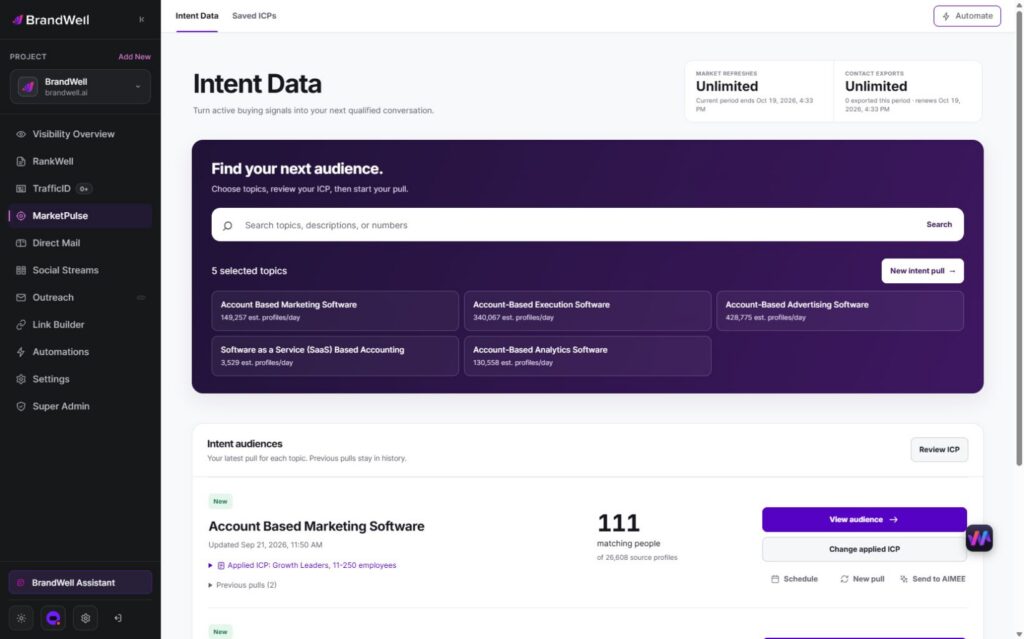
BrandWell MarketPulse: intent data starting at $500/mo. Find people researching topics relevant to what you sell, apply saved ICP filters, and review available contact details before taking action.
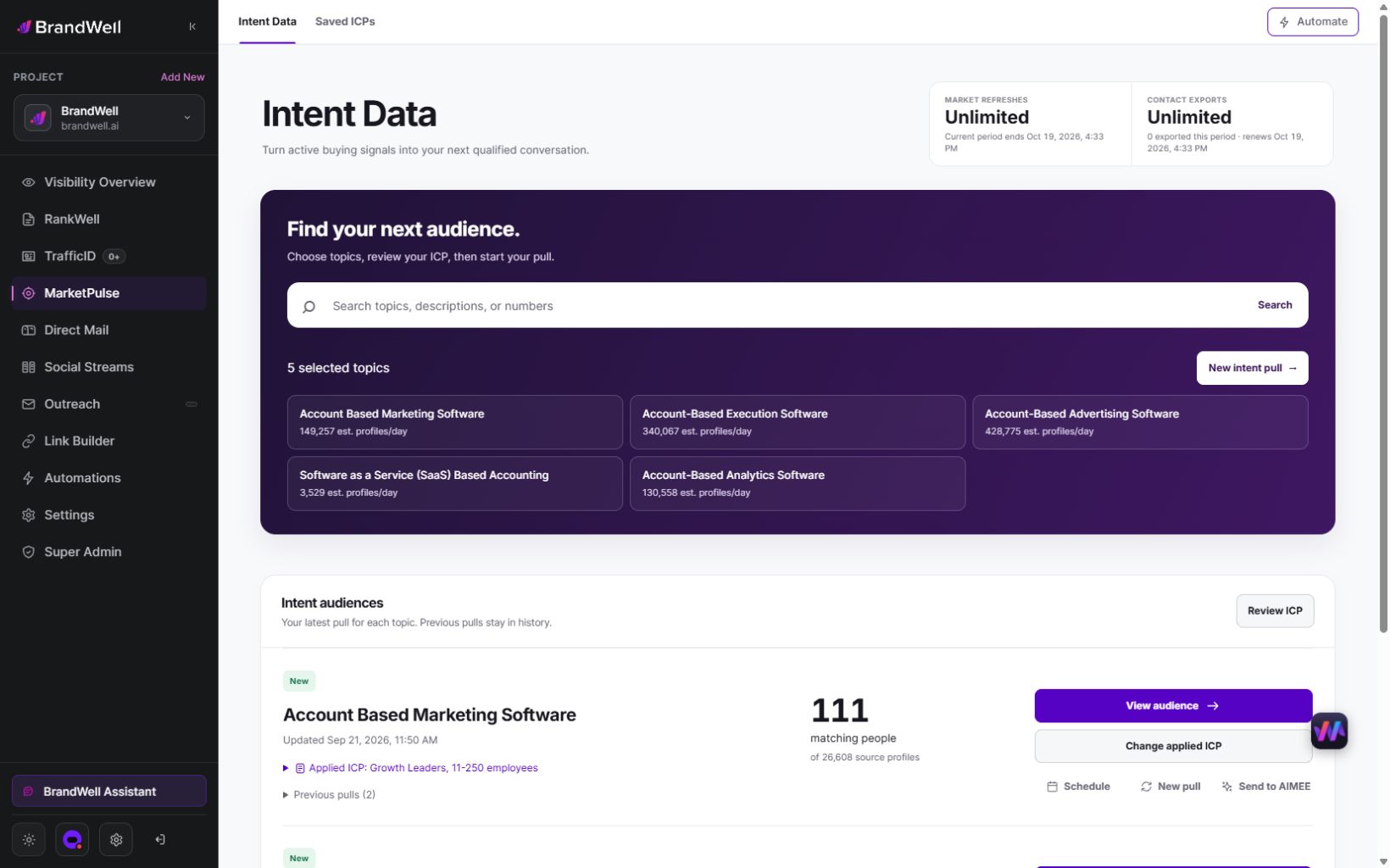
MarketPulse plans are starting at $500/mo. Verify current package scope and offers on the product page.
| Plan | Topics and refreshes | Monthly exports |
|---|---|---|
| Starter | 1 topic, weekly | 25,000 contacts |
| Growth | 3 topics, daily | 100,000 contacts |
| Scale | 10 topics, daily | Unlimited contacts |
Swipe the table to see all columns.
A pull retrieves available data from the previous 24 hours for one topic. Daily use across all included topics provides 90 Growth pulls or 300 Scale pulls in a 30-day month. Weekly Starter pulls vary by calendar month. Available audience size and contact fields vary, and audiences may overlap. Refreshes stop at the plan limit without overage charges.
- Find and qualify: search the topic catalog, save your ICP, and review the people and companies that match.
- Act on the research: export qualified contacts or prepare an Outreach or Direct Mail workflow. Connected products, channel usage, and fulfillment may cost extra.
- Get help from AIMEE: Growth and Scale include AIMEE for the initial user to research accounts and prepare the next step through connected tools.
Agencies and other service businesses can build client deliverables around their available Intent Scans and exports. Keep each client’s scope, permissions, and service fees clear. A subscription is not a promise of a white-label platform or exclusive access to a market.
Explore MarketPulse and watch the demo or compare plans starting at $500/mo. Any early-access discount is a separate, time-limited offer shown to an eligible recipient.
Promise a defined decision cycle
Offer the service when a client has a clear market, meaningful research topics, a person responsible for review, and at least one approved next action. Promise a repeatable way to identify and evaluate account-level topic activity within the contracted scope. Promise transparent reporting, documented limitations, and a review cadence. Do not promise that an observation represents a named buyer or a purchase decision.
The client outcome should be an operating improvement, such as a prioritized account research queue, a better-timed account review, or a clearer set of content and sales hypotheses. The agency can support these decisions. The client still controls its strategy, follow-up, sales process, and outcomes.
Avoid broad promises like continuous access to all intent or unlimited relevant accounts. Define what a topic means, which market is monitored, how often the agency reviews evidence, and what happens when there are few or no actionable observations. A credible quiet report is part of the service.
Specify delivery and client handoffs
Staff the service with an account owner, topic strategist, data or quality steward, analyst, activation owner, and client approver. Small teams can combine roles, but the handoffs remain explicit. The topic strategist maintains definitions. The steward checks source and entity state. The analyst prepares the evidence report. The activation owner executes only approved plays.
The workflow includes market definition, topic discovery, topic approval, contracted signal configuration, identity and enrichment review, account qualification, suppression, report preparation, client review, approved activation, outcome capture, exception handling, and topic maintenance. Each step needs a source record, owner, service level, and stop condition.
Write SLAs around controllable work: report cadence, exception acknowledgement, correction review, topic-change processing, and approved routing. Client dependencies include access, permissions, account criteria, review availability, and timely action. The handoff should include a topic dictionary, account boundary, evidence definitions, report sample, activation matrix, role chart, escalation path, and renewal criteria.
Design the report for decisions, not decoration. Each entry should show why it is present, the entity and confidence state, relevant context, suppression status, recommended review, and limitation. The client should be able to accept, reject, defer, correct, or request more research. Capture that response in a structured field so topic maintenance and renewal rely on evidence rather than anecdotes.
Check tools and service entitlements
Evaluate capabilities instead of relying on a generic provider list. Required categories include topic research and governance, contracted signal access, entity and identity handling, enrichment, suppression, account qualification, branded reporting, client permissions, workflow activation, audit history, and outcome capture. A white-label layer matters when the agency needs consistent client-facing identity, partitions, reports, and controls.
The best tool exposes source and evidence boundaries. It should not flatten account-level topic activity into a claim about a specific person’s intention. It should let the agency maintain topics, see missing or unresolved states, correct records, document approval, and export enough provenance to support a client conversation.
MarketPulse provides topic audiences and ICP filtering. AIMEE can help prepare briefs through configured tools. An agency can define a reviewed client service around these inputs; custom client partitions, branded portals, source monitoring and routing require separately supported implementation and written scope.
Build, resell, refer or decline
Build when the agency has durable data access, engineering capacity, client partitioning, quality controls, reporting, workflow operations, and a maintenance budget. Resell when a contracted platform supplies a repeatable infrastructure layer while the agency owns topics, packaging, analysis, reporting, and client service. Refer when the client requires a specialized deployment beyond the agency’s competence or contract.
Avoid the offer when the client wants guaranteed account volume, named buyers without valid identity evidence, automated outreach without review, or a market too vague to configure. Also pause when the client cannot approve data use, has no suppression process, or lacks an activation owner. Selling the feed before these conditions are resolved creates a support problem disguised as a service.
Compare build, reseller, and referral options across speed, control, maintenance, entitlement, client branding, portability, auditability, support, and dependency. The right decision may differ by account. Use a readiness assessment before committing to a custom path.
Model pricing and delivery costs
Price from the actual operating design. Include enabled modules, usage, topic count, market complexity, configuration, identity and enrichment review, analyst time, branded reporting, client meetings, activation support, exceptions, tooling, overhead, capacity, and contingency. Separate implementation from recurring delivery. Define what triggers a change in price.
There is no universal gross margin or market price for this service. The result depends on scope, contract terms, labor, usage, and support. Model low, expected, and high scenarios with the agency’s own accounting definition. Track planned versus actual input consumption after launch and reprice at a documented checkpoint if the account is outside its capacity band.
A base fee can cover defined strategy, review and reporting; written bands can cover additional topic work, activation or support. A custom retainer should identify the extra work. Compare software allowances with the actual service design before setting a client price.
Measure delivery before financial outcomes
Prove the operating chain before discussing financial outcomes. Record the approved topic, signal observation, account identity state, qualification decision, report delivery, client review, approved action, action completion, and observed outcome. Use agreed definitions, denominators, and windows. Capture missing client follow-up instead of treating it as a negative signal.
Measure account acceptance, completed reviews, review time, corrections, suppression handling, actions and outcome coverage. Name each denominator. Client acceptance is a usefulness decision, not automatically a validated measure of classification precision. Keep operational reporting separate from associated downstream outcomes.
No platform or topic-intent monitoring program can guarantee pipeline or revenue. A useful proof packet shows what the service delivered, what the client did, and what happened next. It does not claim that the signal alone caused the outcome.
Qualify client readiness
Best-fit clients have a defined B2B market, a product that maps to recognizable research themes, account criteria, sufficient deal value to justify human review, accessible CRM or reporting systems, and a named follow-up owner. They are willing to refine topics when evidence is noisy and accept that some periods may produce limited actionable findings.
Exclude clients seeking consumer surveillance, unrestricted personal identification, guaranteed lead counts, or indiscriminate outreach. Pause clients with no topic hypothesis, no account market, weak data-use authorization, or no capacity to act. A client that cannot distinguish research interest from purchase intent is also a poor fit until expectations are reset.
Fit is a delivery-model question as well. A report-only client needs internal analysts and activation capacity. A managed-service client transfers more operational work to the agency and should be scoped accordingly. A consulting client may need topic and workflow design without recurring monitoring.
Use a readiness scorecard with gates for market clarity, topic relevance, source authorization, entity quality, client review capacity, activation ownership, CRM or reporting access, outcome definitions, and budget. A failed gate is not automatically a rejection. It can become a bounded preparation project. The recurring package should begin only after the critical gates have named owners and accepted remedies.
Preserve source and identity states
Record the contracted source, topic definition, time window, account market, entity level, and confidence or validation state. Separate account-level research from website activity, known contact behavior, enrichment, and third-party topic observations. Do not merge them into one unqualified label. Suppress ineligible entities before reporting or activation.
Useful activation workflows can include human account research, CRM queue creation, content recommendation, seller alert, audience review, or executive account planning. Define which options the agency operates, which the client operates, and what approval is required. Preserve evidence through the handoff so the client can understand why an account was included.
Outcome evidence should include accepted account, reviewer decision, completed action, disposition, stage change, and other client-approved observations. The intent topic selection and maintenance framework helps teams treat topic quality as an ongoing operational input rather than a one-time setup task.
Plan for quiet periods and failures
Data-quality risks include ambiguous topics, topic overlap, stale observations, entity mismatches, duplicate accounts, missing fields, source changes, and insufficient evidence. Delivery risks include unowned reports, slow client review, hidden custom work, fragile routing, and outdated topic definitions. Use exception queues and version logs rather than silently correcting history.
Privacy and contractual controls must reflect the source, purpose, market, jurisdiction, access, retention, suppression, and activation channel. Require authorized privacy, legal, and security reviewers to assess applicable facts. Do not describe an internal workflow as universal compliance or legal approval.
Expectation risk rises when sales promises volume or certainty. Use a sample report and explicit glossary before signature. Explain what the observation means, what it does not prove, and why a human evaluates context. Document quiet periods, source limitations, client dependencies, and the correction process.
Operational resilience belongs in the service design. Specify what happens when a source is delayed, a field changes, an integration fails, or an account is disputed. Pause affected automation, preserve the original record, notify the appropriate owner, and release corrected output only after review. A visible incident process protects trust better than silently filling a report with lower-quality substitutes.
Write the recurring package specification
The nine-part TOPICAL service blueprint
- Topics: Approved definitions, inclusions, exclusions, owner, and revision rules.
- Operating market: Account universe, geography, segments, and suppression boundary.
- Provenance: Contracted source, observation window, entity state, and limitations.
- Interpretation: Qualification rules, confidence treatment, exceptions, and human review.
- Cadence: Report schedule, client review, correction, and escalation.
- Activation: Approved options, handoffs, owners, service levels, and stop conditions.
- Ledger: Evidence, action, outcome, missing data, and version record.
- Economics: Modules, usage, labor, support, capacity, billing, and repricing triggers.
- Learning: Topic maintenance, client feedback, renewal review, and next hypothesis.
Use the package blueprint to write a proposal and delivery specification. Define who owns branding, billing, reporting and support, and verify the necessary contractual rights before offering a resale or white-label arrangement.
AIMEE can help organize approved evidence and draft a report through configured connected tools. Verify facts, interpretation and supported actions before client delivery or external activity. The agency remains responsible for its service scope and client relationship.
Copyable agent-ready topic service review
PURPOSE: Prepare one client topic-monitoring operating specification.
INPUTS: Client market, approved topics, exclusions, contracted sources, entity states, cadence, report fields, activation options, responsibilities, SLAs, suppressions, evidence fields, pricing assumptions, and renewal criteria.
TASK FOR Claude, ChatGPT, OR AIMEE:
1. Reconcile every topic to a client decision and owner.
2. Flag overlap, ambiguity, missing exclusions, and unsupported identity claims.
3. Draft the report schema, exception queue, and activation matrix.
4. Map each promise to cost, responsibility, evidence, and a stop condition.
5. Produce client questions and a renewal review worksheet.
OUTPUT: Topic dictionary, service blueprint, risk register, pricing-input sheet, and unresolved questions.
HUMAN APPROVAL REQUIRED: The client approves topics and market; delivery approves capacity; authorized reviewers approve applicable data use; a human approves every activation rule.
STOP CONDITIONS: Stop if topic meaning, market, source entitlement, entity state, permitted use, client owner, or outcome definition is unknown. Do not create a volume or outcome guarantee.
The agent structures the work. The agency and client retain responsibility for the service promise, data-use decisions, topic approval, activation, and renewal. Save the approved specification with the client contract, report version, and change log. Recheck it whenever a topic, source, market, workflow, or owner changes, rather than allowing informal requests to redefine the package. Record each approved change.
Keep acceptance separate from precision
Classification precision measures true positives among predicted positives. It requires a defined target and reference labels. A client accepting an account for research does not independently establish that the account is a true buyer, or validate every source field.
Report acceptance against the written research rubric. If evaluating topic classification, define what a correct topic label means, how labels were reviewed and which records were sampled. Do not call agreement with a usefulness decision “buyer accuracy.” An accepted account can still contain unknowns and require further research.
Worked example: records, accounts and service costs
A fictional monthly review begins with 200 topic records. Company normalization produces 80 distinct candidate accounts, 60 fit the client’s criteria, and the client accepts 30 for research. Fit is 60 / 80 = 75% of candidate accounts. Acceptance is 30 / 60 = 50% of fitting accounts, or 30 / 80 = 37.5% of candidates. Do not divide accepted accounts by person records and label the result an account acceptance rate.
Assume $500 in software, $600 in analysis and $150 in reporting and support. Defined delivery cost is $1,250, or $41.67 per accepted account. A $2,000 client fee leaves $750, or 37.5%, before excluded acquisition, general overhead, tax and financing costs. These invented figures are not typical results or a complete service quote. Additional implementation, channel usage or fulfillment increases cost.
Run the rehearsal in the current product
Search MarketPulse for a relevant topic, apply the saved ICP and review the available audience. Preserve the topic and observation window when preparing the client brief. Where you group people by company, document the mapping rule and unresolved records. AIMEE can help draft from supplied evidence through configured tools; a reviewer checks the brief and proposed action.
The review cadence is an agency commitment, separate from product refresh allowances. Standard Starter is one weekly topic; Growth is three daily topics; Scale is ten daily topics. A report schedule does not create additional refreshes or guaranteed audience volume.
Frequently asked questions
What is the client buying?
A scoped recurring process for topic selection, review, interpretation and an approved handoff, with documented limitations.
Can the agency guarantee a useful account count?
No. Define the work and handling of quiet periods without promising an audience or buyer volume.
Does client acceptance prove precision?
No. Acceptance measures the client’s research decision; classification evaluation requires defined reference labels.
Is the custom service automatically included in MarketPulse?
No. Topic audiences and ICP filtering are product inputs. Analyst delivery, custom portals, branding and integrations need their own supported scope.
Check the topic-data allowances: compare current MarketPulse plans before setting the client package.
Reviewed and updated October 3, 2026.

Written by