On this page
- Start with the distinction the client needs
- Use TrafficID for the client’s own site
- Offer a bounded outcome
- Ten gates for delivery and renewal
- Choose build, service, referral or no sale
- Worked example: price the accepted-account work
- Report usefulness before claiming revenue impact
- Frequently asked questions
Sell website visitor identification as a defined operating service: implement an authorized property, review eligible observations, qualify useful accounts or contacts, and prepare a client-approved next step. Specify evidence, exclusions, reporting, support and price. Do not promise to identify every visitor or turn every match into a buyer.
This guide is for agencies considering a recurring service around their clients’ own website activity. A workable offer needs a client who controls the site, a clear market, enough relevant activity to justify the work, and someone responsible for decisions.
Start with the distinction the client needs
A page visit, a resolved company, an identified person and an enriched contact are different records. An enriched contact at a matched company is not proof that the contact visited. An identified visit is not proof of buying intent or permission for every communication channel.
- Observed activity: the eligible visit or interaction, property and time window.
- Resolved identity: the entity the available evidence supports, including unknown or disputed states.
- Enrichment: additional information associated with a record, kept separate from visit evidence.
- Qualification: your client’s market-fit and usefulness decision.
- Activation: the approved action, with relevant preferences and restrictions applied.
Make this glossary part of the proposal and reports. It prevents a count of potential contacts from being presented as a count of visitors.
Use TrafficID for the client’s own site
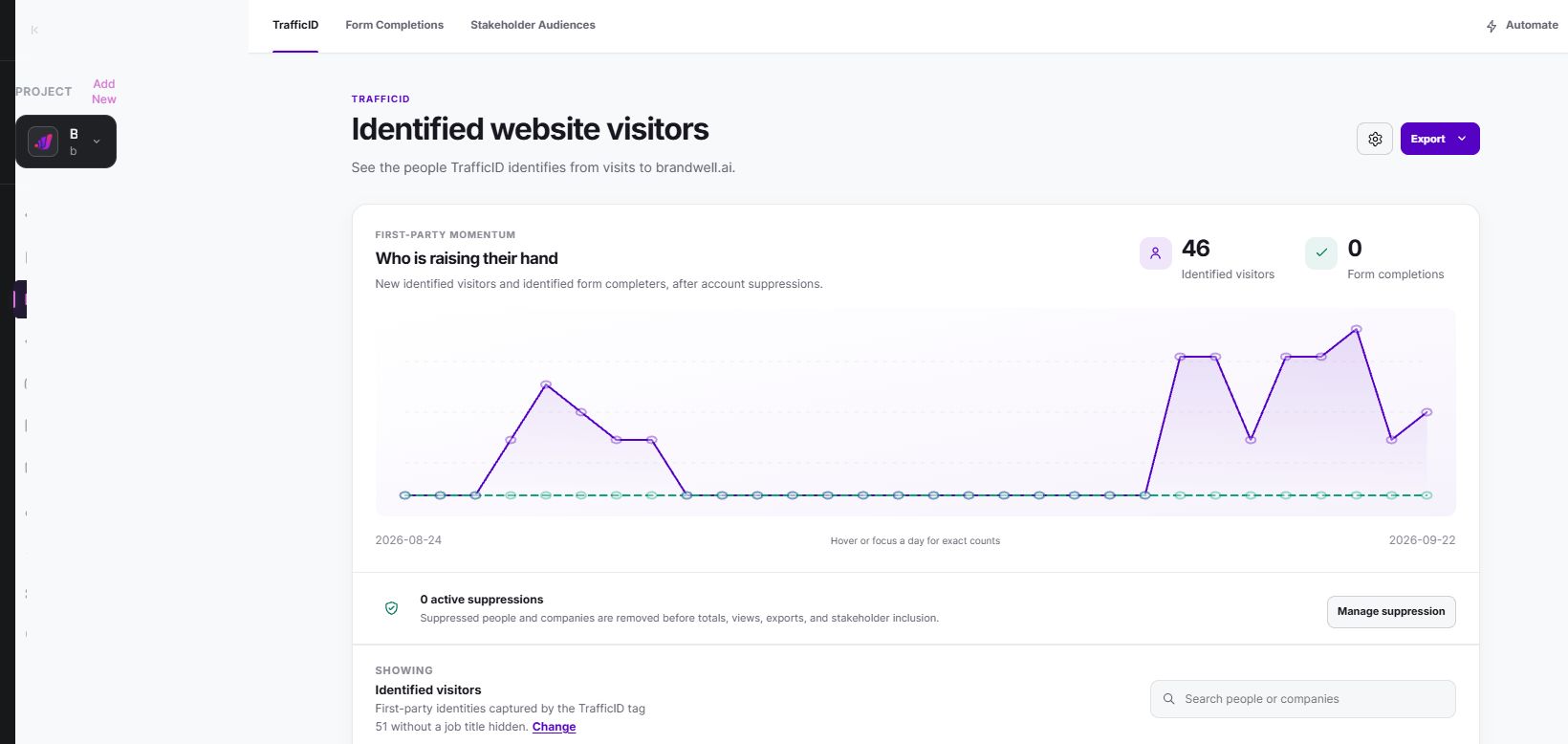
TrafficID helps identify eligible US visitors on a connected website. Review the available details and activity before deciding what is useful. Coverage and fields vary; do not sell universal identification.
MarketPulse serves a different question: who is researching topics relevant to what a business sells. Its standard plans are starting at $500/mo. Topic audiences are not a list of visitors to a particular client’s site. Use the products separately or together when the client’s decision calls for both.
AIMEE can help research and prepare work through configured connected tools. Verify the supported action and destination result. Agency setup, client reporting, integrations and commercial rights need their own scope; do not imply a white-label platform or unrestricted execution is included.
Offer a bounded outcome
A useful first package covers one authorized site, one target market and one review workflow. Deliver a reviewed queue, documented exclusions, a recurring report and a named support owner. Meetings, revenue and identification rates depend on factors beyond the agency’s process.
Good-fit clients have relevant traffic, market clarity, implementation access and time to review results. Pause the sale if ownership is disputed, the intended use is unclear, the buyer expects covert surveillance, or nobody will handle corrections and suppressions. A high total traffic count alone does not establish fit.
Ten gates for delivery and renewal
- Verify authority: record the property, authorized client owner, purpose and approvals.
- Inventory scope: list domains, environments, pages, events, exclusions and destinations.
- Specify states: define anonymous, identified, enriched, unresolved, disputed and excluded records.
- Install and test: validate the supported implementation, actual fields, exclusions and pause procedure.
- Bound qualification: agree on fit, freshness, relevance and exception rules.
- Initiate review: show evidence, limitations and a suggested next decision.
- Limit activation: use approved destinations, owners and applicable channel controls.
- Inspect outcomes: record acceptance, action, correction, missing follow-up and observed results.
- Tend operations: monitor access, implementation changes, incidents, support and retention.
- Renew or exit: evaluate usefulness, costs and fit; remove implementation and access when the service ends.
This is a suggested service runbook, not a claim that every gate is a native TrafficID feature. Assign site ownership to the client, setup to a technical lead, qualification to a reviewer, action to a channel owner, and support to a named operator. Agree on report cadence, response times and escalation separately from sales outcomes.
Keep a property inventory, data-flow map, identity glossary, field definitions, role matrix, test evidence, approved-action rules, correction process and shutdown instructions. Recheck affected controls after a tag, consent tool, destination or field definition changes.
Choose build, service, referral or no sale
Building your own identification infrastructure adds ongoing maintenance, security and identity-quality work. A service around an existing product can focus on implementation, review and reporting, but still needs contractual permission for the proposed client use. A referral is useful when a client can operate the product directly or needs expertise outside your remit.
Evaluate candidates by supported geography, identity level, evidence, implementation requirements, restrictions, export options, support and exit arrangements. Ask for a demonstration using the actual intended workflow. Generic provider rankings do not answer those questions.
For the risk vocabulary, NIST IR 8062 introduces privacy engineering objectives and a risk model for federal systems. It does not certify this service or determine a client’s legal obligations. Obtain appropriate advice for the actual collection, use and communication channels.
Worked example: price the accepted-account work
A fictional monthly service sees 1,000 eligible visits and produces 200 distinct candidate accounts. A reviewer accepts 80 as relevant to the client’s defined use case. The account acceptance rate is 80 / 200 = 40%. Dividing 200 accounts by 1,000 visits gives a different operational ratio; it is not a person-identification rate.
Assume $300 in platform and usage allocations, $600 in review labor and $100 in reporting costs. Defined delivery cost is $1,000, or $12.50 per accepted account. At a $1,500 service fee, the remainder is $500, or 33.3% of revenue, before overhead, taxes and other excluded costs.
If the same work yields only 40 accepted accounts, cost per accepted account rises to $25. The agency may still have the same revenue and labor, but the client receives less useful output. These are invented planning inputs, not TrafficID pricing, typical results, profit guarantees or evidence of incremental sales.
Separate setup fees from recurring work. Define additional sites, integrations, custom reports and exception support before charging for them. Use actual product charges and delivered hours in low, expected and high scenarios. See the visitor-identification pricing guide for related service planning.
Report usefulness before claiming revenue impact
Track eligible visits, distinct candidate records, acceptance, unresolved and disputed records, corrections, action completion and missing outcomes. Give every rate a denominator and reporting period. Keep a single account from being counted repeatedly because several people or sessions are associated with it.
CRM-linked pipeline and revenue can be reported as observed downstream outcomes with consistent definitions. They are not automatically caused by this service. A credible incremental question needs a suitable comparison, stable assignments and uncertainty reporting; a before-and-after chart alone is insufficient.
Frequently asked questions
Can an agency sell named visitors as guaranteed buyers?
No. Available identity evidence, a visit and a buying decision are different. Define the supported record and review its usefulness.
Does a website visit allow text messages?
A visit or enriched phone number does not establish SMS opt-in. Check the intended channel’s requirements and the actual permission record.
What belongs in the monthly service?
Agreed setup support, review, reporting, corrections and approved next steps within a bounded scope. Additional implementation and commercial rights must be confirmed separately.
What happens when the client leaves?
Follow the agreed removal, access revocation, permitted export, retention and deletion process. Record completion and resolve outstanding requests.
Start with the site workflow: explore TrafficID. For broader topic research beyond the client’s website, compare MarketPulse plans starting at $500/mo.
Reviewed and updated October 3, 2026.

Written by