On this page
- TrafficID and MarketPulse serve different purposes
- What should the agency promise?
- Delivery workflow, owners and handoff
- Evaluate the capability stack
- Build, resell, refer or decline
- Price the whole delivery service
- Report progression and outcomes
- Client fit and exclusions
- Keep observation, identity and qualification separate
- Delivery risks and maintenance
- Scope a recurring client package
- A fictional service-cost and acceptance example
- Start with a reviewable website audience
An agency can offer website visitor identification as a managed review and follow-up service for clients with relevant site traffic. Promise a qualified evidence queue and an agreed handoff, rather than identification of every visitor or guaranteed sales. Keep observed visits, submitted forms, resolved identities and added stakeholders distinct.
This guide covers service scope, staffing, client fit, cost, seven delivery gates and acceptance testing. The recommended workflow is an agency operating model, not a claim that every step is an included BrandWell template.
TrafficID and MarketPulse serve different purposes
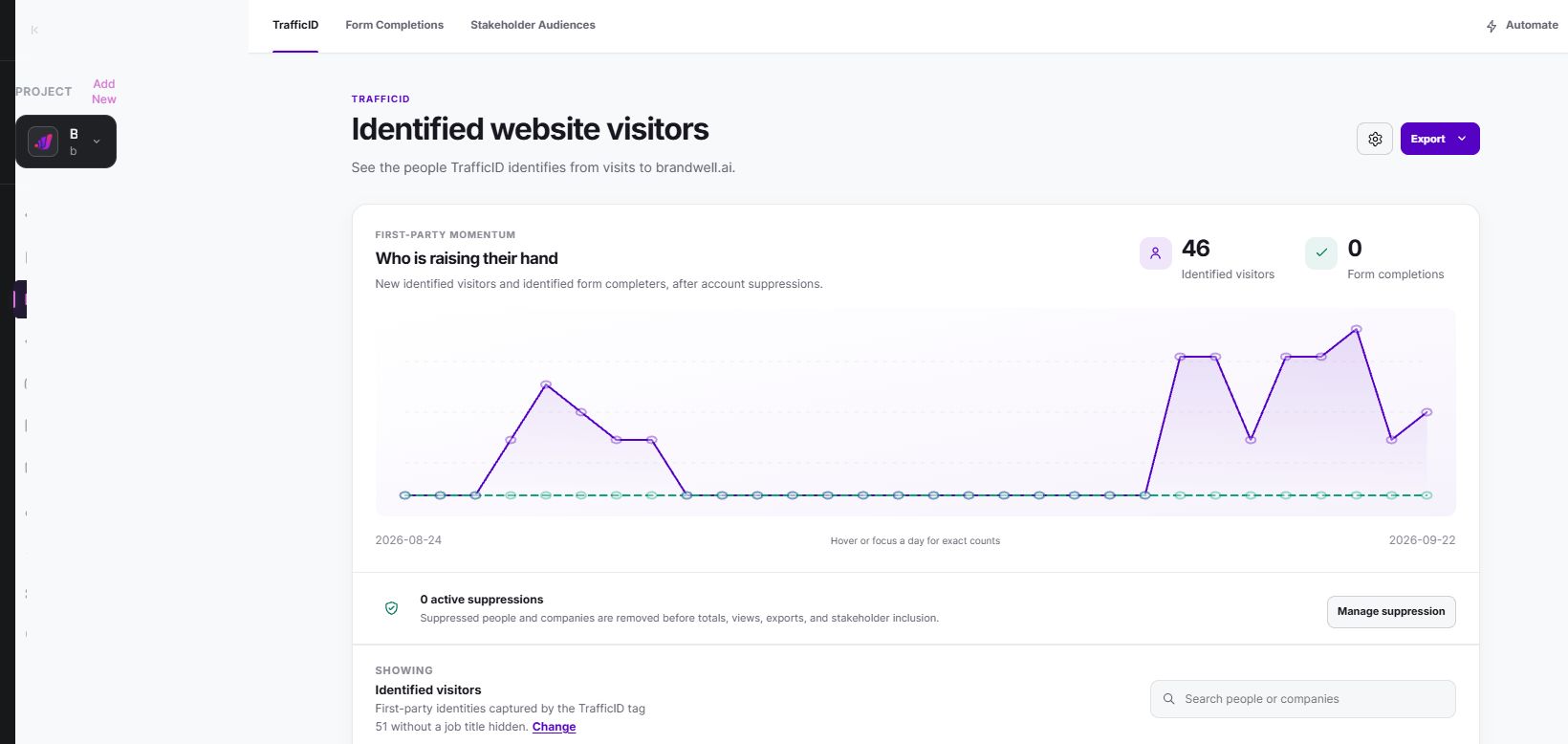
TrafficID concerns identifiable activity on your authorized website. Its current workspace separates identified visitors and captured form submissions, and can group first-party people with additional company decision makers through a saved Stakeholder ICP. Added decision makers must not be reported as observed visitors.
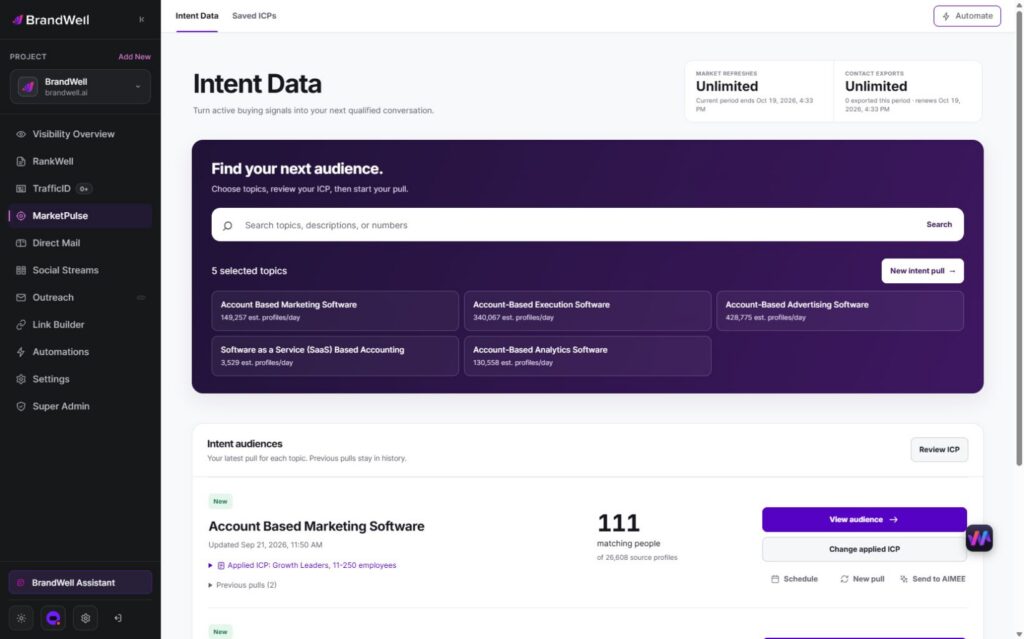
MarketPulse provides topic research intent data and is starting at $500/mo. A topic match does not establish a visit to the client’s website. If your agency uses both products, keep the signal source attached to each record and price each scope explicitly.
TrafficID’s standard monthly plans currently range from $99 for 250 identified visitors to $999 for 10,000. The $499 plan allows up to 2,500. Review the current TrafficID pricing, usage and terms for the client’s needs. Do not assume an unlimited promotional offer or white-label/resale rights are included in a standard plan.
What should the agency promise?
Yes, for a narrow set of clients. The client outcome should be a governed queue of potentially relevant accounts with evidence, confidence, exclusions, and an approved next action. The promise is faster prioritization of known website interest, not a complete list of visitors or confirmed buyers.
Explain these states in the client proposal and evidence cards. Keep unresolved assumptions visible, and agree the acceptance criteria before the first delivery.
The service belongs beside demand generation, ABM, sales research, or RevOps when the client already has traffic and someone can act on evidence. It is a poor fit when the client expects anonymous traffic to become a guaranteed lead source.
Delivery workflow, owners and handoff
Use a defined weekly operating loop with named owners and response targets. An implementation owner authorizes the domain and tracking purpose. A data operator monitors capture and identity states. An analyst applies ICP and suppression rules. A client owner approves activation. A service lead handles exceptions and the monthly review.
The handoff should include an evidence card for each accepted account: observed pages or events, capture time, identity level, match basis, validation status, fit rationale, excluded assumptions, suggested play, approval state, and outcome updates. Set separate SLAs for data incidents, analyst review, client acceptance, and approved action.
Before installation, document domain authorization, the collection purpose, notices, permissions, locations and responsible parties. Have the client and its qualified adviser review the actual technology and intended uses. A product subscription does not settle those requirements.
Evaluate the capability stack
The best choice is a capability stack, not a universal vendor ranking. Evaluate the tracking or capture layer, company-resolution method, possible-person method, enrichment and contact validation, consent and suppression controls, multi-client administration, evidence reporting, routing, and audit logs.
A white-label provider must also support tenant separation, agency branding, permissions, usage visibility, exports, error handling, and contract clarity. Test with authorized traffic and known records. Record false matches, missing fields, latency, suppression behavior, and how the provider explains confidence.
Do not select from a listicle alone. Current product capabilities, lawful-use restrictions, pricing, and coverage require verification on official documentation and written terms. This guide intentionally avoids competitor links and rankings because the correct provider depends on the agency contract and client use case.
Build, resell, refer or decline
Resell when speed and multi-client operations matter; build only when identity logic is strategically core; refer when the client needs software but not agency operations; avoid when governance or activation is missing.
Building requires more than a pixel. It requires identity data rights, security, resolution logic, validation, observability, privacy operations, connectors, support, and continual maintenance. Reselling can reduce build burden, but the agency still owns its client promise, workflow, and oversight. A referral keeps delivery risk lower but also gives away the managed-service layer.
Use this hub to make the model decision, then use the detailed visitor-identification package blueprint for scope and deliverables. Do not recreate that full operating blueprint here.
Price the whole delivery service
Price the work from the cost stack and service risk, not from an assumed gross-margin benchmark. Model wholesale data or platform cost, traffic or usage, setup, QA, analysis, client review, integrations, exception handling, support, compliance work, and account management. Then add the margin needed for the agency model and a reserve for variable usage.
Separate setup from recurring delivery. A simple client with one domain, a clear ICP, one approved route, and weekly reporting costs less to serve than multiple domains, custom identity rules, daily routing, CRM automation, and frequent exceptions. Define overages and change requests before launch.
For a dedicated calculation model, use the visitor-identification pricing and margin controls. Gross margin is an output of contracted cost and observed labor, not a promise made in advance.
Report progression and outcomes
Prove progression, not causation. Record eligible visits, resolvable companies, reviewed records, accepted signals, approved actions, responses, meetings, opportunities, and revenue as distinct stages. Use stable definitions and keep denominators visible.
A signal can be associated with a later opportunity without causing it. Outcome monitoring shows what happened; it does not establish that this service produced the change. Strong causal claims need a suitable comparison or counterfactual. In ordinary client reporting, use language such as sourced observation, accepted for action, associated response, and influenced opportunity according to the client attribution rule.
Include rejected signals and reason codes. A transparent rejection rate is more credible than a report that hides noise. Review cohorts by identity state, page intent, ICP tier, action, and client team response time.
Client fit and exclusions
Best-fit clients have meaningful site traffic, a defined B2B ICP, an accountable sales or marketing owner, an approved outreach path, and enough deal value to justify review. Strong fits include ABM programs, high-consideration services, focused vertical campaigns, and teams that already use CRM stages consistently.
Exclude clients with negligible relevant traffic, consumer or sensitive audiences requiring controls the agency cannot support, no usable ICP, no one to review records, unreliable CRM hygiene, or an expectation that every visitor will become identifiable. Also exclude purposes that fall outside provider rights or the client notice and lawful basis.
Run a readiness session before installation. The decision should depend on traffic quality, purpose, identity tolerance, jurisdiction, activation capacity, and measurement discipline rather than enthusiasm for a new data feed.
Keep observation, identity and qualification separate
Prioritize the actual first-party event and its authorized identity source. Distinguish a person who supplied a form identity from a resolved visitor, a company-only match and an added company stakeholder. A stakeholder may be relevant without having visited the site. Record the source, time and match basis separately from contact validation and buying qualification.
Activation should follow a matrix: high-fit company plus high-relevance behavior can enter analyst research; a validated contact with an approved reason may be proposed for outreach; low-confidence identity stays aggregated; suppressed or prohibited records stop. Each action needs an owner and timestamp.
Outcome evidence includes accepted records, completed actions, responses, meeting progression, opportunity association, and rejection reasons. Keep raw observation, interpretation, decision, action, and outcome in separate fields.
Delivery risks and maintenance
The largest risks are false identity confidence, stale or incomplete data, unclear consent or notice, overbroad use, poor suppression, tenant leakage, and inflated expectations. Online identifiers may become personal data when they distinguish or profile a person. Treat uncertain identity data carefully, document purpose, minimize fields, set retention, and restrict access.
Operationally, test domain authorization, tag behavior, capture gaps, bot filtering, duplicate handling, timezone, validation freshness, connector failures, deletion, and incident response. Contractually, state what the service observes, what it cannot infer, which sources are available, and how clients may act.
A compliance badge or provider assurance does not replace the agency and client assessment. Laws vary. Keep a change log for provider terms and review the program whenever the client purpose, jurisdiction, technology, or activation channel changes.
Scope a recurring client package
A recurring package should combine governed capture, identity-state classification, qualification, activation support, evidence reporting, and continuous controls. Include authorized domains, traffic and use assumptions, ICP rules, exclusions, reporting cadence, analyst hours, accepted-signal definition, routing destinations, approvals, retention, support SLA, usage boundaries, and a monthly improvement review.
AIMEE can help prepare account research and a proposed follow-up through the tools connected to the workspace. Review the current product scope, permissions and workflow before promising any automated action to a client.
Seven-gate visitor-resolution readiness and delivery model
- 1. Authorized client site and purpose: Document every domain, owner, declared use, jurisdiction, notice, and prohibited purpose before capture.
- 2. Company-level resolution state: Record the organization match, method, confidence, timestamp, and known limitations without naming a person.
- 3. Possible-person confidence state: Keep possible-person resolution separate and show the evidence and uncertainty supporting it.
- 4. Contact validation and suppression: Validate the relevant contact channel, apply client and global suppression, and stop on conflicts.
- 5. ICP and buying-context qualification: Combine firmographic fit and observed behavior, but never convert attention into buyer certainty.
- 6. Human-approved activation route: Route only an allowed next step to a named owner. External contact and CRM writes need approval.
- 7. Evidence, retention, and review loop: Log action and outcome, enforce retention, audit access, review rejection reasons, and retune rules.
Copyable analyst brief
Use this analyst brief in your approved AI workspace after supplying only authorized inputs. It is a proposed operating process, not a preconfigured product template.
ROLE: You are an evidence-disciplined visitor-identification analyst.
INPUTS: Authorized domains, declared purpose, ICP, allowed data uses, identity-state definitions, suppression rules, retention, and approved actions.
1. Classify each record as company resolved, possible person, validated contact, qualified account, or excluded.
2. Quote the observed evidence and timestamp. Never infer buyer status from identity alone.
3. Score fit, behavioral relevance, identity confidence, and contact validity separately.
4. Draft an evidence card with unknowns and one proposed action.
5. STOP if the domain is unauthorized, notice or permission is unclear, the record is suppressed, identity conflicts, or jurisdiction review is missing.
6. A human approves identity use, CRM writes, outreach, and client delivery.
OUTPUT: Evidence card, reason code, confidence fields, proposed action, approval status, and maintenance note.
Approval boundary: An agent may research, classify, summarize, draft, and recommend. A human must approve identity use, CRM writes, external outreach, spend, client-facing delivery, legal interpretations, and irreversible actions.
Implementation worksheet: Before choosing a provider, capture seven client facts in writing: authorized domains, intended business purpose, target jurisdictions, identity states the client may receive, approved activation channels, suppression sources, and the human who owns every decision. Then run a small authorized test set through the complete path. Compare the raw event with the company match, possible-person match, validation result, analyst decision, and client action. Record false matches and records that should have stopped. A tool that produces more names but cannot preserve this trail may create more service risk than value.
Use a change ledger after launch. Record tag releases, provider changes, model or matching-rule updates, new fields, altered confidence definitions, connector changes, and policy decisions. Re-test a stable sample when any of those change. The agency should be able to tell a client whether an apparent volume shift came from site traffic, a source change, a rule change, or an actual market pattern.
Client acceptance test before recurring delivery
Use the first delivery to test the service contract, not just the data. Give the client a mixed set that includes strong-fit accounts, weak-fit accounts, company-only matches, possible-person matches, suppressed records, and records with conflicting evidence. Ask reviewers to accept, reject, monitor, or request more research. Require a reason code. If reviewers accept everything, the threshold is probably too loose or the exercise is not psychologically safe. If they reject everything, revisit the ICP, traffic quality, topic fit, or explanation.
Turn the results into an acceptance baseline. Report acceptance by identity state, page or event class, ICP tier, freshness, and proposed play. Measure review time and the percentage of records that need clarification. These are actionable implementation examples because they reveal whether the agency has a useful queue, understandable evidence, and a workable client handoff. They do not forecast meetings or revenue.
Define maintenance at launch. Each month, sample accepted and rejected records, inspect source and identity drift, reconcile suppression, review access, retest one integration, and confirm the client purpose. Each quarter, verify provider terms and data fields, reassess jurisdiction and notice, and retire rules that no longer produce useful decisions. Document the next review date in the client record.
Decision rule: If the agency cannot explain the identity state, authorized purpose, suppression result, and allowed action in one evidence card, keep the record out of client delivery. A smaller, reviewable queue is preferable to a larger queue whose provenance or use cannot be defended. Record why the item stopped so the next review can distinguish data failure from deliberate governance.
A fictional service-cost and acceptance example
Suppose an agency’s monthly fee is $1,500, with $499 of software, six hours of review at $60 per hour and $150 for reporting and support. Listed delivery costs total $1,009, leaving $491 of contribution, or 32.7% of the fee. That is not net profit: setup, additional software, overhead, taxes and exceptional work are not included.
In a separate fictional test, 100 reviewed records produce 40 accepted for research and 10 approved for contact. Research acceptance is 40% of the reviewed set. Contact approval is 25% of accepted research records, or 10% of all reviewed records. None of these rates is visitor coverage, a response rate or a revenue forecast.
Start with a reviewable website audience
Explore TrafficID and its current plans for website visitor identification. Confirm domain authorization, source definitions, suppression, access and the client handoff before launching recurring delivery. Use MarketPulse separately when the service also calls for topic-level research intent.
Reviewed and updated October 3, 2026.

Written by