


On this page
- Lead quality problems can start upstream
- More fields do not necessarily mean better evidence
- Cold audiences are useful for a different purpose
- Stale records can look complete
- Use a three-layer lead test, plus an action gate
- Why weak records create downstream work
- AI-assisted work needs the same evidence checks
- Use each input for its documented role
- What to do with a reviewed research signal
- A fictional audit with clear denominators
- Audit your five main lead sources
- Where MarketPulse fits
- Frequently asked questions
Improve lead quality by checking identity, fit, freshness and the meaning of each interaction before deciding what to do. A complete contact record can be outdated, and a recent research signal can still be irrelevant to your offer. Neither a cold audience nor an intent audience guarantees qualified buyers. The useful question is whether the evidence supports the specific next action.
Lead quality problems can start upstream
Weak inputs may create symptoms later: duplicate tasks, incorrect personalization, wasted review time or inconsistent reports. Those symptoms can also come from the offer, creative, qualification rules, routing or response process. Diagnose the source and the workflow instead of assuming every poor outcome is a data problem.
Review a representative sample of accepted and rejected records. Keep what was originally supplied, when it was observed, what changed and which decision followed. An attractive example does not establish typical usefulness.
More fields do not necessarily mean better evidence
The UK Government Data Quality Framework distinguishes completeness from accuracy: populated fields can still be incorrect. Its dimensions also include uniqueness, consistency, timeliness and validity. Use the dimensions relevant to the intended task rather than treating one completeness score as overall quality.
For a proposed lead review, separate these questions:
- Completeness: are the fields required by this action present?
- Accuracy: what evidence supports those values?
- Uniqueness: are multiple rows the same person, account or event?
- Consistency: do sources disagree about the entity or context?
- Timeliness: does the observation belong to the period needed by the action?
- Validity: do values follow the documented format and allowed range?
A validly formatted email is not necessarily deliverable or owned by the intended person. A recent enrichment timestamp is not necessarily the date a person researched a topic. Preserve these distinctions in the record.
Cold audiences are useful for a different purpose
A cold audience may help introduce an offer to people unfamiliar with the business or test creative and market response. It does not by itself establish current category research. Conversely, category research does not prove budget, authority or an active buying project.
Define the campaign purpose and permitted audience use before selecting inputs. Compare audience usefulness through actual outcomes and appropriate experiments, not by labeling one source “high intent” and assuming it must perform better.
Stale records can look complete
A record can retain a name, title, company and address after the underlying context changes. The person may change roles, an account may leave your target market, or a project may end. Set field-specific review intervals based on the action rather than declaring every record obsolete after one arbitrary number of days.
Keep source observation time, receipt time, enrichment time and last review separate. Record unknown dates explicitly. Updating a row today does not make its historical event current.
Use a three-layer lead test, plus an action gate
- Identity: what entity is supported by the evidence? Keep a company match separate from a person match and leave unresolved fields unresolved.
- Fit: does that entity match the documented ICP, territory, role or use case? Record exclusions as well as matches.
- Research context: what topic or behavior was observed, inferred or supplied, and when? It may be useful context without being a declared purchase plan.
Then apply an action gate: permitted purpose, channel policy, suppression, owner, capacity and approval. These are proposed operating checks, not a validated predictive score. A strong fit and recent event do not override a suppression or missing permission.
Why weak records create downstream work
A bad join can update the wrong account. A duplicate can create several tasks. A stale role can make a message misleading. A missing timestamp can keep an expired signal active. Track the actual consequences in your workflow instead of borrowing an enterprise-wide loss estimate and calling it your lead-generation cost.
Useful diagnostic measures include duplicate rate, missing required fields, age of source events, reviewer rejections, corrections, failed deliveries, manual minutes and unresolved exceptions. State each denominator and the scope of the sample.
AI-assisted work needs the same evidence checks
A fluent account summary is not independent verification of its inputs. Use AIMEE through configured tools for a bounded brief: approved source fields, references, allowed actions and explicit unknowns. Have the responsible owner review claims and consequential changes before execution.
For example, ask for a draft that says “this account matched the stated topic and ICP at the recorded time,” rather than inventing a buyer’s pain, budget or urgency. An agent must not manufacture the missing context or turn a company-level signal into a named person’s request.
Use each input for its documented role
- Cold audiences: broader reach and market or creative exploration.
- Contact lists: available identity and account attributes, subject to validation and permitted use.
- CRM history: recorded relationships, stages and interactions, with source and update context.
- Own-site behavior: activity on your property, subject to coverage and event definitions.
- External topic research: relevant research context within the provider’s stated scope.
You may need several of these. Keep their provenance visible and avoid treating a visit, form submission, category signal and sales conversation as equivalent evidence.
What to do with a reviewed research signal
Choose a bounded action rather than sending every record into every channel:
- Ads: evaluate an eligible audience candidate against destination requirements and the campaign’s purpose.
- Sales research: prepare a sourced account brief and a reason for review.
- CRM: retain the signal category, source time, match level, decision and owner; do not automatically overwrite a sales stage.
- Content: look for repeated questions that your team can answer with useful expertise. In RankWell, prepare and review that content before publishing.
- Reporting: track records through accepted actions and mature outcomes, including rejections and failures.
These are proposed workflows. Actual product connections, destination permissions, channel usage and fulfillment must be confirmed separately.
A fictional audit with clear denominators
Suppose a sample contains 100 delivered records. Ten are duplicates, leaving 90 unique records. Twenty of those lack an event date, leaving 70 dated records; 35 pass the documented fit and freshness checks. Duplicate rate is 10%; date completeness among unique records is 70/90, or 77.8%; acceptance among dated records is 35/70, or 50%.
These invented figures are not benchmarks. Do not describe the final 35 as confirmed buyers. Report what the checks establish, how the sample was chosen and which unknowns remain. A later difference in outcomes is not automatically the causal effect of cleaner data.
Audit your five main lead sources
- What entity and event does the source actually describe?
- Which fields are observed, inferred, enriched or client-supplied?
- What are the timestamps, coverage limits, duplicates and missing fields?
- Which ICP checks, exclusions and suppressions apply?
- What permitted action follows, who owns it and what approval is needed?
- How are rejection, correction, delivery and later outcomes recorded?
- What does review cost, and does the source help the team make a useful decision?
Fix the highest-impact missing definition or broken handoff first. Preserve a baseline and review the same units after the change. Avoid replacing an entire stack before you understand the failure.
Where MarketPulse fits
MarketPulse provides topic research that can be reviewed with an ICP. Standard plans are starting at $500/mo for one topic with weekly refreshes. Growth includes three topics with daily pulls; Scale includes ten topics with daily pulls. Fields and audience sizes vary, and audiences can overlap.
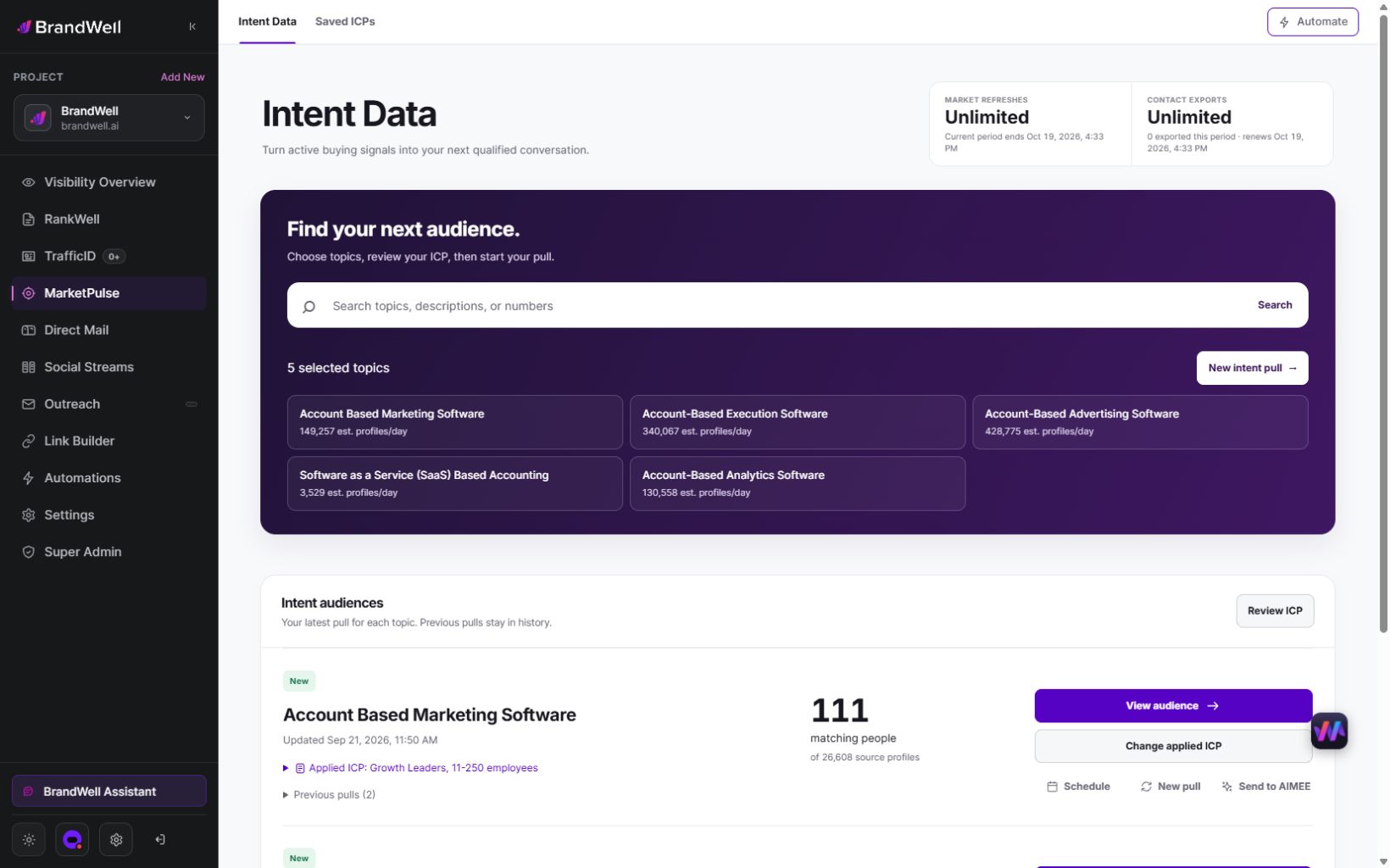
Inspect a topic, apply the ICP and review the available evidence before selecting a next step. Keep TrafficID own-site visitor records distinct from external research. Watch the demo and compare plans.
Frequently asked questions
Are lead lists still useful?
They can be useful for documented identity, fit or relationship work. Assess field quality and permitted use rather than assuming the list proves current demand.
What is the difference between fit and intent?
Fit is a match to your defined market. A research signal provides context about a recorded or inferred activity; it is not necessarily a statement that the entity intends to purchase.
Does recent intent make a lead qualified?
No. Qualification also needs the appropriate identity, business context, exclusions and action rules. Keep unknowns visible.
Does AI fix poor lead data?
It can assist with approved review tasks, but it can also repeat wrong inputs. Verify source evidence, joins and proposed actions instead of relying on fluent output.
How should stale data be handled?
Retain the original evidence and apply field-specific review, expiry or suppression rules. A new processing date should not disguise an old observation.
Reviewed and updated October 3, 2026.

Written by
Jeff Joyce has been helping brands grow online since the Myspace era, when custom HTML layouts were still a competitive advantage. What started in design quickly evolved into a career spanning social media, content strategy, video, agency ownership, and growth marketing. After building his own agency and testing countless AI tools, Jeff joined BrandWell with a clear focus: helping marketers understand how AI can actually improve the way they create, optimize, and scale content. Today, Jeff brings a CMO-level perspective to BrandWell's marketing strategy, blending brand positioning, content, video, customer education, and growth. His work centers on turning complex AI concepts into clear, practical marketing that helps brands move faster, create better content, and stay competitive without losing their voice.
 Farnaz Kia