On this page
- Current MarketPulse research workflow
- Choose one authorized visitor workflow
- Sequence installation and client acceptance
- Evaluate the supported visitor stack
- Choose an agency or consulting model
- Model startup and recurring costs
- Measure service quality before outcomes
- Choose a niche with review capacity
- Keep visits and identity states separate
- Control installation and data-use risks
- Maintain the recurring visitor service
- Worked example: set a revenue target without double-counting costs
- Frequently asked questions
Direct answer: Start a website visitor identification agency with one narrow B2B niche, one authorized site, and one consent-aware service outcome. Define whether the service identifies companies, people, or both. Label match confidence and permitted use. Validate the installation, identity states, qualification, and human-reviewed activation before selling a recurring service.
Current MarketPulse offer: intent-data plans start at $500/mo. See the product, demo, and current plans. Updated October 3, 2026.
Do not sell “every visitor revealed.” Not every visit can or should become an identified record, and an identified company or person is not automatically a buyer. The agency’s value comes from disciplined interpretation, routing, reporting, and correction, not from a raw export.
Who this is for: Prospective and early-stage B2B agency owners willing to own onboarding, privacy review, data quality, client approvals, and activation. It is not for operators who plan to install tracking without authorization or promise universal identification.
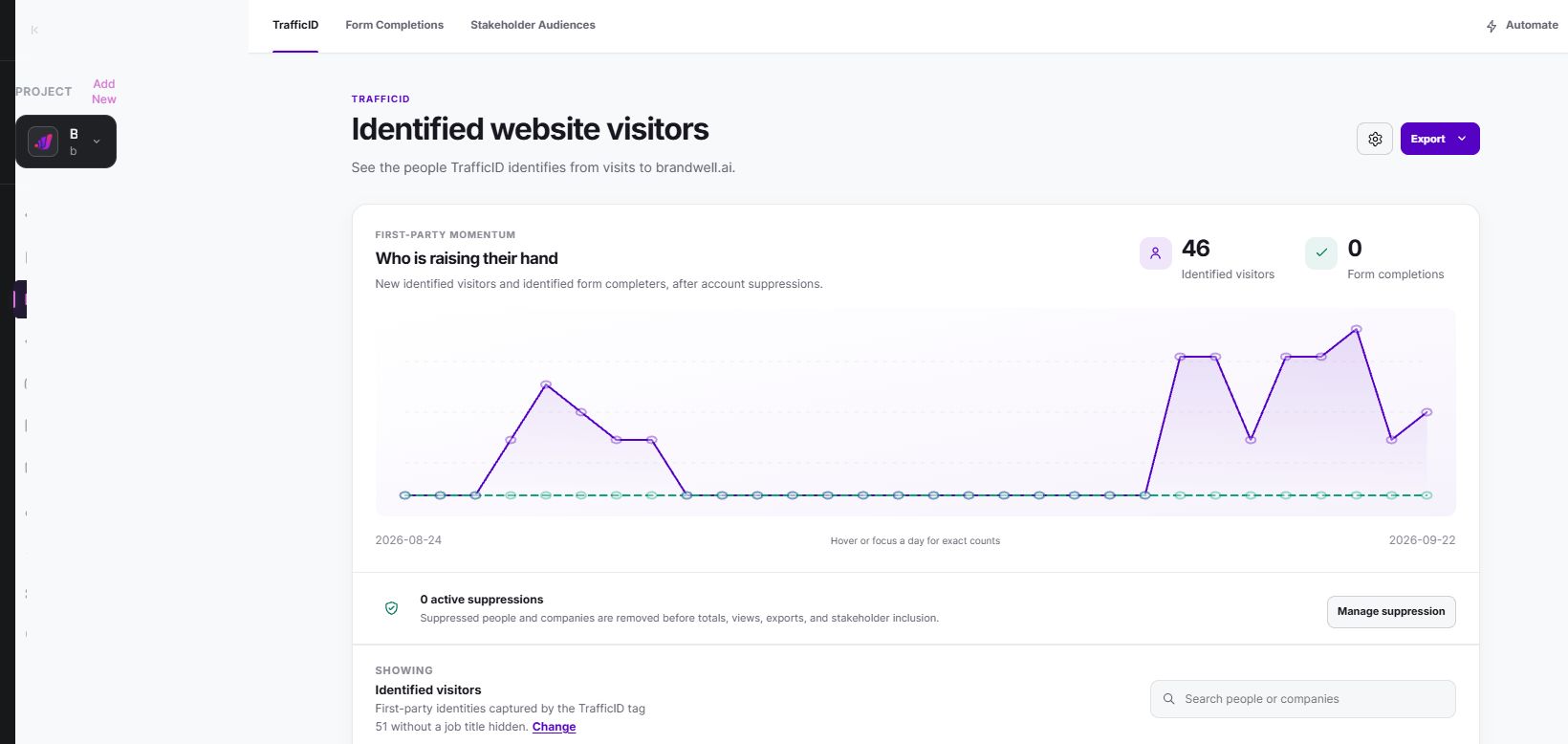
Start with the right product: TrafficID identifies supported visitors to your own authorized site. Its current workflow keeps observed visitors, submitted forms and additional company stakeholders distinct. MarketPulse supplies separate topic audiences; it is not a replacement for site instrumentation.
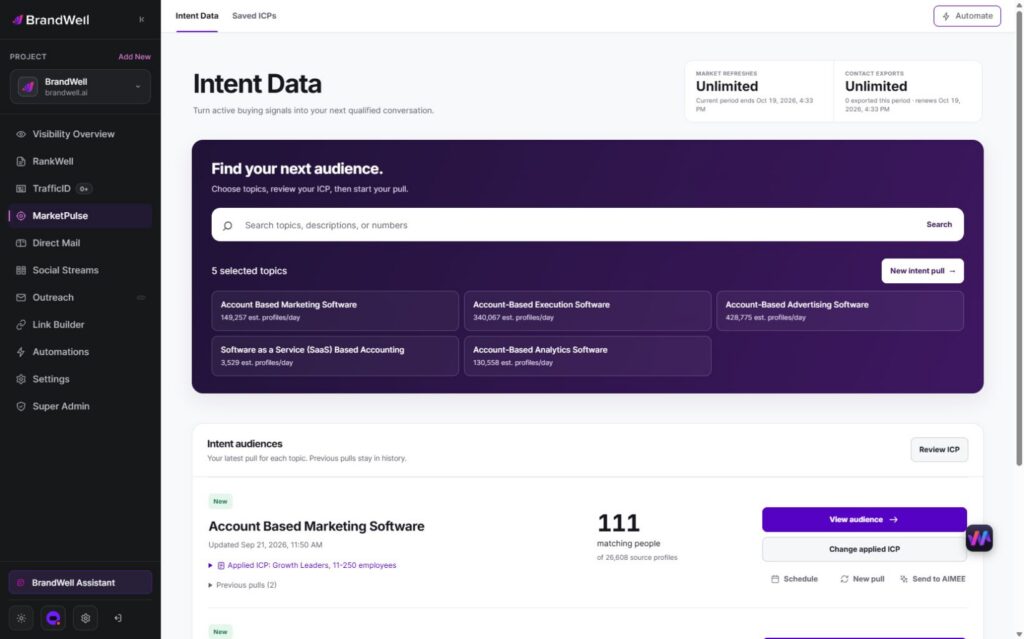
Current MarketPulse research workflow
BrandWell MarketPulse: intent data starting at $500/mo. Find people researching topics relevant to what you sell, apply saved ICP filters, and review available contact details before taking action.
MarketPulse plans are starting at $500/mo. Verify current package scope and offers on the product page.
| Plan | Topics and refreshes | Monthly exports |
|---|---|---|
| Starter | 1 topic, weekly | 25,000 contacts |
| Growth | 3 topics, daily | 100,000 contacts |
| Scale | 10 topics, daily | Unlimited contacts |
Swipe the table to see all columns.
A pull retrieves available data from the previous 24 hours for one topic. Daily use across all included topics provides 90 Growth pulls or 300 Scale pulls in a 30-day month. Weekly Starter pulls vary by calendar month. Available audience size and contact fields vary, and audiences may overlap. Refreshes stop at the plan limit without overage charges.
- Find and qualify: search the topic catalog, save your ICP, and review the people and companies that match.
- Act on the research: export qualified contacts or prepare an Outreach or Direct Mail workflow. Connected products, channel usage, and fulfillment may cost extra.
- Get help from AIMEE: Growth and Scale include AIMEE for the initial user to research accounts and prepare the next step through connected tools.
Agencies and other service businesses can build client deliverables around their available Intent Scans and exports. Keep each client’s scope, permissions, and service fees clear. A subscription is not a promise of a white-label platform or exclusive access to a market.
Explore MarketPulse and watch the demo or compare plans starting at $500/mo. Any early-access discount is a separate, time-limited offer shown to an eligible recipient.
Choose one authorized visitor workflow
Begin by writing a one-sentence service promise the agency can control: “We help a defined B2B client review eligible website activity, identify companies or people at stated confidence levels where supported, qualify the records, and route approved actions.” That promise makes the identity boundary and human review visible. It avoids promising leads, meetings, pipeline, or revenue.
Select a niche where company-level web activity can be useful, account value supports review, and a client has a clear sales or account-management action. Then use buyer-intent discovery questions to qualify the client’s traffic, market, sales ownership, notice and consent posture, allowed data use, destination, suppression, and definition of an accepted record.
Test the full service on your own site or an authorized client property before scaling. Confirm who can approve the installation, how notice and consent work in applicable jurisdictions, which identity outputs are possible, how confidence is represented, where records go, how a visitor can be suppressed or corrected, and how the client returns outcomes. If you cannot explain those steps on one page, the offer is not ready.
Sequence installation and client acceptance
The sequence matters more than a fixed launch timeline. A simple authorized company-identification report can require less integration than a person-level workflow routed into a CRM. Do not publish a universal “launch in days” promise. Set milestones around evidence: approved purpose, installed and tested collection, calibrated identity states, accepted sample, trained client owner, and a signed recurring scope.
Eight-step consent-aware agency launch sequence
- Define: state the service outcome and whether company, person, or both identity types are in scope.
- Choose: score a niche for account value, actionability, review ownership, and manageable risk.
- Authorize: document installation rights, notice, consent where required, source rights, suppression, retention, and jurisdiction review.
- Instrument: select capability classes, install only on an approved property, and write the test plan.
- Calibrate: sample matches, false matches, unknowns, confidence, freshness, and correction handling.
- Qualify: map eligible records to the client’s ICP and require a human activation decision.
- Pilot: run a bounded paid service and measure delivery integrity, acceptance, use, and exceptions.
- Package: set recurring scope and price from actual cost to serve, then revise with evidence.
At minimum, assign an agency owner, technical implementer, data or privacy reviewer, QA owner, sales owner, and client approver. One person can fill several roles, but a technical implementer should not silently decide lawful use, and an automated rule should not contact someone without an approved business process.
Evaluate the supported visitor stack
Choose tools by capability and evidence, not by a best-platform claim. The stack may need a tag or pixel, notice and consent controls, company identification, optional person identity, enrichment, email or phone validation, CRM routing, suppression, reporting, security logs, and deletion or correction handling. Some products combine capabilities. The agency still needs to know which system owns each state.
- Collection: installation documentation, domain authorization, event scope, debugging, and disable controls.
- Identity: explicit company versus person outputs, confidence, geography, source method, and unknown state.
- Validation: separate contact validity from identity and buying intent.
- Activation: field mapping, deduplication, suppression, owner approval, receipts, retry, and rollback.
- Governance: roles, exports, retention, deletion, incident response, and client-specific configuration.
- Commercial fit: written price or quote status, usage basis, entitlements, support, change rights, and exit path.
Run an acceptance test using known internal visits, intentionally ambiguous companies, shared networks, repeat visits, stale contacts, duplicates, and suppressed records. Verify current capabilities and prices on first-party product pages or contracts. The right stack depends on identity scope, jurisdiction, client process and written terms.
Choose an agency or consulting model
Remain a freelancer when clients buy your individual expertise and each project is different. Operate as a consultant when the main value is diagnosis, strategy, and implementation advice. Build a productized agency when the same controlled workflow can serve a defined niche on a recurring cadence. Remain a generalist when visitor identification would distract from stronger services or create risk you cannot support.
| Model | Choose it when | Responsibility you accept |
|---|---|---|
| Freelancer | Work is custom and founder-led | Personal delivery capacity and project continuity |
| Consultant | Clients need design, audit, or implementation help | Clear advice boundaries and handoff |
| Productized agency | A repeatable niche and recurring workflow exist | Ongoing QA, privacy, support, and service evidence |
| Generalist status quo | Another offer has stronger fit and lower risk | A focused reason not to add complexity |
Swipe the table to see all columns.
A staged path is often best: consult on one authorized implementation, turn repeated work into a checklist, run a managed pilot, and productize only when exceptions and costs are understood. Review broader intent-data service models for agencies before choosing to build, resell, refer, or advise. Starting an agency is not automatically better than remaining a specialist.
Model startup and recurring costs
Startup cost comes from software and usage, implementation labor, privacy and legal review, security, insurance where applicable, sales, reporting, support, and a reserve for corrections. One-time cost should include service design, contract review, test-site setup, data mapping, acceptance testing, and client collateral. Recurring cost includes platform commitment, usage, analyst review, validation, support, account management, and rework.
Launch economics worksheet
List each cost with amount or quote-required status, billing unit, minimum, owner, and low, expected, and high scenarios. Estimate monthly delivery capacity in reviewed client cohorts, not raw visitors. For a proportional cost model: required revenue = (owner compensation + fixed operating overhead + reinvestment target) / contribution-margin fraction. Direct delivery cost is represented in that fraction; do not add it again. For known fixed delivery costs, instead add each defined cost and target once without this division. Treat every input as an agency assumption.
No universal startup budget or revenue target is defensible. A report-only company-identification service and a person-level integrated activation service carry different costs and risks. Build the client’s service price with the more detailed website visitor identification pricing framework. Do not claim the pilot or service will recover cost, produce a target margin, or deliver a certain volume.
Measure service quality before outcomes
Use four layers. Installation integrity covers authorized domains, tag health, duplicate firing, event scope, and consent state where applicable. Identity quality covers anonymous, company, person, validated contact, unknown, duplicate, stale, and corrected states. Service quality covers accepted records, delivery receipts, SLA, exceptions, client use, and suppression. Commercial health covers revenue, direct cost, contribution, renewal, and support load.
Define every denominator. A company-match review should report accepted sampled company matches divided by sampled company matches reviewed. It should not report accepted companies divided by all visits unless that is exactly what the metric claims. Person-level and company-level rates should never be combined. Record geography, traffic composition, repeat visits, filters, and date range before comparing cohorts.
Outcome feedback can include action taken, response, opportunity association, and later revenue state. These are useful operating fields, but they do not prove causation. The client controls its offer, targeting, message, timing, and sales execution. Set a stop rule when identity errors, complaints, suppression failures, or exception load exceed the written client threshold.
Choose a niche with review capacity
Look for a B2B niche where company-level activity helps prioritize a finite account market, account value supports human review, the client has sufficient relevant website activity, and a named sales owner can act. Favor a repeatable offer and recognizable business topics over a broad “any company” market.
Niche scorecard
Score each candidate niche from low to high on account value, identifiable company usefulness, relevant traffic, signal interpretability, action owner, sales-cycle fit, review capacity, data sensitivity, jurisdiction complexity, and likelihood of a recurring reporting need. Add a written disqualifier for every dimension. The score helps compare your options; it is not a market benchmark.
A poor-fit client has mostly consumer or student traffic, cannot distinguish company from person identity, lacks a follow-up owner, wants anonymous visitors turned into unsolicited outreach, refuses notice or suppression controls, or expects every identified record to be a buyer. In that situation, offer analytics, conversion research, or a company-level market report instead of person-level activation.
Interview three to five potential clients before choosing the niche, but treat the conversations as qualitative evidence rather than market size. Ask what happens today when a target company visits, which records sales would reject, who owns follow-up, what proof procurement will require, and which data uses are off limits. A niche is attractive only when the operational answers support the service.
Keep visits and identity states separate
Use a visible state chain: anonymous session, observed event, possible company, company confidence, possible person, person confidence, contact validation, qualification, approved action, delivery receipt, and outcome feedback. Do not collapse the chain into “lead.” Each transition needs a source, timestamp, rule, allowed use, and correction path.
Preserve what the evidence actually establishes: an observed visit, a company association, a supported person identity, an added stakeholder or a contact field. These are different claims. Do not borrow an identity assurance level or infer that an added company contact was the visitor.
TrafficID supports identifiable own-site visitors, separately captured form identities and clearly marked added stakeholders. Verify current installation, fields, usage, access and permitted-use terms before committing to client delivery. A subscription does not establish custom white-label entitlements or universal identification.
Agent-ready visitor-record qualification packet
In Claude, ChatGPT, or AIMEE, review only the supplied authorized visitor record.
Inputs: site and client authorization, notice and consent state, observed event, company and person match fields, confidence labels, ICP rule, permitted use, and suppression rules.
Return: observed signal, identity state, confidence, missing evidence, ICP fit, permitted next action, and required human approval.
Do not upgrade a company match to a person, infer buyer status, send outreach, or write to a client system.
Stop if authorization or permitted use is unresolved, identity type is ambiguous, the record is suppressed, or the action would contact a person without approved grounds.
AIMEE can help organize a reviewed visitor record and prepare account research through configured connected tools. Preserve the original visitor, additional stakeholders, suppression and the human approval boundary.
Control installation and data-use risks
Avoid universal identification claims, hidden installation, unclear company-versus-person states, unverified sources, weak access controls, shared client exports, indefinite retention, ignored suppression, scraped sensitive data, and automatic outreach. Do not assume a B2B label removes privacy, consumer-protection, communications, or contractual obligations. Requirements vary by data, channel, location, parties, and purpose.
Document the approved purpose, source and destination rights, notice and consent analysis, minimum fields, retention, suppression, correction and incident owners. Qualified reviewers must assess the specific jurisdictions and facts. This operating checklist does not determine legal compliance.
Contract terms matter too. Document which party is controller, processor, service provider, or another role only after qualified review; who answers access or deletion requests; which subprocessors are approved; what happens at termination; and who can authorize a new destination. A technically possible export may still fall outside the agreed purpose.
Before activation, require documented authorization, notice and consent analysis, source rights, purpose, data minimization, access, security, suppression, correction, retention, deletion, incident response, and client expectations. Stop when the site owner is not authorized, notice is incomplete, the data source cannot be explained, identity confidence is missing, or the proposed channel is not approved.
Maintain the recurring visitor service
Sell a managed identification and activation service rather than a data dump. The recurring package can include authorized onboarding, identity-state reporting, account qualification, contact validation where supported, a human-approved action queue, weekly delivery, monthly evidence review, corrections, suppression, support, and a defined change process. The agency delivers under its brand, bills the client, and chooses retail pricing.
Use TrafficID for supported own-site visitor identification. MarketPulse is a separate topic research product starting at $500/mo, and its audiences do not prove that a person visited the client website. Agency setup, review, reporting and custom integrations need their own scoped delivery and fees.
MarketPulse plans are starting at $500/mo. Starter includes 1 topic, weekly refreshes, and 25,000 exportable contacts per month. Growth includes 3 topics, daily refreshes, and 100,000 exportable contacts. Scale includes 10 topics, daily refreshes, and unlimited contact exports. AIMEE for the initial user is included with Growth and Scale. Compare MarketPulse plans and current offers.
Launch with one authorized, reversible workflow
Choose a narrow niche and one client action. Test every identity state, correction, suppression, and stop condition on a small sample. Productize only after the client accepts the evidence and the agency can explain the limits.
Worked example: set a revenue target without double-counting costs
Suppose a fictional agency wants $4,000 in owner compensation, has $2,000 in fixed operating overhead and plans $1,000 of reinvestment each month. If measured direct delivery cost is 40% of revenue, the remaining contribution fraction is 60%. Required collected revenue is ($4,000 + $2,000 + $1,000) / 0.60 = $11,666.67 before tax and financing. Delivery cost at that level is $4,666.67, leaving the $7,000 for the stated fixed costs and targets.
At a $1,500 client fee, that proportional model requires eight whole clients, or $12,000 collected revenue. Modeled delivery cost is $4,800 and contribution is $7,200. The $200 headroom is small. If delivery cost rises to 50%, required revenue becomes $14,000, or ten whole clients at that fee. Confirm whether review capacity can support them; a revenue target is not a sales or profitability forecast.
For capacity, suppose 40 monthly delivery hours include an eight-hour exception reserve, leaving 32 routine hours. Eight clients requiring four hours each consume all routine capacity. A ninth consumes four hours of reserve; ten consume the full reserve. Do not promise the higher client target without revising workload, price or staffing. All inputs are invented and exclude startup recovery, acquisition, tax, financing and other unstated expenses.
Run the first visitor review in TrafficID
Authorize the client site and establish the supported Company Project tracking setup. Check its reported connection state and an approved test visit. Review the identified visitor’s available context separately from submitted forms and added stakeholders. Apply people and company suppressions, review fit, and prepare a permitted next step through Outreach or configured AIMEE tools. Preserve the actual observed visitor rather than presenting all added decision makers as site visitors.
Frequently asked questions
Does TrafficID identify every visitor?
No. Plan around the supported identifiable portion of site activity and preserve unknowns.
Are added stakeholders the people who visited?
Do not assume that. They are marked separately from observed visitors.
Can MarketPulse replace the site tracking setup?
No. Topic research audiences and own-site visitor events have different origins.
Is eight clients a guaranteed launch target?
No. It is the whole-client result of one fictional cost model, subject to sales and capacity constraints.
Review the actual visitor workflow: explore TrafficID and its current plans.
Reviewed and updated October 3, 2026.

Written by