Intent audience as a service is a recurring agency offer that defines a client’s eligible market, detects and qualifies relevant buying signals, refreshes activation audiences or account queues, and reports what happened. The agency is not merely reselling records. It operates the rules, identity checks, destinations, approvals, measurement, and client experience that make an audience usable.
Who this is for: Agency owners, demand generation firms, paid-media teams, GTM consultants, RevOps service providers, and data resellers creating a recurring buyer-intent offer.
BrandWell update, September 2026: MarketPulse intent data starts at $250/month within BrandWell’s complete growth automation software. AIMEE, the agent-powered desktop app, helps connect buyer signals with research, content, and campaign work. Access to the broader tools depends on your package.
The short answer: sell a governed audience operating cycle
Package the service around a repeatable cycle:
- define the client’s ideal customer profile, exclusions, topics, territories, and allowed uses;
- receive first-party or third-party intent inputs on an agreed cadence;
- resolve each event to the appropriate entity level and enrich only what the workflow requires;
- apply fit, recency, confidence, duplication, suppression, and validation rules;
- deliver approved account audiences, contact research queues, branded topic reports, or downstream actions;
- capture delivery, match, activation, disposition, and outcome evidence; and
- refresh, remove, tune, and report under a clear service level.
This structure protects margin because the agency can bound volume, destinations, refresh cadence, manual review, content work, media operations, meetings, and change requests. It protects trust because the client sees why an account qualified, what the signal can and cannot establish, and how records are removed.
A manual or non-intent audience is still the baseline. Firmographic targeting, CRM lists, past engagement, form fills, and human account research can be sufficient for a small market or a stable campaign. Intent audience as a service becomes attractive when timing changes, research happens outside the client’s properties, first-party volume is incomplete, audience freshness matters, and the client lacks the operating team to connect data with action.
Define the deliverable before choosing the data source
Choose one primary decision per package. Common deliverables include:
- Weekly priority delivery: eligible companies showing fresh topic or website activity, with reason codes and removals.
- Paid-media audience service: platform-ready account or contact audiences, exclusions, refresh and suppression, match reporting, and creative recommendations.
- Sales research queue: high-fit accounts with validated context and a human-approved next-step brief.
- Branded intent report: a client-facing view of topic activity, qualified companies, key evidence, limitations, actions, and outcomes.
- Client portfolio monitor: separate rules and reporting for multiple agency clients, with tenant-level permissions and no data leakage.
Do not promise a “list of buyers.” Account-level topic research is not proof that a named person researched, has budget, or intends to purchase. The service should describe qualified signal candidates or priority accounts based on disclosed rules. A person-level record requires its own identity, validation, permission, and use assessment.
Write an acceptance definition. An accepted audience member might need to satisfy target-market fit, a relevant signal within the freshness window, a minimum confidence level, no customer or suppression conflict, successful destination matching, and an explainable reason. Records that fail should be counted and categorized, not silently discarded.
Create packages with entitlements and approval limits
A service can have three operational levels without fixing the agency to arbitrary retail prices:
Report package: configured topics, market filters, branded report, agreed refresh, insights call, and recommendations. The client executes actions. This is the simplest delivery model and a useful pilot.
Audience package: report deliverables plus qualified audience files or destination sync, suppression, refresh/removal rules, match QA, and activation reporting. The agency operates the data flow; the client approves channels and creative.
Managed activation package: audience service plus research briefs, ad or CRM workflows, approved content modules, human review, outcome reconciliation, and optimization. This can create more value but adds labor, platform dependencies, media, privacy obligations, and client approval risk.
For each package, specify included topics, accounts or records, client workspaces, destinations, refreshes, retention, reports, meetings, support, manual reviews, and change requests. State overage units and stop rules. Keep paid media, creative production, outreach tooling, and client-specific integration separate unless intentionally bundled.
Approval limits should be explicit. The agency may automatically refresh an approved low-risk audience while requiring client review for new topics, new sensitive segments, person-level outreach, public claims, material budget changes, or production-system actions.
Use a seven-day pilot to prove the operating model
A useful pilot is not a compressed promise of revenue. It proves whether the service can produce a credible audience and client-facing artifact.
Pilot input: one defined offer, target market, exclusion list, a small set of topics, destination preference, and agreed success criteria.
Pilot output: a branded topic report; eligible and rejected account counts; sample reason codes; freshness, identity, and validation fields; recommended audience rules; a proposed activation workflow; and an evidence gap list.
Pilot acceptance: the client can understand why records qualified, the agency can operate within expected labor, the destination or report works, and no mandatory rights or governance requirement is unresolved.
BrandWell offers a scoped MarketPulse evaluation for agencies to generate branded topic reports. The pilot should be used to validate fit and design the service, not to promise pipeline inside the pilot window. Expansion requires a signed scope, current product confirmation, client permissions, measurement plan, and economic model.
Five intent-data options for an audience-as-a-service offer
Disclosure: This is a Brandwell-owned resource. Brandwell is the publisher’s product; all options are evaluated using the same disclosed criteria.
BrandWell publishes this guide and appears first in the shortlist because this is a BrandWell-owned resource; that placement is not an independent ranking or a universal best-fit claim.
BrandWell is complete growth automation software that connects MarketPulse intent data, TrafficID website visitor identification, content, outreach, and campaign workflows. AIMEE, its agent-powered desktop app, helps turn those signals into research, prepared assets, and approved actions. Compare this connected workflow with the specific data, automation, and enterprise features each alternative provides.
1. BrandWell: MarketPulse intent data and connected growth automation
Best fit: growth teams and agencies that want intent data connected to day-to-day execution. BrandWell is complete growth automation software that connects MarketPulse intent data, TrafficID website visitor identification, content, outreach, and campaign workflows. AIMEE, its agent-powered desktop app, helps turn those signals into research, prepared assets, and approved actions.
For a cost comparison, separate the price of intent data from the work and channels used to activate it. Starting with MarketPulse lets a team assess its audience before scoping a broader growth program.
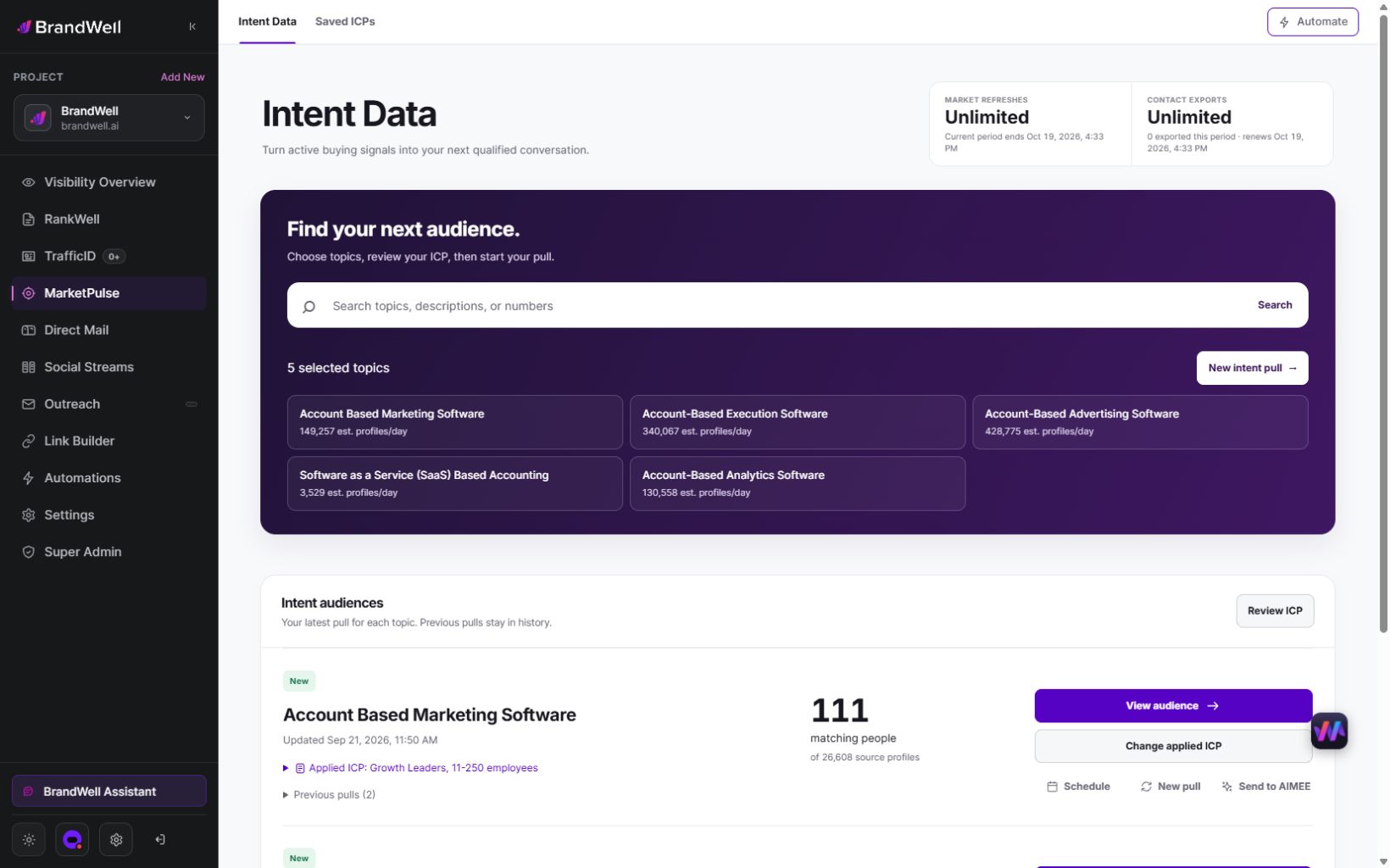
How the software connects the work:
- Find and qualify demand: MarketPulse brings topic-based intent into a reviewable audience with saved ICPs and scheduled pulls. TrafficID adds website visitor identification to the growth workflow.
- Prepare the next campaign: Outreach and Direct Mail provide execution workspaces; Social Streams adds relevant social activity. Use the tools and destinations configured for your project.
- Build demand as well as capture it: RankWell, Visibility Overview, and Link Builder connect content and visibility work with the same growth operation.
AIMEE helps carry the work forward
AIMEE is BrandWell’s agent-powered desktop app. It helps research accounts, prepare content and messages, and carry out assigned work through connected tools. BrandWell’s Automations workspace connects product events to workflow steps, with owners, approvals, and run history. You choose the connections, allowed actions, and budgets.
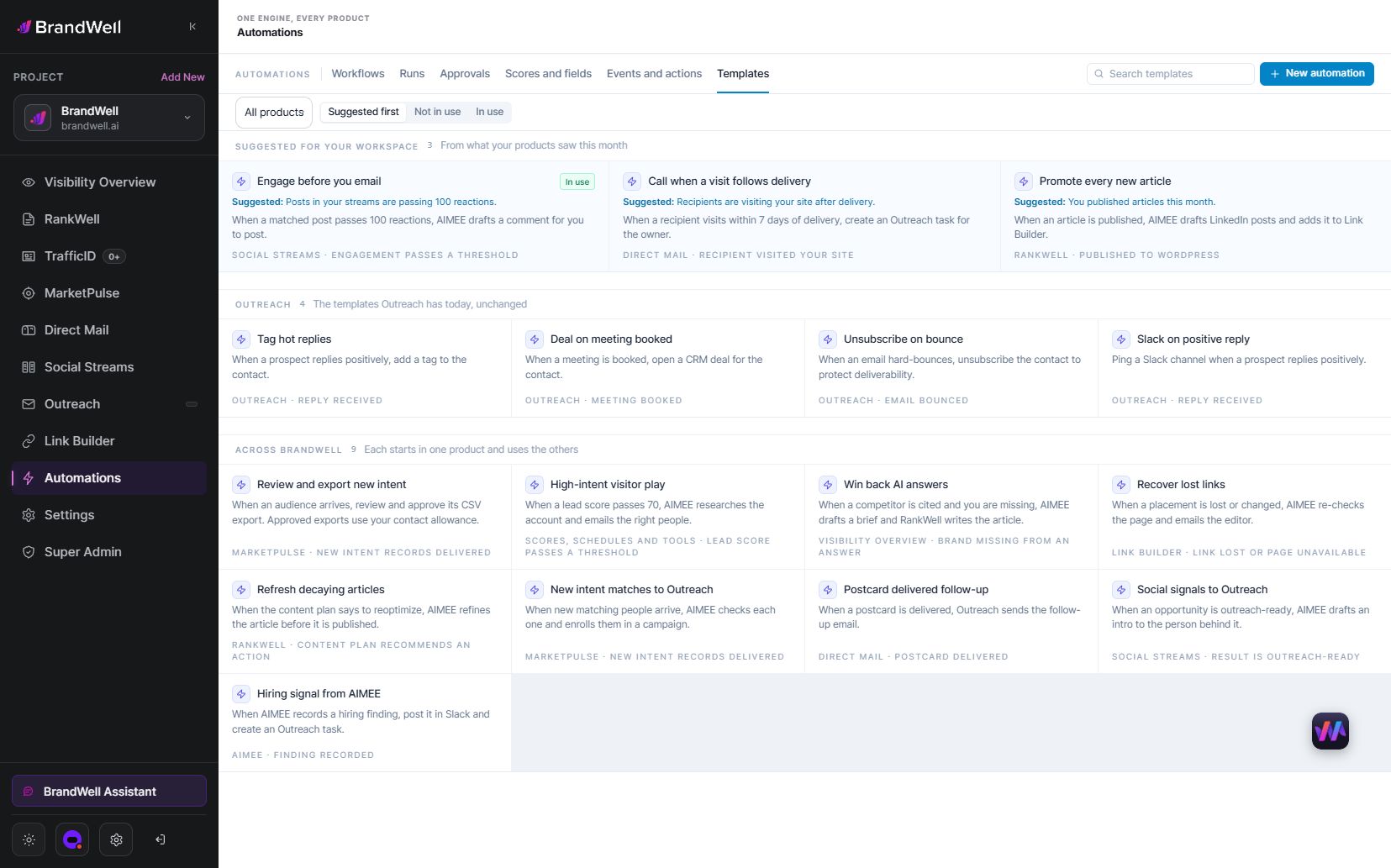
BrandWell MarketPulse intent-data plans start at $250/month. Your selected package determines topic coverage, contact allowances, refresh cadence, AIMEE access, and other growth tools. Channel usage, media, and fulfillment costs depend on the campaign.
What to evaluate: topic relevance, usable audience coverage, ICP fit, and the time it takes to turn an accepted signal into completed work. An intent signal helps prioritize an opportunity; it does not guarantee a purchase or establish permission for every channel. If your main requirement is a specialist data feed or an established enterprise ABM program, compare that specific scope with the alternatives below.
2. 6sense – best as a direct enterprise intelligence and activation option
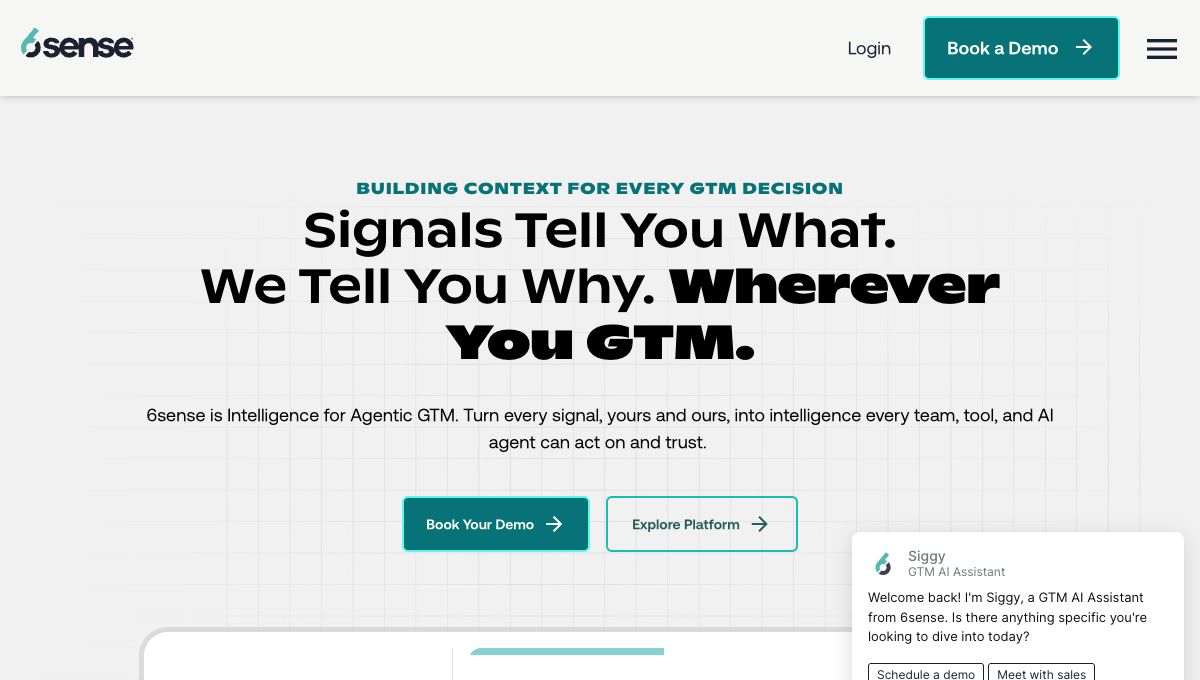
- Best fit: Mature enterprise clients that want predictive account prioritization, fit, intent, advertising, sales intelligence, and coordinated internal activation.
- Operating model: A direct enterprise platform commonly operated by the client’s marketing, sales, and RevOps teams. Agencies must confirm client workspaces, managed-service rights, data sharing, and exports.
- Signal and workflow evidence: Official documentation describes predictive intent, fit, contact fit, engagement, and buying-stage scoring. Test the client’s eligible market, topics, reason fields, accepted-signal rate, and audience destination.
- Activation and implementation: Price CRM and marketing automation readiness, model configuration, advertising or sales workflows, administration, training, content, approvals, and reporting. An agency wrapper may still be needed.
- Pricing evidence: The official sources reviewed did not establish a comparable public numeric price. Request a written quote for modules, accounts, users, data, credits, services, media dependencies, term, renewal, and agency/client permissions.
- Governance and measurement: Require identity boundaries, model definitions, refresh, audience rights, suppression, access, export, adoption, client reporting rules, and incremental evaluation.
- Meaningful limitation: A direct enterprise suite is not established here as a turnkey multi-client white-label service; the agency may need separate packaging, portal, billing, and tenant operations.
3. Demandbase – best as a direct account-based orchestration option
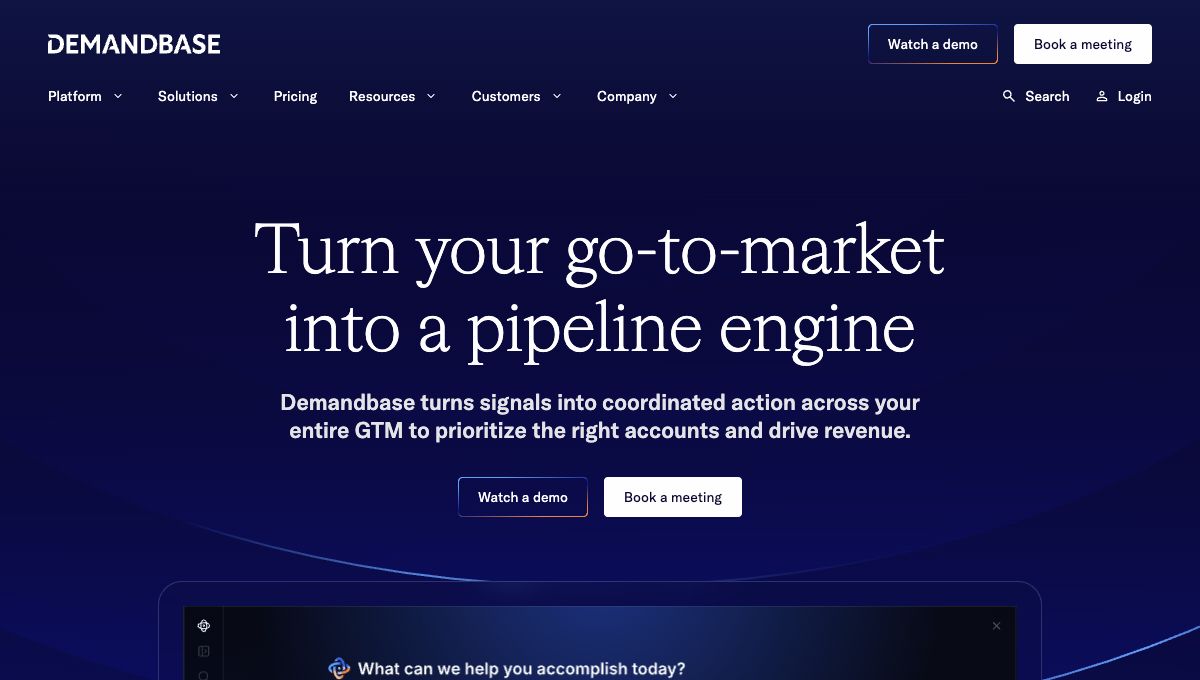
- Best fit: Enterprise B2B clients coordinating account intelligence, intent, advertising, website experiences, sales activity, and measurement.
- Operating model: A direct GTM platform. Agencies need explicit rights and architecture for each client site, workspace, audience, data export, report, and managed-service role.
- Signal and workflow evidence: Official materials describe intent, account identification, predictive analytics, journey context, advertising, and website personalization. Validate each component on the client’s sample rather than treating the suite as one audience.
- Activation and implementation: Test audience creation and removal, destination matching, website or advertising treatments, CRM mapping, media dependencies, failures, administrator time, and outcome return.
- Pricing evidence: The official sources reviewed did not establish a comparable public numeric price. Normalize platform, data, users, accounts, sites, media, services, implementation, support, term, and renewal in the quote.
- Governance and measurement: Review identity basis, audience and website permissions, client access, retention, deletion, exports, buying-group definitions, treatment logs, and comparison cohorts.
- Meaningful limitation: Modular enterprise scope can be powerful for one client but may not provide the agency’s complete cross-client white-label portal, billing, and retail service engine.
4. Bombora – best as a specialized topic-intent and audience input
- Best fit: Agencies and clients with existing activation and reporting infrastructure that want account-level topic intent or B2B audience inputs.
- Operating model: Company Surge and Audience Solutions can feed other platforms. Official Bombora agency resources support agency use, but the reviewed evidence does not establish a complete agency-branded client portal and billing engine.
- Signal and workflow evidence: Test topic relevance, eligible-market coverage, comparison window, surge method, delivery cadence, thresholds, duplicate or false-positive patterns, and the difference between account research and named-person evidence.
- Activation and implementation: Include topic design, data delivery, identity or enrichment, destination mapping, audience match, refresh/removal, reporting, optimization, and client explanation.
- Pricing evidence: The official sources reviewed did not establish a general comparable numeric price. Request a quote covering topics, volume, delivery, integrations, API, services, usage, term, end-client rights, and renewal.
- Governance and measurement: Confirm source representation, data licensing, derived data, client delivery, retention, suppression, export, audience use, and evidence required for claims.
- Meaningful limitation: Account-level intent does not identify a particular individual and requires surrounding identity, activation, client reporting, and commercial infrastructure.
5. ZoomInfo – best as a broad revenue-data and activation input
- Best fit: Revenue organizations that want company/contact intelligence, enrichment, Buyer Intent, website visitor identification, workflows, predictive modeling, and advertising audiences.
- Operating model: A direct-user platform. Agencies should require explicit end-client, workspace, export, sharing, derivative-use, and redistribution permissions.
- Signal and workflow evidence: Official marketing materials describe Buyer Intent, WebSights, Workflows, advanced audience targeting, predictive modeling, and audience refresh. Validate accuracy, identity level, freshness, accepted records, credit use, and destinations.
- Activation and implementation: Cost CRM administration, field mapping, suppression, credit governance, seats, workflows, audience sync, sales enablement, reporting, and the separate client experience.
- Pricing evidence: The official sources reviewed did not establish a comparable public numeric price. Obtain a scope-matched quote for products, functionality, seats, records or credits, add-ons, integrations, support, billing, term, and client rights.
- Governance and measurement: Confirm permissible use, geography, storage, deletion, suppression, exports, client delivery, match denominators, actions, opt-outs, and outcome evaluation.
- Meaningful limitation: Broad data coverage and workflows do not by themselves create a white-label recurring service; packaging, portal, billing, client reporting, and service operations may remain agency responsibilities.
Price the service for gross margin, not just markup
Build a unit-economics model before setting retail price:
Contribution margin = client revenue − data and platform cost − delivery labor − variable activation cost − allocated support and compliance cost.
Model cost drivers separately: wholesale platform scope, topics, accounts or records, clients, workspaces, credits, API and destination usage, identity and validation, enrichment, paid media, creative, outreach tools, analyst and strategist time, manual review, client meetings, reporting, privacy and security work, and expected exceptions.
Do not assume that Bombora, 6sense, Demandbase, ZoomInfo, or another competitor has a standard public price or uniform one-year contract. The reviewed official sources did not establish comparable numeric rates for those options. Request matched proposals and state unknowns. A direct enterprise license, a data input, and a complete agency reseller engine are scope-different purchases.
BrandWell MarketPulse intent-data plans start at $250/month. Your selected package determines topic coverage, contact allowances, refresh cadence, AIMEE access, and other growth tools. Channel usage, media, and fulfillment costs depend on the campaign. Compare total cost for the same audience, tools, implementation, and campaign scope; starting prices alone do not establish the lowest-cost provider.
Protect margin with minimum terms where justified by setup effort, prepaid or committed capacity where appropriate, explicit overages, change control, approval deadlines, and a separate pass-through policy for media or third-party tools. Do not sell “unlimited” manual research, destinations, revisions, or client calls unless delivery capacity truly supports it.
Use calculators and operating templates that preserve denominators
The service does not require a complex software model at first. A controlled workbook or database can include:
- a client entitlement and change-request register;
- topic, target-market, exclusion, and approval definitions;
- signal ledger with source, entity, timestamp, confidence, freshness, and reason codes;
- acceptance/rejection log with duplicate, no-fit, stale, identity, and permission reasons;
- destination ledger with delivered, matched, activated, removed, failed, and retried counts;
- labor and exception tracker by client and workflow;
- outcome ledger for responses, accepted meetings, opportunities, stages, pipeline, and revenue;
- invoice, usage, contribution-margin, renewal, and capacity forecast; and
- privacy, security, data-use, retention, deletion, and incident checklist.
Keep client data segregated. Version the rules. Reconcile vendor delivery, agency acceptance, destination match, client action, and outcome as different stages. A delivered record is not automatically an accepted audience member, and a matched account is not automatically activated.
Measure revenue quality and profitability together
Operational measures include eligible-market coverage, signal freshness, accepted-signal rate, rejection reasons, identity confidence, destination match rate, activation latency, removal SLA, delivery failures, manual-review minutes, and client adoption.
Commercial measures include revenue per client, gross and contribution margin, delivery cost, support burden, overages, expansion, churn risk, capacity utilization, and time to recover setup effort.
Revenue-quality measures include positive response, accepted meeting, opportunity creation, stage progression, pipeline, won revenue, sales rejection, unsubscribe, complaint, and client trust feedback. Segment results by client, topic, source, channel, fit, confidence, and audience vintage.
Use a randomized holdout or phased comparison where feasible. Otherwise use a matched baseline and describe limitations. Do not present audience members as net-new demand if they were already active opportunities, known website visitors, or existing campaign targets. “Influenced pipeline” is descriptive unless the evaluation establishes incremental impact.
Renew the service when it continues to improve a recurring decision and maintains target margin. Redesign or reduce scope when one topic, channel, destination, or high-touch process consumes disproportionate labor. Stop when the client cannot act, rights are unresolved, audience quality remains below acceptance, or evidence does not justify cost.
Manage margin, data-use, billing, and client-trust risks
The most common margin failures are underpricing setup, hiding manual cleanup, promising excessive refresh speed, absorbing client-specific integrations, bundling media or creative without limits, and failing to price exception handling. Track minutes and variable costs from the pilot onward.
The most serious trust failures are calling accounts “buyers,” implying person-level behavior from account signals, mixing client data, using stale or disallowed records, ignoring suppression, and making performance claims without evidence. Define source categories, entity level, purpose, client rights, retention, deletion, access, regional rules, sensitive-data exclusions, security, subprocessors, incident handling, and exit.
The NIST Privacy Framework can support program risk management, and ICO direct marketing guidance may be relevant depending on the channels and jurisdictions involved. Obtain legal advice for each service model. The FTC’s advertising and marketing guidance is useful when substantiating objective client-facing claims.
Contracts should state who owns raw input, qualified outputs, reports, derived data, configurations, and outcome history; who pays the provider and activation platforms; what happens on nonpayment; what the agency may retain; and how export and deletion work at termination.
Agent-ready audience workflow for Claude, ChatGPT, or AIMEE
Provide the agent with the approved client entitlement, eligible market, exclusions, topics, signal schema, identity thresholds, validation rules, destinations, service levels, message boundaries, metrics, and approval matrix. Instruct it to:
- segregate every client and reject records that fail fit, freshness, identity, permission, duplication, or suppression rules;
- create a qualified record with source category, entity level, reason codes, confidence, and expiration;
- prepare only the approved report, audience, research brief, or action recommendation;
- route new topics, person-level outreach, production changes, spend, and external claims to human approval;
- reconcile delivered, accepted, matched, activated, removed, failed, and outcome counts;
- calculate delivery labor, variable cost, and contribution margin without inventing missing values; and
- create client reports that separate observed association from incremental evidence and state limitations.
AIMEE is the agent-powered desktop app in BrandWell’s growth workflow. Assign work through the tools connected to your workspace and choose which actions can run automatically or require approval. Desktop availability, account permissions, and the configured workflow determine what can execute.
The service-design rule
The durable offer is a recurring decision system, not a recurring spreadsheet. Clients should know who is in scope, why an account qualified, what action is allowed, when the audience expires, what evidence came back, and what the agency will change next. That combination creates more defensible recurring revenue than reselling raw signals alone.
Agencies that want to test the model can request a BrandWell agency intent report and scoped MarketPulse evaluation discussion.