Direct answer: Build intent-based outbound as a controlled signal-to-play system, not a trigger that sends messages automatically. Accept only evidence that passes provenance, permitted-use, fit, identity-confidence, freshness, suppression, and channel checks. Then let a person approve a useful account hypothesis, the appropriate contact, and the next-best play. Measure accepted signals through replies, meetings, opportunities, and revenue while preserving the right to stop, suppress, or choose no contact.
Who is this for? B2B sales-development leaders, sales operations teams, outbound strategists, and agencies that want to prioritize relevant accounts without turning inferred buyer behavior into a surveillance script.
BrandWell update, September 2026: MarketPulse intent data starts at $250/month within BrandWell’s complete growth automation software. AIMEE, the agent-powered desktop app, helps connect buyer signals with research, content, and campaign work. Access to the broader tools depends on your package.
BrandWell: MarketPulse intent data and connected growth automation
From audience to action: connect intent data with the work needed to use it. BrandWell is complete growth automation software that connects MarketPulse intent data, TrafficID website visitor identification, content, outreach, and campaign workflows. AIMEE, its agent-powered desktop app, helps turn those signals into research, prepared assets, and approved actions.
For outbound teams, the useful handoff is from a relevant signal to a researched person and a specific next step. MarketPulse combines topic selection with an applied ICP, then offers audience review, export, scheduling, and a handoff to AIMEE.
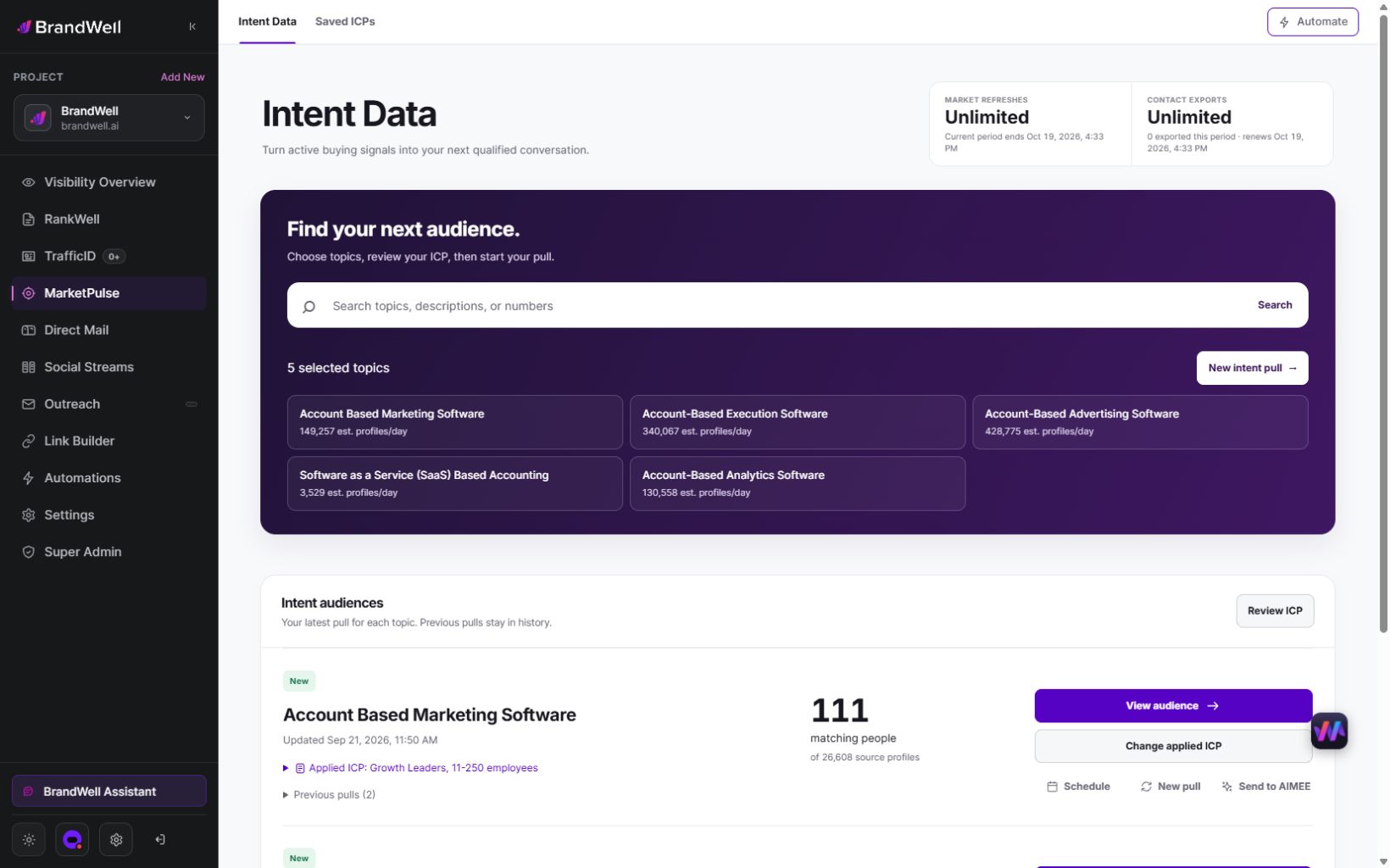
How the software connects the work:
- Find and qualify demand: MarketPulse brings topic-based intent into a reviewable audience with saved ICPs and scheduled pulls. TrafficID adds website visitor identification to the growth workflow.
- Prepare the next campaign: Outreach and Direct Mail provide execution workspaces; Social Streams adds relevant social activity. Use the tools and destinations configured for your project.
- Build demand as well as capture it: RankWell, Visibility Overview, and Link Builder connect content and visibility work with the same growth operation.
AIMEE helps carry the work forward
AIMEE is BrandWell’s agent-powered desktop app. It helps research accounts, prepare content and messages, and carry out assigned work through connected tools. BrandWell’s Automations workspace connects product events to workflow steps, with owners, approvals, and run history. You choose the connections, allowed actions, and budgets.
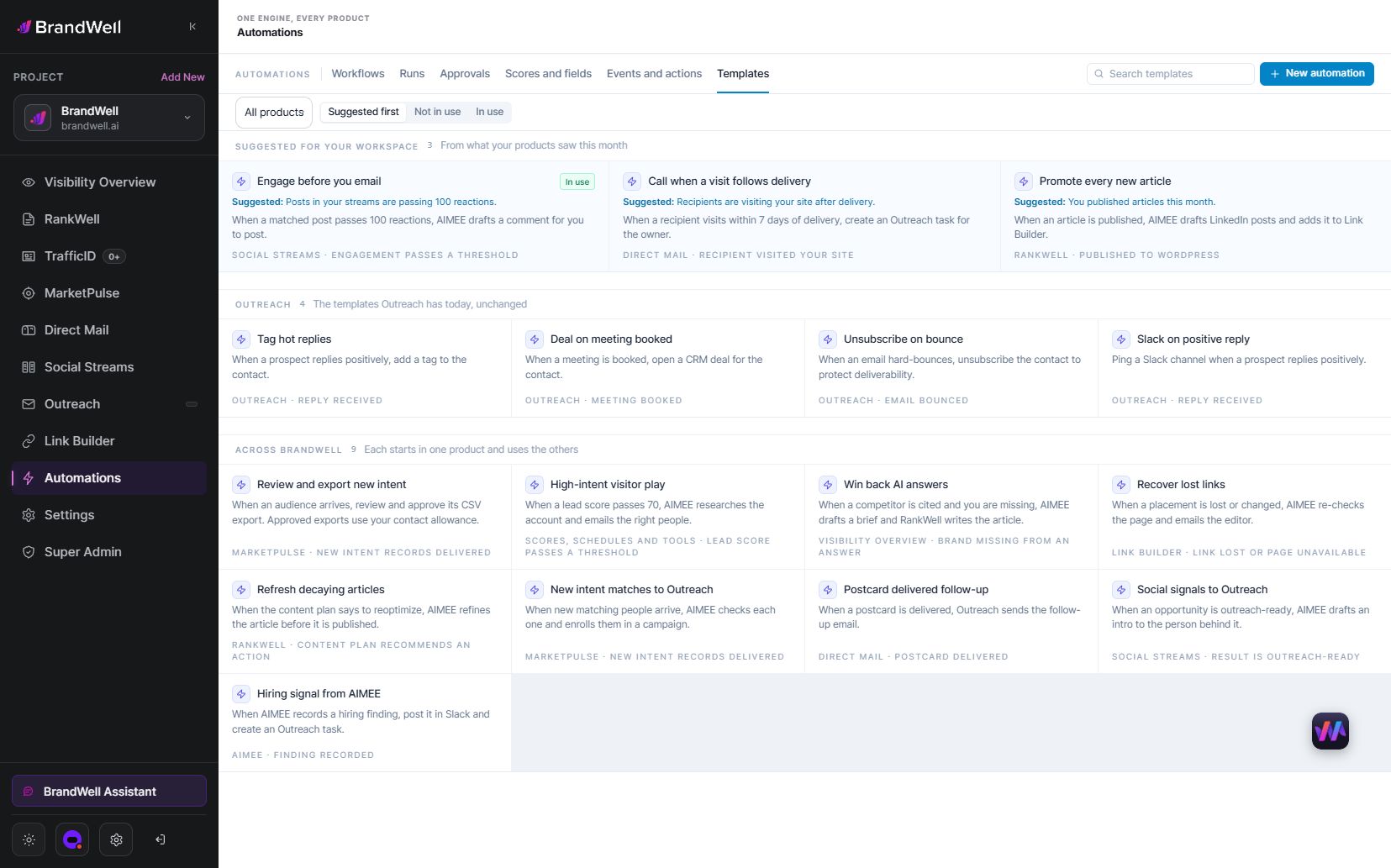
BrandWell MarketPulse intent-data plans start at $250/month. Your selected package determines topic coverage, contact allowances, refresh cadence, AIMEE access, and other growth tools. Channel usage, media, and fulfillment costs depend on the campaign.
What to evaluate: topic relevance, usable audience coverage, ICP fit, and the time it takes to turn an accepted signal into completed work. An intent signal helps prioritize an opportunity; it does not guarantee a purchase or establish permission for every channel. Choose a workflow your team can operate, then evaluate the audience and the completed work against that goal.
Start with an accepted signal and a relevant next-best play
An intent signal is evidence of research or engagement. It may improve prioritization when combined with fit, freshness, identity confidence, and business context, but it does not prove that a person will buy, has budget, or authorized contact. The first decision in an intent based outbound strategy is therefore not “Which sequence should fire?” It is “Should this evidence be accepted, held for review, suppressed, or rejected?”
For an accepted signal, create a restrained account hypothesis: the organization may be evaluating a problem, the available evidence is recent enough to matter, and the account fits a defined offer. Select a next-best play that would still be useful if the hypothesis were wrong. That might be a relevant benchmark, an implementation checklist, an invitation to compare approaches, an account-research task, or no contact until stronger evidence arrives.
Do not put the private signal trail in the message. “We saw you researching this topic on another site” can feel invasive and may expose data use that the recipient did not expect. Translate the evidence into a helpful point of view instead: “Teams at your stage often run into this planning problem; here is a concise way to evaluate it.” Human review remains essential before consequential outreach.
Build the signal-to-sequence workflow, owners, approvals, and suppression
- Define acceptance. Record the signal source, collection context, subject level, observed behavior, event time, confidence, permitted use, retention rule, and alternative explanations.
- Apply fit and account-state gates. Check ICP, territory, existing opportunity, customer status, owner, exclusions, product relevance, and whether another team is already in contact.
- Resolve identity cautiously. Keep anonymous, account-level, matched-person, and known-contact states distinct. A resolved record is a probabilistic match, not certainty that the named person generated the signal.
- Check rights and channel eligibility. Evaluate jurisdiction, collection notice, consent or other permitted basis where applicable, data-sharing terms, do-not-contact records, platform policy, and telemarketing or email requirements.
- Choose the play. Map signal class and account state to a useful hypothesis, asset, channel, cadence, owner, SLA, and stop rule.
- Require approval. A human confirms the account, contact, message, evidence, channel, exclusions, and timing before an email, call, social action, CRM overwrite, or public post.
- Execute with limits. Cap touch frequency, preserve accurate sender details, honor channel rules, and stop on reply, objection, bounce, status change, or suppression.
- Write outcomes back. Record acceptance, rejection, reason, touch, response, meeting, opportunity, revenue, complaint, and opt-out so the system can learn without hiding failures.
Assign one accountable owner for acceptance logic, one for data and integrations, one for deliverability, one for sales play quality, and one for privacy or legal review. The intent based outbound checklist should include an exception queue, an audit log, a suppression sync, a rollback method, and a recurring review of signal quality. Without those controls, automation can scale an error faster than a team can find it.
Seven outbound tools, methods, templates, and operating resources
A useful intent based outbound framework is a coordinated set of operating resources rather than a vendor logo stack. Evaluate each item by evidence quality, permitted use, auditability, operator effort, failure handling, and contribution to a buyer-relevant message.
1. Signal acceptance card
Create a standard record for source, event, subject level, recency, confidence, provenance, permitted use, fit, account state, and accept/hold/reject reason. It makes an otherwise vague “hot lead” inspectable. Limitation: a form cannot establish that the underlying data is accurate or lawfully usable; an owner still needs to validate the source and policy.
2. Account and contact research brief
Summarize the account’s public business context, likely problem, relevant role, existing relationship, and the unanswered questions that a seller must verify. Separate observed facts from inferences. Limitation: research can become stale or reproduce a bad identity match, so the seller must confirm important details before contact.
3. Signal-to-play decision matrix
Map accepted signal classes and account states to next-best actions, offers, channels, owners, SLAs, exclusions, and stop conditions. Include “no outreach” as a valid decision. Limitation: a static matrix can overgeneralize; review exceptions and update the logic from downstream evidence.
4. Helpful-hypothesis message template
Use a short structure: relevant business observation, modest hypothesis, practical resource or question, proof that can be substantiated, and a low-friction next step. Never disclose hidden browsing or sensitive inference. Limitation: templates become generic when operators insert the topic but ignore account context, so require a relevance check.
5. Human approval queue
Present the accepted evidence, identity tier, message, recipient, channel, timing, suppression state, and proposed action to an authorized reviewer. Store the approval and any edit. Limitation: a queue creates delay and false confidence if reviewers rubber-stamp; sample decisions and measure reversal rates.
6. Suppression and frequency-control register
Synchronize unsubscribes, objections, do-not-call choices, bounces, customers, active opportunities, competitors, internal records, and account-level contact limits across every sending system. Limitation: a register fails when one tool cannot receive updates or when multiple identifiers are not reconciled.
7. Outcome and learning report
Follow each signal from acceptance through contact, reply type, meeting quality, opportunity, revenue, opt-out, and complaint. Segment by signal class, freshness, confidence, account fit, play, and channel. Limitation: observational results can reflect seller selection and account differences; use controlled tests where feasible and report uncertainty.
Intent-based outbound vs. fixed sequences and broad static lists
Intent-based outbound prioritizes work with recent evidence and varies the play by account context. It is useful when signals are interpretable, identity and fit can be checked, the market is large enough to support selection, and sellers can act within the evidence window. Its tradeoffs are data cost, governance, uneven signal volume, possible false positives, and a more complex operating model.
Fixed sequences against broad static lists are simpler to staff and forecast. They can be appropriate when a strong ICP and evergreen problem matter more than timing, or when the team lacks defensible signal access. Their weakness is that cadence can outrun relevance, and broad volume can increase deliverability, trust, and opportunity-cost risks.
A hybrid often wins: use a carefully maintained account universe, reserve intent evidence for prioritization and message selection, and keep a low-volume research-led motion for high-value accounts without recent signals. The comparison should be made on total cost per qualified opportunity, opportunity quality, negative responses, seller time, suppression accuracy, and incremental contribution – not send volume alone.
Budget data, enrichment, tooling, labor, deliverability, and QA
Intent based outbound pricing has at least six cost layers: signal acquisition, identity or account matching, enrichment, CRM and engagement tooling, labor, and governance. Add deliverability monitoring, list hygiene, research, copy review, integration maintenance, exception handling, privacy or legal review, and outcome analysis. A cheaper data source can be more expensive if operators spend hours rejecting ambiguous records.
Model cost by accepted signal rather than raw record. For a given period, calculate total direct delivery cost divided by accepted signals, then cost per approved play, positive reply, qualified meeting, accepted opportunity, and won revenue. Show the rejection rate and its reasons. That exposes whether cost comes from low-quality evidence, identity failures, account exclusions, or execution.
Do not use a universal intent based outbound cost benchmark. Volume, market size, data rights, geography, channels, labor rates, sales cycle, and existing systems change the economics. Budget a pilot with a capped audience, explicit owner hours, a control or comparison group, and a stop rule. Scale only when signal availability and qualified outcomes justify the added complexity.
Measure accepted signals, replies, meetings, pipeline, and revenue
Intent based outbound KPIs should begin before sending. Track received, deduplicated, rejected, held, accepted, identity-resolved, fit-qualified, suppressed, and approved signals. Operational metrics include time to review, time to first action, touches per account, bounce rate, opt-outs, objections, complaints, and the percentage of plays changed by a reviewer.
Then measure replies by type, conversations, qualified meetings held, opportunities accepted, stage progression, pipeline, won revenue, contribution margin, and sales-cycle movement. Keep platform or seller attribution separate from causal evidence. Intent based outbound ROI can be expressed as incremental contribution margin minus the full signal and delivery cost, divided by that full cost, but only when the incrementality estimate and time window are credible.
Use a randomized holdout or staggered rollout where volume and operations allow. Preserve the assigned groups, record contamination, and report intervals rather than only point estimates. When a controlled test is infeasible, compare matched cohorts cautiously and disclose selection bias. No reply does not automatically mean the signal was wrong; the offer, contact, channel, timing, deliverability, or message may have failed.
Who benefits from intent outbound – and when it is a bad fit
The best intent based outbound use cases involve considered B2B purchases, a defined account market, enough signal flow, meaningful variation in buyer stage, a CRM with trustworthy outcomes, and sellers capable of research-led follow-up. It can help an SDR leader prioritize limited capacity, an agency add a governed outbound layer, or sales operations test which evidence deserves action.
It is a poor fit when the addressable market is tiny, signal provenance is unclear, identity resolution is too weak, the category is sensitive, outreach rights cannot be established, suppression is fragmented, or the offer cannot support a useful hypothesis. It is also a poor fit for teams that measure success only by activity, cannot respond while a signal is fresh, or expect an automation system to make unsupervised contact.
For a low-volume enterprise motion, direct account research and relationship mapping may outperform a broad signal program. For a high-volume transactional product, contextual advertising or opt-in lifecycle marketing may be simpler. The intent based outbound decision guide should permit these alternatives rather than forcing every buyer into one workflow.
Combine fit, identity, freshness, activation, and outcome feedback
Use a layered intent based outbound planning guide:
- Evidence: what occurred, where it came from, how recently, at what subject level, and with what confidence?
- Fit: does the account match the segment, offer, geography, scale, and current commercial state?
- Identity: is this anonymous, account-level, matched-person, or known-contact evidence, and what rejection rule applies?
- Permission and policy: may this data be used for this purpose, recipient, jurisdiction, and channel?
- Activation: what helpful hypothesis, asset, owner, SLA, cadence, approval, and stop rule follows?
- Outcome: what happened, what cost was incurred, what negative evidence appeared, and what should change?
These intent based outbound activation workflows keep freshness and confidence visible rather than collapsing them into one score. A high-fit account with stale, account-level evidence might receive research but no contact. A known opted-in contact with a recent product action might receive a service message through an approved lifecycle path. The appropriate action depends on the full record, not a single intensity number.
Feedback must update both the play and signal acceptance. If one source produces many rejected matches, downgrade or pause it. If a cohort responds positively but never creates qualified opportunities, revisit the offer and fit definition. Intent based outbound signal quality and measurement are one operating loop.
Protect privacy, deliverability, platform compliance, and buyer trust
Intent evidence does not waive outreach, privacy, consent, suppression, telemarketing, deliverability, or platform requirements. Verify the rules that apply to each jurisdiction, data source, recipient type, and channel. The UK regulator’s lead-generation guidance explains that lead collection and profiling still need fair, lawful, and transparent handling; public availability is not permission for unrestricted use. Its guidance for organizations using data-broker marketing services emphasizes diligence on source, age, collection context, transparency, lawful basis, rights, and suppression.
For United States commercial email, the FTC’s CAN-SPAM guide says the rules apply to B2B messages as well as consumer messages. Use accurate header and subject information, identify the message as required, include a valid postal address, provide a clear opt-out, and suppress requests promptly. A client and its service provider can both carry responsibility; outsourcing sending is not a transfer of accountability.
- Provenance mistake: accepting a record without knowing how it was collected or whether the proposed use is permitted.
- Creepy-message mistake: revealing private research detail instead of presenting a helpful business hypothesis.
- Identity mistake: treating a household, device, domain, or probabilistic match as a known individual.
- Suppression mistake: updating one sender but leaving the person active in another sequence or channel.
- Deliverability mistake: increasing volume from a new signal source without bounce, complaint, reputation, and authentication controls.
- Security mistake: assuming a reseller or tool eliminates oversight. The FTC’s service-provider security guidance recommends putting expectations in contracts, verifying compliance, and monitoring providers.
Package intent-based outbound as a recurring agency service
An agency package can include signal acceptance rules, a limited number of monitored topics or behaviors, account and contact qualification, play design, approval queues, suppression operations, capped execution support, outcome reporting, and a recurring learning review. Define client responsibilities for data authority, privacy notice, channel access, offer claims, account ownership, final outreach approval, sales follow-up, and CRM outcomes.
Scope setup separately from recurring delivery. Setup can cover discovery, source and rights review, CRM field design, routing, suppression synchronization, templates, a baseline, and pilot QA. Recurring service can cover signal review, research briefs, play recommendations, monitoring, exception handling, report production, and optimization. Include volume bands, response SLAs, excluded channels, revision limits, pause conditions, and a clear handoff when a prospect responds.
For agencies, BrandWell connects client-specific MarketPulse audiences with content, outreach, and campaign workflows. AIMEE desktop assistance helps prepare and execute assigned work, while the agency sets the service scope, reviews results, and manages its client relationship. Confirm branding, client capacity, and usage in the selected agency package.
AIMEE is the agent-powered desktop app in BrandWell’s growth workflow. Assign work through the tools connected to your workspace and choose which actions can run automatically or require approval. Desktop availability, account permissions, and the configured workflow determine what can execute.
BrandWell cannot establish lawful use, guarantee identity, create consent, ensure deliverability, replace an outbound strategist, or prove incremental revenue by itself. Renew the service when the operating evidence shows that the governed signal-to-play process improves qualified decisions at an acceptable total cost – not merely because it produces more records or messages.