Short answer: Model intent data API unit economics from the business unit that can support a decision – not from the price of one request. Start with total variable and allocated operating cost, then divide by usable signals, activated accounts, or qualified opportunities. A usable signal has valid provenance, a current timestamp, a resolvable subject, acceptable fit, permitted use, required fields, and an activation path. Include retries, duplicates, stale and unmatched records, identity, enrichment, validation, infrastructure, review labor, governance, and downstream loss.
Who is this for? B2B data, RevOps, engineering, privacy, finance, and agency delivery teams deciding whether an intent API can be operated reliably and profitably.
The economic question is not “How cheap is an API call?” It is “How much does it cost to produce one evidence-bearing unit that the team can lawfully use, operationally support, and connect to a measurable decision?” A low request price can hide a high rejection rate. A more expensive source can be economical if it creates fewer corrections, less labor, and more accepted outcomes.
Intent observations and identity matches are probabilistic evidence; they do not prove that an account is buying or that a particular person generated a signal. Keep confidence and alternative explanations visible, and require explicit human approval before consequential outreach, spend, or CRM action.
BrandWell update, September 2026: MarketPulse intent data starts at $250/month within BrandWell’s complete growth automation software. AIMEE, the agent-powered desktop app, helps connect buyer signals with research, content, and campaign work. Access to the broader tools depends on your package.
BrandWell: MarketPulse intent data and connected growth automation
From audience to action: connect intent data with the work needed to use it. BrandWell is complete growth automation software that connects MarketPulse intent data, TrafficID website visitor identification, content, outreach, and campaign workflows. AIMEE, its agent-powered desktop app, helps turn those signals into research, prepared assets, and approved actions.
When evaluating data access, start with the workflow that will use it. MarketPulse gives operators a topic-to-audience workspace, while the wider platform gives those audiences a place to go. API and connector access should be matched to the integration you actually need.
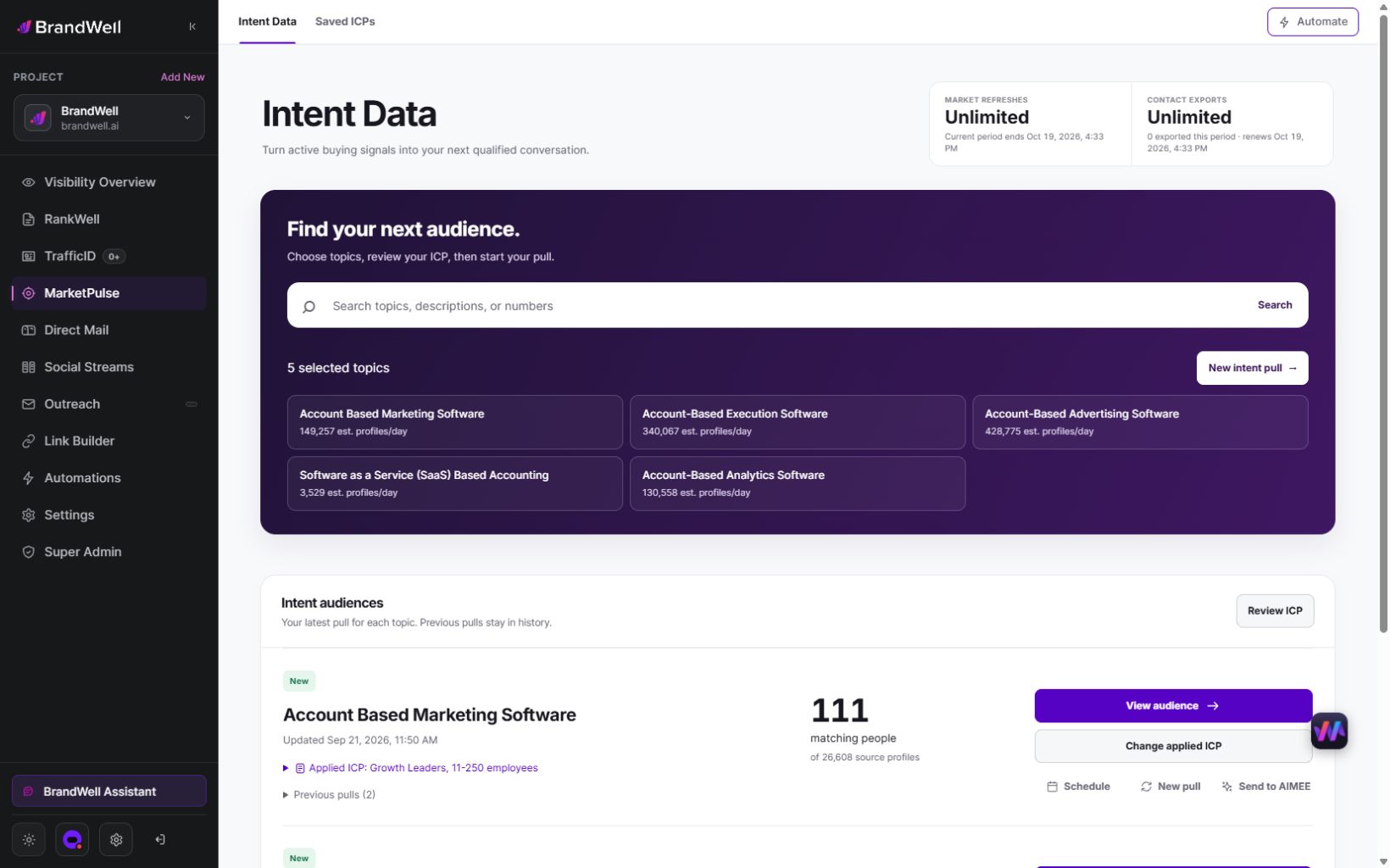
How the software connects the work:
- Find and qualify demand: MarketPulse brings topic-based intent into a reviewable audience with saved ICPs and scheduled pulls. TrafficID adds website visitor identification to the growth workflow.
- Prepare the next campaign: Outreach and Direct Mail provide execution workspaces; Social Streams adds relevant social activity. Use the tools and destinations configured for your project.
- Build demand as well as capture it: RankWell, Visibility Overview, and Link Builder connect content and visibility work with the same growth operation.
AIMEE helps carry the work forward
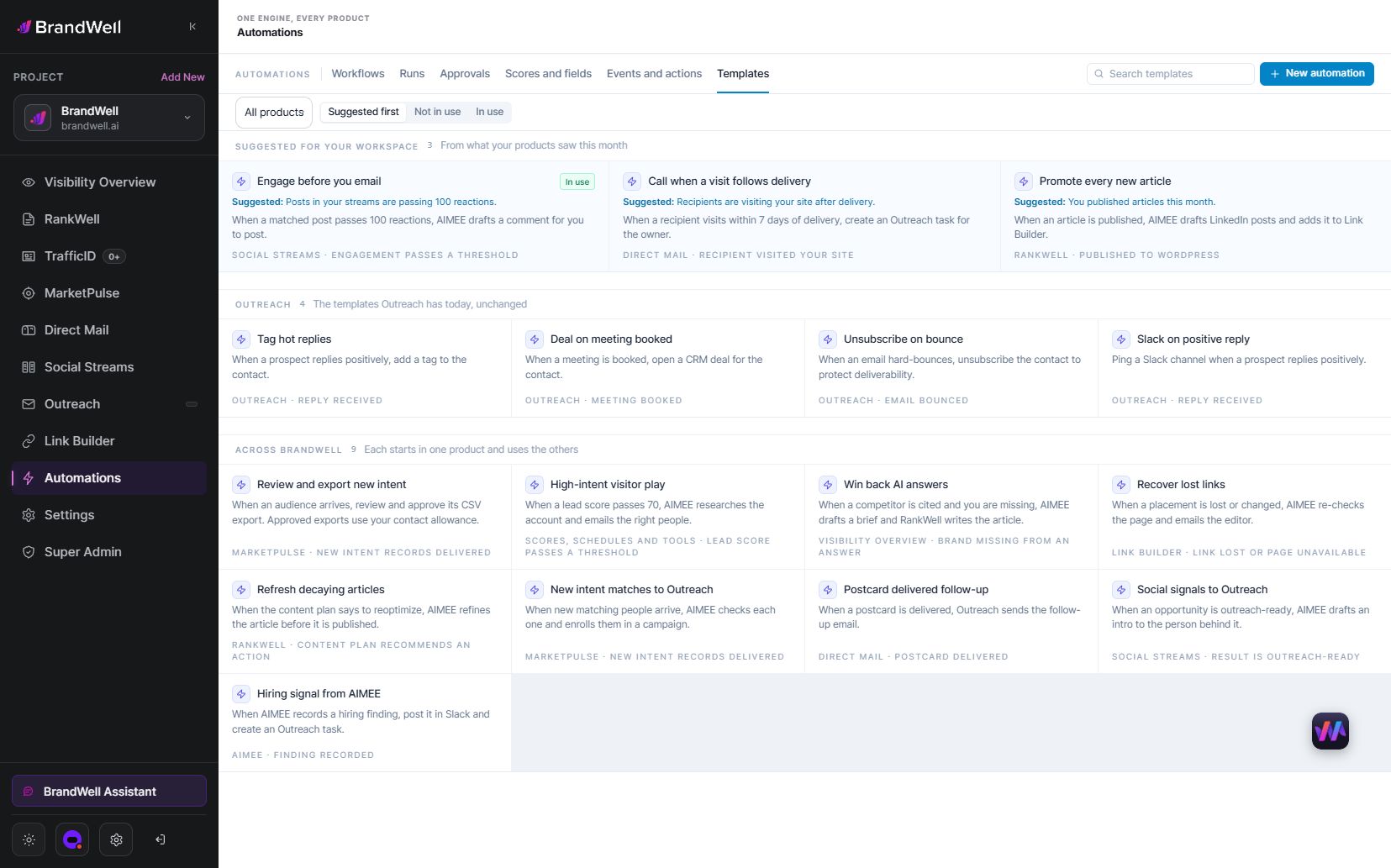
AIMEE is BrandWell’s agent-powered desktop app. It helps research accounts, prepare content and messages, and carry out assigned work through connected tools. BrandWell’s Automations workspace connects product events to workflow steps, with owners, approvals, and run history. You choose the connections, allowed actions, and budgets.
BrandWell MarketPulse intent-data plans start at $250/month. Your selected package determines topic coverage, contact allowances, refresh cadence, AIMEE access, and other growth tools. Channel usage, media, and fulfillment costs depend on the campaign.
What to evaluate: topic relevance, usable audience coverage, ICP fit, and the time it takes to turn an accepted signal into completed work. An intent signal helps prioritize an opportunity; it does not guarantee a purchase or establish permission for every channel. Choose a workflow your team can operate, then evaluate the audience and the completed work against that goal.
Define the economic unit: usable signal, activated account, or opportunity
Define a raw event as the provider’s delivered observation. Define an accepted signal as a record that passes schema, source, timestamp, duplication, identity, and contract checks. Define a usable signal as an accepted signal that also passes fit, freshness, permitted-use, suppression, and routing rules. Define an activated account as a usable signal that reaches a specified channel with a receipt. Define an opportunity only under the CRM’s current qualification standard.
Choose one primary denominator for the decision and keep the preceding denominators visible. Engineering may optimize cost per accepted record. RevOps may care about cost per routed account. An agency may price around cost per maintained client workflow. Finance may compare cost per incremental qualified opportunity. These units cannot be substituted without showing conversion and loss at every stage.
The core equation is: total cost divided by the selected usable unit. Total cost includes vendor, implementation, compute, storage, observability, identity, enrichment, validation, orchestration, security, privacy, legal, analyst review, exception handling, activation, reporting, support, and correction. Use sensitivity ranges for uncertain inputs.
Map calls, retries, identity, enrichment, validation, routing, and owners
An intent API unit economics implementation guide should map the full operating sequence:
- Contract the input. Freeze endpoint, request unit, fields, source, identity level, event and delivery times, permitted use, rate limit, quota, and service expectations.
- Make ingestion idempotent. Assign stable request and event keys, detect replay, and prevent retries from creating duplicate cost or records.
- Validate schema and provenance. Reject or quarantine missing, malformed, future-dated, stale, unsupported, or contract-ineligible records.
- Resolve the subject. Track match attempts, unresolved records, confidence, hierarchy, and correction cost separately from the raw feed.
- Enrich and verify only as needed. Request the smallest fields required for qualification and activation, then preserve source, freshness, and validation status.
- Apply fit and eligibility. Enforce ICP, geography, customer state, open-opportunity state, consent or other lawful-use conditions, suppression, and client boundaries.
- Route with receipts. Capture accepted, rejected, delayed, expired, reviewed, and activated states in the CRM or destination.
- Return outcomes. Feed sales acceptance, corrections, complaints, opportunity state, and no-action evidence back to cost and threshold owners.
Useful intent API unit economics templates include a unit dictionary, pricing-unit translator, call ledger, retry and duplicate log, acceptance waterfall, labor model, cost allocation policy, sensitivity worksheet, break-even calculator, and client margin sheet. The checklist should assign engineering, data, RevOps, finance, privacy, security, legal, and delivery owners.
Seven cost models and sensitivity tests for intent APIs
These are analytic methods, not a list of vendors. Use several models together so one convenient denominator does not hide loss.
1. Cost per raw delivered event
Divide source and transport cost by delivered events. Best fit: monitoring feed volume and billing reconciliation. Limitation: it rewards noise and ignores whether records are valid, unique, or usable.
2. Cost per successful unique request
Allocate request, overage, retry, and transport cost to successful idempotent requests. Best fit: engineering teams comparing request and credit models. Limitation: a technically successful response can contain no accepted business signal.
3. Cost per accepted signal
Divide full ingestion and QA cost by records that pass schema, provenance, freshness, duplication, and identity thresholds. Best fit: data-quality and source evaluation. Limitation: accepted signals may still fail ICP, permission, or activation.
4. Cost per usable or eligible signal
Add identity, enrichment, validation, fit, suppression, and governance, then divide by records eligible for a defined action. Best fit: RevOps and agency delivery decisions. Limitation: eligibility does not guarantee reach or response.
5. Cost per activated account
Include destination fees, list acceptance, audience matching, routing, review, and operations, then divide by accounts with an execution receipt. Best fit: comparing channel-ready workflows. Limitation: activation is an operational output, not a qualified outcome.
6. Cost per qualified opportunity
Allocate the full workflow cost to opportunities meeting a frozen qualification standard, with a comparable baseline. Best fit: finance and renewal decisions. Limitation: attribution and small samples can make this estimate unstable; correlation is not incrementality.
7. Break-even and sensitivity model
Vary volume, retries, acceptance, identity coverage, labor, activation, qualification, gross margin, and time to outcome. Best fit: build-versus-buy and capacity planning. Limitation: the result is only as credible as the assumptions and ranges disclosed.
Build vs. buy vs. exports: compare the complete operating model
Buy an API when the team needs automation, fresh access, controlled schemas, observability, and enough recurring volume to justify integration. Use scheduled exports when latency is less important, operations can tolerate batches, and the lower implementation burden outweighs reduced control. Build more of the workflow when identity logic, governance, customer experience, or proprietary evidence creates strategic value and the team can maintain it.
A manual export is not free: include analyst preparation, uploads, errors, refresh, reconciliation, and delay. An API is not automatically scalable: include rate limits, retries, pagination, provider changes, versioning, outages, monitoring, support, and security. A complete intent API unit economics comparison evaluates the same source coverage, fields, identity level, freshness, rights, acceptance, activation, and outcome definition across alternatives.
Use a break-even boundary such as: fixed build and maintenance cost divided by the unit-cost advantage over a managed alternative. Then test whether forecast volume, engineering capacity, opportunity cost, and risk make that break-even plausible. Do not use an optimistic single case.
Compare credits, records, requests, overages, licenses, and total cost
Intent API unit economics pricing may be based on credits, requests, processed records, returned records, unique entities, fields, refreshes, seats, topics, or subscriptions. Clarify whether failed requests, empty responses, retries, duplicates, provider lookups, enrichment, identity, historical access, exports, and support consume units. Document minimums, overages, rate limits, contract term, and data-retention rights.
Translate every offer into the same workload. Estimate raw calls, pagination, retry rate, average records, expected duplicates, unresolved subjects, stale records, accepted signals, eligible signals, and activated accounts. Add implementation and recurring labor. A current official usage price can support one line item only when its unit, region, technique, included and excluded fees, and re-check requirement are preserved; it is not a managed-service total by itself.
Request a scope-comparable written quote. Do not repeat unsupported market estimates or assume that a broader platform’s subscription is the price of the exact API workflow.
Measure waste, cost per accepted signal, pipeline, reliability, and payback
Core intent API unit economics KPIs include calls, successful unique requests, retries, throttles, errors, empty responses, duplicate records, schema rejects, provenance gaps, stale records, unresolved subjects, accepted signals, eligible signals, manual-review time, activation receipts, and correction cost. Reliability measures include latency distributions, backlog age, uptime evidence, recovery, and data freshness – not just request success.
Business measures include cost per accepted signal, usable signal, activated account, sales-accepted account, qualified opportunity, and incremental outcome. Report pipeline separately from revenue, and distinguish sourced, influenced, and merely associated records. Payback requires full cost, gross-margin assumptions, outcome timing, and uncertainty.
There is no universal intent API unit economics benchmark. Volume, topic specificity, entity level, geography, ICP, source quality, sales motion, implementation, and opportunity value change the result. Use internal historical cohorts and test a representative sample before committing.
Choose the right API model by volume, latency, control, and team maturity
A real-time API fits teams with meaningful recurring volume, time-sensitive actions, engineering ownership, observability, and an explicit fallback. Batch or managed delivery fits teams that can trade latency for lower implementation burden. Manual workflows fit low-volume pilots where learning matters more than automation.
High-volume does not automatically justify building. If the team cannot own source contracts, schema changes, identity, compliance, monitoring, exceptions, and support, a managed option may have better unit economics even with a higher visible fee. Conversely, a mature data team may value an API when it needs control, portability, and integration with proprietary qualification logic.
Connect source provenance, identity, freshness, eligibility, and activation
A durable intent API unit economics strategy stores one linked record for each stage: source observation, delivered event, identity candidate, match confidence, enriched fields, fit decision, eligibility decision, destination receipt, human review, and outcome. Add the cost and processing time incurred at each transition.
This unit-cost waterfall exposes where value is lost. If raw events are cheap but most lack provenance, improve the source contract. If identity fails, change match inputs or accept account-level use. If eligibility fails, narrow collection and client scope. If activation fails, repair destination rules. If outcomes fail, revisit the offer, ICP, channel, or sales capacity rather than buying more records.
Common intent API unit economics use cases include account prioritization, visitor workflows, advertising cohorts, outbound research queues, agency reporting, and customer expansion review. Each needs a distinct usable-unit definition and activation threshold. One blended score cannot represent all of them safely.
Expose rate limits, stale data, duplicates, licensing, privacy, and hidden costs
The biggest intent API unit economics mistakes are modeling price per call as total cost, ignoring retries and empty responses, paying twice for duplicates, hiding unresolved records, assuming attributes are fresh, omitting exception labor, and activating beyond licensed or permitted use.
Keep retry policy bounded and observable. Respect server guidance, use idempotency, backoff, and a dead-letter or review queue; never turn a transient failure into an infinite spend loop. Version schemas and pricing assumptions. Maintain export and deletion paths so switching cost is visible.
For California data-broker registration and deletion questions, use the California Privacy Protection Agency’s guidance as a current regulatory starting point, then obtain legal review for the actual parties and data. For any client-facing savings or performance claim, the FTC advertising guidance explains substantiation and disclosure principles. Neither source proves a provider is compliant or economical.
Protect agency margin when embedding an intent API in client delivery
An agency service should separate wholesale source cost, variable usage, implementation, recurring operations, analyst review, client support, reporting, and risk reserve. Define included topics, records, refresh, destinations, service levels, exception volume, and change requests. Use a margin floor and alert when retries, review, or activation loss crosses it.
BrandWell may fit an agency that wants a managed, branded service layer and can measure cost per usable signal across clients. It is not a universal replacement for a raw production API, a custom identity stack, or a workload whose endpoint, schema, topic coverage, or rights have not been verified.
Agent-ready operating instructions:
- Give Claude or ChatGPT the approved unit dictionary, pricing schedule, call logs, retry rules, acceptance waterfall, labor assumptions, client scope, and outcome definitions.
- Ask it to reconcile costs, identify missing denominators, calculate sensitivity ranges, and flag assumptions rather than inventing unavailable values.
- Require a human owner to approve pricing, architecture, client commitments, consequential routing, and any ROI claim.
- Optionally execute approved browser reporting steps through the AIMEE desktop app, preserving inputs, calculations, receipts, exceptions, and rollback.
The best unit-economics model makes waste actionable. It shows which stage consumes money, which evidence survives, and which operating change – not just which cheaper call – can improve the decision.