Direct answer: Calculate intent-data total cost as license or platform fees plus users, topics, account universe, credits, enrichment, validation, exports, API, implementation, integrations, services, media, overages, support, internal labor, change management, contract risk, and exit work. Then divide by usable and activated ICP coverage – not raw records. Quote-required is a valid pricing result; an unsupported competitor estimate is not.
Who this is for: VPs of Marketing, RevOps and procurement leaders, agency owners, demand generation teams, and CROs comparing monthly intent-data cost, hidden fees, managed services, or build-versus-buy options.
BrandWell update, September 2026: MarketPulse intent data starts at $250/month within BrandWell’s complete growth automation software. AIMEE, the agent-powered desktop app, helps connect buyer signals with research, content, and campaign work. Access to the broader tools depends on your package.
Calculate total cost from the operating workflow
Begin with one defined revenue workflow and its units: accounts monitored, topics, regions, users, records enriched, audiences activated, client tenants, and qualified outcomes. Price the system that produces the outcome. A vendor may quote by platform, user, topic, credit, record, API call, media percentage, service, or a mix; the invoice alone does not reveal comparable cost.
Use this planning equation: total operating cost = fixed platform and license + variable data and usage + setup and integration + services and support + media and activation + internal labor + governance and risk + renewal and exit exposure. Convert every quote to the same time horizon, scope, expected usage, and adoption scenario.
Build one normalized pricing workbook
Create a pricing workbook with inputs, vendor evidence, buyer assumptions, formulas, sensitivity cases, and decision notes. Keep public fact, written quote, BrandWell-provided planning, and analyst assumption in separate columns. Record units, included allowance, overage, minimum, billing cadence, term, renewal, change right, and source for every line.
- Freeze the ICP, use case, accounts, topics, geographies, users, modules, integrations, destinations, support, and outcome.
- Test representative coverage, freshness, identity, required fields, validation, activation acceptance, and operational effort.
- Request a written price schedule, order form, implementation statement, data terms, support scope, renewal language, and exit obligations.
- Normalize fixed and variable charges into base, expected, high-usage, low-adoption, expansion, and exit scenarios.
- Add internal roles and hours for setup, data, RevOps, media, sellers, analytics, QA, training, privacy/security, support, and procurement.
- Calculate coverage-adjusted cost, qualified-outcome cost, contribution or gross-profit sensitivity, and stop thresholds before selecting.
Five provider pricing models to compare
Disclosure: BrandWell owns and publishes this article. BrandWell appears first because it is our product; every option is evaluated using the same disclosed criteria, and another provider may be a better fit for some buyers.
This list compares five provider archetypes with current official pricing evidence or a clear quote-required state. No scraped marketplace estimate is substituted for primary pricing material. We applied the same ten cost criteria to every company and stated a meaningful limitation. The homepage screenshots identify the companies only; they are not price evidence, endorsements, or outbound links.
- Platform or license fee
- Seats and user fees
- Topics, account universe, and signal volume
- Credits, enrichment, export, and API usage
- Implementation and integration
- Advertising spend and separate service fees
- Overages and support
- Term, renewal, cancellation, and pilot
- Internal labor, change management, and adoption
- Coverage-adjusted cost per activated and qualified account
1. BrandWell: MarketPulse intent data and connected growth automation
Best fit: growth teams and agencies that want intent data connected to day-to-day execution. BrandWell is complete growth automation software that connects MarketPulse intent data, TrafficID website visitor identification, content, outreach, and campaign workflows. AIMEE, its agent-powered desktop app, helps turn those signals into research, prepared assets, and approved actions.
For a cost comparison, separate the price of intent data from the work and channels used to activate it. Starting with MarketPulse lets a team assess its audience before scoping a broader growth program.
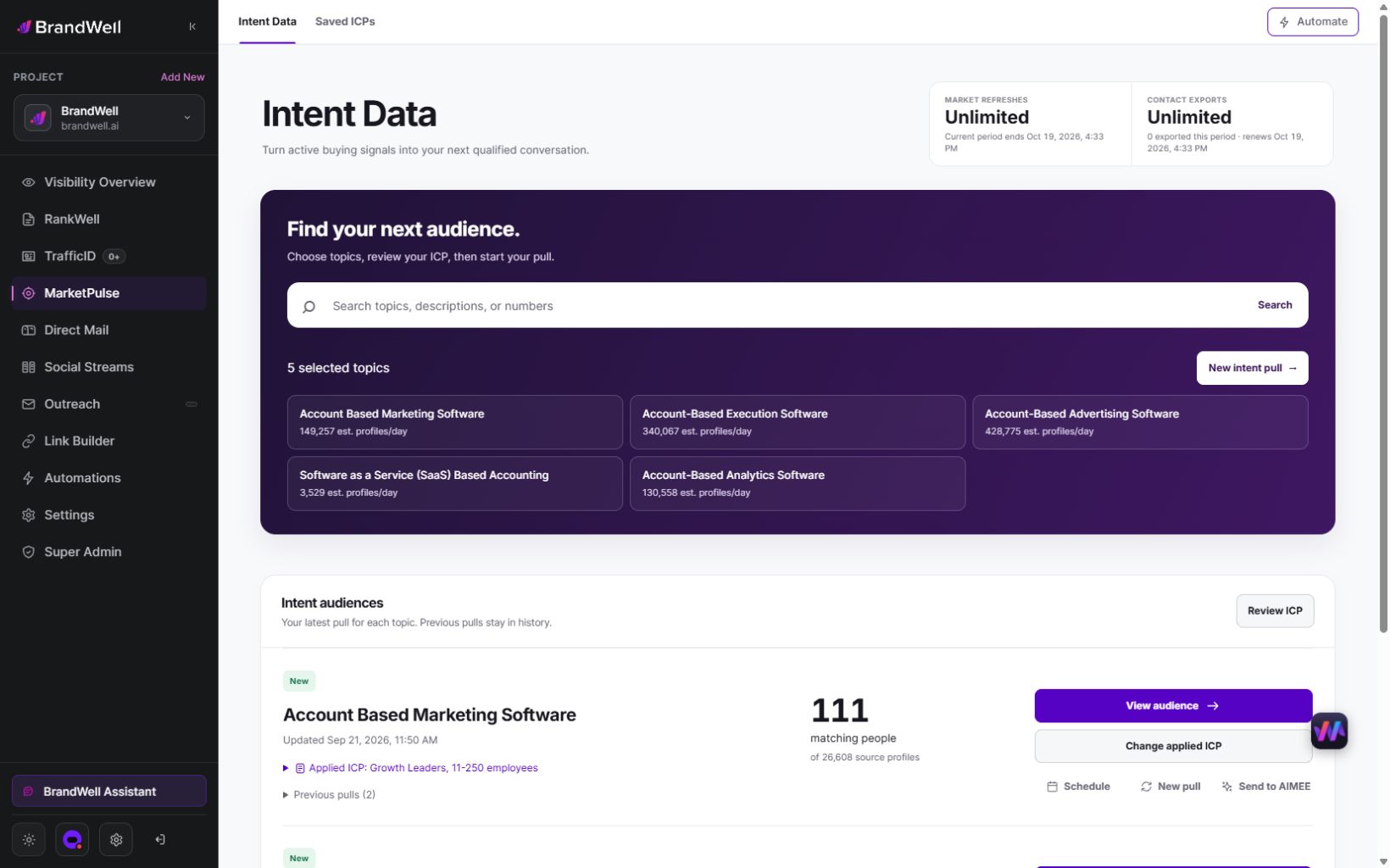
How the software connects the work:
- Find and qualify demand: MarketPulse brings topic-based intent into a reviewable audience with saved ICPs and scheduled pulls. TrafficID adds website visitor identification to the growth workflow.
- Prepare the next campaign: Outreach and Direct Mail provide execution workspaces; Social Streams adds relevant social activity. Use the tools and destinations configured for your project.
- Build demand as well as capture it: RankWell, Visibility Overview, and Link Builder connect content and visibility work with the same growth operation.
AIMEE helps carry the work forward
AIMEE is BrandWell’s agent-powered desktop app. It helps research accounts, prepare content and messages, and carry out assigned work through connected tools. BrandWell’s Automations workspace connects product events to workflow steps, with owners, approvals, and run history. You choose the connections, allowed actions, and budgets.
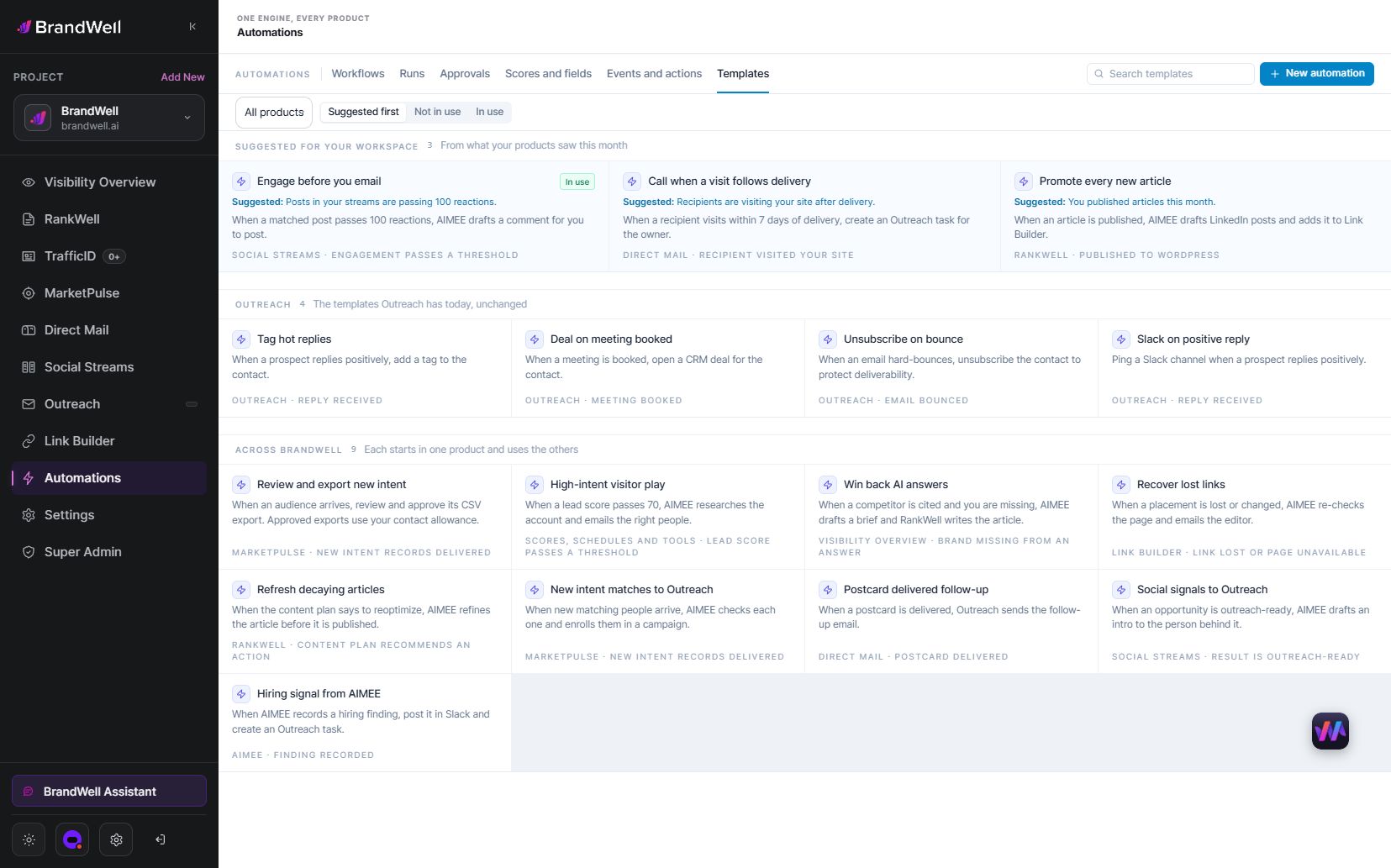
BrandWell MarketPulse intent-data plans start at $250/month. Your selected package determines topic coverage, contact allowances, refresh cadence, AIMEE access, and other growth tools. Channel usage, media, and fulfillment costs depend on the campaign.
What to evaluate: topic relevance, usable audience coverage, ICP fit, and the time it takes to turn an accepted signal into completed work. An intent signal helps prioritize an opportunity; it does not guarantee a purchase or establish permission for every channel. If your main requirement is a specialist data feed or an established enterprise ABM program, compare that specific scope with the alternatives below.
2. 6sense
Platform or license fee: Custom/quote required; no current public platform dollar amount was verified. Official material describes feature and data-credit bundles and directs buyers to a demo. Do not substitute a marketplace estimate for the license.
Seats and user fees: Ask how seller, marketing, admin, analytics, and other users are packaged, which functions need paid access, and whether new teams or business units change the quote.
Topics, account universe, and signal volume: Normalize the number of accounts, markets, intent topics or keyword coverage, signal products, data credits, and refresh. Test whether coverage is usable in priority segments before valuing volume.
Credits, enrichment, export, and API usage: Model data credits, contact or account data, exports, enrichment, API/connectors, and any consumption tied to selected products. Request examples of high-usage months and enforcement.
Implementation and integration: Include data preparation, CRM and marketing automation connections, model configuration, implementation services, enablement, governance, and internal change management.
Advertising spend and separate service fees: Advertising has separate campaign economics and documented data/service fees, typically stated as a percentage for that product. Those charges and campaign minimums are not the platform license and must be modeled separately.
Overages and support: Request support level, professional services, training, additional models or destinations, data-credit overage, and change-order pricing. Confirm which support is standard.
Term, renewal, cancellation, and pilot: No universal contract term was verified. Get written initial term, billing cadence, renewal, price changes, cancellation, reduction, data access, deletion, and proof or pilot conditions.
Internal labor, change management, and adoption: Enterprise deployment can require RevOps, marketing operations, sales enablement, data, analytics, campaign, admin, and manager time. Adoption cost can exceed software differences when workflows change.
Coverage-adjusted cost per activated and qualified account: Divide fully loaded cost by qualified ICP accounts with fresh usable signals, then by activated and accepted opportunities. A modeled stage or delivered impression is not a qualified account outcome.
Meaningful limitation: No public platform dollar amount was verified, and total value depends on data readiness, credits, integrations, advertising, and sustained enterprise adoption. A smaller team may pay for breadth it cannot operate.
3. ZoomInfo
Platform or license fee: Configuration-based custom quote; no current public numeric platform amount was verified. The proposal can vary with products, features, licenses, credits, integrations, and add-ons.
Seats and user fees: Normalize seller, manager, operations, admin, and other licenses plus access rules for contractors and business units. Confirm reassignment, minimums, and the cost of expansion.
Topics, account universe, and signal volume: Ask how intent keywords/topics, account universe, website-visitor capabilities, refresh, territories, and product modules affect the package. Test the buyer’s real ICP instead of valuing database size.
Credits, enrichment, export, and API usage: Model export, enrichment, phone/email, validation, workflow, API, intent, visitor, and add-on credits or limits. Include record reprocessing and failed or duplicate use.
Implementation and integration: Budget for CRM/warehouse integration, field governance, deduplication, territories, workflow build, enablement, migration, admin, and data-quality remediation.
Advertising spend and separate service fees: Advertising, sales-engagement, messaging, or other adjacent execution costs may sit outside the selected data package. Separate tool fees, media, and agency operations.
Overages and support: Request support, implementation, training, add-on, credit overage, API limit, professional-service, and custom-work pricing in writing. Clarify the remedy for coverage or quality issues.
Term, renewal, cancellation, and pilot: No universal term was verified. Obtain initial and renewal term, billing, price increase, seat reduction, credit rollover, cancellation, export, deletion, and evaluation conditions.
Internal labor, change management, and adoption: Include seller research, RevOps administration, workflow monitoring, correction, credit governance, enablement, and management. Broad data creates cost when reps cannot prioritize or trust it.
Coverage-adjusted cost per activated and qualified account: Calculate usable ICP coverage, valid contact yield, rep acceptance, activated accounts, accepted opportunities, and cost. Raw company or contact counts are scope-mismatched denominators.
Meaningful limitation: Pricing is configuration dependent and no current public numeric amount was verified. Teams must validate segment coverage, freshness, credits, implementation, and adoption rather than treating database breadth as value.
4. Bombora
Platform or license fee: Custom/quote required; no current public core-platform dollar amount was verified. A support-package inquiry or commissioned scenario is not the Company Surge license price.
Seats and user fees: Clarify which buyer, analyst, admin, sales, and client users need access and which systems receive data through integrations rather than direct seats.
Topics, account universe, and signal volume: Price topics, markets, account universe, signal delivery, refresh, history, and audience products. Topic quality and account-level coverage matter more than raw topic count.
Credits, enrichment, export, and API usage: Include data delivery, API or partner integration, enrichment and contact identity from adjacent tools, audience activation, exports, and storage or warehouse operations.
Implementation and integration: Budget topic design, domain and corporate-family mapping, CRM integration, thresholds, enrichment, seller workflow, testing, analytics, and ongoing quality review.
Advertising spend and separate service fees: Media, destination platforms, audience services, campaign management, and agency fees can sit outside the core intent feed. Do not report those as the license or omit them from TCO.
Overages and support: Request support, data delivery, new topic or market, integration, service, correction, and overage terms. Clarify response and remediation for feed or mapping defects.
Term, renewal, cancellation, and pilot: No universal term was verified. Obtain a written order for term, billing, renewal, change, reduction, cancellation, delivery after termination, deletion, and pilot.
Internal labor, change management, and adoption: Include strategist time for topics, data operations, identity/enrichment, seller enablement, advertising, analytics, QA, and stakeholder education about account-level probability.
Coverage-adjusted cost per activated and qualified account: Measure cost per fresh, relevant, ICP-qualified surged account, then per identity-enriched, activated, acted-on, and qualified account. A surge is not a named-person lead.
Meaningful limitation: Company-level intent normally requires adjacent identity and activation work, and it cannot identify a specific buyer. No current core-license amount or universal contract term was verified.
5. Demandbase
Platform or license fee: Customized quote; no current public dollar amount was verified. Official pricing describes a Demandbase One platform fee, so buyers need a scope-matched order rather than a guessed range.
Seats and user fees: Official pricing describes a flat fee per user in addition to the platform fee. Confirm user types, minimums, admin access, reassignment, contractors, business units, and expansion.
Topics, account universe, and signal volume: Normalize account universe, data products, intent topics, buying groups, web/advertising scope, markets, refresh, and product modules. Test coverage by segment.
Credits, enrichment, export, and API usage: Ask about data, contact, enrichment, export, API, integration, and audience consumption or limits. Separate included platform capabilities from third-party data and connectors.
Implementation and integration: Budget account and buying-group design, CRM/marketing automation/warehouse integration, identity mapping, implementation services, governance, enablement, and change management.
Advertising spend and separate service fees: Advertising media, activation, agency services, and other channel costs are separate unless the order explicitly bundles them. Model platform attribution and media operations independently.
Overages and support: Request support tiers, professional services, implementation, training, new products, users, markets, integrations, and custom-work pricing plus service and data remedies.
Term, renewal, cancellation, and pilot: No universal term was verified. Get initial term, billing, renewal, price change, user reduction, cancellation, data return/deletion, transition support, and pilot language in writing.
Internal labor, change management, and adoption: ABM value depends on shared account definitions, sales and marketing adoption, RevOps/analytics, governance, campaign operations, and management. Include the cost of changing behavior.
Coverage-adjusted cost per activated and qualified account: Calculate cost against fresh, relevant, usable account coverage, active users, activated accounts, qualified buying groups, accepted opportunities, and incremental gross profit where evidence supports it.
Meaningful limitation: Intent is probabilistic, numeric pricing is not public, and the operating burden can be material. Cost and value depend on products, users, coverage, integrations, advertising, and adoption.
Platform, managed service, or in-house cost
A platform shifts more configuration and operation to the buyer but may create reusable internal capability. A managed service bundles expert labor and can shorten time to value, but scope, transparency, portability, and margin must be examined. Building in-house can make sense with proprietary first-party signals, engineering/data maturity, strict control needs, and enough scale to fund ongoing identity, policy, security, support, and product maintenance.
A manual or non-intent approach is the baseline for small markets and unsettled ICPs. Price researchers, list building, enrichment, rep time, missed timing, and quality control honestly. In-house is not free, and managed service is not automatically expensive; compare the same outcome and include opportunity cost.
Monthly price, hidden fees, and quote requirements
Hidden costs most often appear in seats, topics, credits, account universes, exports, phone/email fields, validation, APIs, connectors, implementation, migration, professional services, support tiers, advertising fees, media, client tenants, data storage, overages, training, QA, privacy/security, renewal increases, minimum terms, and exit support. Ask which features in the demo are not in the quote.
Build sensitivity cases. The base case uses expected accounts, users, signals, match, action, and support. The high-usage case adds topics, enrichment, exports, audiences, clients, and overages. The low-adoption case keeps the contract cost but reduces active users and seller action. The expansion case adds a region or business unit. The exit case includes data return, deletion, migration, replacement overlap, and lost workflow capacity.
Do not turn anecdotal market research into a general competitor price band or a universal contract term. Those observations are not verified facts for every vendor or scope. Use the provider entries above and a current written quote.
Connect price to signal quality and activation
Price must be joined to signal quality. Track fit coverage, relevant-topic coverage, freshness, account resolution, person or role coverage, field completeness, validation, permitted-use yield, destination acceptance, match, rep adoption, qualified outcomes, and corrections. A low license can have a high cost per usable account; an expensive platform can be economical if it replaces several tools and the team uses it.
Use gates before weighted scores. If a provider cannot cover a required geography, supply a permitted field, integrate with the system of record, or meet security requirements, a lower price should not compensate. For tradeoffs, weight only business-relevant dimensions and show how the decision changes under conservative assumptions.
Which buyers can justify intent-data cost
Intent data is easiest to justify when deal value and volume can fund prioritization, topics map to actual buying problems, the addressable market is large enough for data coverage, teams can act quickly, and outcomes are reliably recorded. Multi-product, enterprise, expansion, advertising, and agency-reseller motions can benefit when timing and coordination matter.
It is harder to justify for a tiny market, very low contract value, undefined ICP, no action capacity, weak CRM, sparse signals, sensitive uses, or leadership expecting certainty. Start with a coverage assessment and manual baseline. Decline a long, high-minimum contract if the team cannot define what it will do with one qualified signal.
Measure coverage-adjusted cost and ROI
Calculate cost per raw record only for data operations. For the commercial decision, calculate cost per usable account, activated account, rep-accepted account, accepted opportunity, win, and incremental gross profit. Show the numerator and denominator, observation window, segment, adoption, and confidence. Compare with the baseline and include all channels that touched the account.
ROI should use incremental gross profit when a credible holdout, randomized test, or staged comparison supports it: (incremental gross profit − total operating cost) ÷ total operating cost. Platform-attributed or influenced pipeline can support diagnosis but is not automatically causal. A short pilot may prove coverage, integration, and adoption without proving revenue.
Contract, adoption, privacy, and data-quality risk
Contract risk includes auto-renewal, notice windows, price changes, minimums, non-cancellable commitments, seat floors, lost credits, restricted exports, data deletion, transition support, service dependencies, and unclear remedies. Procurement should model the expected and downside cases and assign an owner to every renewal trigger.
Data and privacy cost includes diligence, rights, notices, direct-marketing rules, suppression, sensitive categories, security, access, retention, deletion, subprocessors, transfers, incidents, audits, and AI-agent use. The FTC’s business security guidance emphasizes data minimization, access control, and service-provider oversight. Adapt controls to the actual workflow and obtain qualified counsel; this article is not legal advice.
Data-quality and adoption risks include wrong companies, stale employment, invalid contacts, broad topics, opaque scores, model drift, duplicate workflows, seller distrust, unused seats, and poor outcome capture. Price monitoring and remediation rather than assuming quality remains fixed for the contract term.
Price intent data inside an agency service
An agency should quote its client on service objects: diagnostic or coverage test; setup and integration; recurring signals/data; operations and QA; managed activation; reporting and client success; usage; media; and custom work. The agency’s retail price should fund wholesale cost, labor, exceptions, selling, management, and churn while remaining tied to a client decision.
Reconcile wholesale usage and client scope every billing cycle. Show the client topic and coverage changes, usable signals, actions, qualified outcomes, total program cost, limitations, and next decision. A white-label service should be transparent about methodology and uncertainty even when the underlying vendor is not linked.
Common questions
Why do many intent-data providers use custom quotes?
Scope varies by accounts, topics, data products, users, credits, geography, integrations, support, services, and activation. Custom pricing is not automatically bad, but it makes a normalized written workbook and contract review essential.
Should annual value be divided by twelve?
That can normalize the license for comparison, but it does not turn an annual commitment into a cancellable monthly plan. Preserve payment timing, non-cancellable amount, renewal, implementation, usage, and exit exposure.
What is the most important hidden cost?
Usually the largest unmodeled category is internal adoption and operation: data work, integration, seller behavior, QA, reporting, and change. The answer varies, so price each role and hour instead of applying a generic percentage.
Can a public price replace a quote?
No. A public amount can anchor a line item, but the current offer, rights, limits, term, services, and buyer scope need a written quote and order. If a page is inconsistent or promotional, preserve the uncertainty.