The right intent-data service for a B2B SaaS client begins with qualification, not a data feed. Sell the service only when the client has a defined ICP, a meaningful revenue event, enough addressable accounts, usable destinations, an owner who will act, and a way to judge accepted outcomes. If those conditions are missing, the better first project may be ICP work, CRM cleanup, offer positioning, or sales-process repair.
When the client is ready, an agency can package intent into seven recurring services: market and topic intelligence, ICP account prioritization, website visitor identification, contact and buying-group enrichment, CRM routing, activation playbooks, and branded evidence and renewal. Each service needs its own input, output, owner, acceptance gate, and limitation.
Intent and identity signals are probabilistic evidence. They do not prove identity, consent, need, authority, a buying cycle, or a future outcome.
BrandWell update, September 2026: MarketPulse intent data starts at $250/month within BrandWell’s complete growth automation software. AIMEE, the agent-powered desktop app, helps connect buyer signals with research, content, and campaign work. Access to the broader tools depends on your package.
BrandWell: MarketPulse intent data and connected growth automation
From audience to action: connect intent data with the work needed to use it. BrandWell is complete growth automation software that connects MarketPulse intent data, TrafficID website visitor identification, content, outreach, and campaign workflows. AIMEE, its agent-powered desktop app, helps turn those signals into research, prepared assets, and approved actions.
For agencies, this creates a repeatable client workflow: identify relevant demand, apply a client-specific ICP, prepare a campaign, and review the work in the same platform. Branded delivery and multi-client requirements should be scoped to the agency package.
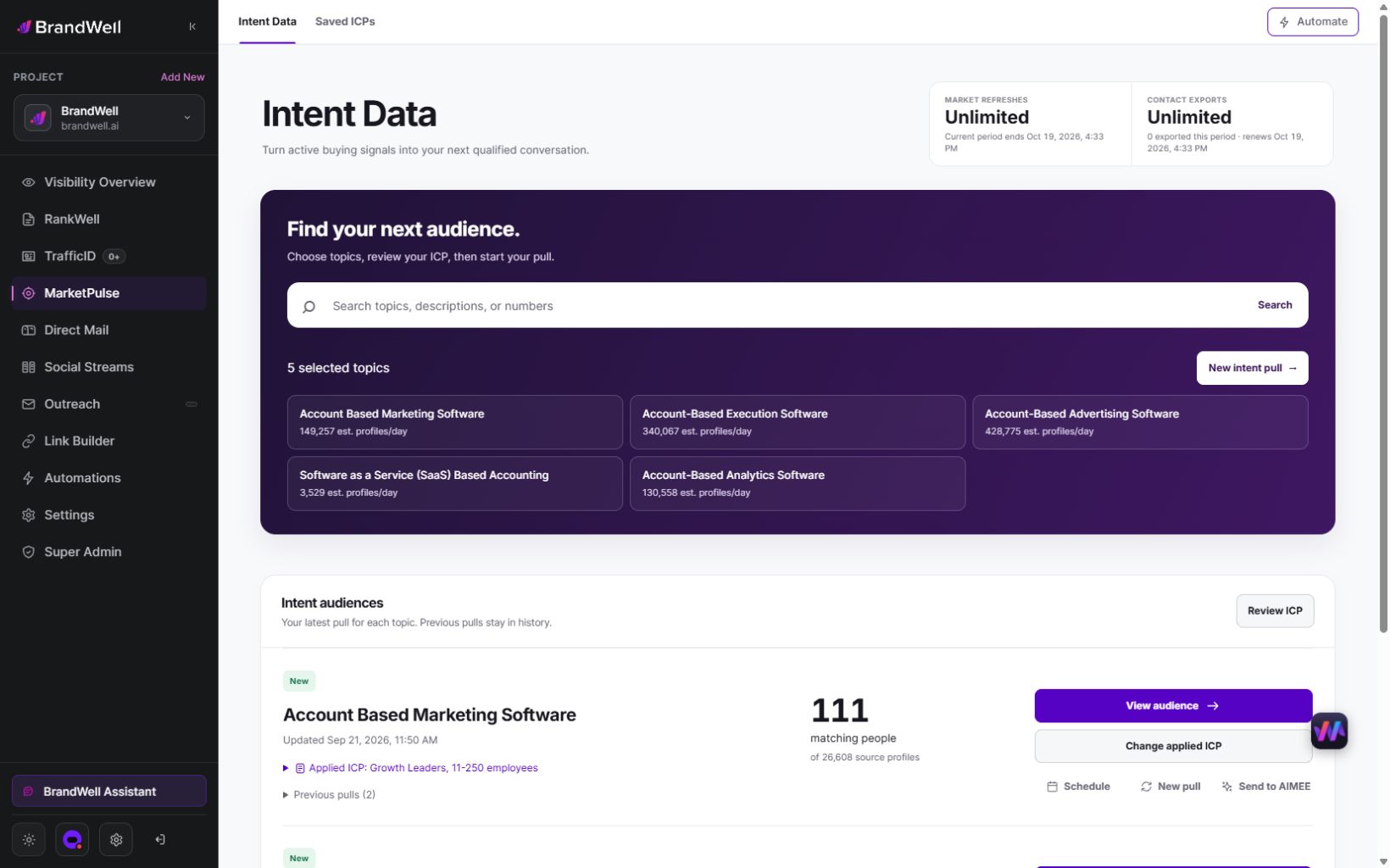
How the software connects the work:
- Find and qualify demand: MarketPulse brings topic-based intent into a reviewable audience with saved ICPs and scheduled pulls. TrafficID adds website visitor identification to the growth workflow.
- Prepare the next campaign: Outreach and Direct Mail provide execution workspaces; Social Streams adds relevant social activity. Use the tools and destinations configured for your project.
- Build demand as well as capture it: RankWell, Visibility Overview, and Link Builder connect content and visibility work with the same growth operation.
AIMEE helps carry the work forward
AIMEE is BrandWell’s agent-powered desktop app. It helps research accounts, prepare content and messages, and carry out assigned work through connected tools. BrandWell’s Automations workspace connects product events to workflow steps, with owners, approvals, and run history. You choose the connections, allowed actions, and budgets.
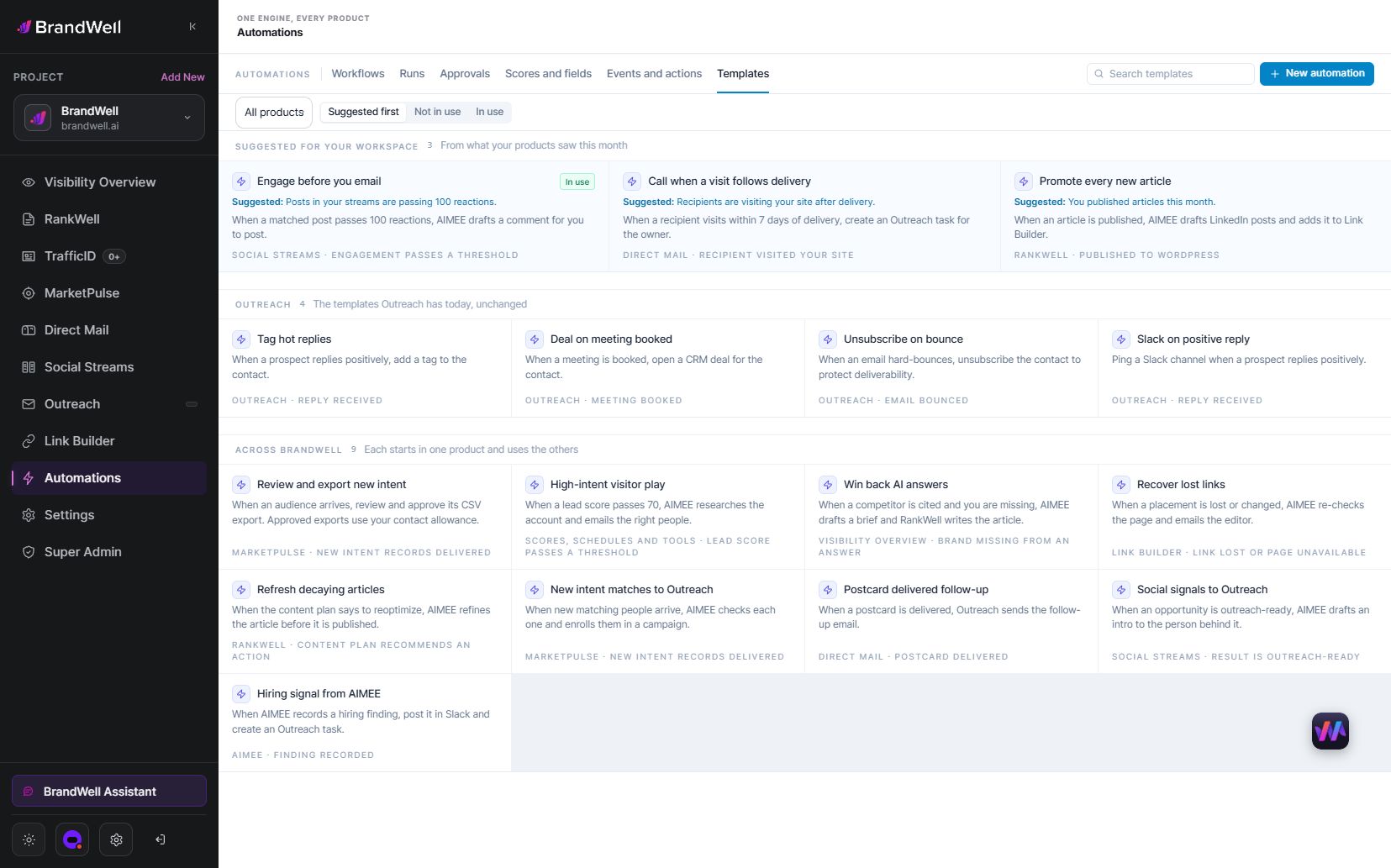
BrandWell MarketPulse intent-data plans start at $250/month. Your selected package determines topic coverage, contact allowances, refresh cadence, AIMEE access, and other growth tools. Channel usage, media, and fulfillment costs depend on the campaign.
What to evaluate: topic relevance, usable audience coverage, ICP fit, and the time it takes to turn an accepted signal into completed work. An intent signal helps prioritize an opportunity; it does not guarantee a purchase or establish permission for every channel. Choose a workflow your team can operate, then evaluate the audience and the completed work against that goal.
Who is this for?
This guide is for:
- agency owners serving B2B SaaS clients;
- demand-generation and RevOps consultants packaging recurring services;
- strategists deciding whether intent data fits a client’s sales motion; and
- delivery leaders responsible for client value, margin, and renewal.
It is not for agencies that plan to sell the same unqualified “hot lead” export to every SaaS company. A good service adapts to the client’s product, contract value, buying group, sales cycle, data maturity, and activation capacity.
Eight client-fit gates before you sell intent data
Use these gates before preparing a proposal. A “no” does not always kill the opportunity, but it should change the scope.
1. Is the ICP operational?
The client should be able to define inclusion, exclusion, and priority fields in observable terms. “Innovative companies” is not operational. Industry, employee band, geography, technology, business model, use case, and explicit exclusions can be.
Acceptance gate: the client can label a sample of accounts consistently. Failure mode: vague fit turns intent into broad prospecting.
2. Is the revenue event valuable enough?
Name the event: a qualified new-logo opportunity, expansion, renewal defense, partner recruitment, or another client-approved outcome. Estimate whether the event’s value supports the full cost of data, delivery, activation, and sales follow-up.
Acceptance gate: the economics work at a downside conversion case. Failure mode: even accurate data can be uneconomic for a low-value or poorly defined event.
3. Is there enough addressable volume?
Estimate eligible accounts after geography, company size, category, current customers, partners, conflicts, and exclusions. The client also needs enough volume for its chosen channel and an evaluation design.
Acceptance gate: the available audience supports the play. Failure mode: a tiny audience may not meet advertising platform minimums and can create privacy or identification risk.
4. Can the buying evidence be observed?
Define which topics, website actions, review activity, product signals, customer events, or other evidence can be sourced and time-bounded. Store source and freshness with each record.
Acceptance gate: every signal has provenance and an expiration rule. Failure mode: broad topics create impressive volume without SaaS buying relevance.
5. Can the destination accept the data?
Validate CRM objects, field names, deduplication, account hierarchy, routing, ownership, suppression, and rollback before live delivery.
Acceptance gate: sample records land in a sandbox with the correct owner and evidence ID. Failure mode: good signals disappear into bad CRM operations.
6. Will somebody act?
Name the team, approved play, response expectation, exception path, and capacity limit. “Sales will follow up” is not ownership.
Acceptance gate: the client accepts the workload. Failure mode: unworked signals create no learning, no outcome, and no credible renewal story.
7. Is the intended use allowed?
Review the data source, purpose, transparency, legal basis or consent where applicable, privacy notice, channel rules, opt-out, suppression, and sensitive-category restrictions. Business-to-business use does not erase every privacy, advertising, or email obligation.
Acceptance gate: the appropriate privacy, compliance, legal, security, and platform reviewers approve the intended use. Failure mode: the agency activates data it was allowed to receive but not allowed to use in that way.
8. Can the client accept or reject the evidence?
Agree on event definitions, stable IDs, denominators, comparison logic, costs, and review cadence. The agency and client need the same definition of an accepted signal and a qualified opportunity.
Acceptance gate: both parties can reconcile the report to destination records. Failure mode: influenced pipeline becomes an all-purpose claim with no causal boundary.
Map intent evidence to the SaaS buying motion
A useful intent-data services strategy separates evidence types instead of blending everything into one mystery score.
- Category research: useful for market education and account research, but often broad.
- Competitor or comparison activity: closer to vendor evaluation, but limited to the observed source and account resolution.
- Website behavior: first-party context can be valuable, but anonymous or resolved activity still requires confidence, purpose, and suppression controls.
- Product and customer evidence: can support expansion or renewal plays, but should remain inside agreed customer-data boundaries.
- Contact and account identity: makes routing possible, but identity quality must be tested separately from fit and intent.
Keep fit, intent, identity confidence, freshness, and permitted use in separate fields. Apply hard exclusions first. Then map accepted evidence to a stage-appropriate play. A return visit from a current customer should not trigger the same workflow as a new high-fit account researching a competitor category.
Seven intent-data services agencies can sell to B2B SaaS clients
These are service modules, not seven promises that every client should buy at once.
1. Market and topic intelligence reports
Monitor client-approved topics and markets, explain where the evidence came from, and deliver a branded report with a clear time window and exclusions. This gives a low-maturity client a view of demand without pushing records into production.
Best fit: market planning, content, and account research. Limitation: broad topics can produce volume without relevance. Acceptance: the client confirms the topics map to a real product and revenue motion.
2. ICP account prioritization
Combine separately stored fit and intent evidence to prioritize a client-owned account universe. Show why each account qualified and why other accounts were rejected or held.
Best fit: named-account sales and ABM planning. Limitation: intent should never override a hard ICP exclusion. Acceptance: a labeled account sample passes the client’s quality threshold.
3. Website visitor company identification
Identify eligible website activity at the account or person level only when the evidence supports that level. Preserve the source, page or event category, time, confidence, and no-match state.
Best fit: high-consideration SaaS sites with enough qualified traffic and a defined follow-up motion. Limitation: a reveal is probabilistic and is not proof of a specific person, consent, or buying intent. Acceptance: false and missed match handling is explicit.
4. Contact and buying-group enrichment
After account fit, add only the roles and contact fields the approved workflow needs. Record provenance, field date, validation state, suppression, and current-employment checks.
Best fit: clients with clear buying-group roles and owned follow-up. Limitation: more contacts can increase cost and risk without improving relevance. Acceptance: required fields pass sampled QA and destination validation.
5. CRM signal routing and service-level operations
Map accepted evidence to CRM fields, owners, tasks, notifications, deduplication, exceptions, and rollback. Carry an evidence ID through every write.
Best fit: clients with functioning RevOps and named sales owners. Limitation: unowned alerts become noise. Acceptance: sandbox records land correctly and can be reversed.
6. Intent-led audience and outreach playbooks
Translate approved signal tiers into channel-eligible audiences, messages, sequences, suppression, pacing, and human approval. Prepare the action before executing it.
Best fit: clients with tested offers, enough audience volume, and disciplined channel owners. Limitation: automation amplifies stale data, message fatigue, and policy mistakes. Acceptance: source, purpose, audience, creative, and stop rules receive approval.
For Customer Match, Google’s policy requires eligible first-party-context customer information, disclosures, consent where required, an approved interface, and adherence to platform rules. Third-party intent does not automatically qualify for that workflow.
7. Branded evidence, optimization, and renewal
Reconcile signal receipt, QA, acceptance, action, response, opportunity, cost, client adoption, and agency margin. End each review with a scale, repair, or stop decision.
Best fit: any recurring package. Limitation: influenced pipeline is not proof of incremental pipeline. Acceptance: the client can reconcile the report and agrees on the next decision.
People, process, systems, and cadence
The operating team normally includes:
- an agency service owner for scope and margin;
- a data and QA operator for provenance, freshness, identity, and fit;
- a client sponsor for outcomes and commercial decisions;
- a RevOps owner for fields, routing, deduplication, and rollback;
- channel owners for outreach and advertising eligibility;
- privacy and security reviewers for source, purpose, access, retention, and rights; and
- a named human approver for consequential actions.
Run the cadence around events rather than a made-up universal schedule: intake approval, signal QA, exception handling, activation review, evidence reconciliation, and renewal. Every handoff needs an input, owner, acceptance test, and escalation path.
The NIST Privacy Framework is useful for thinking about current and target controls, governance, risk assessment, and monitoring. It is a framework, not a certification of a data source or a substitute for legal review.
Manual research, a generic package, or a SaaS-specific playbook?
Use manual research when volume is low or the play is still being learned. It offers control and close review, but labor grows with every client.
Use a generic package only for stable primitives that truly repeat: intake, evidence fields, QA states, routing controls, reporting structure, and change management. Its limitation is that SaaS buying motions differ. A usage-led expansion play and an enterprise new-logo play do not share the same evidence or owners.
Use a SaaS-specific playbook when contract value, buying group, sales cycle, CRM objects, product evidence, metrics, or activation differ materially. Its limitation is setup work. The agency must resist turning every client variation into custom software.
Use white-label infrastructure when the agency wants branded, repeatable delivery without rebuilding the underlying data and operations. Confirm branding, client separation, data rights, exports, modules, support, billing boundaries, and exit terms in writing.
Model price, total cost, and agency margin
Build the economics from the bottom up:
Retail package = wholesale platform and data + setup amortization + recurring operations + QA and exceptions + client service + activation or media + reporting + compliance and security work + support + target margin.
Separate one-time discovery, ICP and topic design, integration, sandbox testing, and training from recurring monitoring, QA, activation support, evidence review, and changes. Stress-test a low-volume case, because fewer usable signals can mean more manual exception work rather than lower delivery cost.
Do not label one platform universally inexpensive. Compare the same topics, accounts, contacts, identity fields, integrations, reports, activation, media, services, users, support, term, overages, exports, and exit rights.
Metrics for client value, retention, and agency economics
Track a chain of measures:
- eligible account coverage;
- signal provenance and freshness completeness;
- accepted, held, and rejected records;
- sampled precision and error reasons;
- time to an owned action;
- CRM and sales acceptance;
- responses and qualified opportunities;
- cost per accepted signal and accepted opportunity;
- client adoption and unresolved exceptions;
- recurring scope retained or expanded; and
- agency gross margin.
The government linkage quality guide explains the tradeoff between false links and missed links and describes labeled reference data, controls, and clerical review. Apply those principles to identity QA, but do not treat government record linkage as certification of a commercial provider.
Use a holdout, phased rollout, or matched cohort when practical. Keep attribution separate from incrementality. Do not invent a benchmark because a client asks for one; establish a baseline from the client’s own accepted definitions.
Risks that damage strategy, trust, and data use
The highest-risk failures are:
- unclear source or permitted use;
- cross-client data mixing;
- stale signals and employment data;
- false person or account matches;
- unapproved sensitive inference;
- missing correction, suppression, opt-out, or deletion handling;
- deceptive outreach or ineligible ad audiences;
- uncontrolled CRM writes; and
- reporting that cannot reconcile to source evidence.
The ICO’s lead-generation guidance emphasizes transparency, fairness, lawful processing, profiling and matching controls, choice, and the right to object. Requirements depend on jurisdiction, source, role, and channel. This article is not legal advice.
Where BrandWell fits a SaaS agency offer
In this article, BrandWell means the current MarketPulse intent-data and growth automation platform, connected with the broader BrandWell content and growth tools. It is positioned as a complete growth automation platform with agency delivery options with branded portals, reports, modules, and automations. Retail pricing and client billing remain agency-controlled.
That operating model can fit a SaaS-focused agency that wants to assemble the seven services without presenting the underlying infrastructure as the client’s product. Topic exclusivity is conditional on availability, scope, purchase, and written terms. It is not a universal claim that every topic can be exclusive.
Assess the audience and the operating cost before expanding the service. Discuss a BrandWell agency package with the data, tools, and client delivery scope you need.
AIMEE is the agent-powered desktop app in BrandWell’s growth workflow. Assign work through the tools connected to your workspace and choose which actions can run automatically or require approval. Desktop availability, account permissions, and the configured workflow determine what can execute.
BrandWell has real limits. It does not make intent deterministic, create consent, replace a CRM or ad platform, guarantee identity or outcomes, or remove product, pricing, privacy, security, compliance, legal, and platform-policy review. A broad enterprise ABM suite, a focused point tool, or an in-house process may fit a different buyer better.
Agent-ready pilot workflow
- Provide the approved ICP, exclusions, topic definitions, source permissions, destination schema, owners, and outcome event.
- Ask the agent to identify missing data, stale evidence, unclear provenance, policy conflicts, and records below confidence thresholds.
- Require reject, hold, human review, and approved-for-staging states with reasons.
- Generate a branded topic report and a proposed action for each accepted tier without executing it.
- Have the client and agency review quality, cost, privacy, security, compliance, legal, product, pricing, and platform rules.
- Let the named approver authorize any consequential action.
- Record the evidence ID, action, approver, destination result, response, opportunity, cost, and exception.
- Finish with a scale, repair, or stop memo.
Freeze the pilot’s accounts, topics, time window, evidence, owners, costs, destinations, and acceptance thresholds before it begins. Otherwise, every disappointing result will cause the test definition to move.
The agency decision
Start with the smallest service that closes a real client gap. A reporting-first client does not need a complex activation program. A mature SaaS team does not need another unowned dashboard. Sell the connection between evidence, action, and a decision.
When you can show which accounts were eligible, why records were accepted, what the client did, which outcomes followed, what the work cost, and whether the agency can deliver it profitably, intent-data services become a renewable operating product rather than a short-lived data experiment.