Intent led outbound for agencies is a client-acquisition system that starts with observable buying context, filters for agency fit, and then uses human-reviewed outreach across appropriate channels. It is not a larger cold list with an “intent” column. The agency should combine current research signals, first-party website behavior, company change events, and its own commercial criteria, then prove that the resulting accounts are more workable than a comparable control group.
Who this is for: B2B agency owners, business-development leads, and growth leaders that want a repeatable alternative to referrals alone. The agency is using signals to win its own clients first; delivering outbound as a client service is a separate offer with different responsibilities.
BrandWell update, September 2026: MarketPulse intent data starts at $250/month within BrandWell’s complete growth automation software. AIMEE, the agent-powered desktop app, helps connect buyer signals with research, content, and campaign work. Access to the broader tools depends on your package.
Build the motion around a narrow agency offer
Intent only helps when the agency knows what it wants to sell and to whom. “Companies interested in marketing” is too broad. A useful starting definition is: one buyer role, one painful business change, one service module, one minimum commercial fit, and one reason the agency can credibly help.
For example, a paid-media agency might seek B2B software companies in a defined revenue range that are researching in-market audience activation, recently changed demand-generation leadership, and have a large enough addressable market for account-based media. An RevOps consultancy might focus on companies researching CRM enrichment while hiring sales operations roles. The signal creates timing; fit creates economics; an evidence-based offer creates relevance.
Use a signal matrix with four columns:
- Signal family: third-party topic research, identified first-party visit, return visit, content engagement, job posting, executive change, technology adoption, funding or expansion, competitive evaluation, or a trusted combination.
- What it actually supports: account may be researching a category, known visitor viewed a relevant page, organization is investing in a function, or current stack may create a service need.
- What it does not support: a named person has budget, an individual searched a phrase, the company is dissatisfied, or a buying decision is imminent.
- Permitted next step: add to analyst review, research the account, identify the buying group, run a low-frequency ad, invite to a relevant resource, or prepare a human-approved outreach message.
That last column prevents the common failure of giving every signal the same aggressive treatment. A repeat visit to a service page and a broad topic surge may both be useful, but they justify different confidence and language.
The operating team and weekly cadence
A lean agency can run the program with three accountable roles even if one person fills more than one:
- Signal operator: maintains topics, sources, identity rules, freshness, exclusions, and the daily candidate queue.
- Account researcher or business developer: validates fit, identifies the real buying group, chooses a helpful angle, and proposes the next action.
- Approver and commercial owner: protects positioning, reviews high-risk claims, owns offers and capacity, and decides whether an opportunity advances.
Privacy or legal review should approve the sources, markets, outreach rules, retention, and opt-out process. Technical ownership is also needed for domains, CRM records, sending systems, and credentials.
Run a compact rhythm. Review new candidates daily; do not let a “current” signal wait in a weekly spreadsheet. Hold a short twice-weekly quality review for rejected accounts, ambiguous identity, and message relevance. Review economics and source performance monthly, because small samples fluctuate. Update topics and thresholds only through a logged change, not because one seller dislikes a lead.
A seven-day client-acquisition pilot
A pilot should answer whether the motion is operationally credible, not promise a specific number of meetings.
Day one: define the wedge. Write the ICP, disqualifiers, offer, topic set, named-account exclusions, target roles, and the exact next action. Establish a no-contact holdout.
Day two: collect and normalize. Pull candidate accounts from approved topic, visitor, and change-event sources. Normalize domains, resolve parent and subsidiary relationships, remove customers and active opportunities, and assign identity confidence.
Day three: score human usefulness. Review accounts for fit, signal relevance, freshness, contactability, existing relationships, and economic potential. Capture rejection reasons. A queue with a lower volume and a higher acceptance rate is a success.
Day four: research the buying context. Identify likely problems from public company context and the agency’s expertise. Do not say a named person researched a topic unless the evidence genuinely and permissibly supports that statement.
Day five: prepare channel-specific actions. Draft a call brief, email, LinkedIn research note, ad audience, or helpful artifact. Keep all public posts and direct messages behind human approval. Use one defensible reason for relevance rather than a stack of invasive details.
Day six: launch a small approved cohort. Protect deliverability, obey platform terms, respect opt-outs, and limit contact frequency. Record the signal ID, message hypothesis, channel, owner, and holdout status.
Day seven: produce a branded evidence report. Show candidate volume, qualified rate, rejection reasons, identity confidence, contacted accounts, early response, holdout design, cost, and next test. Avoid extrapolating a few replies into annual pipeline.
Continue only if the queue is relevant, the team can act within the response window, and the cost per accepted account supports the agency’s deal economics.
Five platforms for intent led outbound for agencies
Disclosure: This is a Brandwell-owned resource. Brandwell is the publisher’s product; all options are evaluated using the same disclosed criteria. BrandWell publishes this guide and appears first in the shortlist.
The shortlist uses the same criteria for every company: signal coverage, identity and contact context, activation workflow, agency or multi-client suitability, implementation, governance, pricing evidence, measurement, and an honest limitation. A well-known platform can still be a poor fit for a small agency’s own acquisition motion.
1. BrandWell: MarketPulse intent data and connected growth automation
Best fit: growth teams and agencies that want intent data connected to day-to-day execution. BrandWell is complete growth automation software that connects MarketPulse intent data, TrafficID website visitor identification, content, outreach, and campaign workflows. AIMEE, its agent-powered desktop app, helps turn those signals into research, prepared assets, and approved actions.
For a cost comparison, separate the price of intent data from the work and channels used to activate it. Starting with MarketPulse lets a team assess its audience before scoping a broader growth program.
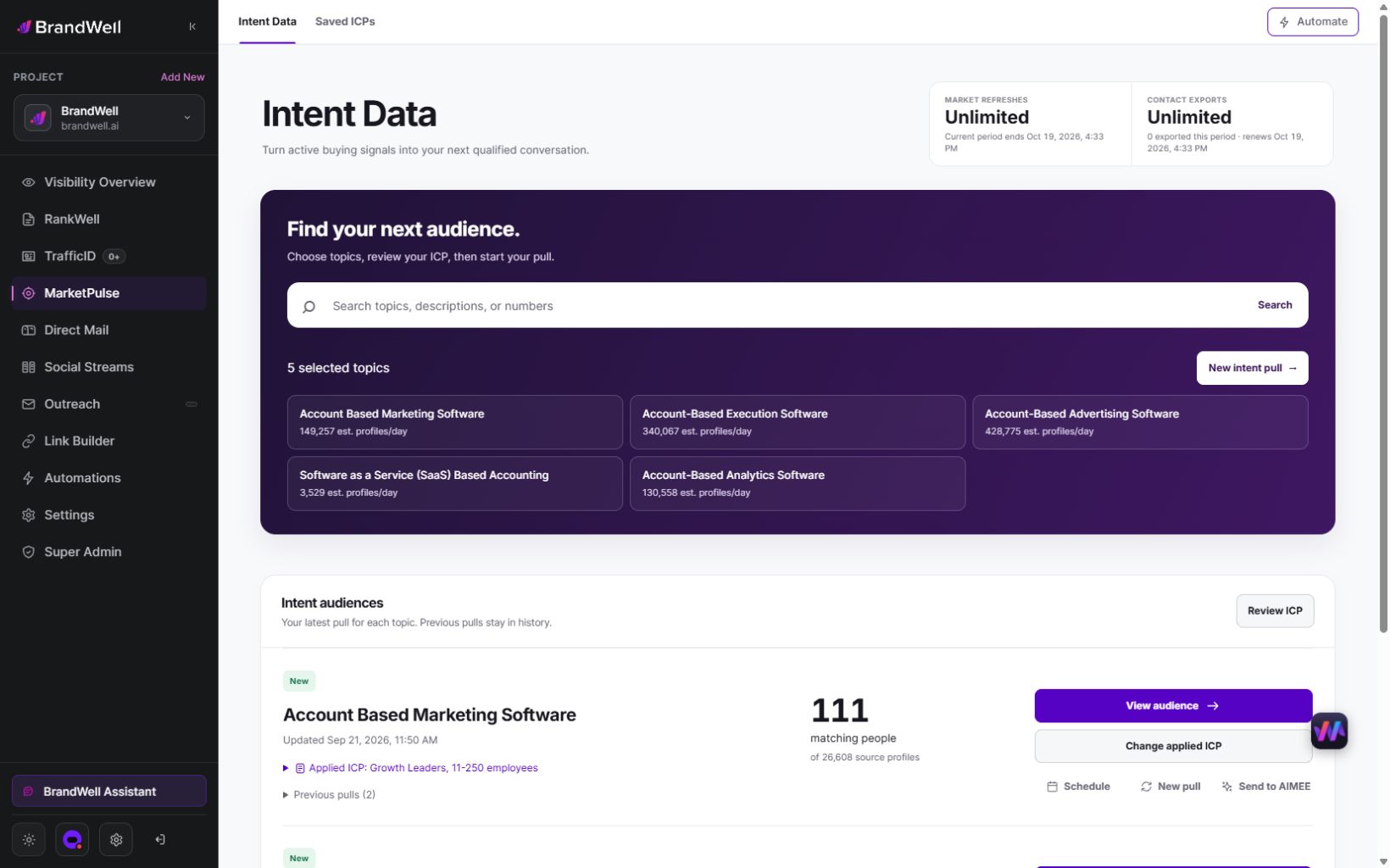
How the software connects the work:
- Find and qualify demand: MarketPulse brings topic-based intent into a reviewable audience with saved ICPs and scheduled pulls. TrafficID adds website visitor identification to the growth workflow.
- Prepare the next campaign: Outreach and Direct Mail provide execution workspaces; Social Streams adds relevant social activity. Use the tools and destinations configured for your project.
- Build demand as well as capture it: RankWell, Visibility Overview, and Link Builder connect content and visibility work with the same growth operation.
AIMEE helps carry the work forward
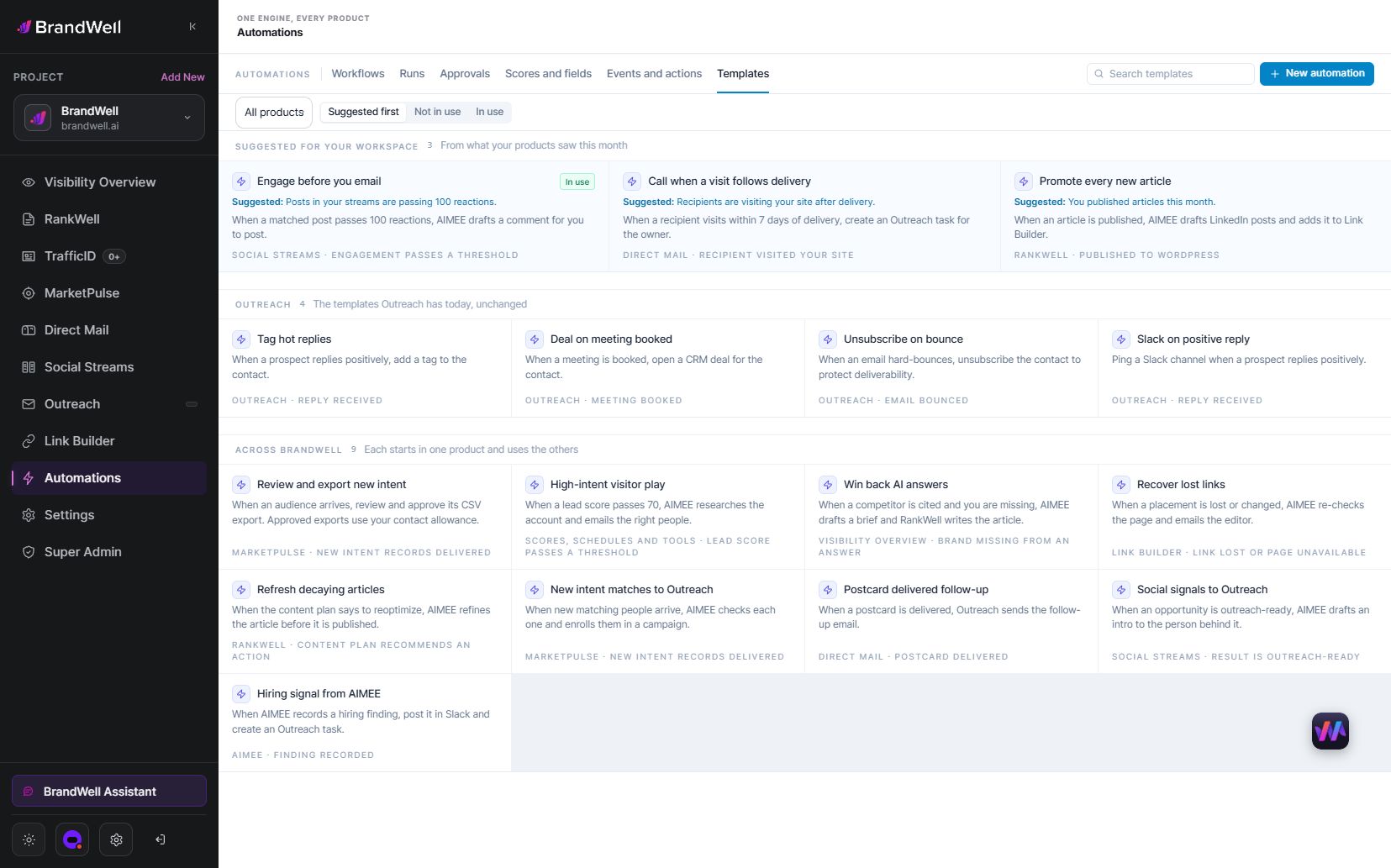
AIMEE is BrandWell’s agent-powered desktop app. It helps research accounts, prepare content and messages, and carry out assigned work through connected tools. BrandWell’s Automations workspace connects product events to workflow steps, with owners, approvals, and run history. You choose the connections, allowed actions, and budgets.
BrandWell MarketPulse intent-data plans start at $250/month. Your selected package determines topic coverage, contact allowances, refresh cadence, AIMEE access, and other growth tools. Channel usage, media, and fulfillment costs depend on the campaign.
What to evaluate: topic relevance, usable audience coverage, ICP fit, and the time it takes to turn an accepted signal into completed work. An intent signal helps prioritize an opportunity; it does not guarantee a purchase or establish permission for every channel. If your main requirement is a specialist data feed or an established enterprise ABM program, compare that specific scope with the alternatives below.
2. 6sense
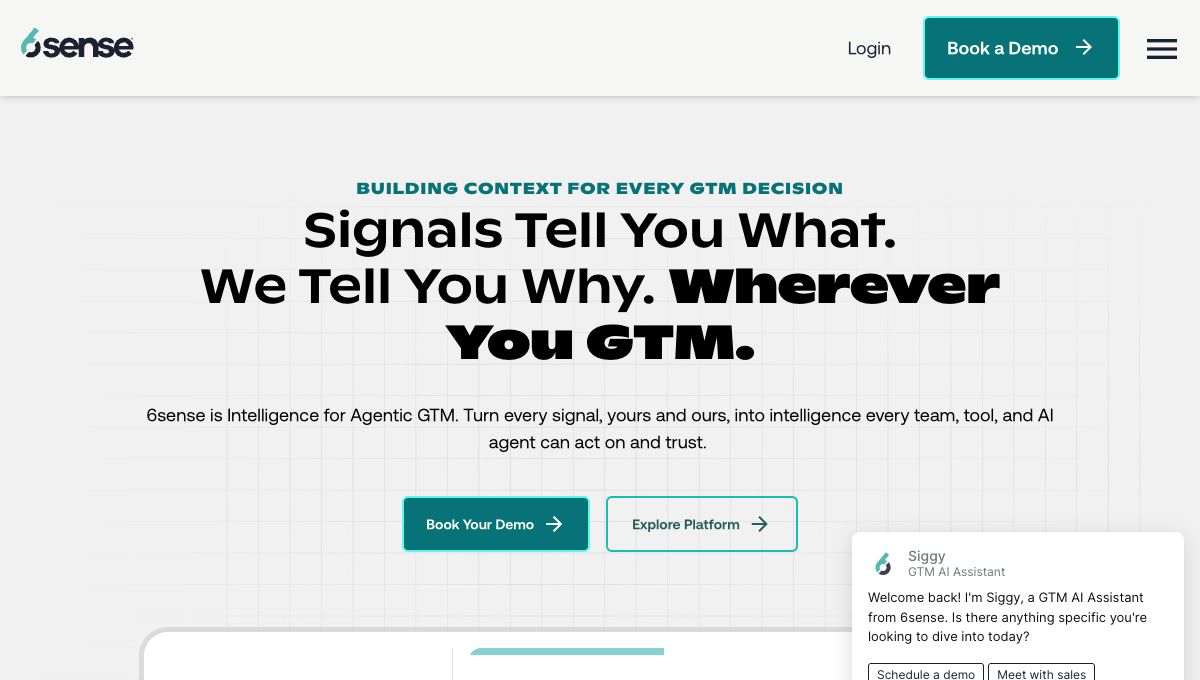
Best fit: Established agencies or enterprise-style consultancies with a sophisticated ABM stack, larger target market, and clients already using 6sense.
Signals and workflow: 6sense Sales Intelligence describes in-market account prioritization, people context, intent, predictive stages, alerts, and access through CRM, sales-engagement platforms, browser, or its own interface. That can support research and prioritization when the agency has the implementation capacity.
Agency suitability and pricing: No scope-matched public subscription figure was verified. Ask whether agency use, client separation, data rights, users, predictive models, CRM and sales-engagement integrations, services, and reporting are included. A platform designed for one enterprise revenue organization is not automatically a white-label reseller system.
Measurement: Test accepted-account and opportunity lift against a similarly fit cohort, not only the platform’s account-stage labels.
Meaningful limitation: Platform breadth, data governance, administration, and quote-based procurement can exceed what a small agency needs to prove its own outbound channel. It may be strongest when client demand already justifies the enterprise stack.
3. Demandbase
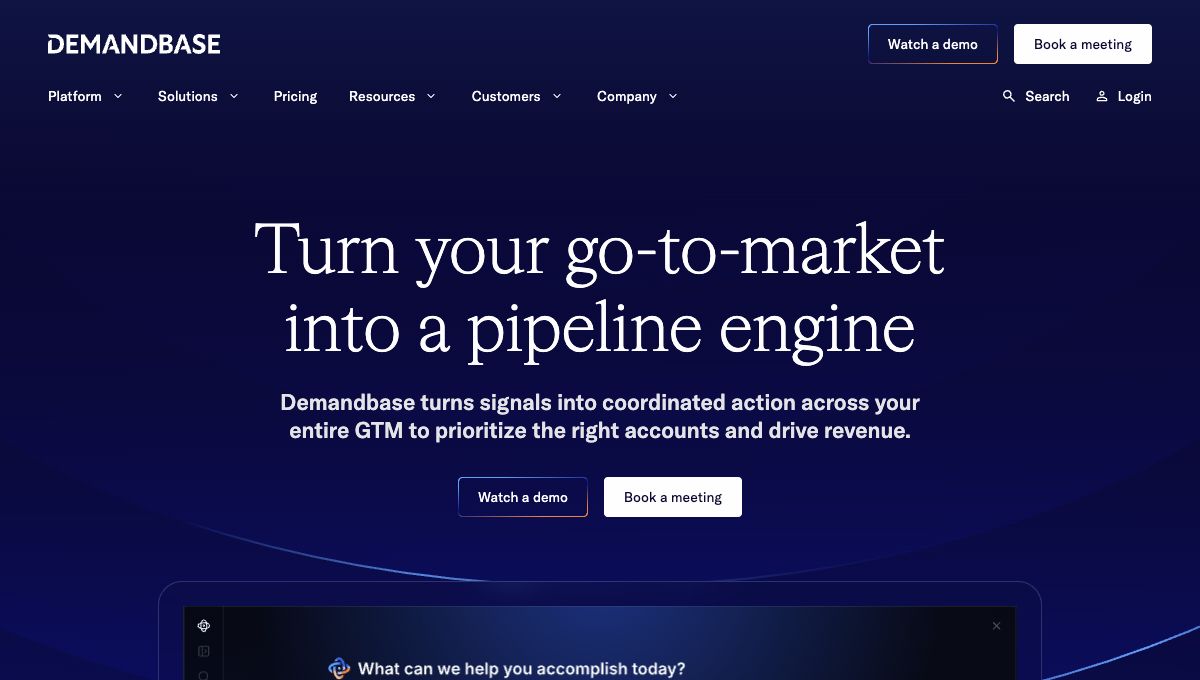
Best fit: Account-based agencies and consultants working with clients that already organize sales, marketing, advertising, and journey stages around Demandbase.
Signals and workflow: Demandbase’s official sales materials position the platform around focusing sellers on in-market accounts and buying groups. Its intent documentation and sales integrations can support prioritization and action when CRM ownership and account matching are mature.
Agency suitability and pricing: A comparable public amount was not verified. Obtain a quote and written rights for the exact users, data, intent, advertising, sales intelligence, CRM, sales-engagement actions, services, and client model. Do not assume a client platform license permits agency resale or cross-client operations.
Measurement: Use CRM stages and controlled outcome definitions to evaluate whether signaled accounts create more qualified conversations or faster progression.
Meaningful limitation: The platform is oriented toward coordinated ABM programs, which may be more infrastructure than an agency needs for a narrow self-prospecting pilot. Multi-client white-label economics require separate confirmation.
4. ZoomInfo
Best fit: Agencies with a substantial outbound practice that want a broad combination of company data, contacts, intent, orchestration, and engagement and can support enterprise procurement.
Signals and workflow: ZoomInfo’s public filing describes company, contact, and intent intelligence; CRM integration and routing; and multichannel engagement. This can consolidate research and execution, subject to purchased functionality and data-use terms.
Agency suitability and pricing: A current scope-matched price was not publicly verified. The filing says pricing depends on functionality, users, and data integrated, with contracts typically non-cancellable for one to three years. The agency should request explicit client-use rights, credits, data destinations, service levels, renewal, and exit terms.
Measurement: Separate the value of the underlying data from the effect of messages, rep effort, and the agency’s offer. Consolidation makes attribution convenient but not automatically causal.
Meaningful limitation: A long, broad commitment can be difficult to justify before an agency has proven its acquisition economics. Contact volume can also tempt teams back toward broad lists instead of disciplined signal qualification.
5. Dealfront
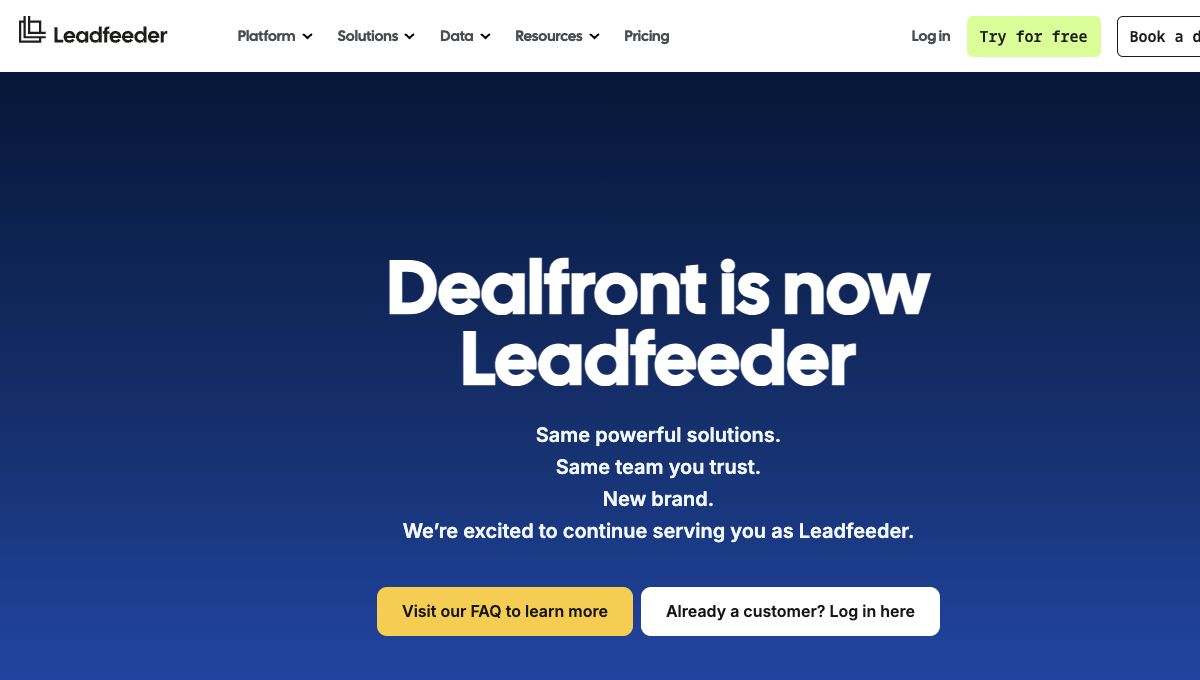
Best fit: B2B agencies that place strong emphasis on identifying companies visiting their own website, especially when European market context and web-led sales motions are important.
Signals and workflow: Dealfront sales-intelligence materials focus on company identification and prospecting context. Website behavior can be a high-value first-party signal when the agency has meaningful traffic and service pages mapped to real buying questions.
Agency suitability and pricing: Official materials describe modular sales-intelligence offerings, but no exact scope-matched amount for this comparison was verified. Ask for visitor identification, company/contact data, seats, filters, integrations, usage, client rights, service, and term.
Measurement: Track qualified identified visits, account acceptance, time to research, contactable buying-group members, conversations, and opportunities. Do not treat all identified traffic as sales intent.
Meaningful limitation: A visitor-led platform sees only accounts that reach the agency’s site. It may need third-party topic research or change signals to find in-market companies that have not encountered the brand, and person-level certainty remains a separate question.
Compare intent-led outbound with the status quo
Referrals alone carry trust and often close well, but timing and volume are outside the agency’s control. Keep referrals; use signal-led prospecting to create a second, measurable path. Broad cold lists can reach more accounts cheaply, but force the team to spend attention on companies with no current context. They can still support a carefully selected named-account motion when intent coverage is weak. Untargeted paid media builds awareness but may waste budget outside the ICP; intent-qualified audiences can narrow activation, although they still require match and incrementality testing.
The most resilient mix uses referrals for trust, helpful content for inbound demand, intent for prioritization, outbound for direct conversations, and paid media for air cover. Intent does not replace positioning or reputation. It chooses where scarce human and media attention should go first.
Model the economics before buying data
Start with contribution margin, not activity. Estimate monthly qualified accounts, human acceptance rate, contactable-account rate, approved outreach rate, qualified-conversation rate, opportunity rate, win rate, average first-year gross profit, and time to close. Then subtract data and platform cost, contact validation, tooling, operator hours, researcher or SDR hours, creative, media, compliance, and management.
Useful calculations include:
- Cost per accepted account = full program cost divided by accounts approved for action.
- Cost per qualified conversation = full cost divided by conversations meeting the agency’s qualification definition.
- Expected gross profit per accepted account = conversation rate × opportunity rate × win rate × average gross profit.
- Payback = acquisition cost divided by expected monthly gross profit from won retainers.
BrandWell MarketPulse intent-data plans start at $250/month. Your selected package determines topic coverage, contact allowances, refresh cadence, AIMEE access, and other growth tools. Channel usage, media, and fulfillment costs depend on the campaign.
Metrics that show agency growth rather than list growth
At the top of the funnel, track candidate accounts, qualified rate, rejection reasons, identity confidence, source overlap, and signal age. For operations, measure review SLA, research time, approved-action rate, send or call completion, duplicate prevention, opt-outs, and complaints. For revenue, measure qualified conversations, opportunities, pipeline, wins, first-year gross profit, sales-cycle length, and channel concentration.
Also track resale evidence: how many internal workflows become client-ready modules, pilot-to-paid conversion, wholesale cost, agency retail revenue, gross margin, client retention, and support hours. An agency can win its own clients with a method but still package it poorly; those are separate scorecards.
Use a holdout or phased rollout where feasible. Compare accounts with similar fit and signal strength that were not activated, and record concurrent referrals, ads, and content touches. This avoids crediting outbound for buyers who would have arrived anyway.
Privacy, deliverability, and trust boundaries
Never expose a creepy signal narrative. “We help companies building an ABM motion reduce wasted media” is safer and more defensible than “we saw someone at your company researching intent data.” Use business relevance and public context, not surveillance theater.
Commercial email requirements apply in B2B. Review the FTC CAN-SPAM compliance guide, along with applicable privacy law, calling rules, platform terms, and local requirements. Maintain accurate sender information, a valid postal address, opt-out processing, suppression across tools, and vendor oversight. Separate every client’s data, credentials, audiences, and reports.
Differentiate the agency without pretending intent is proprietary magic
Many agencies can buy similar data. Differentiation comes from the operating insight layered around it: a focused category point of view, better topic definitions, client-specific fit rules, a distinctive research artifact, disciplined approval, and transparent measurement. Lead with the buyer problem and the useful output, not the size of a database.
A credible offer might promise a weekly set of explainable in-market account opportunities, each with evidence, fit rationale, confidence, recommended action, and a feedback record. It should not promise that every account is “ready to buy.” Show rejected examples as well as accepted ones; this demonstrates that the agency is applying judgment rather than reselling a feed unchanged.
Create an asset that travels beyond direct outreach. A branded topic report, market map, benchmark, or account-level research graphic can support a thoughtful sales conversation and also become a shareable proof artifact. Keep public comments authentic and useful, disclose relevant affiliations, and require human review before posting. The distribution loop should reward insight, not automate spam.
Position the pilot as a decision product. At the end, the prospect should know which topics produced relevant accounts, which sources could be resolved, how much review was required, what actions were safe, and what a monthly service would cost. If the evidence is weak, recommend another signal mix or defer the program. That candor improves agency trust and protects margin by avoiding clients that cannot activate the data.
AIMEE is the agent-powered desktop app in BrandWell’s growth workflow. Assign work through the tools connected to your workspace and choose which actions can run automatically or require approval. Desktop availability, account permissions, and the configured workflow determine what can execute.
Turn self-use into a white-label client offer
After the agency has evidence from its own pipeline, it can sell a recurring intent intelligence module: branded topic reports, qualified account queues, visitor reveals, lead validation, agent-ready action plans, governance, and monthly outcome review. The client pays the agency’s retail price; the platform charges wholesale for enabled modules and usage. Outreach execution, paid media, and SDR labor should be scoped separately.
Start client conversations with a MarketPulse seven-day branded topic-report pilot. Show what signals exist, which accounts fit, what cannot be inferred, and which workflow would follow. Do not promise pipeline before the client approves topics, identity, channels, and measurement.
Agent-ready instructions for agency prospecting
These instructions can be run as an analysis workflow in Claude or ChatGPT or converted into approved browser actions with AIMEE. Public posting and direct outreach always require human judgment.
- Load the agency’s offer, ICP, disqualifiers, named accounts, customers, active opportunities, recent contacts, opt-outs, target roles, signal definitions, freshness limits, and capacity.
- Normalize candidate companies, resolve parent and subsidiary relationships, and assign identity confidence. Stop low-confidence matches.
- Score fit and signal separately. Keep the evidence source and avoid converting an account signal into a person claim.
- Research public company context, likely service need, existing relationship, and a genuinely useful asset or observation the agency can provide.
- Recommend one channel and next step per account. Create a draft call brief, email, ad-audience record, or comment asset without sending or posting it.
- Place every proposal in a human review queue with reason for relevance, risk flags, expiry, owner, and holdout status.
- After approval, execute only the authorized action, respect frequency and suppression, and record outcome in the CRM.
- Produce a weekly branded report covering sources, accepted accounts, rejection reasons, actions, responses, opportunities, cost, and the next controlled experiment. Require approval for any topic, threshold, or channel change.
Intent led outbound for agencies succeeds when the agency learns faster and contacts fewer irrelevant companies. To validate a branded signal report and client-acquisition queue before scaling, request BrandWell’s scoped MarketPulse evaluation.