Direct answer: Treat off-site research intent as time-bounded evidence that a company or market may be researching a problem – not proof that a named person is buying. The useful workflow is to preserve where the signal came from, define what was observed, combine it with account fit and freshness, choose the least invasive eligible action, and feed qualified-opportunity outcomes back into the model.
BrandWell update, September 2026: MarketPulse intent data starts at $250/month within BrandWell’s complete growth automation software. AIMEE, the agent-powered desktop app, helps connect buyer signals with research, content, and campaign work. Access to the broader tools depends on your package.
BrandWell: MarketPulse intent data and connected growth automation
From audience to action: connect intent data with the work needed to use it. BrandWell is complete growth automation software that connects MarketPulse intent data, TrafficID website visitor identification, content, outreach, and campaign workflows. AIMEE, its agent-powered desktop app, helps turn those signals into research, prepared assets, and approved actions.
For growth teams, the useful result is a current audience and a clear next action. MarketPulse connects topic selection and ICP filtering with audience review, export, scheduling, and a handoff to AIMEE.
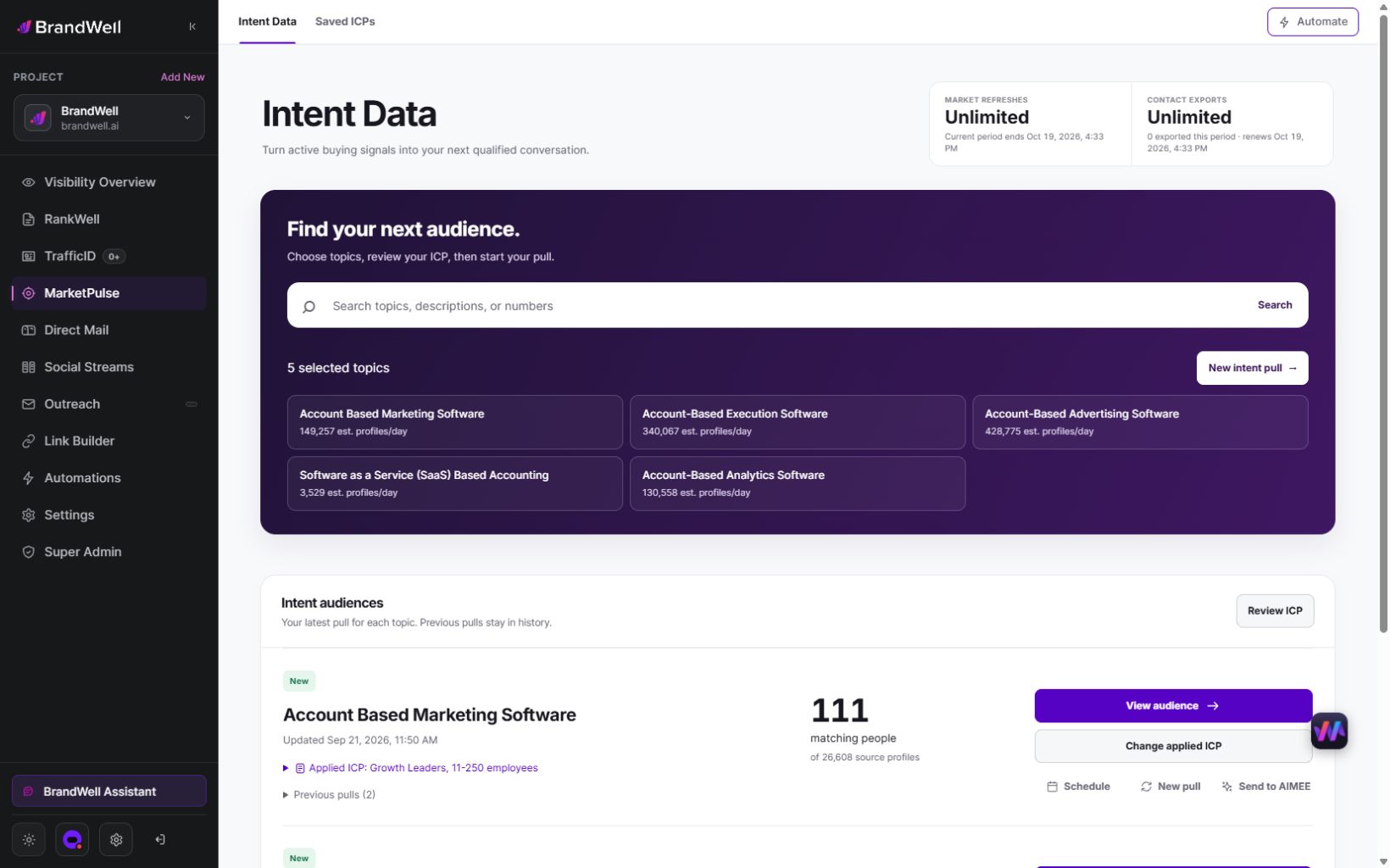
How the software connects the work:
- Find and qualify demand: MarketPulse brings topic-based intent into a reviewable audience with saved ICPs and scheduled pulls. TrafficID adds website visitor identification to the growth workflow.
- Prepare the next campaign: Outreach and Direct Mail provide execution workspaces; Social Streams adds relevant social activity. Use the tools and destinations configured for your project.
- Build demand as well as capture it: RankWell, Visibility Overview, and Link Builder connect content and visibility work with the same growth operation.
AIMEE helps carry the work forward
AIMEE is BrandWell’s agent-powered desktop app. It helps research accounts, prepare content and messages, and carry out assigned work through connected tools. BrandWell’s Automations workspace connects product events to workflow steps, with owners, approvals, and run history. You choose the connections, allowed actions, and budgets.
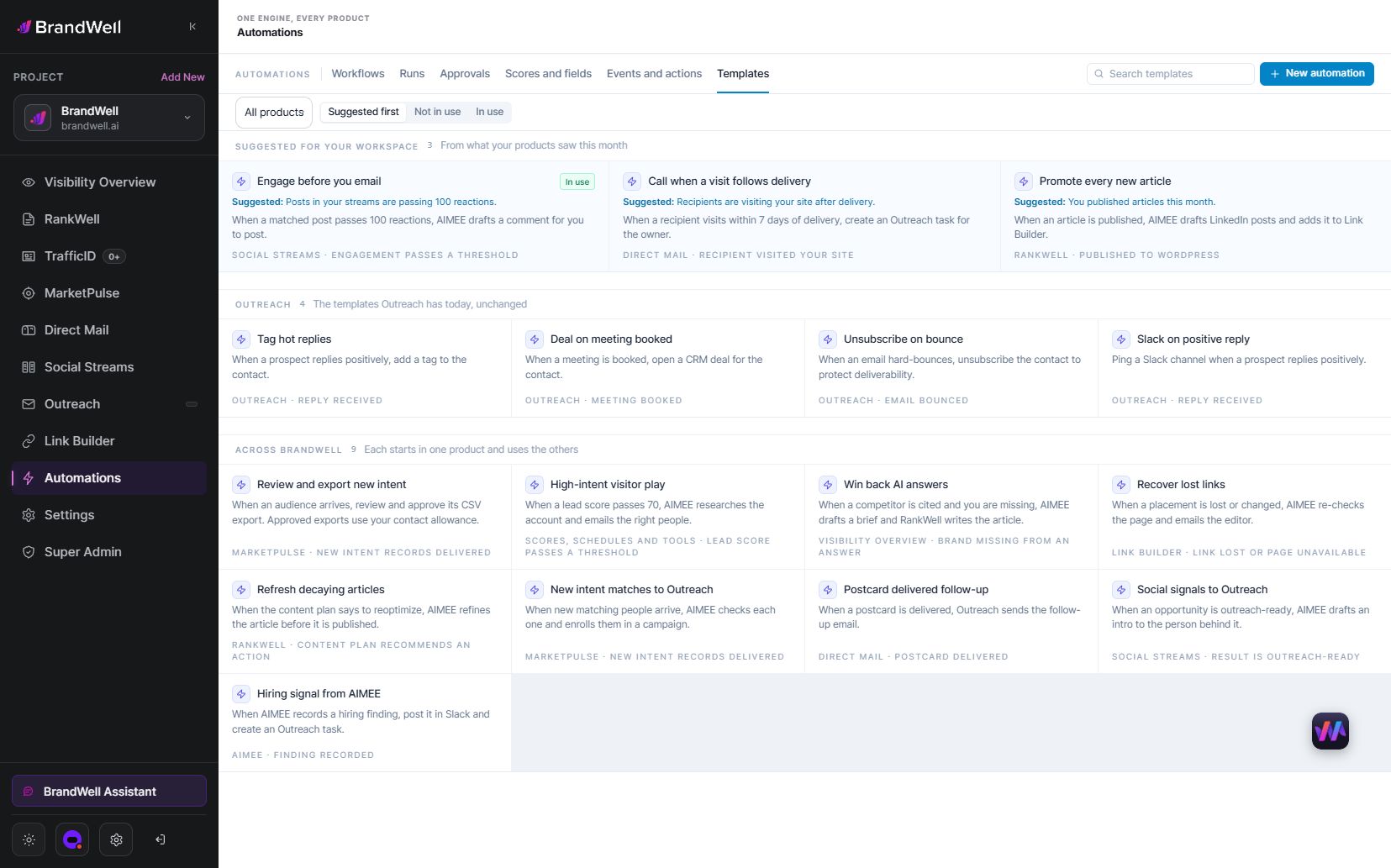
BrandWell MarketPulse intent-data plans start at $250/month. Your selected package determines topic coverage, contact allowances, refresh cadence, AIMEE access, and other growth tools. Channel usage, media, and fulfillment costs depend on the campaign.
What to evaluate: topic relevance, usable audience coverage, ICP fit, and the time it takes to turn an accepted signal into completed work. An intent signal helps prioritize an opportunity; it does not guarantee a purchase or establish permission for every channel. Choose a workflow your team can operate, then evaluate the audience and the completed work against that goal.
Who is this for?
This guide is for demand generation, ABM, RevOps, sales-intelligence, and agency teams that want earlier evidence than a form fill or an owned-site conversion. It works best when the team has a defined account universe, meaningful deal economics, clear opportunity stages, and someone who can review signals while they are still useful.
It is not a shortcut to knowing who will buy. An off-site topic event can represent an account, device, content cohort, household, modeled segment, or another unit. Identity resolution is a separate step, and even a high-confidence match does not prove that the resolved person generated the research event, consented to outreach, or has a purchase project.
1. Pass the signal-to-action decision gate
Start with the decision you may make. “Find in-market buyers” is too vague. “Move a well-fit account into a human review queue when it shows recent research across three tightly related topics” is testable.
Before acting, answer seven questions:
- Provenance: Who collected the event, from what source class, and through how many reseller or modeling layers did it pass?
- Observation unit: Is the evidence aggregate, topic-cohort, account, device, contact, or authenticated first-party person data?
- Topic quality: Is the topic specific to the buyer problem, or broad enough to include students, job seekers, competitors, customers, and casual readers?
- Freshness: When was it observed, how quickly does relevance decay, and is the buying cycle long enough for the signal to matter?
- Fit: Does the account match the industry, size, geography, operating model, and commercial constraints of the offer?
- Permission: Does the proposed use fit contracts, privacy notices, applicable law, channel rules, suppression lists, and the client’s own policies?
- Feedback: Can sales acceptance, qualified opportunity, loss reason, and revenue status return to the model?
The IAB Tech Lab Data Transparency Standard offers a useful due-diligence vocabulary for provenance, recency, and segmentation criteria. It is a disclosure baseline, not a quality grade. A complete disclosure can still describe a weak segment, so inspect representative output and rejection reasons before committing scarce sales attention.
The best-fit use cases have a finite account universe, enough signal activity to create a reviewable sample, and an operator who can act within the chosen freshness window. Use aggregate research instead when the audience is too small, identity is unnecessary, or person-level activation would be disproportionate.
2. Keep six evidence layers separate
An explainable off-site research intent framework keeps each layer visible rather than hiding everything inside one “hot account” score.
- Topic evidence: the topic or cluster, event source, observation unit, timestamp, baseline, and confidence.
- Account fit: firmographic and operational facts that explain why the organization could buy.
- Optional identity: the separate match method, match confidence, provenance, and permitted purpose.
- Freshness: a documented window and decay rule appropriate to the sales cycle.
- Activation eligibility: the destination, data rights, suppression result, sensitive-topic check, and named approver.
- Outcome evidence: the action taken, seller disposition, qualified stage, revenue result, and elapsed time.
A composite score may help sort work, but every row should retain the reason codes. If a seller cannot see whether a record ranked highly because of fit, recency, repeat topic activity, or a modeled match, the score cannot support a good decision or a useful correction.
This separation also prevents a common category error: adding enrichment to an account signal does not turn it into first-party data or prove which employee did the research. Google’s Customer Match policy, for example, limits eligible uploads to customer information collected in a first-party context and imposes other account and policy conditions. Hashing or resolving third-party records does not change their collection context.
3. Choose one of seven proportionate uses
These off-site research intent use cases use the same criteria: decision, evidence gate, best fit, action, limitation, and measurement. Choose the least invasive option that can answer the business question.
Method 1: Aggregate market analysis
Decision: Is attention to a problem category changing enough to influence content, market research, or client planning?
Evidence gate: Stable topic definitions, adequate aggregate volume, known methodology, and a comparable baseline.
Best fit and action: Use it for category research or branded client reports. Describe direction and uncertainty; do not create a person-level lead queue.
Limitation and measurement: Aggregation hides account differences and cannot identify a buyer. Measure topic coverage, stability, report use, and whether later tests support the hypotheses.
Method 2: Account prioritization
Decision: Which accounts in an existing target list deserve review first?
Evidence gate: Account-level evidence or a documented account-resolution method, recent activity, and an ICP rule.
Best fit and action: Rank a finite account universe, then move only corroborated accounts to a human reviewer with a visible reason code.
Limitation and measurement: The signal does not identify the researcher or prove a buying project. Track accepted priorities, false-positive reasons, meetings, qualified opportunities, and win/loss movement.
Method 3: Topic-cluster monitoring
Decision: Does repeated research across related problems justify a higher priority than one broad topic event?
Evidence gate: A maintained topic dictionary, inclusion and exclusion rules, a baseline, and a decay window.
Best fit and action: Monitor narrow clusters for complex products. Escalate repeat or convergent activity rather than every single event.
Limitation and measurement: Loose clusters can manufacture apparent surges. Measure cluster precision, repeat-signal rate, and downstream qualification by cluster.
Method 4: Optional contact resolution
Decision: Is account context insufficient for a permitted, high-value next step?
Evidence gate: A documented purpose, contract permission, provenance, confidence threshold, suppression check, minimization rule, and human approval.
Best fit and action: Resolve only the minimum data needed for a small set of high-value cases. Keep identity confidence and the original account signal in separate fields.
Limitation and measurement: A match can be wrong and does not prove that person performed the research. Track verified-contact coverage, corrections, complaints, and qualified outcomes – not raw match volume.
Method 5: Human-reviewed outreach
Decision: Can the evidence support a relevant, non-invasive message to an eligible contact?
Evidence gate: Permitted contact data, jurisdiction and channel review, suppression, a helpful message, and named sender approval.
Best fit and action: Use a small, high-fit account set. Discuss the business problem rather than announcing that you watched someone research it.
Limitation and measurement: Surveillance-style wording destroys trust, and B2B status is not a universal exemption. The FTC’s CAN-SPAM guidance covers commercial B2B email and requires accurate headers, non-deceptive subjects, disclosures, an opt-out mechanism, and prompt suppression. Measure positive replies and qualified meetings alongside opt-outs and complaints.
Method 6: Eligible paid activation
Decision: Can the signal lawfully and contractually enter a destination that permits it?
Evidence gate: Documented data rights, destination eligibility, required consent, sufficient audience size, and sensitive-topic exclusion.
Best fit and action: Use an eligible aggregate or first-party route with a prewritten test plan. If eligibility is unclear, keep the data in planning or account-review workflows.
Limitation and measurement: Third-party topic evidence is not automatically an eligible customer list, and excessive layers can shrink delivery until the test learns nothing. Measure qualified conversions, reach, frequency, downstream value, and incremental lift where a valid comparison is feasible.
Method 7: Agency topic reports
Decision: Can the agency turn changing evidence into a repeatable client decision and service?
Evidence gate: Client-approved topics, a provenance statement, action boundaries, reporting cadence, access controls, reviewer ownership, and outcome feedback.
Best fit and action: Deliver what changed, why it matters, confidence, exclusions, recommended next step, and what happened after the last recommendation.
Limitation and measurement: A list of names and scores becomes noise quickly. Measure client adoption, recommendations accepted, qualified pipeline, renewal, expansion, and privacy or quality exceptions.
4. Build the minimum operating workflow
A practical implementation guide needs more than a data feed. Assign an owner to each handoff:
- Define topics and exclusions. Product marketing and sales clarify the problems, alternatives, use cases, and misleading terms.
- Ingest with provenance. Data or RevOps stores source class, observation unit, event time, transformation, permitted use, and supplier terms.
- Normalize time and entities. Standardize timestamps, deduplicate records, map domains to accounts, and retain confidence.
- Join fit without overwriting evidence. Add ICP facts and an explicit rejection reason while preserving the original signal.
- Apply the action gate. Check freshness, corroboration, jurisdiction, suppression, sensitive topics, channel policy, and reviewer ownership.
- Create a review queue. Show the evidence stack, conflicts, recommended action, and a “do not act” option.
- Route only approved actions. A named human approves outreach, ad activation, CRM writes, or data deletion.
- Return outcomes. Capture rejection, accepted action, qualified stage, revenue status, complaint, correction, and elapsed time.
Useful operational resources include a topic dictionary, signal field guide, provenance questionnaire, recency rubric, account-to-person resolution checklist, approval matrix, suppression ledger, outcome taxonomy, and a monthly calibration worksheet. Those tools matter more than collecting the largest possible number of events.
The NIST Privacy Framework can help teams identify processing, governance, individual-control, communication, and protection needs. It is voluntary process guidance, not a legal conclusion or a provider certification.
5. Compare off-site research with fit and owned engagement
Static firmographics answer who could buy. Owned-site and product engagement answer who interacted with the company. Off-site research intent suggests who may be exploring the problem or category before that owned interaction.
Use firmographics first when the market is stable and sales capacity is the main constraint. Use owned engagement first when the site or product has enough authenticated, meaningful activity. Add off-site research when earlier timing could change a high-value decision and the source can explain its observation unit.
The strongest operating model combines the three:
- Fit prevents irrelevant research from consuming attention.
- Off-site evidence may improve timing before a conversion.
- Owned engagement strengthens company-specific relevance.
- CRM outcomes reveal whether the combined rule is useful.
Do not force every team into the full stack. A small account list may be better served by manual research. A high-volume, low-value offer may not support the review cost. A company with broken first-party instrumentation should repair it before buying a more complex explanation of demand.
6. Budget for the full evidence-to-action system
The subscription is only one line in off-site research intent pricing. Model:
- topic design, coverage, and refresh;
- data rights and source due diligence;
- optional account matching, identity, validation, or enrichment;
- integration, storage, and access controls;
- analyst and seller review;
- creative, outreach, media, or activation work;
- suppression, correction, retention, and deletion operations;
- CRM outcome capture, experiments, and reporting;
- onboarding, support, overages, contract term, and exit costs.
Ask every supplier for a written scope that defines topics, observation unit, geography, freshness, confidence, volume, destinations, users, service work, overages, deletion, export, and offboarding. Compare cost per eligible account, accepted review, and qualified opportunity before cost per raw record.
Do not use a universal ROI benchmark. The right ceiling depends on gross profit per win, realistic incremental wins, sales capacity, and time to outcome. A program can be affordable at a higher license cost if it replaces fragmented labor and improves accepted opportunities; a cheap feed is expensive if no one trusts or uses it.
7. Measure quality before claiming pipeline impact
Use three scorecards.
Signal quality: relevant coverage, provenance completeness, recency, topic precision, account-match confidence, duplicates, corrections, and false-positive reasons.
Operating adoption: reviewed within the useful window, accepted priorities, approved actions, seller follow-through, suppression compliance, and routing failures.
Business outcomes: qualified meetings, accepted opportunities, stage progression, gross profit, and time to outcome with a stated denominator and attribution rule.
Keep sourced, influenced, and incremental outcomes distinct. A closed opportunity that touched an intent-ranked account may be influenced; that does not show the program caused it. Where volume permits, use a holdout, phased rollout, or another comparison design. Research on incrementality through experimentation illustrates why observational attribution and causal decisions can diverge, but the method and statistical power still need to fit the program.
Prewrite stop and repair rules. Stop when provenance is unacceptable, relevant coverage is insufficient, actions are routinely ineligible, complaints are high, or qualified outcomes cannot justify total cost. Repair when the data is useful but the topic set, fit rule, SLA, message, or feedback loop is weak.
8. Control privacy, quality, and trust failures
Reject opaque data lineage, stale events presented as current, broad topics labeled as buying intent, sensitive-topic targeting, identity overclaiming, unsuppressed outreach, unlimited retention, and autonomous consequential action.
For third-party personal data, map who acts as controller, processor, supplier, or reseller; what notice and rights apply; and how corrections, objections, deletion, and downstream suppression travel. UK teams should review the ICO’s B2B marketing guidance, which explains that personal-data duties still matter in business marketing and that corporate, sole-trader, and partnership contexts can differ. Other jurisdictions and channels require their own review.
Security controls should minimize collection, restrict access, protect transfers and storage, supervise service providers, and remove data when the purpose ends. An agent may prepare a summary or recommendation, but a person must approve data use, outreach, audience activation, campaign spend, CRM changes, and client-facing claims.
9. Package the service – and decide whether BrandWell fits
An agency can sell this as a governed operating service rather than a raw signal feed. A strong package includes topic design, source and limitation disclosure, branded reporting, a review queue, permitted activation recommendations, outcome measurement, and periodic recalibration. The client approves topics and consequential actions; the agency owns delivery quality and reports what the evidence cannot establish.
BrandWell is a potential fit when the agency wants a complete growth automation platform with agency delivery options, branded portals or reports, configurable intent-data modules and automations, and agency-controlled client billing and retail pricing. It is the current MarketPulse intent-data and growth automation platform built on LeadFuze infrastructure – connected with the broader BrandWell content and growth tools. Confirm current entitlements, client isolation, supported destinations, usage, export, and offboarding before promising a service.
Start with MarketPulse intent data from $250/month. Review a topic and its matching audience, then use BrandWell’s connected growth tools and AIMEE desktop assistance to prepare the next action. Agency packaging and services can be scoped around the client workflow.
AIMEE is the agent-powered desktop app in BrandWell’s growth workflow. Assign work through the tools connected to your workspace and choose which actions can run automatically or require approval. Desktop availability, account permissions, and the configured workflow determine what can execute.
Treat every intent, identity, account match, and recommendation as probabilistic evidence. Before activation, assign named human owners for editorial claims, product configuration, pricing, privacy, security, compliance, legal review, and platform policy. Agents can prepare options; people approve consequential decisions and document exceptions.
BrandWell does not make probabilistic evidence deterministic, supply consent, replace an ad platform or CRM, or guarantee pipeline. Its useful role is to help an agency turn governed topic evidence into a branded, repeatable client service with explicit limits and measurable decisions.