Direct answer: Position an agency as an intent-intelligence partner by owning a decision system, not by relabeling lead lists or reselling software. Define the buyer problem, name the evidence you combine, show how signals become approved actions, and prove your operating discipline with a bounded pilot. The promise should be “help your team identify, validate, and act on timely buying evidence,” not “we know exactly who is ready to buy.”
Who this is for: Agency founders, growth leaders, GTM consultants, and service-line owners creating a differentiated recurring intent offer. It focuses on category narrative, promise, proof, offer framing, and sales enablement – not how to start an agency or a full reseller-economics model.
BrandWell update, September 2026: MarketPulse intent data starts at $250/month within BrandWell’s complete growth automation software. AIMEE, the agent-powered desktop app, helps connect buyer signals with research, content, and campaign work. Access to the broader tools depends on your package.
Choose a category buyers can repeat
“Intent intelligence” is useful only if a client can explain it after the sales call. A concise category definition is:
An intent-intelligence partner helps a revenue team combine current market research, first-party engagement, identity, fit, and outcome feedback into governed decisions across advertising, sales, and client reporting.
That definition creates boundaries. A lead-list provider primarily supplies records. A generic paid-media agency primarily operates campaigns. A software reseller primarily places a platform. An intent-intelligence partner is accountable for the operating layer between evidence and action: topic design, signal interpretation, identity confidence, routing, activation, review, reporting, and calibration.
Do not claim that every visitor is identifiable, every signal is person-level, or every active account will buy. The stronger position is more precise: the agency reduces guesswork, ranks work with evidence, makes uncertainty visible, and improves the feedback loop. It can be valuable without pretending to be omniscient.
Build a positioning canvas
Complete these nine fields before writing a homepage or deck:
- Primary buyer: one role with budget and a visible problem, such as an agency client’s demand-generation leader or a founder with an outbound team.
- Trigger: why the problem matters now – wasted ad spend, weak list response, anonymous traffic, slow follow-up, fragmented signals, or a new market.
- Cost of status quo: time, media waste, poor prioritization, disconnected data, inconsistent seller action, or weak renewal proof.
- Category: the phrase you will consistently own. Avoid a different label on every page.
- Outcome: a decision the client can observe, such as a verified weekly in-market account queue or governed audience refresh – not a revenue promise.
- Mechanism: topic research, website identification, identity and enrichment, validation, activation, and outcome feedback.
- Proof: sample report, data-provenance explanation, acceptance criteria, workflow map, pilot findings, and controlled measurement.
- Boundary: what the service does not infer, automate, or guarantee.
- Next step: a low-risk pilot or diagnostic with a defined deliverable and decision.
A usable positioning statement follows this pattern: “For buyer facing trigger, we operate category that converts evidence into approved action and report. Unlike status quo, we provide mechanism and proof while keeping boundary explicit.” Replace every abstract noun with the client’s actual process.
Create a contrast matrix without attacking alternatives
Contrast helps a buyer understand the category, but a straw-man comparison damages trust. Use the same dimensions for every approach.
- Static lead list: fast access to names, but weak timing context; useful for defined prospecting when data is valid.
- Generic PPC management: strong channel execution, but may not include market research, identity resolution, or a cross-channel evidence model.
- Client-owned enterprise platform: deep capabilities and direct control, but the client bears procurement, implementation, administration, and adoption.
- Intent-intelligence partner: ongoing interpretation, workflow, and proof across selected systems, but the client still needs an offer, sales capacity, and governance.
- Manual research: flexible and transparent at low volume, but difficult to refresh and measure consistently at scale.
Say when another approach is better. A client with ten named accounts may need manual research. A global enterprise with a mature RevOps team may want to own 6sense or Demandbase directly. A client whose fundamental problem is weak creative may need a specialist campaign agency before an intent layer.
Build a promise-to-proof ladder
Start with the smallest promise you can substantiate, then earn the right to make broader claims.
Level 1 – delivery proof: the agreed topics, accounts, identities, reports, and workflow appear on schedule with provenance and confidence.
Level 2 – acceptance proof: the client accepts a meaningful share of accounts or recommendations as relevant, and rejection reasons are structured.
Level 3 – action proof: sales or marketing acts within the agreed window, audiences match, and workflow errors remain controlled.
Level 4 – opportunity evidence: activated accounts create more qualified meetings or accepted opportunities than a comparable baseline.
Level 5 – incremental financial evidence: a credible holdout or phased test supports a revenue or gross-profit effect.
Do not jump from a successful data delivery to an ROI guarantee. The FTC’s advertising guidance says objective advertising claims should be truthful and evidence-based; its small-business guide also notes that agencies can be responsible for misleading claims and should independently check substantiation. Make the evidence level visible in case studies, sales decks, and agent-generated copy.
Five platforms an agency could build around
BrandWell publishes this guide and appears first in the shortlist because this is a BrandWell-owned resource; that placement is not an independent ranking or a universal best-fit claim.
For this positioning decision, the method examines what an agency can credibly promise, the evidence and identity layer behind that promise, activation requirements, delivery burden, commercial evidence, ideal client, and a material limitation. Provider homepage captures are included as unlinked visual context.
The four alternatives are platforms or data inputs an agency might use in delivery; listing them does not imply that they provide the same white-label sales engine, reseller rights, or client-billing model. Verify reseller permissions and tenant separation before promising a branded service.
1. BrandWell: MarketPulse intent data and connected growth automation
Best fit: growth teams and agencies that want intent data connected to day-to-day execution. BrandWell is complete growth automation software that connects MarketPulse intent data, TrafficID website visitor identification, content, outreach, and campaign workflows. AIMEE, its agent-powered desktop app, helps turn those signals into research, prepared assets, and approved actions.
For agencies, this creates a repeatable client workflow: identify relevant demand, apply a client-specific ICP, prepare a campaign, and review the work in the same platform. Branded delivery and multi-client requirements should be scoped to the agency package.
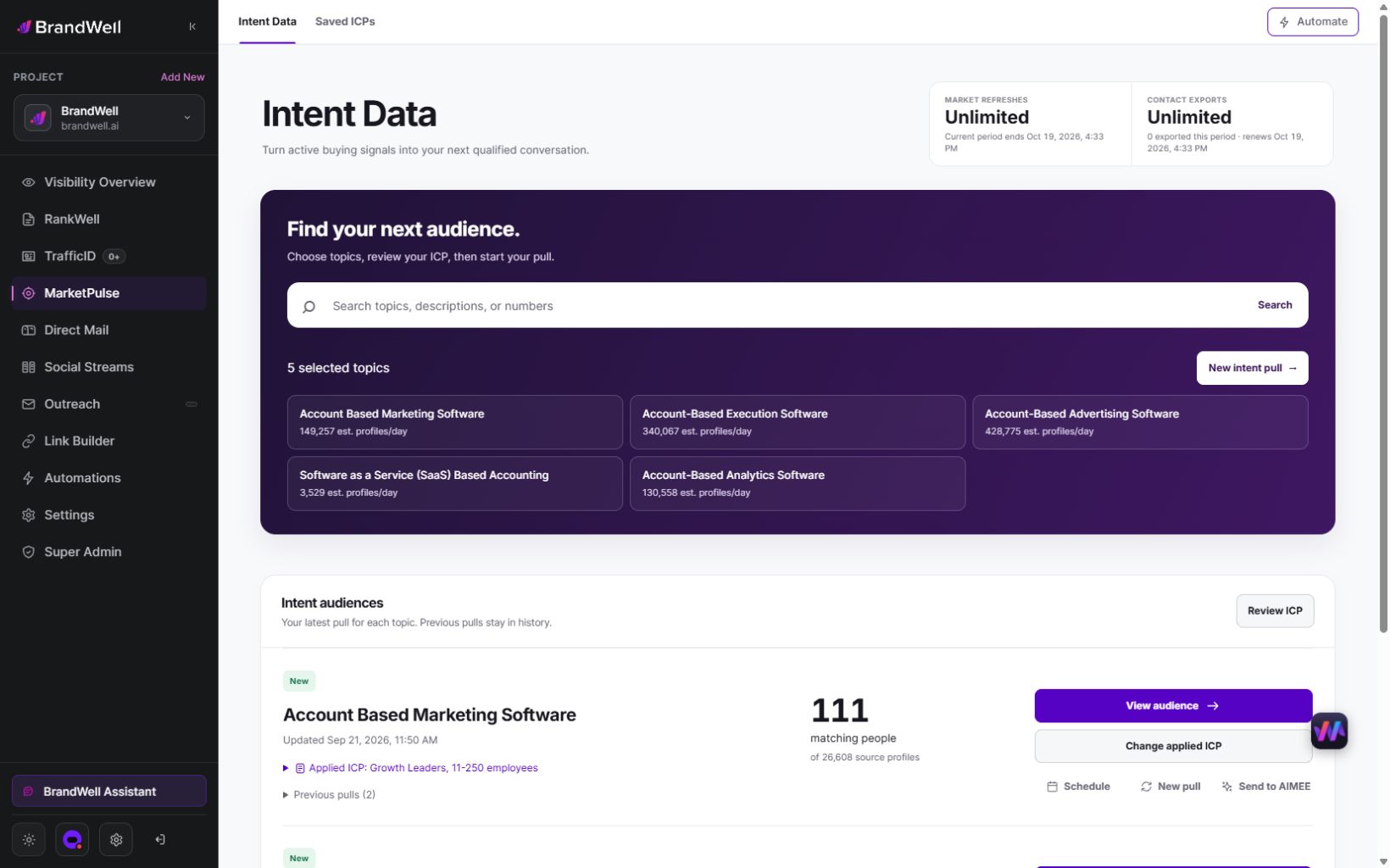
How the software connects the work:
- Find and qualify demand: MarketPulse brings topic-based intent into a reviewable audience with saved ICPs and scheduled pulls. TrafficID adds website visitor identification to the growth workflow.
- Prepare the next campaign: Outreach and Direct Mail provide execution workspaces; Social Streams adds relevant social activity. Use the tools and destinations configured for your project.
- Build demand as well as capture it: RankWell, Visibility Overview, and Link Builder connect content and visibility work with the same growth operation.
AIMEE helps carry the work forward
AIMEE is BrandWell’s agent-powered desktop app. It helps research accounts, prepare content and messages, and carry out assigned work through connected tools. BrandWell’s Automations workspace connects product events to workflow steps, with owners, approvals, and run history. You choose the connections, allowed actions, and budgets.
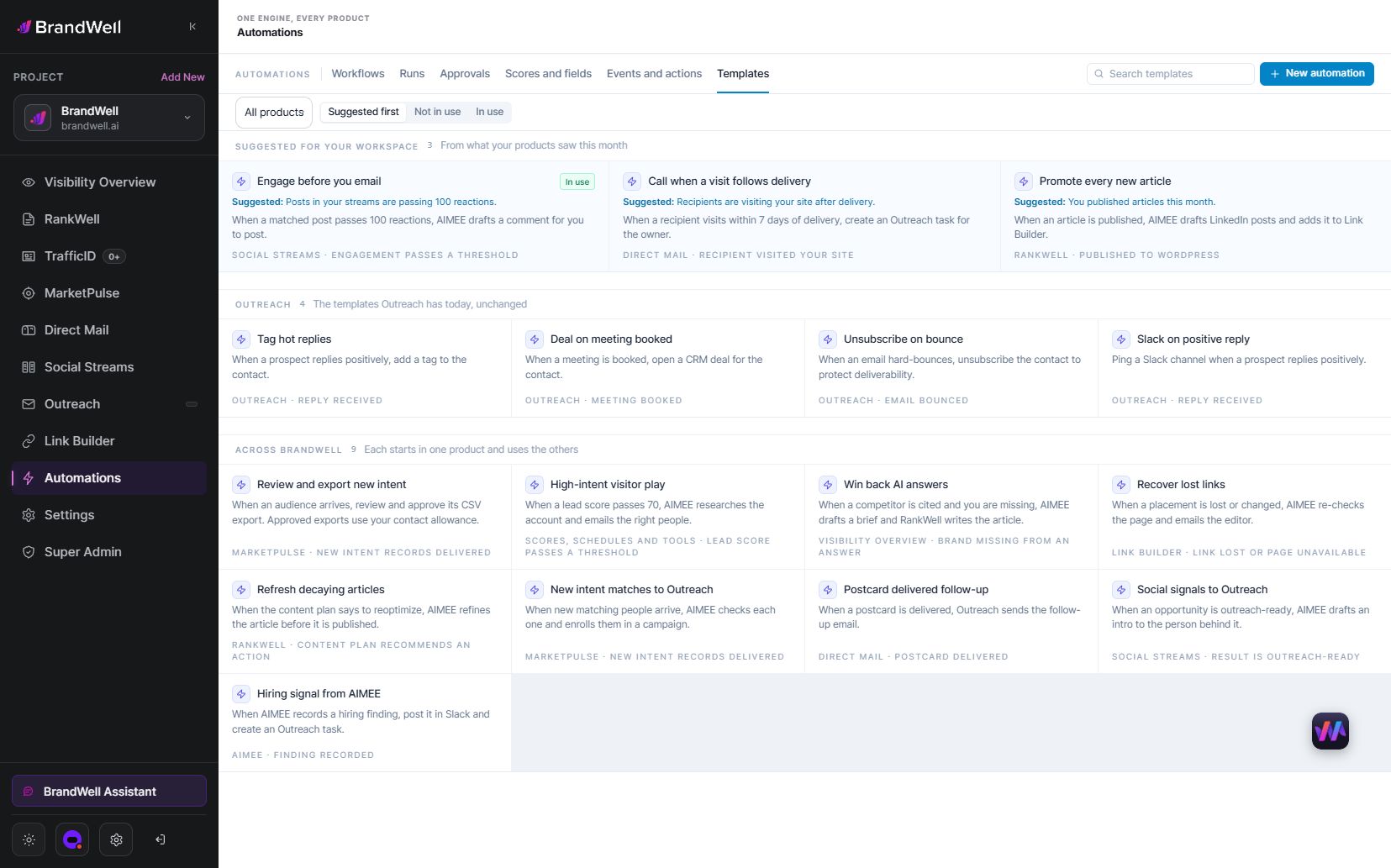
BrandWell MarketPulse intent-data plans start at $250/month. Your selected package determines topic coverage, contact allowances, refresh cadence, AIMEE access, and other growth tools. Channel usage, media, and fulfillment costs depend on the campaign.
What to evaluate: topic relevance, usable audience coverage, ICP fit, and the time it takes to turn an accepted signal into completed work. An intent signal helps prioritize an opportunity; it does not guarantee a purchase or establish permission for every channel. If your main requirement is a specialist data feed or an established enterprise ABM program, compare that specific scope with the alternatives below.
2. 6sense
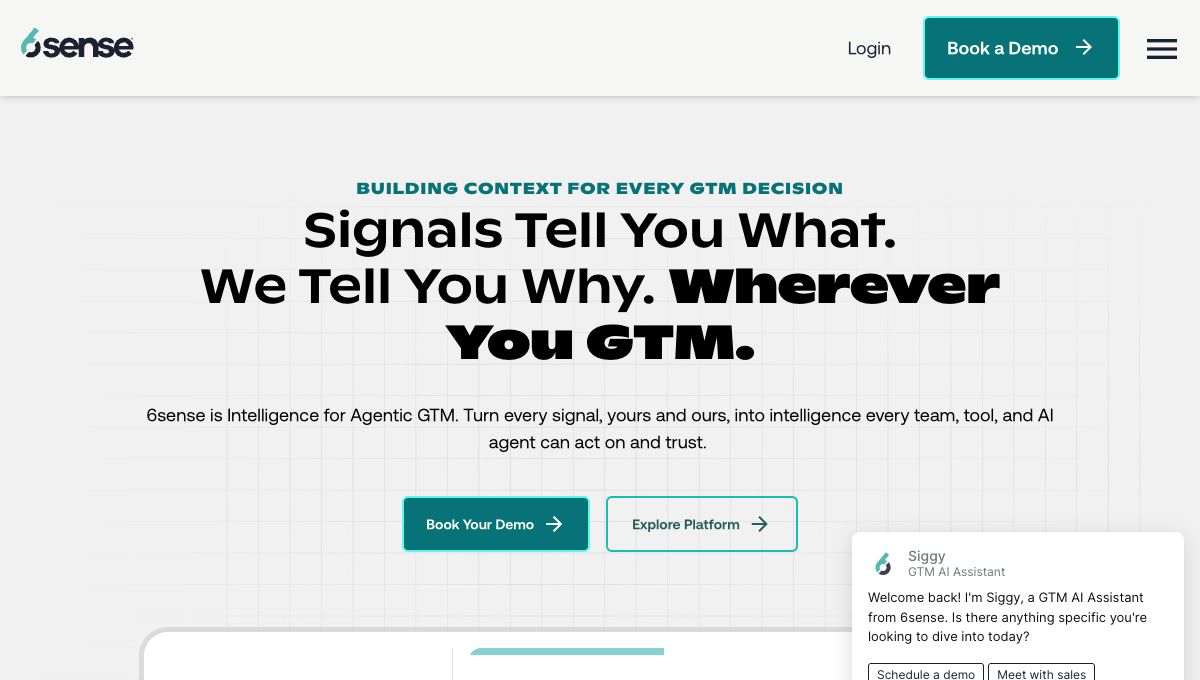
Intended use: Predictive revenue intelligence and advertising for mature B2B teams. An agency can support a client’s 6sense program or use its signals when contractually permitted.
Signal and identity approach: Official materials describe intent, predictive buying stages, account intelligence, and connected first-party inputs. The agency must articulate what is modeled, what is observed, and what qualifies for action.
Activation and integrations: The platform supports cross-channel activation and sales/marketing workflows, which can underpin sophisticated enterprise engagements.
Implementation burden: Data history, integrations, model governance, campaign design, adoption, and enterprise change management make the implementation part of the service – not a footnote.
Pricing and contract: No clear scope-matched public rate for the relevant platform configuration was found in official material reviewed. Request a quote for modules, users, data, media, implementation, services, term, and reseller or agency rights.
Best fit: Agencies serving mature enterprises that already own or are prepared to implement 6sense.
Meaningful limitation: The platform is not automatically a white-label agency business; positioning it as one without written rights and a delivery model would overstate fit.
3. Demandbase
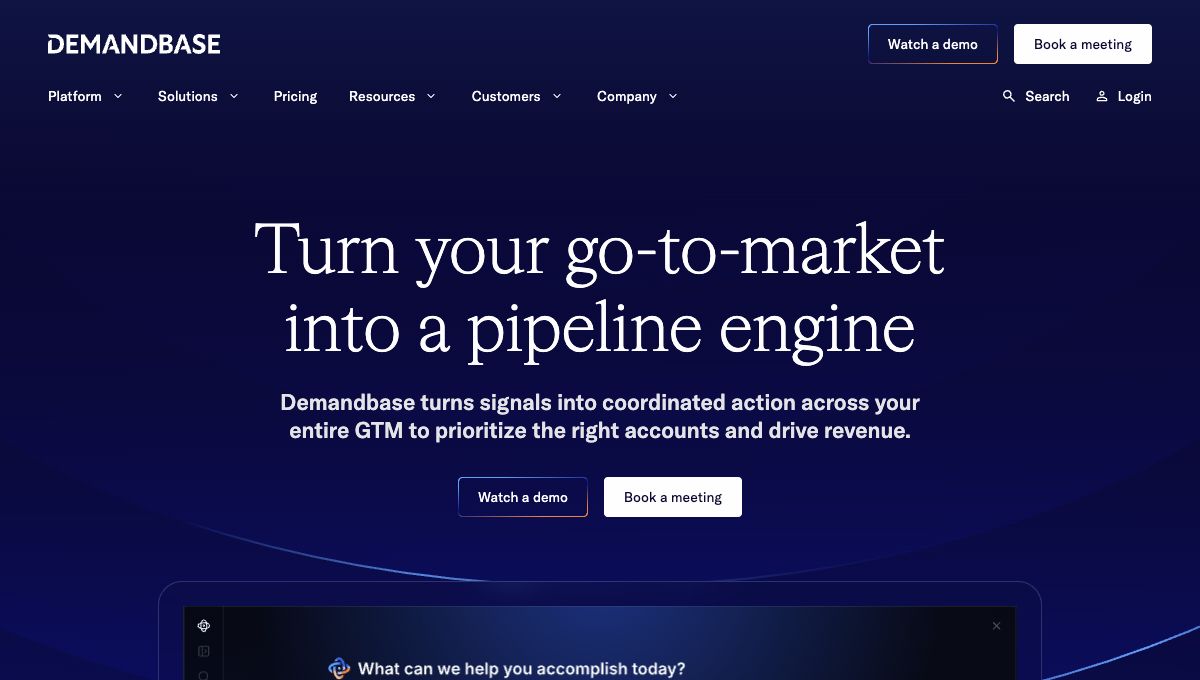
Intended use: Enterprise account-based intelligence, data, advertising, and orchestration. Agencies may deliver strategy and operations around a client-owned deployment.
Signal and identity approach: Demandbase describes account and buyer intelligence, first- and third-party data, intent, account identification, and buying groups. Evidence definitions still need to be translated into the client’s decision language.
Activation and integrations: Its connected GTM surface can support account-based media and coordinated sales and marketing actions.
Implementation burden: Account models, CRM and warehouse alignment, campaign operations, governance, and stakeholder enablement favor clients with operational maturity.
Pricing and contract: Official pages reviewed did not show a comparable public package price. Ask for a written scope covering platform, data, advertising, services, support, limits, commitment, and permitted agency use.
Best fit: Enterprise ABM consultancies and agencies operating inside a client’s established Demandbase environment.
Meaningful limitation: It does not remove the need for the agency’s category narrative, sales collateral, client reporting, or proof methodology.
4. Factors.ai
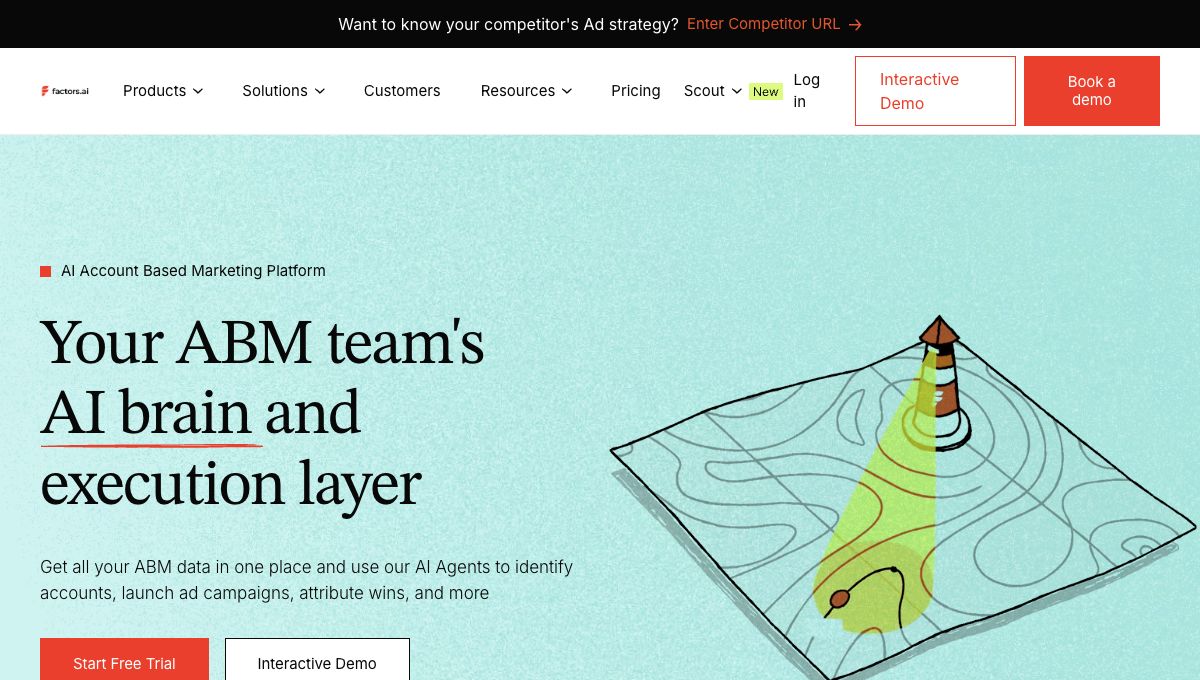
Intended use: Account intelligence, website identification, attribution, advertising analysis, and workflows for B2B teams.
Signal and identity approach: Public product material describes first-party web and CRM context plus supported external intent and ad signals, with capabilities varying by tier.
Activation and integrations: Factors.ai can support account views, alerts, CRM sync, and – in higher packages – ad-audience and measurement workflows. An agency must test multi-client separation and resale rights.
Implementation burden: Lower tiers can reduce initial setup, while advanced scoring, attribution, audience sync, and agentic workflows still require data hygiene and governance.
Pricing and contract: The official pricing page lists Lite at $199 per month, Basic at $6,000 per year, Growth at $20,000 per year, and Enterprise from $30,000 per year. Features and capacities vary materially; these public rates are not scope-equivalent to BrandWell’s complete agency-reseller offer.
Best fit: B2B agencies or clients wanting a comparatively accessible account-intelligence and measurement layer, subject to rights and client architecture.
Meaningful limitation: A client-facing analytics platform is not automatically an agency sales engine, exclusive topic entitlement, or fully white-labeled service.
5. ZoomInfo
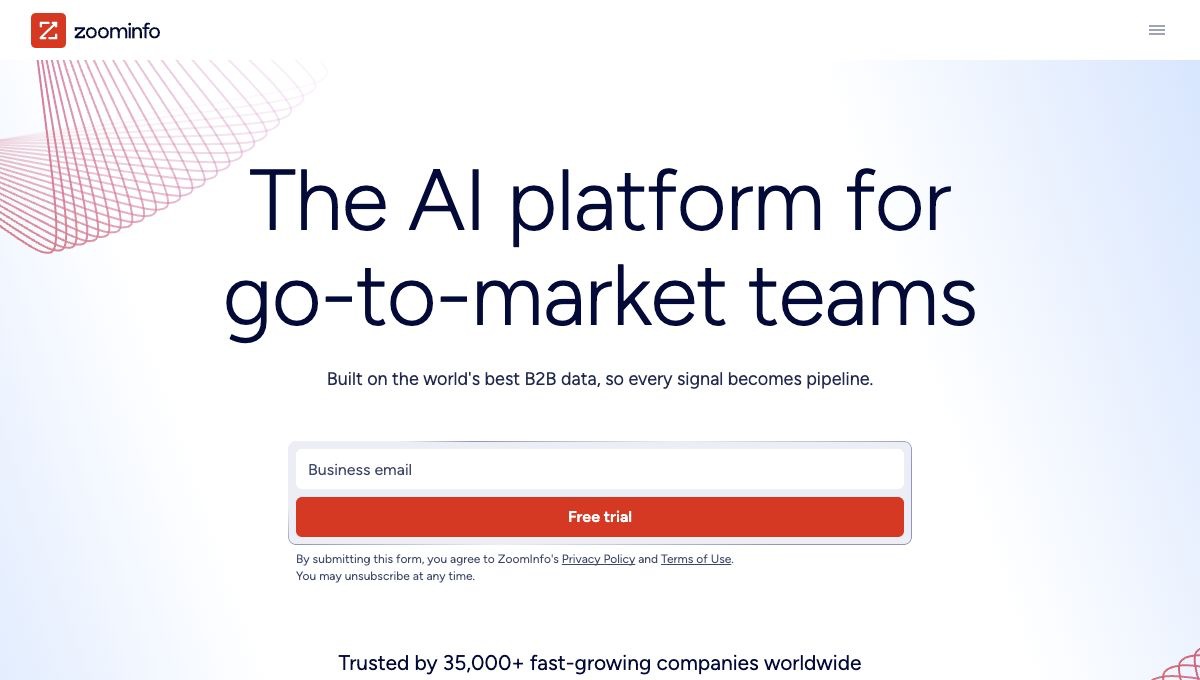
Intended use: Broad sales and marketing intelligence spanning company, contact, intent, enrichment, and workflow use cases.
Signal and identity approach: Its breadth can support account research and prospect data, but the agency must disclose which record or signal supports each recommendation and how it was validated.
Activation and integrations: CRM and engagement integrations can help operationalize data. Multi-client delivery and redistribution require explicit contractual review.
Implementation burden: Seats, records, credits, product editions, matching, data governance, integrations, and training all affect the service design.
Pricing and contract: No comparable public list price was verified. ZoomInfo’s SEC filing states that pricing varies by functionality, users, and records under management and that subscriptions generally range from one to three years. The signed order controls.
Best fit: Agencies supporting clients that already rely on ZoomInfo and need disciplined strategy and operations around that investment.
Meaningful limitation: A broad data platform can reinforce a “we sell lists” perception unless the agency clearly owns the decision, activation, and evidence layer.
Compare investment and economics honestly
Positioning cost includes product access, training, niche research, offer design, portal or reporting, sample deliverables, sales enablement, data governance, implementation, and the opportunity cost of focus. Do not benchmark only software licenses. Model how many qualified clients the service can support, realistic onboarding labor, recurring operator time, churn, usage, and the period required to earn back setup.
BrandWell MarketPulse intent-data plans start at $250/month. Your selected package determines topic coverage, contact allowances, refresh cadence, AIMEE access, and other growth tools. Channel usage, media, and fulfillment costs depend on the campaign.
Design a seven-day pilot that sells the category
A strong pilot is a decision instrument, not free ongoing service. Before day one, agree on one client segment, a small topic set, exclusions, signal definitions, identity thresholds, report format, reviewer, and acceptance criteria. Produce branded topic reports, explain why accounts appeared, show confidence and limitations, and ask the client to accept or reject each finding with a reason.
At the end, answer four questions: Were the topics relevant? Were enough accounts identifiable and in scope? Could the client take a permitted action? Is a recurring workflow economically justified? A “no” can still be a successful pilot if it prevents a bad annual program. Do not claim the seven-day observation proves incremental revenue; it proves whether the input and operating design deserve a larger test.
Equip sales with proof, objections, and disqualification
Give every seller a one-page category narrative, a contrast matrix, a sample report, a signal-to-action map, the evidence ladder, pricing boundaries, and a non-fit checklist. Use explicit answers to common objections:
- “Is this just a list?” No. Records are one input; the service includes current signals, verification, governed action, feedback, and recurring reporting.
- “Can you tell exactly who searched?” Not from account-level topic data. Person-level identity and first-party behavior require separate evidence and permissions.
- “Will it guarantee meetings?” No. It improves prioritization and execution; results also depend on market, offer, creative, follow-up, and sales.
- “Why not buy software?” A mature team may do so. The agency adds design, operation, interpretation, and proof; do not position service as universally superior.
- “Can we own a topic?” BrandWell can offer contractually scoped topic exclusivity when available. Availability, geography, term, and meaning must be written.
Disqualify buyers who demand secretive surveillance language, automated spam, unsupported performance claims, or data use outside contract and law. A clear “not for you” protects the category.
Measure whether the position improves agency performance
Measure category comprehension first: can prospects accurately repeat the service, distinguish it from lists and PPC, and name the next step? Then track qualified discovery rate, pilot acceptance, proposal rate, sales-cycle length, win reasons, discounting, setup time, gross margin, service adoption, renewal, expansion, and referral.
Separate messaging success from delivery success. A higher close rate with poor retention means the promise outran the product. Strong delivery with low qualified pipeline means the category or distribution is unclear. Review lost-deal language, pilot rejection reasons, and client outcome evidence monthly; revise the proof and audience before changing the category name.
Protect data use and client trust
Maintain source, permission, granularity, freshness, confidence, retention, suppression, and access for each signal. Never tell a named person that you observed private research when the evidence is company-level. Do not reuse one client’s audience, prompt context, or report across another client without a valid contractual and legal basis.
Use calibrated phrases: “research activity associated with the account,” “identified website visit under the approved setup,” or “verified role data.” Avoid “we know you searched” and “ready to buy.” For UK-oriented programs, the ICO’s direct-marketing guidance recommends privacy by design, a lawful basis, fair collection, clear explanation, and respect for objections. Jurisdiction-specific counsel should review the actual motion.
Package the recurring service around decisions
AIMEE is the agent-powered desktop app in BrandWell’s growth workflow. Assign work through the tools connected to your workspace and choose which actions can run automatically or require approval. Desktop availability, account permissions, and the configured workflow determine what can execute.
The durable differentiator is not “more data.” It is a repeatable decision system, transparent uncertainty, and a client-ready proof loop. Topic exclusivity, when available, can strengthen positioning, but it should support – not replace – a specific niche and excellent delivery.
Agent-ready positioning instructions
Give this brief to Claude or ChatGPT, or adapt it for approved browser research and assembly through AIMEE. The agent drafts evidence-based material; a human approves all external claims and publishing.
- Load the chosen buyer, trigger, current alternative, service scope, signal definitions, evidence, limitations, pricing boundaries, and prohibited claims.
- Draft a one-sentence category definition, a positioning statement, and a contrast matrix using identical dimensions for all approaches.
- Map every promise to its evidence level: delivery, acceptance, action, opportunity, or incremental financial proof. Remove or qualify any promise whose evidence is weaker.
- Produce a pilot brief with topics, exclusions, identity rules, deliverables, reviewer, success criteria, and explicit non-ROI boundary.
- Create objection responses that disclose account-versus-person intent, data permissions, implementation work, and when another approach fits better.
- Flag any price, exclusivity, coverage, accuracy, customer outcome, privacy, or platform claim for named human verification against current primary material and the order form.
- Prepare approved sales assets and a monthly positioning scorecard. Do not publish, contact prospects, or change customer systems without approval.
Assess the audience and the operating cost before expanding the service. Discuss a BrandWell agency package with the data, tools, and client delivery scope you need.