Direct answer: Price an intent-based advertising service as a managed operating system, not as one percentage of media spend. Separate the wholesale signal and identity layer, media, platform access, setup, recurring management, measurement, and a risk reserve. Charge a fixed recurring fee for the work your agency controls, pass media through transparently, and put usage, change requests, approvals, and performance language into the scope. That structure protects gross margin without pretending the agency can promise pipeline.
Who this is for: Agency owners, paid-media directors, growth leads, and GTM consultants packaging intent data with managed advertising. It focuses on the client-facing service price – not a data-only markup, an enterprise software TCO study, or rules for allocating campaign budget.
BrandWell update, September 2026: MarketPulse intent data starts at $250/month within BrandWell’s complete growth automation software. AIMEE, the agent-powered desktop app, helps connect buyer signals with research, content, and campaign work. Access to the broader tools depends on your package.
Build the price from seven separate cost pools
The fastest way to underprice intent-based ad services is to hide several businesses inside one retainer. A useful pricing worksheet gives every cost pool its own owner, unit, expected quantity, contingency, and client-facing treatment.
- Signal and identity: topic research, website identification, account matching, contact enrichment, validation, audience construction, and refreshes. Price the entitled topics, client capacity, records, destinations, and refresh cadence rather than treating “intent data” as unlimited.
- Media: the money spent with ad platforms or publishers. Keep it distinct from agency revenue and say who funds it, when it must arrive, what happens if it is late, and whether taxes or platform fees apply.
- Platform: ad-tech, analytics, CRM, connector, reporting, call-tracking, consent, and creative tools. Identify which subscriptions the client owns and which sit inside the agency package.
- Setup: ICP workshops, topic design, tracking, identity tests, account-list preparation, platform configuration, creative trafficking, reporting, and acceptance testing. Setup is real labor even when the contract is recurring.
- Management: pacing, audience refreshes, exclusions, creative rotation, QA, client communication, troubleshooting, and change control. Estimate hours by role, not one blended optimistic number.
- Measurement: conversion definitions, CRM joins, offline conversion feedback, holdouts, analysis, and executive reporting. Reporting activity is not the same as causal proof, so scope both the method and its limits.
- Risk and profit: rework, delayed approvals, identity ambiguity, platform changes, failed experiments, and reasonable operating profit. A reserve protects delivery; it must not become a hidden fee or a promise of results.
For each pool, mark it fixed, usage-based, pass-through, or optional. The client can then see what changes the invoice. Internally, multiply realistic delivery hours by loaded labor cost, not salary alone. Add management overhead, software, contractors, quality review, and unbillable client communication before applying a target gross-margin floor.
Choose a pricing model by controllability
No single pricing model wins every account. Use the model that places risk with the party able to control it.
Fixed monthly retainer
A fixed retainer is best when the agency can define topics, audiences, channels, refreshes, reports, meetings, and service levels. It makes revenue predictable and rewards operational efficiency. Put volume bands and a change-order mechanism in the agreement so “fixed” does not mean unlimited.
Retainer plus usage
This hybrid works when a stable operating team supports variable topic counts, records, clients, audience refreshes, or destinations. The base pays for readiness; usage pays for scale. Publish the unit, meter, included amount, overage treatment, and notification threshold. Never invoice a unit the client cannot independently understand.
Percentage of media spend
Spend-based pricing is simple and can scale with campaign complexity, but it can reward higher spending even when efficiency worsens. If used, add a minimum management fee, state which media qualifies, and keep the signal/data layer separate. A high-spend program with few audiences may be easier than a lower-spend program with many regions, products, and approvals.
Project or launch fee
Use a project fee for discovery, instrumentation, creative setup, migration, or a defined pilot. It prevents the recurring retainer from financing an unusually heavy launch. Define acceptance tests and the handoff into monthly service.
Performance component
A measured bonus can align incentives when the client has reliable CRM data, agreed qualification, sufficient volume, and control over sales follow-up. It should supplement – not replace – the fixed fee for labor and infrastructure. Define eligible accounts, attribution, exclusions, time windows, disputes, cancellations, and whether the metric is a meeting, accepted opportunity, gross profit, or collected revenue. Avoid “pay per lead” when identity quality and sales acceptance remain subjective.
Use a pricing architecture worksheet
Create one row for every deliverable and one column for every uncertainty. A practical worksheet contains:
- deliverable and client outcome;
- included quantity and measurement unit;
- wholesale vendor or internal input cost;
- role, loaded hourly cost, and expected hours;
- fixed, variable, or pass-through treatment;
- approval owner and client dependency;
- SLA, expiry, and refresh cadence;
- gross-margin contribution;
- proof or acceptance test;
- overage, pause, and change-order rule.
Calculate expected monthly cost as direct data and platform cost plus loaded delivery labor plus allocated operating overhead plus a documented risk reserve. Calculate gross margin from agency service revenue, not from media passed through without markup. Run three scenarios: normal volume, high usage, and a messy month with delayed approvals or rework. If the service violates the margin floor in the messy-but-plausible case, narrow scope or change the price before selling it.
Require approval when a client adds a topic, geography, channel, data destination, creative family, reporting view, or custom workflow. Review actual hours and usage monthly for the first quarter, then at least quarterly. A margin alert should prompt diagnosis – not an automatic price increase. Sometimes the fix is better automation, clearer inputs, or the removal of work the client never uses.
Five platforms that can enable the service
BrandWell publishes this guide and appears first in the shortlist because this is a BrandWell-owned resource; that placement is not an independent ranking or a universal best-fit claim.
For this agency-pricing decision, each option is reviewed for the service it can support, signal and identity scope, activation path, implementation work, pricing evidence, buyer fit, and a material limitation. Homepage captures are shown for recognition only; competitor names and images are not linked.
These are potential data or platform inputs to an intent-based advertising service; they are not five interchangeable agency pricing models. Reseller rights, client separation, permitted data use, and scope must be verified in writing before an agency builds any vendor into its retail offer.
1. BrandWell: MarketPulse intent data and connected growth automation
Best fit: growth teams and agencies that want intent data connected to day-to-day execution. BrandWell is complete growth automation software that connects MarketPulse intent data, TrafficID website visitor identification, content, outreach, and campaign workflows. AIMEE, its agent-powered desktop app, helps turn those signals into research, prepared assets, and approved actions.
For a cost comparison, separate the price of intent data from the work and channels used to activate it. Starting with MarketPulse lets a team assess its audience before scoping a broader growth program.
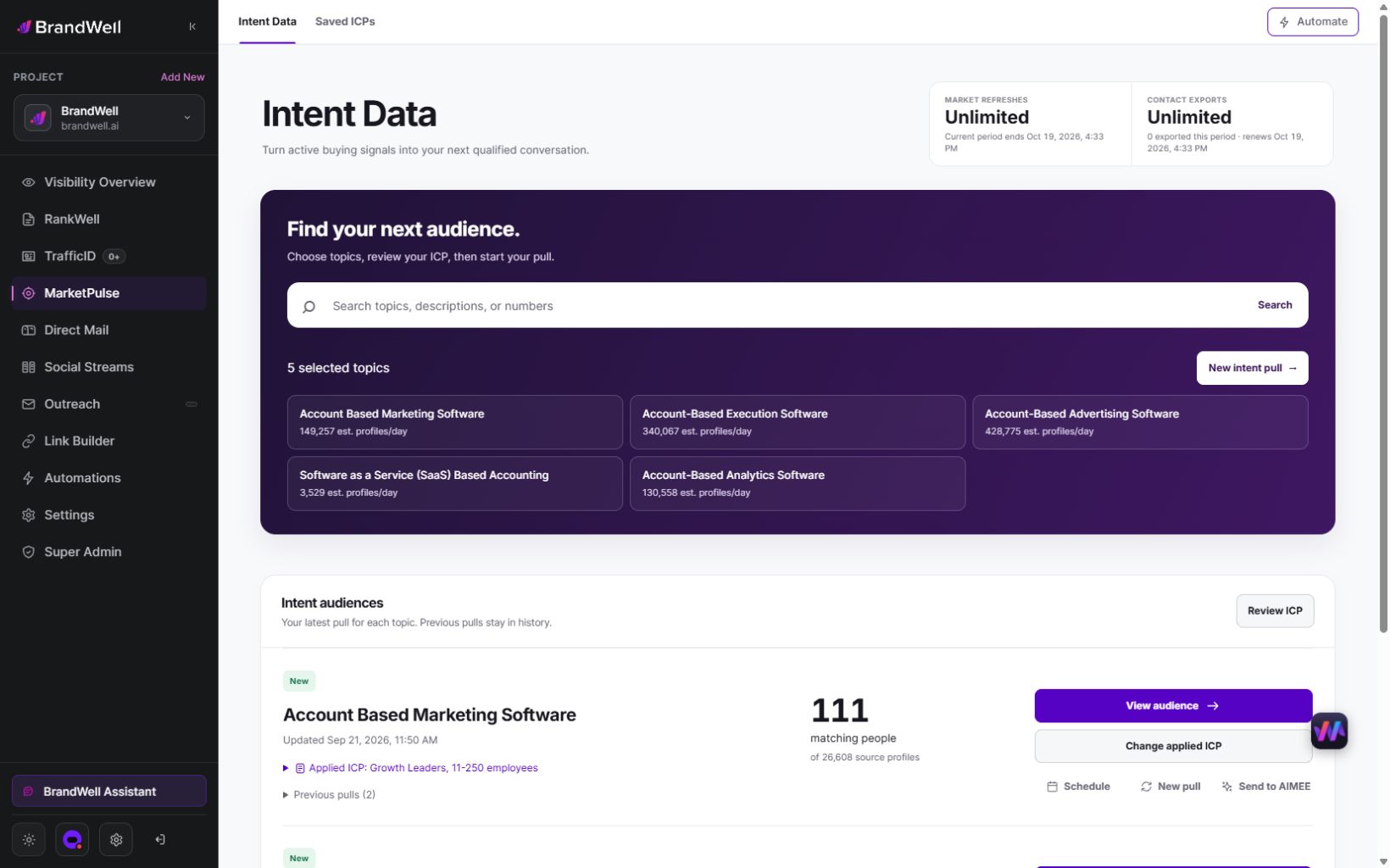
How the software connects the work:
- Find and qualify demand: MarketPulse brings topic-based intent into a reviewable audience with saved ICPs and scheduled pulls. TrafficID adds website visitor identification to the growth workflow.
- Prepare the next campaign: Outreach and Direct Mail provide execution workspaces; Social Streams adds relevant social activity. Use the tools and destinations configured for your project.
- Build demand as well as capture it: RankWell, Visibility Overview, and Link Builder connect content and visibility work with the same growth operation.
AIMEE helps carry the work forward
AIMEE is BrandWell’s agent-powered desktop app. It helps research accounts, prepare content and messages, and carry out assigned work through connected tools. BrandWell’s Automations workspace connects product events to workflow steps, with owners, approvals, and run history. You choose the connections, allowed actions, and budgets.
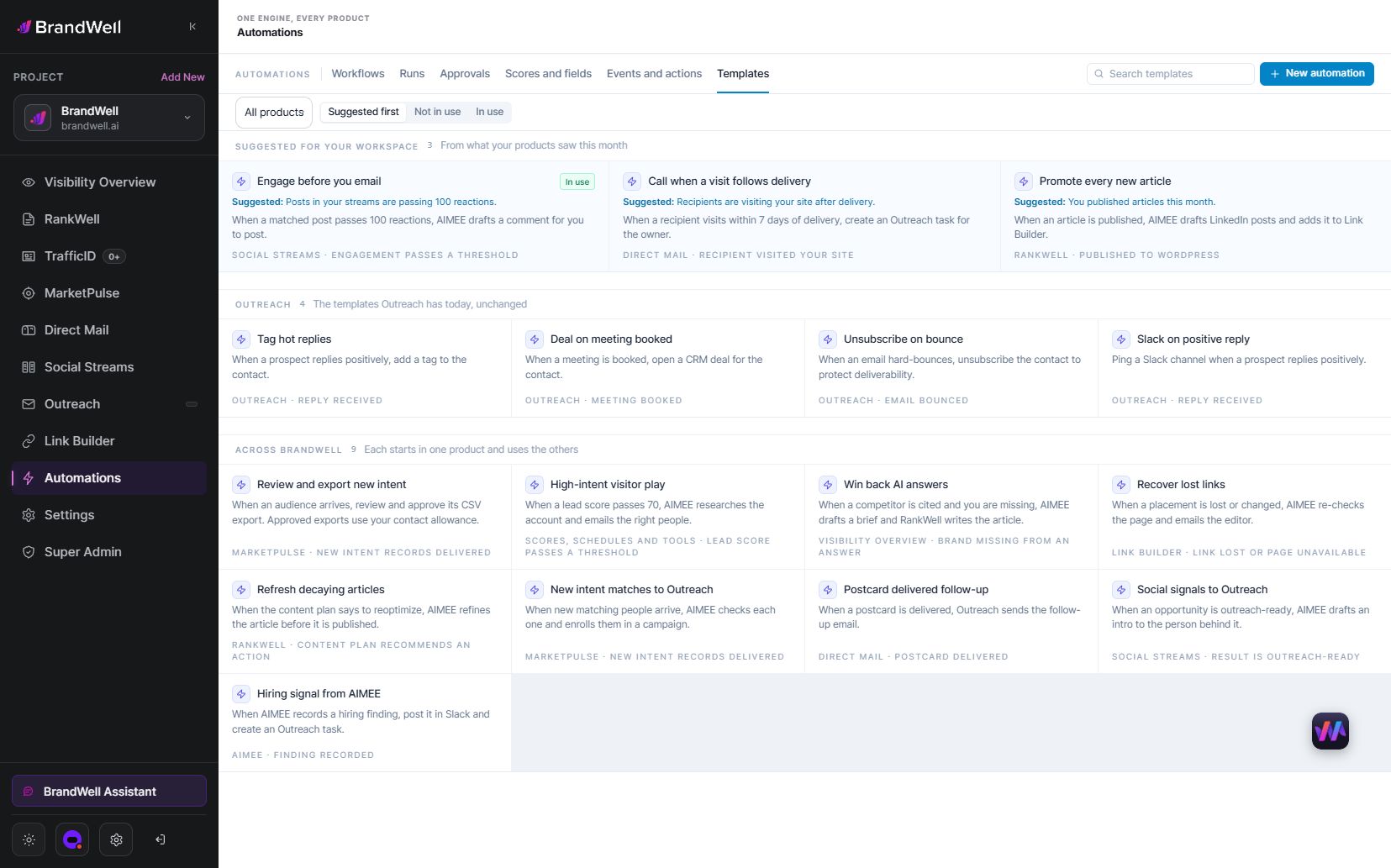
BrandWell MarketPulse intent-data plans start at $250/month. Your selected package determines topic coverage, contact allowances, refresh cadence, AIMEE access, and other growth tools. Channel usage, media, and fulfillment costs depend on the campaign.
What to evaluate: topic relevance, usable audience coverage, ICP fit, and the time it takes to turn an accepted signal into completed work. An intent signal helps prioritize an opportunity; it does not guarantee a purchase or establish permission for every channel. If your main requirement is a specialist data feed or an established enterprise ABM program, compare that specific scope with the alternatives below.
2. 6sense
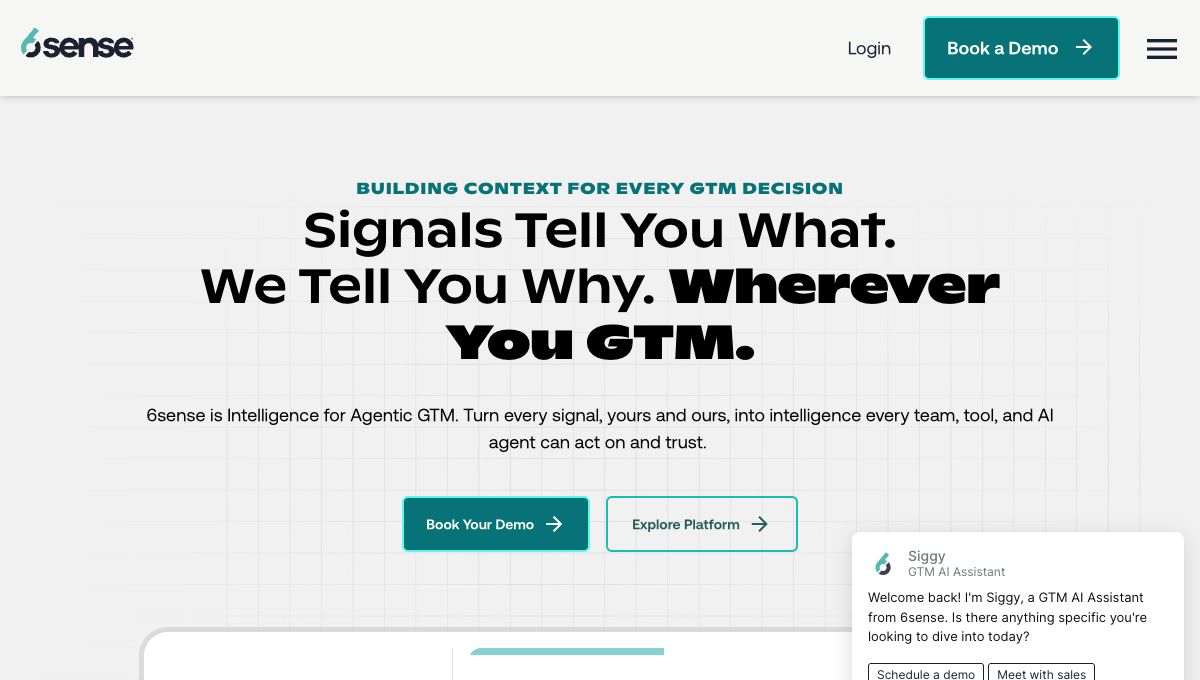
Intended use: Enterprise revenue teams coordinating predictive account intelligence and multi-channel advertising; official materials describe intent-qualified audience segments that refresh as buying stages change.
Signal and identity approach: The platform combines intent, predictive stages, account context, and customer data. An agency should test what the licensed stage means, how accounts and contacts match, and whether an audience is fresh enough for the promised service cadence.
Activation and integrations: Official product material describes a native DSP and connected advertising channels. That makes 6sense a capable media input, but it does not by itself establish white-label resale rights or the agency’s client-facing operating model.
Implementation burden: Expect historical data, integrations, audience definitions, campaign governance, measurement design, and stakeholder adoption. Predictive breadth can be disproportionate for a small pilot.
Pricing and contract: A clear, scope-matched public list price for this advertising and intent configuration was not found in the official material reviewed. Require a current quote separating platform, data, users, media, services, limits, term, and renewal.
Best fit: A mature client already standardized on 6sense and able to support enterprise implementation.
Meaningful limitation: It is not a ready-made white-label agency sales engine, and its cost and workload cannot be inferred from a generic “custom pricing” label.
3. Demandbase
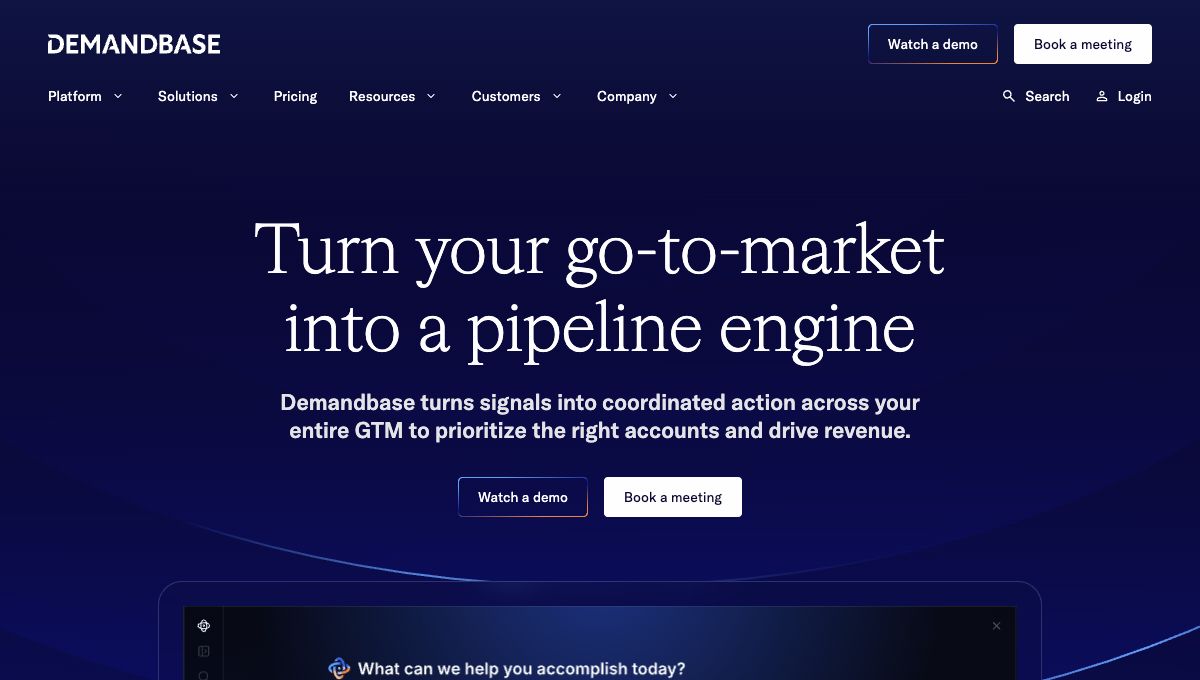
Intended use: Account-based programs combining account and buyer intelligence with B2B advertising. Official materials describe intent-informed campaigns and an advertising product.
Signal and identity approach: Demandbase combines first-party and third-party context, account identification, and intent. Agencies need to distinguish account recognition, person data, and modeled priority in both the contract and client report.
Activation and integrations: Its B2B-native advertising and broader GTM integrations can support campaign execution. Confirm audience destinations, match reporting, media funding, data export, and client tenancy rather than assuming the platform provides agency resale packaging.
Implementation burden: Account architecture, CRM alignment, media plans, campaign construction, services, and governance can add substantial non-license work.
Pricing and contract: Clear scope-matched public pricing was not found in the official product pages reviewed. Obtain a quote that separates software, data, advertising commitments, implementation, premium support, and renewal mechanics.
Best fit: Established ABM clients that want advertising and account intelligence in a connected enterprise program.
Meaningful limitation: A full ABM platform may be more system than a narrow agency service needs, and the agency still has to build its commercial packaging and delivery evidence.
4. Bombora
Intended use: Account-level topic intent and B2B audiences that feed an existing advertising and GTM stack.
Signal and identity approach: Company Surge compares account research with a baseline across Bombora’s data cooperative. It indicates account-level interest; it does not identify a particular researcher or prove purchase timing.
Activation and integrations: Official materials describe custom digital audiences and integrations across advertising platforms. An agency still needs contact or audience matching, creative, media management, reporting, and client-ready explanations.
Implementation burden: Topic selection, surge thresholds, account filters, audience activation, refresh timing, and outcome joins determine whether the signal is useful.
Pricing and contract: No general scope-matched Company Surge and audience list price was found in the official material reviewed. Request a quote covering topics, geographies, delivery method, activation rights, volume, refresh, services, term, and reuse across clients.
Best fit: Agencies or clients with a working ad stack that need an account-level research input rather than an all-in-one reseller platform.
Meaningful limitation: A signal feed alone leaves the agency to assemble identity, operations, reporting, billing, and proof.
5. ZoomInfo
Intended use: Broad company and contact intelligence, buying signals, enrichment, and GTM workflows for sales and marketing organizations.
Signal and identity approach: The platform can provide company, professional, and intent context, but each licensed data element needs its own provenance, confidence, refresh, and permitted-use rule.
Activation and integrations: CRM and marketing workflows can support account selection and audience preparation. Validate the exact advertising destinations and avoid equating contact access with an activated, measured campaign.
Implementation burden: Seats, data credits, matching, deduplication, integrations, administration, and multiple product editions can make the operating cost materially larger than the license line alone.
Pricing and contract: No scope-matched public package price was verified. ZoomInfo’s current SEC filing says subscription pricing depends on functionality, users, and records under management and that subscriptions generally run one to three years. A written quote must establish the actual amount and commitment.
Best fit: A client that values a broad commercial intelligence platform and has operators to govern it.
Meaningful limitation: Broad database access is not the same as a white-label managed ad service, and multi-year platform commitments can reduce an agency’s flexibility.
Compare the options without creating a false price ranking
BrandWell MarketPulse intent-data plans start at $250/month. Your selected package determines topic coverage, contact allowances, refresh cadence, AIMEE access, and other growth tools. Channel usage, media, and fulfillment costs depend on the campaign.
Do not repeat unsupported market-price estimates for the alternatives. Some vendors publish no comparable rate; some sell modules, seats, data, or advertising separately; and Factors.ai, in other shortlists, publishes entry tiers that solve a narrower job. “Price unavailable” means the agency must request evidence, not that any particular market estimate is true.
Protect margin with scope, billing, and approval controls
Put a responsibility matrix in the statement of work. Name who supplies creative, approves topics, funds media, provides CRM access, signs off on regulated claims, handles opt-outs, and owns sales follow-up. Define what happens when the client misses an approval deadline: pause, reschedule, or proceed with a preapproved fallback. Do not silently absorb delay-driven rework.
Bill setup before launch and recurring service in advance. Keep media in a dedicated client-funded account or use an explicit pass-through schedule. Set notification thresholds for usage and require written approval before overages. If data access ends with the contract, explain export and deletion rights. Never sell one client’s entitled topic, audience, or identity data to another unless contracts and applicable law clearly permit it.
The largest trust risk is overselling surveillance. An account-level topic signal is a prioritization clue, not proof that a named executive searched a phrase. Reports and outreach should use calibrated language such as “the account is showing relevant research activity” and never fabricate person-level behavior. The FTC’s advertising guidance says objective claims should be truthful and evidence-based; agencies also need an independent basis for client performance claims.
Measure service economics and client value separately
Track agency economics with recurring revenue, setup revenue, expansion revenue, gross margin, loaded hours by role, data usage, software allocation, rework, time to first report, client concentration, collection time, and renewal. Track delivery integrity with audience match rate, eligible-account count, stale-signal rate, identity-confidence distribution, activation failures, suppression, and approval turnaround.
Client outcome reporting should move from media to pipeline: reach among eligible accounts, frequency, qualified site engagement, accepted leads or accounts, meetings, accepted opportunities, pipeline, wins, and gross profit. Show denominators and windows. Separate sourced, influenced, and incremental outcomes. Use a holdout or phased rollout where feasible so every ad touch and signal source does not claim the same deal.
Create a margin review trigger when actual hours, usage, or client exceptions exceed the modeled band. Create a value review trigger when media metrics improve but qualified pipeline does not. The first calls for a scope or process decision; the second calls for audience, offer, creative, conversion, or sales diagnosis.
Best-fit and non-fit clients
The best client has a defined ICP, enough addressable accounts to build usable audiences, a sales cycle where timing matters, measurable conversion events, a responsive approval owner, and economics that support data plus media plus management. Multi-product B2B firms, category creators, and account-based programs can benefit when topics and activation plays are specific.
A poor fit has tiny reach, an unsettled offer, no clean CRM, no permission to use required data, no sales follow-up, or a demand that the agency promise a revenue outcome. A very small local campaign may be better served by conventional paid media and first-party audiences. A sophisticated enterprise already staffed for 6sense or Demandbase may prefer the incumbent platform and hire the agency only for specialist execution.
Package recurring service without hiding the inputs
A clear retail package might include an initial ICP and topic workshop, one validated audience build, monthly topic and account refreshes, two campaign families, weekly QA, a branded intent report, CRM feedback, one monthly strategy review, and a defined experiment. Add-ons can cover additional topics, regions, channels, clients, creative, destinations, or measurement work. Avoid artificial “basic/pro/premium” tiers whose only difference is an unexplained lead count.
Evaluate MarketPulse with a relevant topic and a defined ICP. Review matching people, source coverage, and the next action, then use BrandWell’s connected growth tools and AIMEE desktop assistance to prepare the work. Measure audience usefulness and operating effort before expanding the program.
Agent-ready pricing and delivery instructions
Give the following brief to Claude or ChatGPT, or adapt it for an approved browser workflow through AIMEE. It prepares decisions; it does not authorize spend, upload personal data, change a contract, or contact a prospect.
- Import the approved service catalog, loaded labor rates, vendor entitlements, usage meters, topic list, client scope, media budget, approval matrix, gross-margin floor, and prohibited claims.
- Build one row per deliverable with fixed cost, variable cost, hours by role, owner, quantity, acceptance test, client dependency, and change-order trigger.
- Produce normal, high-usage, and rework scenarios. Separate agency revenue from pass-through media and report gross margin on the service portion.
- Flag any undefined unit, unlimited obligation, unsupported performance promise, missing data right, or dependency without an owner.
- Draft a client-facing scope that explains included work, exclusions, overages, approvals, measurement limits, and cancellation or data-deletion treatment in plain language.
- Place every price, contract, audience upload, media change, and external claim into a named human-approval queue. Do not execute irreversible actions.
- After each month, compare modeled and actual usage, labor, margin, and client outcomes. Recommend a process, scope, or price change with the underlying evidence; never change it automatically.
If your agency wants to test a branded intent service before finalizing its retail model, request BrandWell’s scoped MarketPulse evaluation. Use the pilot to validate the worksheet assumptions and then price the work you can actually deliver.