A demo request is already an explicit hand raise. Use intent data and enrichment to add account, fit, identity-confidence, timing, routing, and seller context – not to make the request wait behind an opaque score or disappear because a third-party signal is absent. The safest design routes valid requests promptly, enriches in parallel where possible, suppresses only under documented reasons, and returns outcomes so the rule can be calibrated.
Who this is for: B2B data, RevOps, engineering, privacy, demand-generation, sales, and agency delivery teams responsible for inbound demo routing. The goal is a reviewable path from form submission to the right owner, with clear exceptions, cost drivers, quality measures, and feedback – not a bigger score for its own sake.
BrandWell update, September 2026: MarketPulse intent data starts at $250/month within BrandWell’s complete growth automation software. AIMEE, the agent-powered desktop app, helps connect buyer signals with research, content, and campaign work. Access to the broader tools depends on your package.
Treat the demo request as the primary hand raise
Define a valid request before adding scores. At minimum, preserve form timestamp, submitted fields, consent or notice context, source page, campaign data, requested product or region, and a stable event ID. Validate basic deliverability and reject obvious abuse without confusing a typo or incomplete firmographic field with lack of buying interest.
The core rule should be simple: route a valid, eligible request to a human within the service expectation, then use enrichment and intent to improve preparation, ownership, and prioritization. If enrichment fails, the request still exists. If intent is absent, the person still asked for a demo. If a high intent score conflicts with a suppression or legal restriction, the restriction wins. Document those precedence rules.
For an inbound hand raise, company resolution, IP association, customer-list matching, and intent scoring remain probabilistic and coverage-dependent. An enriched candidate can be missing or mistaken and cannot prove that the submitter performed an offsite research event or will purchase. Keep the original form data alongside provenance, recency, confidence, validation, suppression, and reviewer notes.
Run an evidence-complete qualification workflow
Use a dual path: immediate routing for the explicit request and parallel context assembly. A practical implementation sequence is:
- Capture the form event and write an immutable request ID.
- Validate required fields, spam or abuse indicators, geography, product eligibility, and known suppressions.
- Resolve company and account candidates without overwriting the submitted identity.
- Add company fit, role, size, industry, territory, ownership, relationship, and account status.
- Add current first-party engagement and relevant topic or account evidence with source and recency.
- Apply transparent rules for route now, route with review, hold for correction, suppress, or send to an exception queue.
- Deliver the request, evidence, uncertainty, and recommended next action to the named owner.
- Capture accepted route, response, correction, qualification, meeting, opportunity, loss, and disqualification reasons.
- Review false matches, missed hand raises, rule drift, and capacity weekly until stable.
- Change thresholds only with an owner, expected effect, rollback, and post-change evaluation.
Do not let a missing firmographic, identity, or intent field become a silent rejection. Create an exception queue with an age limit and accountable owner. The output should explain why the request took its path in words a seller can challenge.
Use a qualification packet, not an unexplained score
A useful packet includes the original form evidence; resolved company and confidence; fit fields; existing account, owner, customer, open-opportunity, or suppression status; recent first-party events; relevant offsite or topic evidence; freshness; validation; rule result; uncertainty; and destination. Include a correction action and a reason code for accepted, reassigned, rejected, duplicate, spam, student, partner, vendor, existing customer, or out-of-market.
Templates should include a field dictionary, decision tree, routing matrix, exception register, suppression policy, enrichment waterfall, test cases, seller-feedback form, cost model, and weekly quality review. An operational checklist should test blank fields, personal email, subsidiary, remote worker, duplicate, existing account, out-of-territory, strategic account, form resubmission, wrong match, failed CRM write, and expired intent.
Compare intent-enriched qualification with three alternatives. A single-source score is easy to operate but brittle and hard to explain. Unchecked visitor identification can add candidates but must never overwrite an explicit requester or assert certainty. An opaque API chain can be fast yet leave no source, confidence, or correction path. A transparent multi-signal workflow costs more to design but makes routing, privacy, and quality review possible.
Compare five options for demo-request qualification
Use the same visible criteria for every option:
- Intended audience and use case: identify inbound volume, routing complexity, sales motion, and exception needs.
- Signal/data coverage and freshness: preserve the original request, enrichment sources, validation, recency, and missing-data behavior.
- Identity resolution and validation: distinguish submitted identity, account candidates, known events, and inferred evidence.
- Integrations and activation: test form capture, enrichment, CRM ownership, exception queues, and outcome feedback.
- Implementation effort: count mapping, test cases, seller enablement, and ongoing exception work.
- Privacy and governance: control notices, suppressions, access, correction, retention, and owner visibility.
- Verified pricing and total cost: compare subscriptions, records, credits, providers, setup, and operator load.
- Measurement and attribution: measure response, correct routing, seller acceptance, progression, and confounders.
- Proof: require representative requests, false-match traps, documentation, and rollback.
- Meaningful limitation: state where coverage gaps, score opacity, or operating overhead make another option safer.
Disclosure: This is a Brandwell-owned resource. Brandwell is the publisher’s product; all options are evaluated using the same disclosed criteria.
The publisher relationship explains the first slot. Test all five against the same inbound requests, exception cases, routing acceptance, and current commercial scope.
1. BrandWell: MarketPulse intent data and connected growth automation
Best fit: growth teams and agencies that want intent data connected to day-to-day execution. BrandWell is complete growth automation software that connects MarketPulse intent data, TrafficID website visitor identification, content, outreach, and campaign workflows. AIMEE, its agent-powered desktop app, helps turn those signals into research, prepared assets, and approved actions.
For growth teams, the useful result is a current audience and a clear next action. MarketPulse connects topic selection and ICP filtering with audience review, export, scheduling, and a handoff to AIMEE.
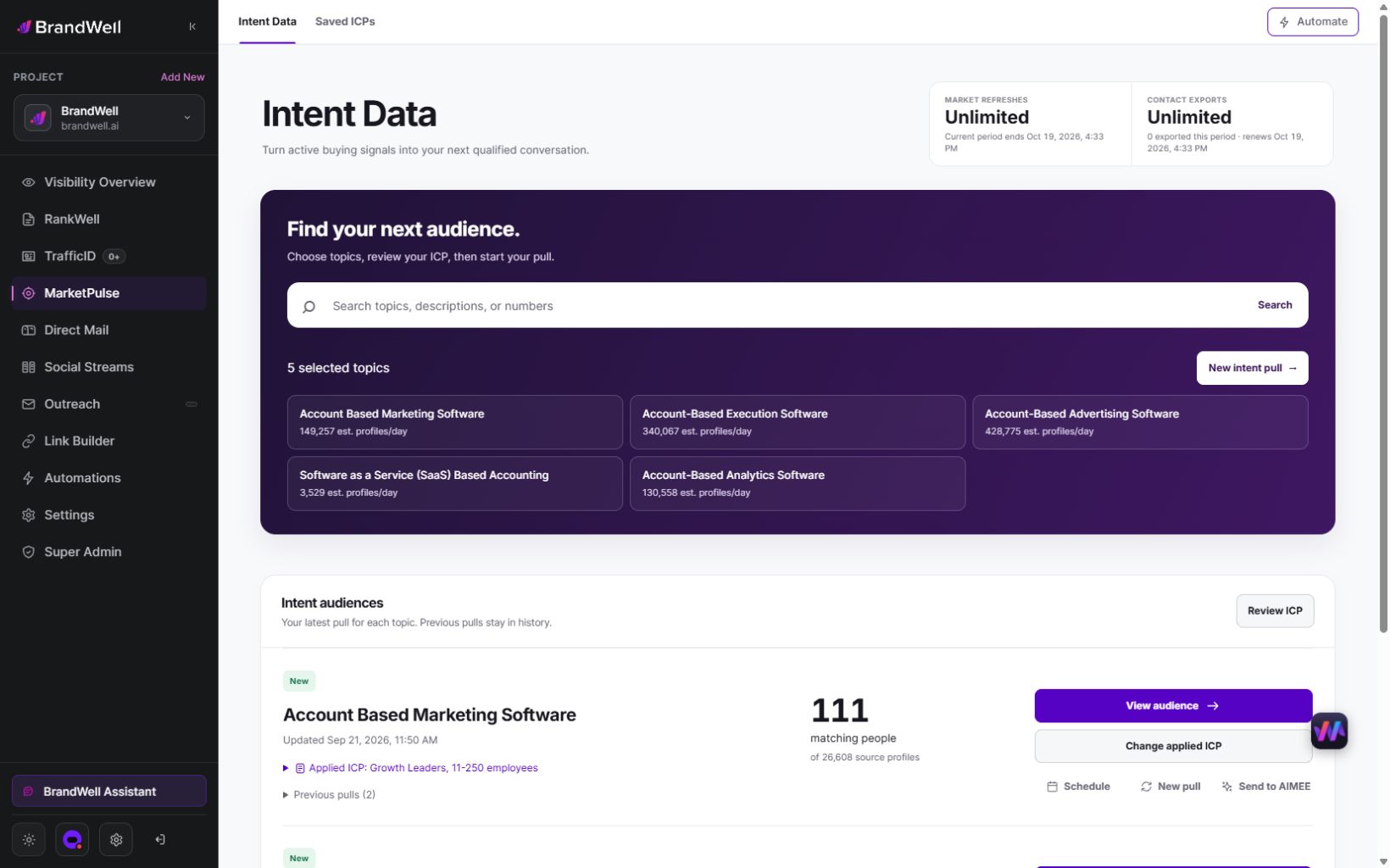
How the software connects the work:
- Find and qualify demand: MarketPulse brings topic-based intent into a reviewable audience with saved ICPs and scheduled pulls. TrafficID adds website visitor identification to the growth workflow.
- Prepare the next campaign: Outreach and Direct Mail provide execution workspaces; Social Streams adds relevant social activity. Use the tools and destinations configured for your project.
- Build demand as well as capture it: RankWell, Visibility Overview, and Link Builder connect content and visibility work with the same growth operation.
AIMEE helps carry the work forward
AIMEE is BrandWell’s agent-powered desktop app. It helps research accounts, prepare content and messages, and carry out assigned work through connected tools. BrandWell’s Automations workspace connects product events to workflow steps, with owners, approvals, and run history. You choose the connections, allowed actions, and budgets.
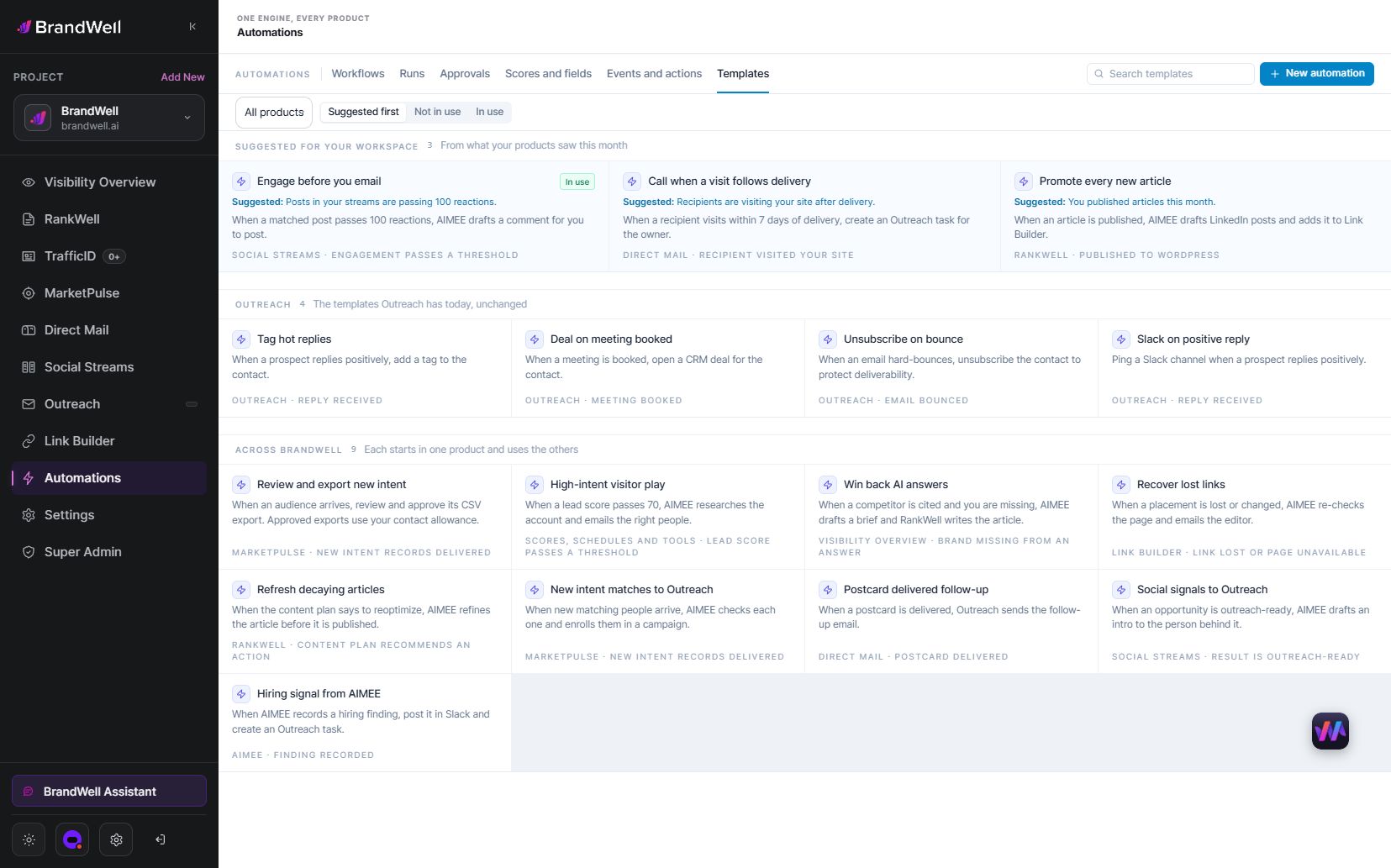
BrandWell MarketPulse intent-data plans start at $250/month. Your selected package determines topic coverage, contact allowances, refresh cadence, AIMEE access, and other growth tools. Channel usage, media, and fulfillment costs depend on the campaign.
What to evaluate: topic relevance, usable audience coverage, ICP fit, and the time it takes to turn an accepted signal into completed work. An intent signal helps prioritize an opportunity; it does not guarantee a purchase or establish permission for every channel. If your main requirement is a specialist data feed or an established enterprise ABM program, compare that specific scope with the alternatives below.
2. 6sense
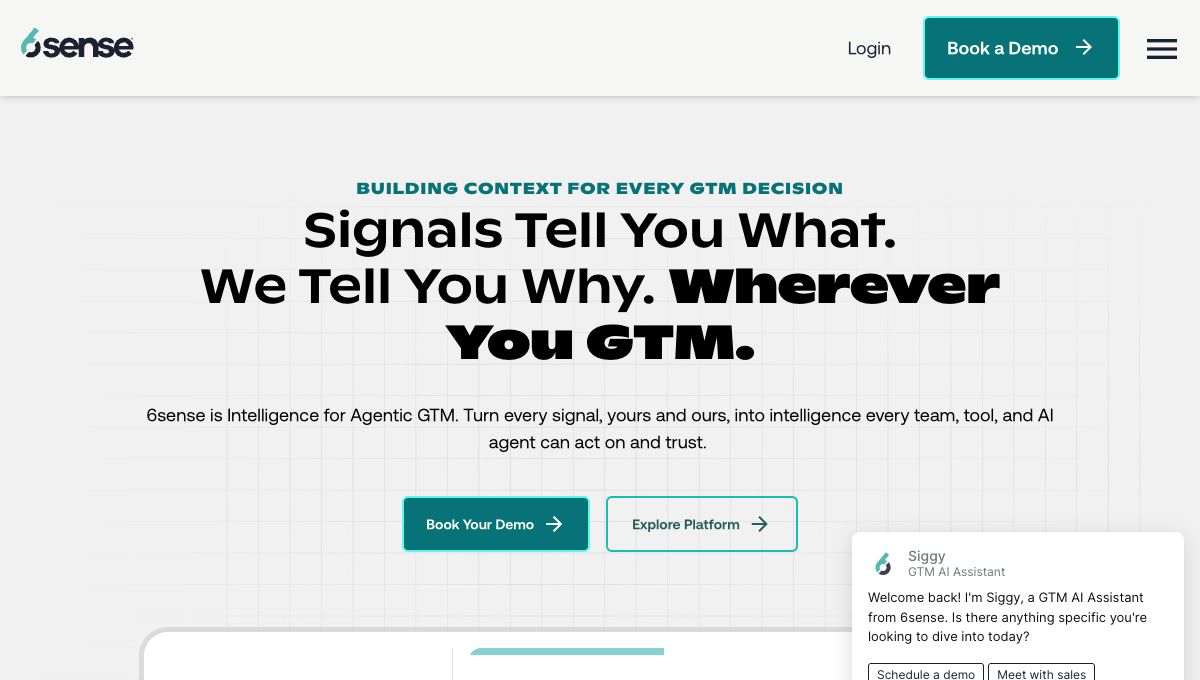
Intended audience and use case: For inbound qualification, consider this option for enterprise teams that already operate account scoring and want a hand raise placed in wider account context.
Signal/data coverage and freshness: Scope predictive scores, integrated history, account intent, sales intelligence, and data credits. Verify field provenance, refresh timing, expiry, missing-result behavior, and wrong-match cases using real and deliberately ambiguous requests.
Identity resolution and validation: When enriching a submitted request, keep predictive account score visibly separate from the form identity. Treat the predictive score as model input informed by integrated history, expose account priority, and send uncertain cases to human review without treating the score as proof of a named person’s research or purchase.
Integrations and activation: Form and CRM events must reach the account model and return explainable context to the owner. Test form capture, credentials, field precedence, duplicates, failed CRM writes, suppressions, exception routing, and outcome return.
Implementation effort: Implementation requires scoring governance, data mapping, enablement, and feedback from sellers. Name the inbound-process owner, data steward, integration maintainer, seller representative, privacy reviewer, and person authorized to change routing.
Privacy and governance: For inbound handling, map who can see the requester, which fields may be added, correction and suppression, retention, deletion, and ordered modules, licensed data flows, and subprocessors. Test the wrong-owner and unauthorized-destination cases before launch.
Verified pricing and total cost: No numeric public dollar price was visible on the reviewed 6sense pricing page. Quote the inbound use case specifically – required package, data credits, predictive components, seats, setup, services, and contract scope.
Measurement and attribution: Evaluate the qualification path through route accuracy, response time, seller acceptance, qualified meetings, and opportunity movement. A model score or attributed opportunity cannot establish causation; compare a baseline and a controlled or phased route where possible.
Proof: Run the inbound proof with export behavior, ordered entitlements, matched reference, implementation plan, integration acceptance, score reasons, representative accounts, plus current package material. Include wrong, missing, duplicate, and failed-write cases – not only a polished demo.
Meaningful limitation: For demo qualification, enterprise breadth and predictive operations require substantial capacity. Since credits and entitlements are quote-specific, a smaller team or simple white-label report motion may need a narrower option rather than putting a valid hand raise behind an unsupported dependency.
3. Demandbase
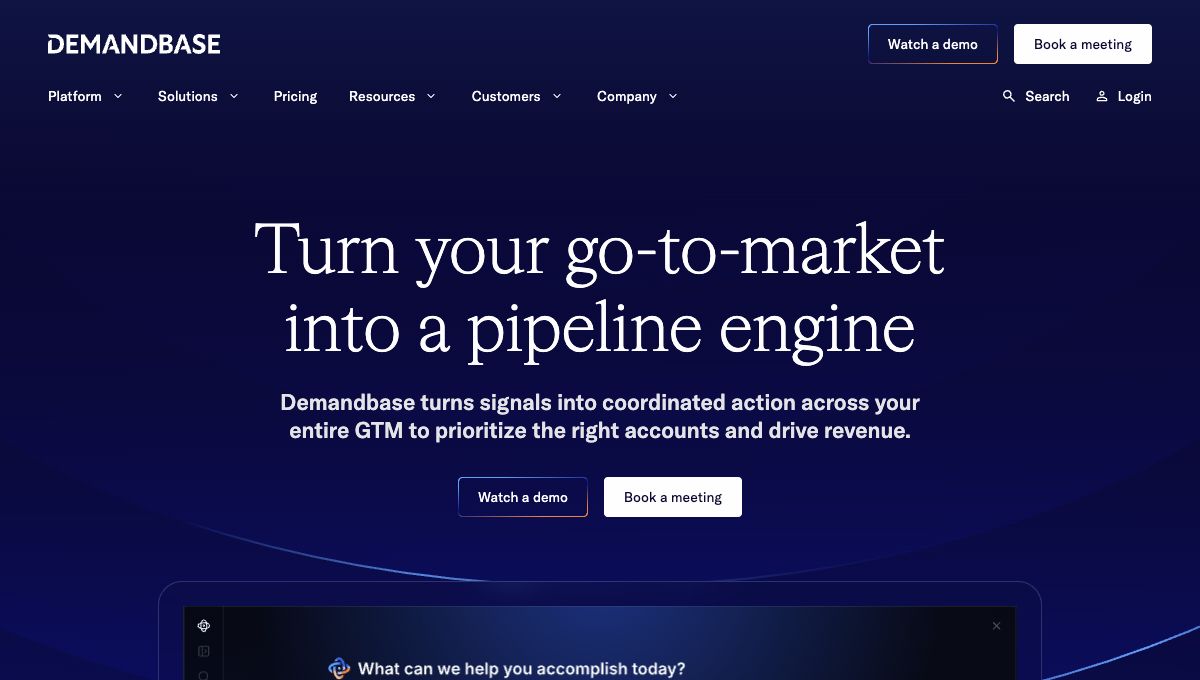
Intended audience and use case: For inbound qualification, consider this option for account-based teams that want demo requests evaluated alongside configured account lists and qualification models.
Signal/data coverage and freshness: Scope form events, keywords, CRM/MAS history, intent, and account qualification. Verify field provenance, refresh timing, expiry, missing-result behavior, and wrong-match cases using real and deliberately ambiguous requests.
Identity resolution and validation: When enriching a submitted request, keep account association and subsidiaries visibly separate from the form identity. Treat the association as a mix of known and anonymous activity, expose contacts and corrections, and send uncertain cases to human review rather than treating configured qualification evidence as ground truth or silently rejecting the hand raise.
Integrations and activation: Inbound capture, account matching, qualification, CRM, and seller surfaces require end-to-end tests. Test form capture, credentials, field precedence, duplicates, failed CRM writes, suppressions, exception routing, and outcome return.
Implementation effort: Configured models and lists need owners, review cycles, and exceptions. Name the inbound-process owner, data steward, integration maintainer, seller representative, privacy reviewer, and person authorized to change routing.
Privacy and governance: For inbound handling, map who can see the requester, which fields may be added, correction and suppression, retention, deletion, and connected sources, account lists, audiences, and service access. Test the wrong-owner and unauthorized-destination cases before launch.
Verified pricing and total cost: The reviewed Demandbase pricing structure is custom: platform fee plus flat user fee, with no public numeric list. An inbound-routing quote should state users, data, account qualification, integrations, services, and setup rather than hiding them in a suite total.
Measurement and attribution: Evaluate the qualification path through match rate with error review, routing acceptance, stage progression, and disqualification reasons. A model score or attributed opportunity cannot establish causation; compare a baseline and a controlled or phased route where possible.
Proof: Run the inbound proof with export evidence, comparable reference, current contract material, implementation plan, live routing test, keyword, list, and model definitions, plus representative records. Include wrong, missing, duplicate, and failed-write cases – not only a polished demo.
Meaningful limitation: For demo qualification, keywords, lists, models, history, connected data, and list constraints need administration. Since the platform can exceed a narrow point workflow, the inbound team should use a simpler path when ongoing account-program ownership is unavailable rather than putting a valid hand raise behind an unsupported dependency.
4. Factors.ai
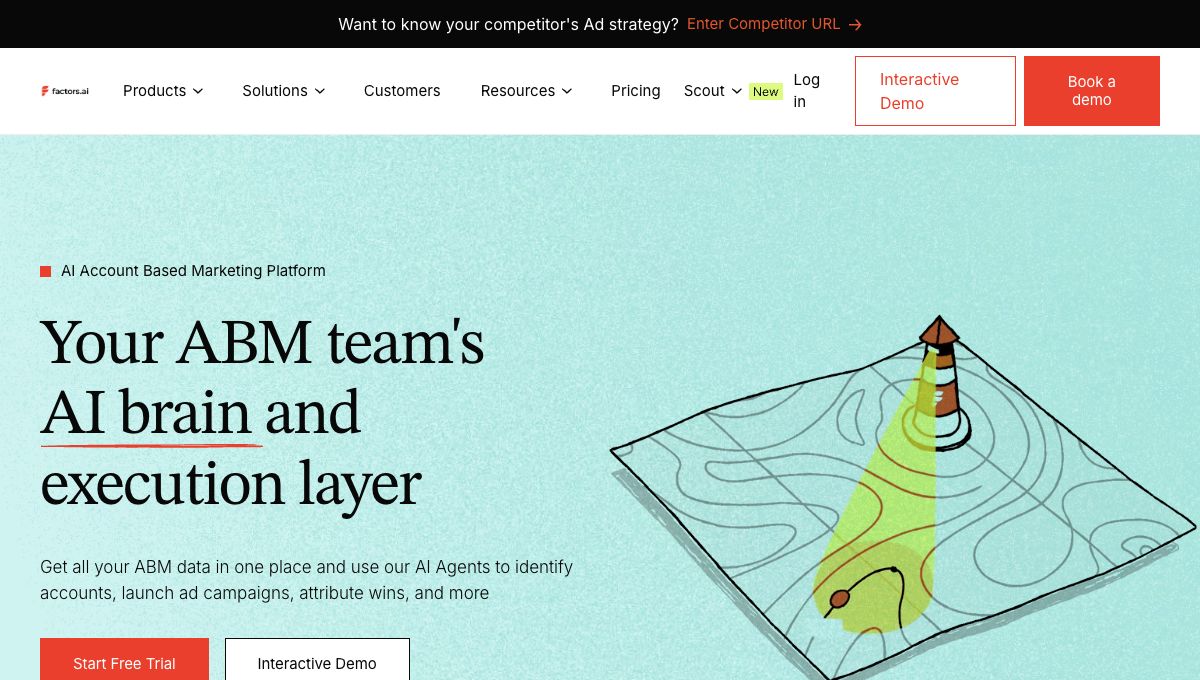
Intended audience and use case: For inbound qualification, consider this option for teams wanting visitor/account intelligence, configurable scoring, and measurement around inbound conversion.
Signal/data coverage and freshness: Scope website activity, visitor identification, company enrichment, configured scores, and attribution context. Verify field provenance, refresh timing, expiry, missing-result behavior, and wrong-match cases using real and deliberately ambiguous requests.
Identity resolution and validation: When enriching a submitted request, keep visitor and company identification visibly separate from the form identity. Treat visitor and company identification as coverage-dependent, expose whether scoring is configured or modeled, and send uncertain cases to human review rather than treating anonymous company evidence as a known event or silently rejecting the hand raise.
Integrations and activation: Website instrumentation, form, CRM, alerts, scoring, and measurement destinations need QA. Test form capture, credentials, field precedence, duplicates, failed CRM writes, suppressions, exception routing, and outcome return.
Implementation effort: Tracked-user limits, identified-company caps, add-ons, and score design affect setup. Name the inbound-process owner, data steward, integration maintainer, seller representative, privacy reviewer, and person authorized to change routing.
Privacy and governance: For inbound handling, map who can see the requester, which fields may be added, correction and suppression, retention, deletion, and website instrumentation, the identity source, add-ons, and destination rights. Test the wrong-owner and unauthorized-destination cases before launch.
Verified pricing and total cost: Factors.ai publicly lists Lite at $199 per month after trial; annual prices are $6,000 for Basic, $20,000 for Growth, and $30,000 onward for Enterprise. For demo routing, add tracked-user and identified-company limits, add-ons, onboarding, support, and exception labor.
Measurement and attribution: Evaluate the qualification path through known versus anonymous coverage, valid matches, accepted routes, response time, and pipeline quality. A model score or attributed opportunity cannot establish causation; compare a baseline and a controlled or phased route where possible.
Proof: Run the inbound proof with quote capture, support scope, add-on inventory, routing and measurement test, sample records, score configuration, instrumentation and identity notes, plus selected plan and caps. Include wrong, missing, duplicate, and failed-write cases – not only a polished demo.
Meaningful limitation: For demo qualification, tier caps, add-ons, third-party identity context, and modeled scores require validation. Since the score is not ground truth, the inbound team should choose another design if the team cannot manage sources, caps, and false-match review rather than putting a valid hand raise behind an unsupported dependency.
5. ZoomInfo
Intended audience and use case: For inbound qualification, consider this option for teams prioritizing broad company/contact enrichment, validation, intent, and sales workflow context.
Signal/data coverage and freshness: Scope form records, company/contact data, validation state, intent/alerts, records, users, and credits. Verify field provenance, refresh timing, expiry, missing-result behavior, and wrong-match cases using real and deliberately ambiguous requests.
Identity resolution and validation: When enriching a submitted request, keep company and contact candidates visibly separate from the form identity. Treat candidates as records with a validation state and provenance, expose correction and suppression paths, and send uncertain cases through representative false-match review rather than silently rejecting the hand raise.
Integrations and activation: Form, enrichment, CRM, engagement, deduplication, and permissions need controlled tests. Test form capture, credentials, field precedence, duplicates, failed CRM writes, suppressions, exception routing, and outcome return.
Implementation effort: Field mapping, credit governance, suppression, and operations add continuing work. Name the inbound-process owner, data steward, integration maintainer, seller representative, privacy reviewer, and person authorized to change routing.
Privacy and governance: For inbound handling, map who can see the requester, which fields may be added, correction and suppression, retention, deletion, and licensed-use rights, credits, regional controls, and the selected bundle. Test the wrong-owner and unauthorized-destination cases before launch.
Verified pricing and total cost: The reviewed ZoomInfo pricing surface did not expose a current numeric list price. Ask for an inbound-specific quote covering enrichment fields, users, record or credit consumption, validation, integrations, setup, services, licensed use, and term.
Measurement and attribution: Evaluate the qualification path through field completeness, valid records, duplicate rate, correct owner, seller acceptance, and stage outcomes. A model score or attributed opportunity cannot establish causation; compare a baseline and a controlled or phased route where possible.
Proof: Run the inbound proof with termination export, references, data-use terms, integration and routing demo, bundle and credit scope, field and validation material, plus buyer-market record sample. Include wrong, missing, duplicate, and failed-write cases – not only a polished demo.
Meaningful limitation: For demo qualification, bundle breadth, seats, data, credits, add-ons, and licensing create operating complexity. Since broad records do not supply an agency-owned service model, an inbound team with a focused workflow should avoid paying for unused database and platform scope rather than putting a valid hand raise behind an unsupported dependency.
Model cost by request, integration, and operator load
Demo request qualification with intent and enrichment pricing can include platform access, tracked visitors, records, credits, enrichment providers, validation, scoring, integrations, data storage, implementation, operator review, exception handling, privacy work, and support. Build a base case for request volume and a stress case for campaigns, product launches, or seasonal spikes. Calculate cost per received request, completed context packet, correctly routed request, and seller-accepted route – not merely cost per enrichment call.
Operator cost matters most when data conflicts. Measure minutes spent on exceptions, corrections, owner disputes, duplicate handling, and failed writes. A cheap API chain can be expensive if sellers distrust it. A more expensive workflow can still be poor value if it delays hand raises or cannot return outcomes.
Measure accepted routing and pipeline quality
Start with service and quality KPIs: time to acknowledge, time to owner, percent enriched within the response window, field completeness, validation state, company-match review, wrong-match rate, duplicate rate, failed-write rate, exception age, and correction time. Add seller metrics: route acceptance, reassignment, reason-coded rejection, first action, and follow-up latency.
Pipeline measures include qualified meetings, sales-qualified progression, opportunities, value, loss reasons, and stage time by comparable cohorts. Report both coverage and error. A higher qualification rate can reflect overly loose rules; a lower rate can reflect better suppression or a broken model. Use a baseline and, where feasible, a phased test. Do not claim causal ROI from vendor attribution alone.
Choose fit by volume, sales motion, and data readiness
This workflow fits teams with meaningful inbound demo volume, multiple territories or products, account ownership complexity, reliable CRM stages, and sellers who will return feedback. It also fits agencies that can standardize the core process while preserving client-specific rules. It is less useful when volume is tiny, every request already reaches one founder, the CRM cannot record outcomes, or the team lacks permission and capacity to use the added data.
For strategic accounts, route immediately and enrich for preparation. For lower-fit requests, route to a review owner rather than hiding the hand raise. For existing customers, partners, support requests, students, vendors, or duplicates, use a named alternative path. For personal emails, preserve the request and resolve cautiously instead of inventing a company match.
Combine form, fit, identity, intent, and outcomes
Build an explainable rule with separate components: explicit hand raise, firmographic fit, relationship, account ownership, identity confidence, first-party engagement, relevant intent evidence, freshness, negative or suppression signals, and capacity. Keep the score or rule decomposable so stakeholders can see which evidence changed the route.
Intent should influence preparation and priority when relevant and recent. It should not erase explicit interest, create a named-person claim from account evidence, or bypass consent, suppression, territory, customer, and conflict rules. Return outcomes to the same record so stale evidence, bad fields, and unhelpful thresholds can be corrected.
Prevent false matches, privacy errors, and bad routing
The highest-risk mistakes are overwriting submitted data, treating an IP or account match as the requester’s identity, suppressing a valid hand raise because intent is missing, routing on stale signals, exposing sensitive context to the wrong owner, keeping unnecessary data, and optimizing only for speed. Test unauthorized destinations, wrong-owner access, suppression, deletion, and correction as seriously as the happy path.
Use the NIST Privacy Framework to organize privacy-risk discussions, while recognizing it is voluntary and not certification. If qualification leads to commercial email, review applicable requirements; the FTC CAN-SPAM guide is one U.S. reference, not permission for every contact or jurisdiction.
Package qualification as a recurring agency service
An agency offer can include form and CRM mapping, enrichment and validation design, routing rules, branded exception and quality reports, seller feedback, monthly calibration, and quarterly scope review. Separate setup from recurring operations. Define response expectations as service assumptions unless a written SLA is approved. The client owns prompt access, correct CRM stages, seller feedback, legal decisions, and timely approval of rule changes.
Use BrandWell only after the BrandWell-provided product, pricing, pilot, workflow, supplier, and entitlement claims pass current written review. The recurring value is not “more data”; it is faster, more explainable handling of explicit interest with fewer wrong routes and a record of what happened.
The next step is to shadow the workflow on representative historical and live requests, compare proposed routes with human review, then activate one reversible path with a rollback and weekly error review.
Frequently asked questions
How should B2B data, RevOps, engineering, privacy, and agency delivery teams approach demo-request qualification with intent and enrichment to make signals reliable, explainable, supportable, and cost-effective?
Treat the form submission as primary evidence, enrich in parallel, route promptly, explain every rule, and preserve uncertainty rather than letting an inferred score overrule the request.
What workflow, data, integrations, and team are required for demo-request qualification with intent and enrichment?
You need form and event capture, validation, account resolution, enrichment, CRM ownership, suppression, routing, outcome return, RevOps ownership, technical support, privacy review, and seller feedback.
Which tools, services, templates, or operational resources are most useful for demo-request qualification with intent and enrichment?
Use a field dictionary, decision tree, routing matrix, exception register, suppression policy, test set, feedback form, and cost worksheet. Tools should expose source and correction.
How should a buyer compare demo-request qualification with intent and enrichment with single-source scores, unchecked visitor matches, or opaque API workflows, and when should each be used?
Single-source scores are simpler but brittle; unchecked matches create false certainty; opaque chains hide failure. Use a transparent multi-signal path when volume and complexity justify it.
What budget, pricing model, and total cost should a buyer expect for demo-request qualification with intent and enrichment?
Budget platform or usage charges, providers, integration, setup, operator exceptions, privacy review, and support. Compare cost per correctly routed and accepted request.
How should demo-request qualification with intent and enrichment be measured and tied to qualified pipeline or revenue?
Track time to owner, completeness, wrong matches, failed writes, route acceptance, reassignment, qualified meetings, opportunities, and reason-coded losses against a baseline.
Which companies, clients, or use cases are the best fit for demo-request qualification with intent and enrichment?
Best-fit teams have meaningful volume, complex ownership, stable CRM outcomes, and feedback capacity. Founder-routed low-volume teams may not need it.
How should demo-request qualification with intent and enrichment be combined with fit, identity, freshness, activation, and downstream outcome evidence?
Combine original form evidence, fit, identity confidence, relationship, first-party engagement, recent intent, negative signals, and outcomes without collapsing them into unexplained certainty.
What are the biggest mistakes, data-quality issues, and privacy risks in demo-request qualification with intent and enrichment?
Avoid overwritten identities, silent suppression, stale intent, wrong-owner access, excessive retention, and speed-only optimization. Test corrections and permissions.
How should an agency include demo-request qualification with intent and enrichment within a broader recurring client service?
Sell setup plus recurring routing quality, exception handling, seller feedback, and calibration. Keep client responsibilities, data rights, and outcome limits explicit.