Short answer: Agencies can use eligible website-visitor identification evidence to prioritize their own prospect research, but a visit is not proof of buying intent and visitor and identity matches are probabilistic, and an inferred identity is not certainty. The safest revenue workflow combines qualifying-page behavior, recency and frequency, stated identity confidence, ICP fit, exclusions, lawful data use, and human review before any outreach.
Who is this for? B2B agencies with meaningful website traffic, a defined ideal client profile, and a sales process that can review a small number of high-context prospect signals.
The goal is not to contact everyone who loads a page. It is to build a repeatable agency-prospect funnel in which useful first-party behavior improves prioritization. A visitor may be a buyer, competitor, job seeker, vendor, customer, employee, researcher, bot, or accidental click. The workflow must be designed to reject more records than it activates.
BrandWell update, September 2026: MarketPulse intent data starts at $250/month within BrandWell’s complete growth automation software. AIMEE, the agent-powered desktop app, helps connect buyer signals with research, content, and campaign work. Access to the broader tools depends on your package.
BrandWell: MarketPulse intent data and connected growth automation
From audience to action: connect intent data with the work needed to use it. BrandWell is complete growth automation software that connects MarketPulse intent data, TrafficID website visitor identification, content, outreach, and campaign workflows. AIMEE, its agent-powered desktop app, helps turn those signals into research, prepared assets, and approved actions.
For agencies, this creates a repeatable client workflow: identify relevant demand, apply a client-specific ICP, prepare a campaign, and review the work in the same platform. Branded delivery and multi-client requirements should be scoped to the agency package.
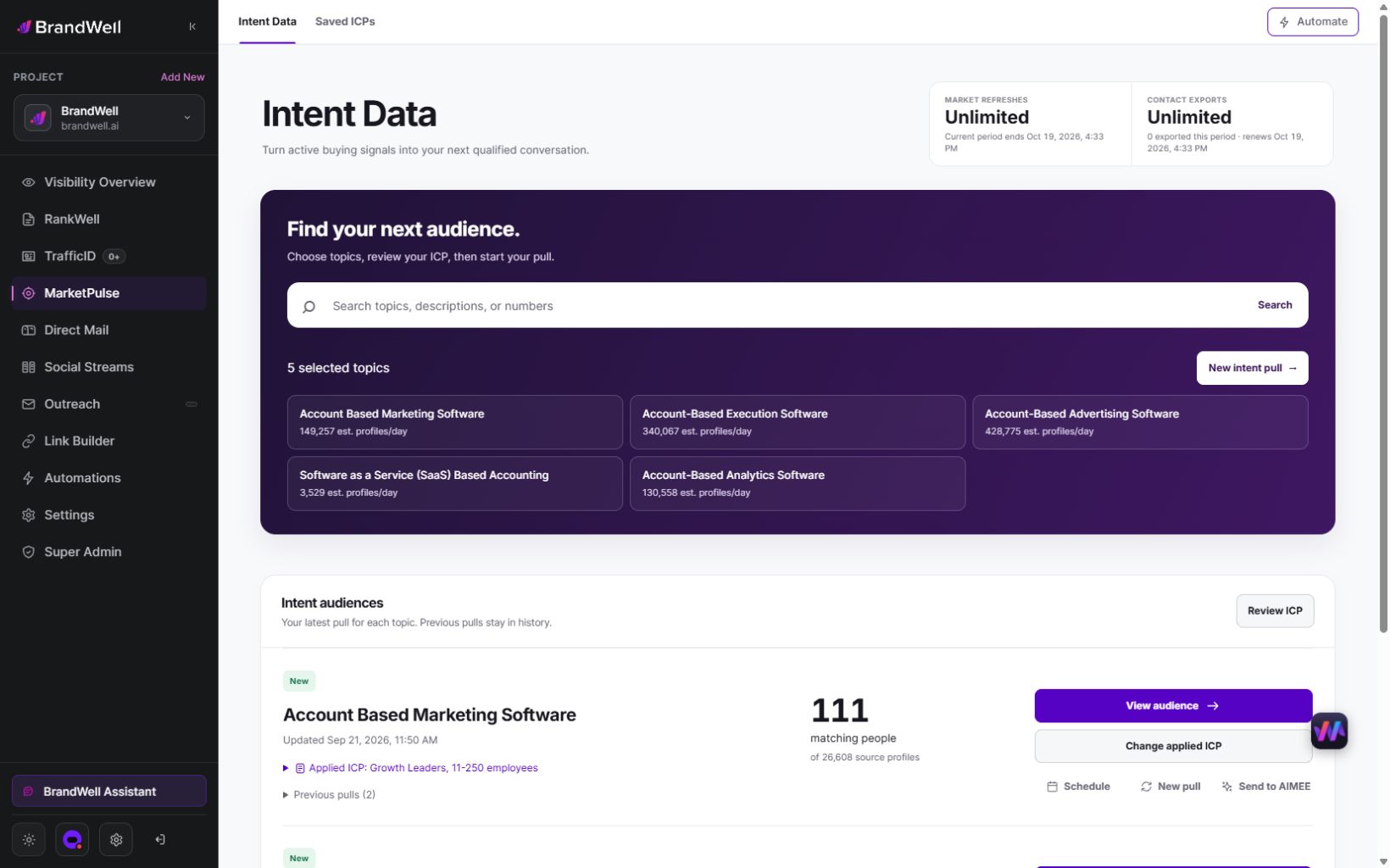
How the software connects the work:
- Find and qualify demand: MarketPulse brings topic-based intent into a reviewable audience with saved ICPs and scheduled pulls. TrafficID adds website visitor identification to the growth workflow.
- Prepare the next campaign: Outreach and Direct Mail provide execution workspaces; Social Streams adds relevant social activity. Use the tools and destinations configured for your project.
- Build demand as well as capture it: RankWell, Visibility Overview, and Link Builder connect content and visibility work with the same growth operation.
AIMEE helps carry the work forward
AIMEE is BrandWell’s agent-powered desktop app. It helps research accounts, prepare content and messages, and carry out assigned work through connected tools. BrandWell’s Automations workspace connects product events to workflow steps, with owners, approvals, and run history. You choose the connections, allowed actions, and budgets.
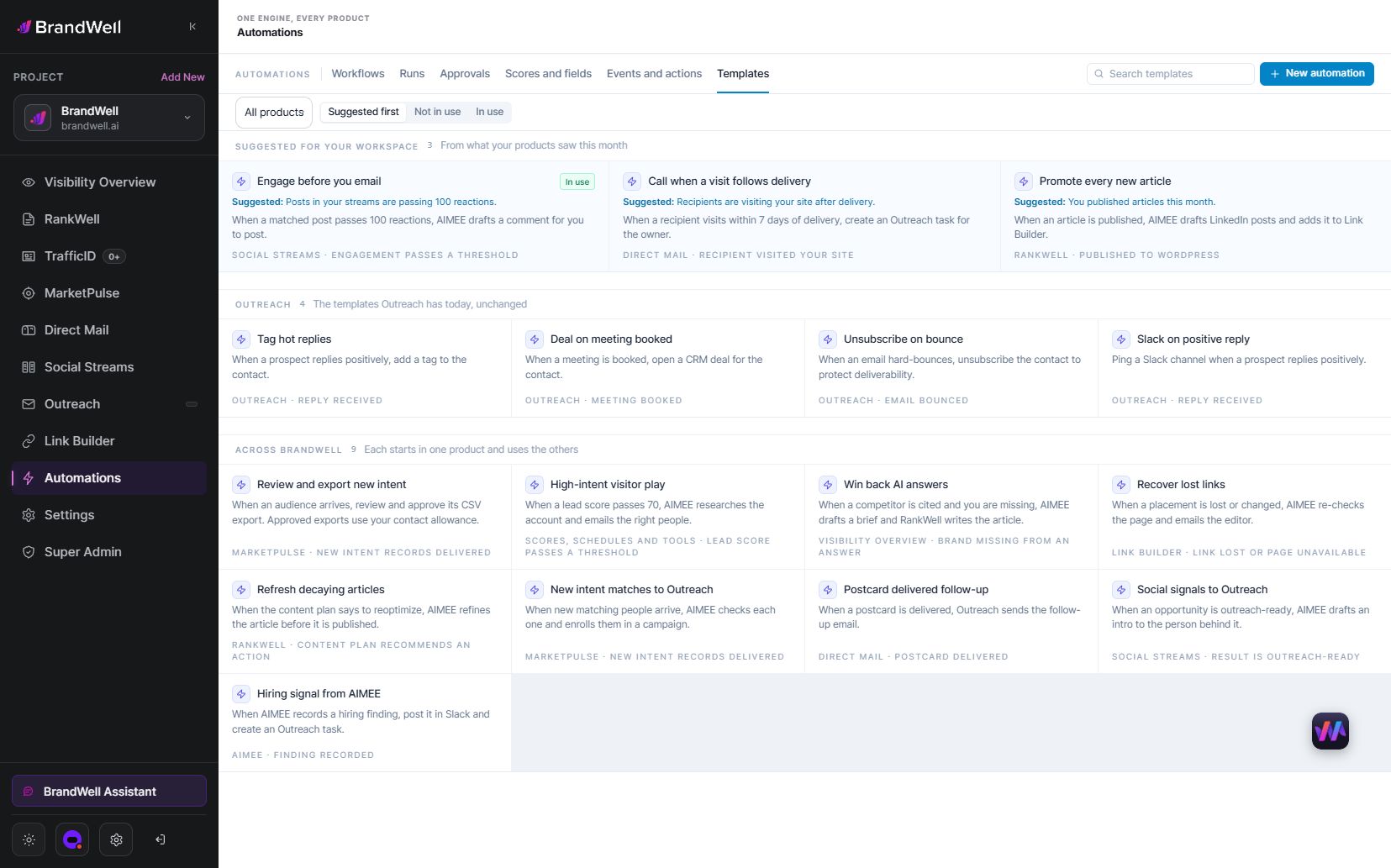
BrandWell MarketPulse intent-data plans start at $250/month. Your selected package determines topic coverage, contact allowances, refresh cadence, AIMEE access, and other growth tools. Channel usage, media, and fulfillment costs depend on the campaign.
What to evaluate: topic relevance, usable audience coverage, ICP fit, and the time it takes to turn an accepted signal into completed work. An intent signal helps prioritize an opportunity; it does not guarantee a purchase or establish permission for every channel. Choose a workflow your team can operate, then evaluate the audience and the completed work against that goal.
Turn eligible website visits into a qualified agency-prospect funnel
Start with a short list of pages that indicate a business problem related to the agency’s offer: service detail, pricing, comparison, case study, implementation, industry solution, or consultation. Treat homepage and blog traffic as weak evidence unless the visit has additional context. Define a freshness window and a frequency rule so an old or single low-value pageview cannot remain “hot” forever.
Then layer evidence in order: observed first-party behavior, consent and notice state, bot and internal-traffic filtering, company or profile match at a stated confidence, ICP fit, customer and opportunity status, role relevance, and approved next action. Preserve the reason a record passed each gate.
The output should be a review queue, not an automated blast. A seller sees the company, qualifying behavior category, timing, match-confidence state, fit notes, exclusions checked, and a recommended research step. Personalized claims about the exact page or topic should be avoided unless the interaction is known first-party and the use is appropriate.
Build the visitor-to-prospect workflow, owners, cadence, and QA
This website visitor identification for agency sales implementation guide uses nine steps:
- Set the objective. Choose one agency offer, ICP, qualifying action, and accepted pipeline outcome.
- Review instrumentation. Map tags, pixels, cookies, local storage, device signals, analytics, identity vendors, forms, and CRM IDs. Google explains that Consent Mode communicates consent states; it is not itself a consent-management platform or a legal determination.
- Publish accurate notice. Explain collection, purposes, sharing, choices, and contact channels. Obtain jurisdiction-specific legal review before deployment.
- Define qualifying behavior. Assign page categories, minimum depth or recurrence, session exclusions, and decay. Avoid sensitive topics.
- Resolve the entity. Label the result as anonymous, domain/account matched, known first-party contact, or profile resolved at a stated confidence.
- Apply fit and suppression. Check geography, industry, size, service fit, customer status, open opportunity, competitors, employees, vendors, students, bots, opt-outs, and do-not-contact records.
- Research before contact. Verify employer, role, company need, and an appropriate reason to engage without revealing surveillance-like detail.
- Approve the action. A human chooses no action, nurture, account research, referral request, advertising audience, or one-to-one outreach under the applicable rules.
- Record the result. Capture acceptance, rejection reason, time to action, meeting, qualified opportunity, progression, revenue, unsubscribe, complaint, and correction.
Marketing owns page taxonomy and notice coordination; RevOps owns matching, routing, CRM state, and reporting; sales owns research and action; privacy, security, and legal owners approve collection and use. Review daily only when signal decay justifies it. A weekly queue can be more credible than instant outreach.
Seven tools, methods, and templates for an agency-owned workflow
1. Qualifying-page map
Classify pages by problem, stage, offer, and sensitivity. Best fit: every agency site. Limitation: page intent is contextual; a case study view alone does not identify a buyer.
2. Consent and tag inventory
List every storage and access technology, purpose, vendor, trigger, and consent state. Best fit: governance before collection. Limitation: inventory does not by itself establish lawful use.
3. Confidence-tier queue
Separate anonymous, account-matched, resolved-profile, and known first-party records. Best fit: preventing identity overstatement. Limitation: confidence labels require tested definitions.
4. ICP and exclusion worksheet
Score company fit while applying customer, employee, competitor, vendor, bot, geographic, and suppression exclusions. Best fit: reducing false positives. Limitation: stale firmographic data can misroute records.
5. Account-research brief
Summarize public business context, likely problem, missing evidence, safe messaging angle, and recommended action. Best fit: high-value services. Limitation: research can become speculation unless sources and uncertainty remain visible.
6. Human approval card
Show source class, behavior category, identity state, fit, suppression, suggested channel, and rollback. Best fit: controlled activation. Limitation: it slows volume – which is intentional when evidence is weak.
7. Outcome and correction log
Track acceptance, false match, stale data, meeting, opportunity, opt-out, and complaint. Best fit: improving the rules. Limitation: seller feedback must be standardized or it becomes anecdotal.
Visitor identification vs. referrals, broad cold lists, and untargeted ads
Website visitor identification for agency sales is a prioritization layer, not a replacement for every acquisition channel. Referrals carry trust but are unpredictable and narrow. Broad cold lists create reach but require heavy fit and permission work. Untargeted ads can build awareness but often spend on out-of-market audiences. Visitor identification adds first-party timing context but sees only people who reach the site and can be measured or matched appropriately.
Use referrals for trust-intensive introductions, targeted outbound for accounts the agency can genuinely help, paid media for market creation and retargeting under platform and privacy rules, and visitor evidence to prioritize research within those motions. A diversified system is more resilient than a single identification feed.
For a low-traffic agency, improving positioning, partnerships, content, referrals, or targeted account selection may create more value than installing another tag. For a high-traffic agency with poor ICP clarity, identification will amplify noise until the offer and exclusions are fixed.
Model data, tooling, labor, opportunity cost, and unit economics
Website visitor identification for agency sales pricing can include a platform subscription, traffic or reveal units, enrichment, validation, CRM or automation tools, implementation, consent tooling, security review, and support. Add analyst and seller time for match review, account research, personalization, corrections, and suppression.
Build a unit-economic model from eligible visits – not all visits. Calculate cost per reviewed record, accepted company, approved contact action, held meeting, qualified opportunity, and won client. Include the cost of false matches, no-shows, opt-outs, complaints, and seller time diverted from stronger opportunities.
Use a bounded pilot with a fixed page set, ICP, daily review capacity, and outcome window. Compare with the agency’s prior process or a similar fit-only group. Do not justify cost using a vendor’s raw reveal count when the agency cannot safely or usefully activate the records.
Measure accepted identities, meetings, qualified pipeline, and revenue
Website visitor identification for agency sales KPIs should expose both value and harm:
- eligible sessions and qualifying-page rate;
- bot, employee, customer, competitor, vendor, and geographic exclusion rates;
- account-match, profile-resolution, accepted-match, and false-match rates by confidence tier;
- ICP-fit and seller-acceptance rates;
- median time from eligible visit to review;
- approved actions, held meetings, qualified opportunities, stage progression, and wins;
- unsubscribe, objection, correction, complaint, and suppression rates.
For website visitor identification for agency sales ROI, use incremental gross profit attributable under a documented rule minus platform, data, labor, and activation costs, divided by those costs. Exclude opportunities already open before the visit. Report assisted influence separately from sourced pipeline.
There is no universal benchmark across agency offers, traffic sources, deal sizes, identity methods, and qualification rules. The most useful benchmark is the agency’s own fit-only or prior-process baseline with the same definitions.
Which agency models and traffic profiles are a fit
The method best fits B2B agencies with a narrow offer, meaningful client lifetime value, strong conversion pages, steady qualified traffic, a defined ICP, and capacity for fast human review. It can work well for specialized demand-generation, RevOps, paid-media, web, data, and GTM consultancies where site behavior maps clearly to a service problem.
It fits poorly for very low traffic, broad consumer audiences, sensitive services, unclear positioning, tiny contracts, or teams that cannot staff research and suppression. If most traffic comes from content unrelated to the agency’s commercial offer, improve page taxonomy and acquisition before buying more identity coverage.
Combine behavior, identity checks, fit, activation, and outcomes
Use a transparent evidence chain:
- Behavior: page category, recency, frequency, source, and bot filtering.
- Identity: account, known first-party contact, or resolved profile with confidence and conflict state.
- Fit: market eligibility, service relevance, territory, customer state, and exclusions.
- Activation: permitted channel, capacity, owner, approval, and expiry.
- Outcome: accepted, acted on, meeting, opportunity, revenue, opt-out, correction, or complaint.
AIMEE is the agent-powered desktop app in BrandWell’s growth workflow. Assign work through the tools connected to your workspace and choose which actions can run automatically or require approval. Desktop availability, account permissions, and the configured workflow determine what can execute.
Protect privacy and trust while controlling false positives
The UK ICO’s guidance on collecting information and generating leads emphasizes fair, lawful, and transparent collection and profiling; public data is not a free-for-all. Its cookies and similar technologies guidance covers pixels and related storage or access methods. These resources are UK-specific and are not legal advice for every campaign.
For email in the United States, review the FTC’s CAN-SPAM compliance guide. It does not authorize every data source or message; other privacy, consumer-protection, state, sector, contract, and platform rules may apply.
- Do not identify a person with certainty when the match is inferred.
- Do not tell a prospect that you watched a sensitive page or know private research.
- Do not let a pageview override consent, objection, suppression, customer, or open-opportunity status.
- Do not retain raw device or identity data longer than the approved purpose requires.
- Do not share client or prospect data across agency tenants.
- Provide correction, opt-out, deletion, complaint, and audit procedures.
- Test bots, shared devices, VPNs, agencies, remote workers, and subsidiary domains.
Connect agency acquisition learning to a separate recurring client offer
The agency’s own acquisition workflow can teach it which pages, fit rules, confidence tiers, research steps, approvals, and metrics work. A separate client-facing service may then package those operating lessons – but it needs its own contract, privacy roles, client notice, tenant separation, permitted-use review, reporting, and approvals. Do not silently reuse the agency’s prospect data as client data.
Start with MarketPulse intent data from $250/month. Review a topic and its matching audience, then use BrandWell’s connected growth tools and AIMEE desktop assistance to prepare the next action. Agency packaging and services can be scoped around the client workflow.