


On this page
- How intent differs from a contact list or enrichment
- Keep the source and identity level visible
- Useful research categories, without a universal intent ranking
- Use MarketPulse for topic research starting at $500/mo
- Own-site activity is a separate workflow
- Turn a signal into reviewed work
- Example: an IT services account brief
- Choose the next action around the evidence
- Common mistakes to avoid
- Measure usefulness rather than record volume
- Frequently asked questions
Intent data is information about observed behavior or research associated with a topic. It can suggest that a person or account is exploring a relevant problem, product category, service, or implementation. The source, observation window, identity level, and uncertainty determine what the signal actually supports.
For lead acquisition, intent is an input to review and prioritization. It is not proof that the person intends to buy, requested contact, or will become a customer. Combine it with fit, identity, an appropriate offer, channel permissions, and a reviewed next action.
How intent differs from a contact list or enrichment
A contact list identifies possible people or companies. Enrichment adds fields such as company, role, or available contact details. Intent adds context about relevant observed activity. These inputs answer different questions and should not be treated as interchangeable.
- Fit: does the account belong in your target market?
- Identity: which company or person does the record describe, and how certain is the match?
- Research: what relevant activity is observed, through which source, and when?
- Action: what reviewed step is useful and permitted?
- Outcome: what actually happened after that step?
A well-matched profile without recent activity can still be a relevant prospect. A recent signal from the wrong market can still be irrelevant. Neither input should replace the other.
Keep the source and identity level visible
First-party activity concerns your own connected property or relationship. Wider topic research comes from a different source. A submitted inquiry is different again: it includes a stated request rather than an inference from research.
The IAB Tech Lab Data Transparency Standard addresses audience-data disclosures including provenance, recency, and segmentation criteria. Those are useful questions to ask about the data you evaluate. A reference to the standard does not establish that a particular product is certified under it.
An account-level observation does not prove a specific employee performed the research. Added stakeholders are not necessarily observed visitors. Preserve unknowns and any confidence information instead of filling them with assumptions.
Useful research categories, without a universal intent ranking
Category and solution research
Subjects such as payroll software or IT services can indicate interest in a solution space. Check the topic’s scope and whether it corresponds to your offer. Broad relevance does not establish buying readiness.
Provider and comparison research
Comparisons, reviews, and alternatives can reflect evaluation, but may also come from existing customers, researchers, employees, or unrelated users. Treat the label as context to inspect rather than automatically the strongest signal.
Implementation research
Setup, migration, integration, and deployment topics can inform useful educational material. The reader may be evaluating, implementing an existing purchase, or troubleshooting. Role and relationship matter.
Problem research
A broad operational question can help identify content needs or a reason for further account research. It may be too general for a sales action. Validate the topic and use it at the appropriate stage.
These categories are planning aids. There is no universal ladder in which a comparison always outranks an implementation question or proves greater purchase likelihood. Test relevance and outcomes in your actual market.
Use MarketPulse for topic research starting at $500/mo
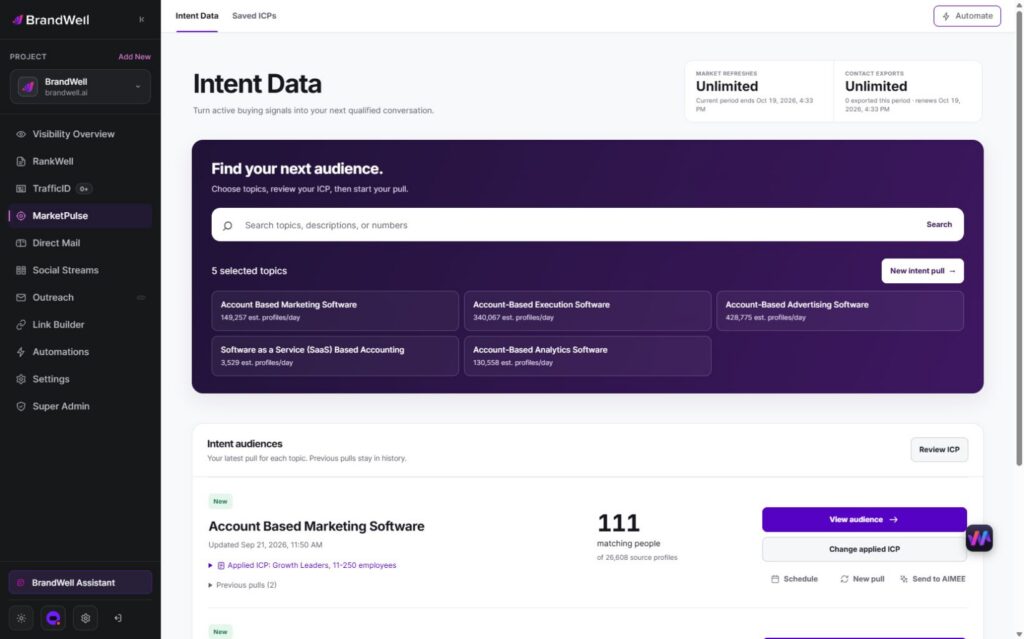
MarketPulse helps teams search relevant topics, apply a saved ICP, and review available people and company details.
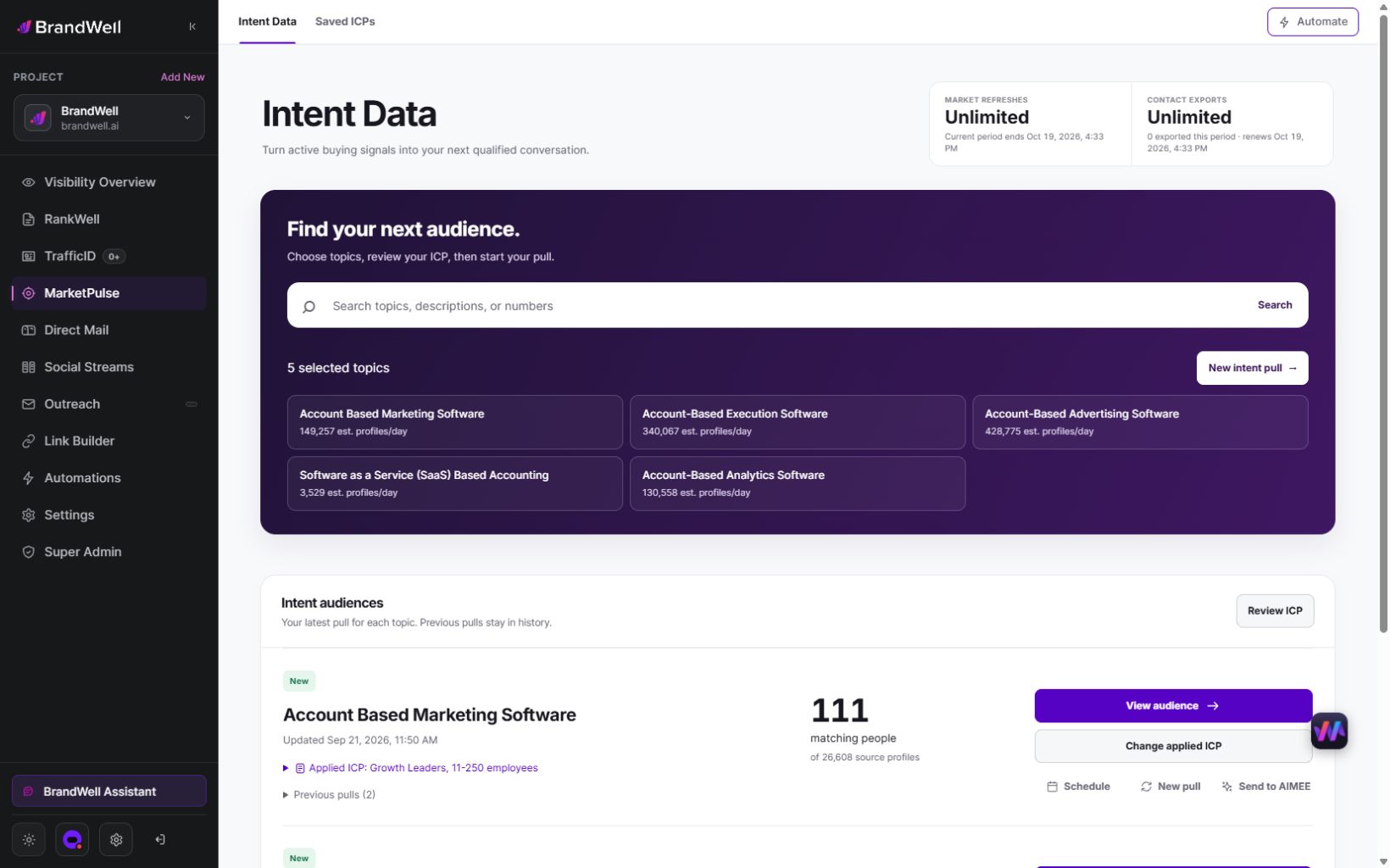
- Starter:one weekly topic, and 25,000 monthly contact exports.
- Growth:three daily topics, and 100,000 monthly exports.
- Scale:ten daily topics, and unlimited exports.
A pull retrieves available data from the previous 24 hours for a topic. Daily use across included topics gives 90 Growth pulls or 300 Scale pulls in a 30-day month. Weekly Starter pulls vary by calendar month. Counts and fields vary, and audiences can overlap. Any eligible early-access discount is separate from standard pricing.
Growth and Scale include AIMEE for the initial user to help research and prepare assigned work through configured tools and permissions. Connected products, channel usage, and fulfillment may cost extra. Do not infer universal API, advertising integration, white-label, license-resale, or desktop-execution access from a workflow example.
Own-site activity is a separate workflow
TrafficID deals with your connected website audience. Keep identified visitors, submitted forms, and additional company stakeholders distinct. A stakeholder added to a company record is not necessarily a site visitor.
Own-site activity can inform account review when the source and relationship are appropriate. It does not replace wider topic research, and it should not be presented as knowledge of every individual’s private browsing.
Turn a signal into reviewed work
- Map the market. Define your offer, relevant topics, ICP, and excluded meanings.
- Inspect the signal. Record source, observation time, identity level, available fields, and uncertainty.
- Check the account. Review role, fit, employment, duplicates, customers, and existing opportunities.
- Approve the use. Confirm the destination, channel, source rights, suppression, and review requirements.
- Prepare the next step. Create an account brief, useful content, a permitted audience plan, or a reviewed follow-up.
- Assign and verify. Name the owner, confirm the completed action, and record errors or exceptions.
- Measure the outcome. Separate accepted work, useful responses, meetings, opportunities, and customers.
Routing and integrations need actual configuration. An export can be a suitable handoff; it does not automatically update a CRM, launch an ad, or send an email.
Example: an IT services account brief
A fictional IT services firm reviews a relevant topic and applies its target-company criteria. Its owner checks the matching account, public business context, role, and existing relationship, then prepares a brief about a plausible operational problem.
The owner selects an appropriate next action after review. The message can offer useful information without asserting that a named person searched a particular phrase. The report records what was reviewed, approved, and answered.
This is a process example, not a measured BrandWell result or a guarantee of a meeting.
Choose the next action around the evidence
A relevant account with incomplete identity may need more research. A broad topic may inform an article brief in RankWell. A submitted request may need prompt handling by its owner. A record with unresolved permissions should remain out of the proposed channel.
Research data does not create missing advertising eligibility or contact permission. An enriched mobile number is not an opted-in reminder number. Do not turn topic matches into consumer, sensitive, or consequential personal inferences without the appropriate source, scope, and review.
Common mistakes to avoid
- Treating account-level activity as proof about a named person.
- Automatically sending every signal to sales.
- Using available contact details as permission for every channel.
- Claiming all topic categories are equally available or commercially predictive.
- Hiding source, freshness, exclusions, or uncertainty.
- Counting overlapping audiences as unique people.
- Promising integrations or delivery rights outside the actual plan.
- Calling attributed outcomes incremental without a credible comparison.
Measure usefulness rather than record volume
Track relevant records, accepted account briefs, time spent reviewing, approved actions, useful replies, held meetings, qualified opportunities, and full costs. Use a fit-only or other appropriate baseline where practical.
For a fictional test, 100 reviewed records produce 40 accepted briefs and eight useful conversations. Brief acceptance is 40%; conversations per accepted brief is 20%; conversations per reviewed record is 8%. The denominator changes the interpretation. None of these example rates proves customers or incremental revenue.
Frequently asked questions
Is buyer intent a confirmed purchase decision?
No. It is research or behavioral evidence to evaluate in context. A direct request, qualification, and purchase remain separate events.
Can intent data help an agency’s clients?
Relevant pulls and exports can support agreed client work. Define rights, access, scope, review, fees, and reporting rather than promising automatic resale or a white-label platform.
What if the signal is incomplete?
Research further, keep it in a watch queue, or exclude it from the action. Preserve the reason instead of treating missing information as a positive signal.
Watch the MarketPulse demo and compare plans starting at $500/mo. Choose a relevant topic, review its matches with your ICP, and test one useful, permitted handoff.
Reviewed and updated October 3, 2026.

Written by
Jeff Joyce has been helping brands grow online since the Myspace era, when custom HTML layouts were still a competitive advantage. What started in design quickly evolved into a career spanning social media, content strategy, video, agency ownership, and growth marketing. After building his own agency and testing countless AI tools, Jeff joined BrandWell with a clear focus: helping marketers understand how AI can actually improve the way they create, optimize, and scale content. Today, Jeff brings a CMO-level perspective to BrandWell's marketing strategy, blending brand positioning, content, video, customer education, and growth. His work centers on turning complex AI concepts into clear, practical marketing that helps brands move faster, create better content, and stay competitive without losing their voice.
 Farnaz Kia