On this page
- Current MarketPulse workflow
- Define the client decision and topic charter
- Assign owners, tests and handoffs
- Choose tools that preserve topic meaning
- Compare manual, automated and managed delivery
- Price setup and portfolio maintenance
- Measure relevance and client action
- Adapt the package to client readiness
- Preserve sources through activation
- Control scope and semantic drift
- Maintain the recurring topic service
- Keep topic meaning separate from the displayed label
- Worked example: account overlap changes the denominator
- Frequently asked questions
Direct answer: Package a topic-intent monitoring service as a maintained portfolio of business questions, approved topics, account-fit rules, freshness windows, qualification states, delivery cadence, and review evidence. Sell the operating discipline that turns changing topic activity into a client decision, not an unexplained stream of records.
Current MarketPulse offer: intent-data plans start at $500/mo. See the product, demo, and current plans. Updated October 3, 2026.
The package should tell a client why each topic exists, what a signal does and does not mean, which accounts qualify, what happens next, how topics are revised, and how the client can correct the model.
Who this is for: Agencies, GTM consultants, RevOps firms, and demand generation teams productizing third-party topic-intent monitoring for B2B clients. It assumes the client has a defined market, an action owner, and a reason to monitor specific buying themes.
Current MarketPulse workflow
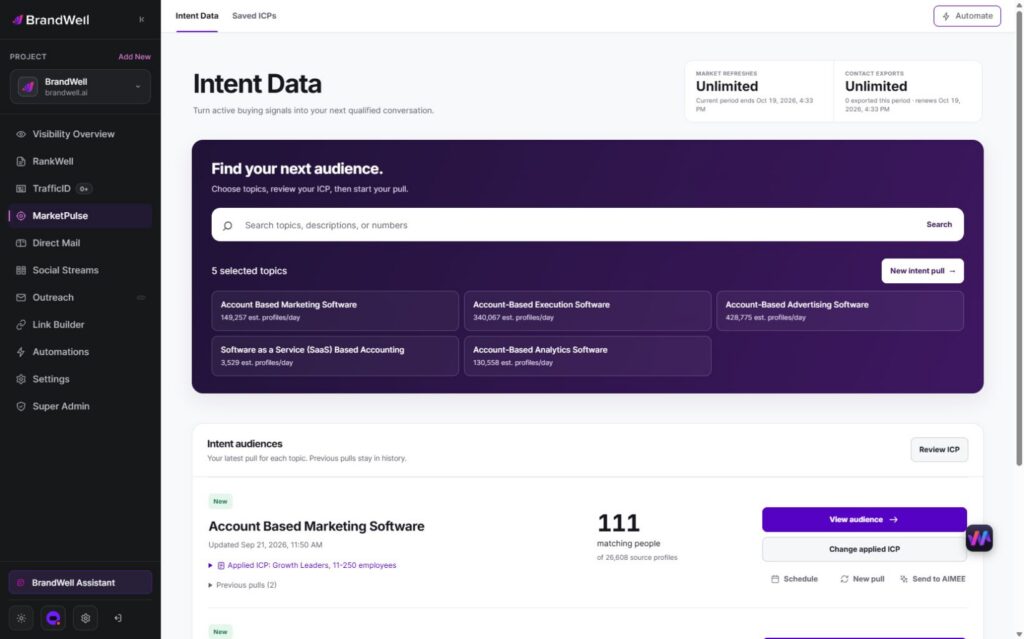
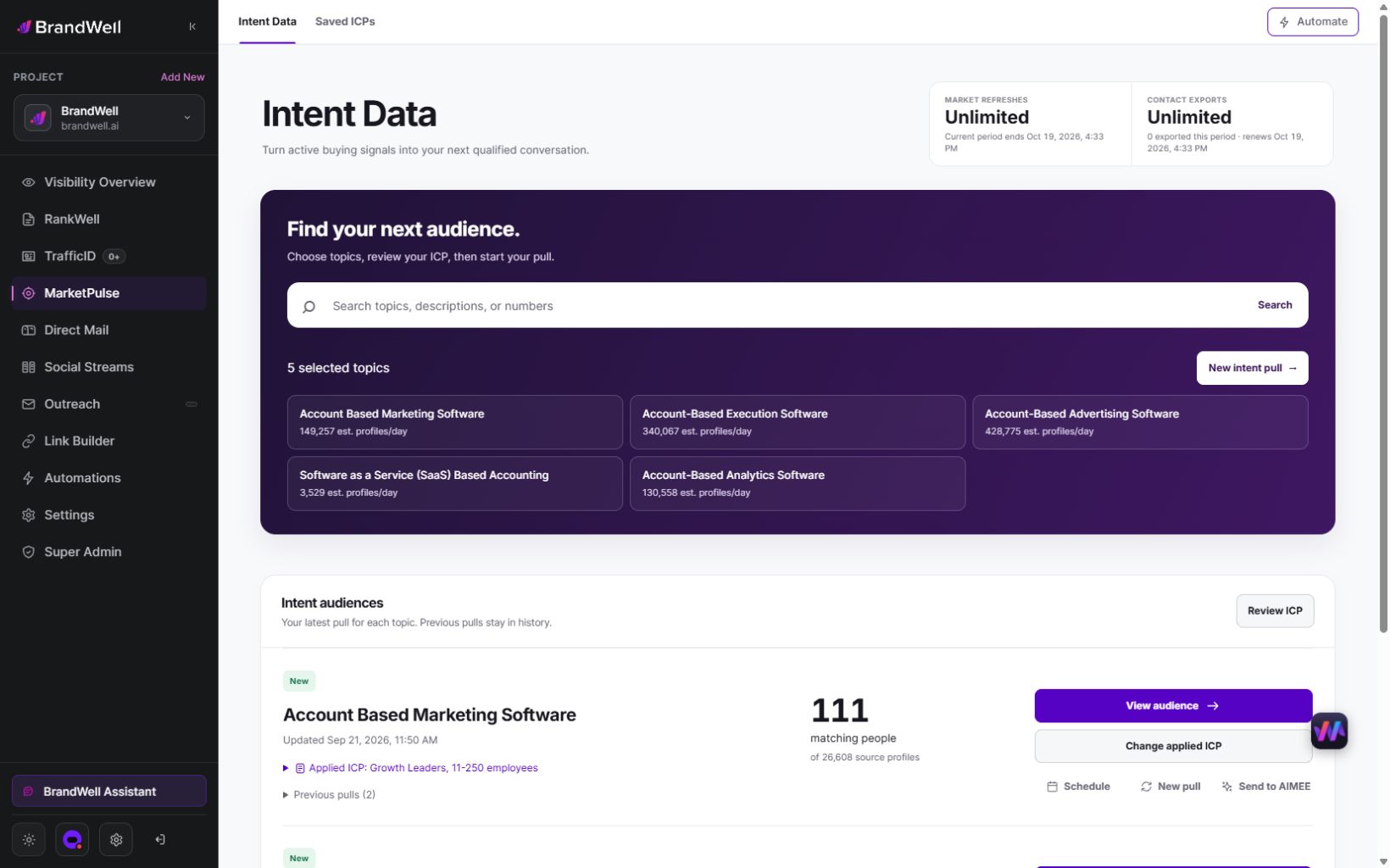
BrandWell MarketPulse: intent data starting at $500/mo. Find people researching topics relevant to what you sell, apply saved ICP filters, and review available contact details before taking action.
MarketPulse plans are starting at $500/mo. Verify current package scope and offers on the product page.
| Plan | Topics and refreshes | Monthly exports |
|---|---|---|
| Starter | 1 topic, weekly | 25,000 contacts |
| Growth | 3 topics, daily | 100,000 contacts |
| Scale | 10 topics, daily | Unlimited contacts |
Swipe the table to see all columns.
A pull retrieves available data from the previous 24 hours for one topic. Daily use across all included topics provides 90 Growth pulls or 300 Scale pulls in a 30-day month. Weekly Starter pulls vary by calendar month. Available audience size and contact fields vary, and audiences may overlap. Refreshes stop at the plan limit without overage charges.
- Find and qualify: search the topic catalog, save your ICP, and review the people and companies that match.
- Act on the research: export qualified contacts or prepare an Outreach or Direct Mail workflow. Connected products, channel usage, and fulfillment may cost extra.
- Get help from AIMEE: Growth and Scale include AIMEE for the initial user to research accounts and prepare the next step through connected tools.
Agencies and other service businesses can build client deliverables around their available Intent Scans and exports. Keep each client’s scope, permissions, and service fees clear. A subscription is not a promise of a white-label platform or exclusive access to a market.
Explore MarketPulse and watch the demo or compare plans starting at $500/mo. Any early-access discount is a separate, time-limited offer shown to an eligible recipient.
Define the client decision and topic charter
Start with a client decision, not a keyword dump. Ask what the client would do differently if a relevant account showed recent activity around a defined problem or solution theme. The answer might be to research the account, alert an owner, review ad coverage, prepare a personalized message, or include it in a weekly planning meeting.
Translate that decision into a small topic portfolio. Each topic needs a business question, inclusion logic, exclusion logic, target audience, recency expectation, account-fit conditions, permitted actions, owner, and review date. Begin narrow enough that a person can inspect the first deliveries and explain the qualification.
Define first value as an accepted report or queue that helps the client make the named decision. Do not define it as a guaranteed reply, opportunity, or sale. Repeatability comes from using the same portfolio method for every client while allowing topics and qualification to reflect each client’s offer and market.
A strong initial service might contain one primary problem family, several supporting themes, a documented exclusion set, and one weekly action ritual. Expand only after the client shows which items were useful, irrelevant, too broad, too late, or impossible to act on.
Minimum viable topic charter
Record the business question, topic name, plain-language meaning, included concepts, excluded concepts, target accounts, freshness expectation, minimum qualification state, permitted next action, client owner, agency owner, review date, and retirement trigger. Include one positive and one negative example so an operator can test interpretation.
Separate a topic from the client’s message. The topic identifies a research theme; it does not automatically reveal pain, budget, authority, or preference for the client’s offer. The service earns trust by combining the signal with account context and presenting a reasonable next decision, not by pretending to read a buyer’s mind.
Assign owners, tests and handoffs
The eight-step topic portfolio loop
- Frame: name the business question, audience, action, and accountable client owner.
- Select: choose candidate topics and document why each belongs in the portfolio.
- Baseline: observe early volume, noise, account mix, overlap, and timing before promising a cadence.
- Qualify: apply account fit, freshness, exclusions, duplication, and action-readiness rules.
- Review: inspect samples and route ambiguous or newly emerging patterns for human judgment.
- Deliver: publish the approved branded report or route records to the agreed destination.
- Learn: collect accepted, rejected, acted-on, corrected, and unowned feedback.
- Maintain: retain, revise, split, merge, pause, or retire topics with versioned evidence.
Assign the agency a portfolio owner, an operations owner, and a quality approver. Assign the client a business owner and an action owner. One person may hold more than one role at a small firm, but no gate should be ownerless. Use the topic selection and maintenance process to keep changes out of informal chat threads.
Set SLAs around portfolio operations, such as review by a defined business day, delivery after eligibility, correction acknowledgement, or urgent pause. Record the signal timestamp separately from the processing and delivery timestamps. A fast delivery of stale or misunderstood activity is not high service quality.
Use sampling that reflects the portfolio. Review high-volume topics, low-volume topics, newly changed topics, high-priority accounts, borderline fits, and suppressed records. A random sample alone may miss the conditions most likely to create client harm or confusion. Record the sample, reviewer, finding, decision, and any required reprocessing.
Choose tools that preserve topic meaning
The service needs six capability groups: a topic registry, signal source, account enrichment, qualification workspace, branded delivery, and evidence log. The components can be separate, but the topic ID and account ID must survive every handoff. Otherwise, the client cannot tell which rule produced a record or which version was active.
- Topic registry: records purpose, aliases, exclusions, status, owner, version, review date, and retirement trigger.
- Signal intake: preserves source, observed time, topic, account, and available intensity or context without inventing certainty.
- Account qualification: applies the client’s ICP, territory, customer, competitor, partner, suppression, and action-capacity rules.
- Review workspace: separates eligible, ambiguous, duplicate, stale, suppressed, and rejected items.
- Client surface: provides a branded report, portal view, spreadsheet, or destination record with explanation and owner fields.
- Evidence ledger: stores what changed, who approved it, what was delivered, and how the client responded.
Test a system’s maintenance behavior, not just its topic count. Can the agency compare versions, pause one topic, suppress an account, explain an overlap, correct a mapping, and reproduce a previous report? A broad catalog is useful only when the agency can operate a relevant subset responsibly.
Compare manual, automated and managed delivery
An analyst-led report is best while the agency and client learn what relevance means. It supports context and narrative, but it can be slow and difficult to scale. An automated feed improves consistency and frequency, but it can create unowned volume when qualification or explanation is weak. A white-label managed loop combines branded delivery with ongoing portfolio operations, provided the agency keeps human review and client-specific governance.
| Approach | Useful when | Client receives | Maintenance burden |
|---|---|---|---|
| Analyst-led report | Relevance is still being discovered | Curated interpretation and discussion | High recurring analyst time |
| Automated feed | Rules are stable and owners act frequently | Faster structured records | Monitoring, exceptions, and drift control |
| White-label managed loop | The agency owns recurring portfolio quality | Branded delivery plus review cadence | Operations, support, governance, and reporting |
Swipe the table to see all columns.
A practical progression is manual baseline, rules-assisted qualification, then automated stable handoffs. Keep topic interpretation, exclusions, material changes, outreach, and client promises approval gated. Automation should make a clear service faster, not make an unclear service louder.
Price setup and portfolio maintenance
Setup cost includes discovery, portfolio design, baseline review, topic configuration, account-fit rules, exclusions, branding, destinations, test reports, client training, and acceptance. Recurring cost includes platform allocation, signal review, account qualification, exception handling, report production, portfolio maintenance, support, and outcome reconciliation.
Topic portfolio cost model
Setup cost = discovery + topic research + baseline + configuration + qualification rules + test delivery + training.
Monthly cost to serve = platform allocation + review time + exceptions + reporting + maintenance + support + risk reserve.
Change cost = requested topic work + baseline test + rule changes + validation + approval + documentation.
Price the package through understandable drivers such as topic count, reporting cadence, qualification depth, destinations, customization, support, and contract terms. The current MarketPulse plans can help separate a setup fee from recurring service economics.
Measure relevance and client action
Measure time from approved portfolio to first accepted delivery. Track portfolio quality through topic acceptance, account-fit acceptance, rejection reasons, duplicate rate, stale rate, exception age, and correction rate. Track service quality through on-time delivery, successful receipts, unresolved incidents, maintenance completion, and change lead time.
Adoption includes reports reviewed, records assigned, client feedback supplied, approved actions completed, and topics revised from evidence. A report can be accurate but commercially useless when nobody owns the next step. Record unowned items as an operating signal, not as hidden volume.
Downstream outcomes can include replies, meetings, qualified opportunities, and revenue when the client’s systems support those definitions. Report counts and rates with denominators and comparison windows. Label sourced, influenced, and correlated evidence separately. Topic monitoring does not prove causation by itself.
Adapt the package to client readiness
For a client without dependable CRM ownership, use a small branded report and a regular review meeting. For a client with clear territories and account owners, add structured assignments and feedback. For a mature RevOps operation, connect approved records to multiple destinations, automate stable updates, and reconcile outcomes through durable IDs.
Package maturity can progress from insight, to qualified monitoring, to activation support. An insight package explains what changed in an approved market and topic set. A qualified package filters activity through client account fit. An activation package adds approved research, audience, alert, or outreach-draft workflows. Do not include a higher-level action unless the client can govern and use it.
Vary frequency based on the client’s decision cadence and the signal’s useful freshness. Daily delivery is not automatically better than weekly delivery. If the client reviews accounts once a week, a well-curated pre-meeting queue may create more value than constant alerts.
Set an expansion gate for every package. Require evidence that the current portfolio is being reviewed, that rejection reasons are captured, and that at least one approved action has a real owner. If those conditions are absent, improve adoption before adding topics, people data, destinations, or automation.
Preserve sources through activation
Third-party topic intent is usually account-oriented evidence of research activity around a theme. Keep it separate from first-party website behavior, company enrichment, and possible person or contact identity. A topic signal should not be described as proof that a named person performed a specific action unless that identity is independently supported and the use is approved.
Apply identity checks after the account qualifies for the service decision. Confirm company match, geography where relevant, account category, exclusions, customer status, and contact validation for any person-level activation. Preserve uncertainty in the record rather than upgrading it to make the output appear more actionable.
Activation options include an account-research task, owner alert, advertising audience review, content selection, personalized outreach draft, or client-facing topic narrative. Outcome evidence should connect the topic version, account, qualification, approved action, and later client result. The weekly or monthly intent-data reporting cadence should show both activity and the decisions made from it.
Control scope and semantic drift
The main scope risk is topic sprawl. Every added theme creates baseline work, overlap, exceptions, client explanation, and maintenance. Other risks include stale or vague topics, activity misinterpreted as purchase readiness, weak account matching, missing suppressions, duplicate delivery, broken destinations, excessive retention, and unsupported outcome claims.
Document source limitations, identity meaning, freshness, permitted uses, access, retention, corrections, incident handling, and client responsibilities. Store topic configuration and evidence by client. Stop delivery when the tenant is unclear, an integration routes incorrectly, or a material meaning change has not been approved.
Treat a topic revision like a production change. Show the old and proposed definitions, expected effect, test sample, affected reports, approver, deployment time, and rollback method. If a revision materially changes what the client believes the service monitors, explain it before the next delivery. Quiet semantic drift can damage trust even when the underlying system is functioning as configured.
Keep a correction channel simple. A client should be able to reject an account, flag an exclusion, question a topic mapping, or request deletion through a documented route. Capture resolution and determine whether the fix applies to one record, one report, one topic version, or the full client history.
Agent-ready weekly portfolio review
Role: Prepare one client's weekly topic portfolio review.
Inputs: approved topic charter, current version, eligible signals, account-fit rules, exclusions, client feedback, action policy, and destination status.
Tasks: summarize changes; group qualified accounts; flag overlap, drift, stale items, and exceptions; draft a branded narrative; propose retain, revise, pause, or retire decisions.
Never: claim a named buyer researched a topic without evidence, change configuration, contact a prospect, publish, or send data.
Stop when: client context is missing, topic meaning is unsupported, identity state is unclear, an exclusion conflicts, or a destination is unapproved.
Output: draft report and decision queue for human approval.
Human approval: required before topic changes, delivery, activation, outreach, or client claims.
Maintain the recurring topic service
Include a client-specific topic charter, maintained portfolio, account-fit and exclusion rules, identity labels, review cadence, branded delivery, action options, feedback, correction, change control, support boundaries, evidence reporting, pricing drivers, and renewal criteria. Make the agency’s point of view visible in how topics are selected and interpreted, rather than hiding behind a generic feed.
AIMEE can help prepare a topic review through configured connected tools. Keep the source, topic window, account-fit decision and uncertainty with the draft. The designated owner approves configuration changes, external delivery and activation.
MarketPulse supplies topic audiences and saved ICP filtering starting at $500/mo. An agency can build appropriately scoped deliverables around its available pulls and exports. Custom topic registries, client portals, routing and reporting need separately supported implementation and confirmed rights.
Keep the portfolio small enough to explain. Relevance that survives review is a stronger foundation than breadth the client cannot use.
Build the first portfolio around one decision
Select a client action, write the topic charter, baseline the signals, and deliver a reviewed sample. Use client feedback to earn the next topic instead of adding breadth before relevance is proven.
Keep topic meaning separate from the displayed label
W3C’s SKOS reference describes concepts with labels, documentation and relationships. That distinction is useful when designing an agency’s topic registry: retain a stable identifier, a readable label, a scoped definition and a dated change note. This is a proposed operating design, not a claim that MarketPulse implements SKOS or accepts custom ontologies.
If a client changes a label from “payroll” to “payroll software,” review the meaning rather than treating it as a harmless wording edit. Record inclusion and exclusion examples, test the proposed mapping against a reviewed sample, and obtain approval before applying it to future reports. Keep old reports associated with their original definition.
Worked example: account overlap changes the denominator
In a fictional reporting period, Topic A produces 100 distinct candidate companies and Topic B produces 80. Thirty companies appear in both, so the combined portfolio contains 100 + 80 − 30 = 150 distinct companies, not 180. Forty-five pass the shared client-fit rules and 30 are accepted for research. Fit is 45 / 150 = 30%; acceptance is 30 / 45 = 66.7% of fitting companies, or 20% of the complete candidate portfolio.
Assume $500 in software, $600 in review and $150 in reporting and maintenance. Defined cost is $1,250, or $41.67 per accepted company. These invented numbers are not typical results, a complete service quote or evidence of buyer readiness. Include applicable setup, integration, activation and support costs separately.
Choose the reporting cadence without inventing missing data
A weekly client report can summarize records actually retained from supported pulls. A weekly pull does not automatically retrieve seven days of history: MarketPulse’s available topic data concerns the preceding 24 hours. Record each actual pull window, avoid duplicate audience counts, and explain any gaps rather than claiming continuous monitoring.
Prepare a reviewed topic brief in BrandWell
Review an available MarketPulse topic and audience, apply the saved client ICP and preserve the source window with the brief. Use AIMEE through configured tools to draft the account context and proposed next step. Keep custom portfolio administration separate from the product’s stated topic and export allowances; the responsible owner approves client delivery.
Frequently asked questions
Does a weekly pull include the whole previous week?
No. Do not infer a seven-day history from a weekly cadence; record the actual preceding-24-hour data window.
Can topic counts be added together?
Only after checking overlap and using consistent units. Deduplicate companies when reporting a company portfolio.
Does topic interest prove purchase intent?
No. Preserve the evidence and uncertainty, then separately evaluate fit and an appropriate next action.
Does MarketPulse include a custom client portal or taxonomy?
Custom registries, client access and branded delivery require separately confirmed implementation and rights.
Evaluate your topic-data input: explore MarketPulse and current plans.
Reviewed and updated October 3, 2026.

Written by