



On this page
Online communities can help you learn how your target audience describes a problem. Start with relevant public discussions, record recurring questions and validate what you learn against customer conversations and search data. A forum participant is not automatically a qualified prospect, and a public post is not permission to send marketing messages.
The five examples below are different kinds of communities, not a ranked list of the best lead sources. This guide explains how to research them and turn useful patterns into content without treating participation as an advertising shortcut.
What is a forum, and what can it tell you?
A forum organizes conversations around topics or communities. Some spaces are public; others restrict reading, joining or posting. Question-and-answer networks and project discussions can also reveal audience problems, although their rules and purpose differ from a general discussion board.
Useful observations include the language people use, where they get stuck, what they have already tried and what a satisfactory answer needs to explain. The limitation is sampling: active posters are only a subset of a market. Their comments cannot establish market size, buying intent or a representative demographic profile.
Five community examples and their research uses
1. Reddit: conversations within specific communities
Research the relevant community rather than assuming all of Reddit is your audience. Read its rules, recent discussions and the context around popular answers. Look for repeated problems and differences in experience, such as questions from beginners versus experienced operators.
If you participate, contribute a useful answer and respect local rules. Do not scatter business links or repeat promotional responses across threads. Reddit’s spam guidance specifically addresses repeated unwanted activity and links to businesses you benefit from. Community rules can add further restrictions.
2. Quora: questions and competing explanations
A question-and-answer site can reveal the way someone frames a problem and the kinds of explanations other readers find useful. Review the actual question, publication date and answer context rather than copying a headline into a content calendar.
Separate personal anecdotes from established facts. If several answers repeat a statistic, trace it to an original source before including it in your own article. Check the site’s current rules before posting or adding any business link. The presence of a question does not demonstrate that its author wants a sales approach.
3. Stack Exchange: focused questions within site scopes
Stack Exchange includes communities with distinct subjects and rules. Stack Overflow is a programming-focused example, not a general marketing forum. Research questions relevant to your expertise and pay attention to their technical context and accepted solutions.
Stack Overflow’s promotion guidance says contributions should solve the question, links should support the answer and a product affiliation must be disclosed in the post. A link alone is not a substitute for an explanation. Do not use support discussions to insert unrelated pitches.
4. GitHub Discussions: project-specific needs
GitHub is a software collaboration platform rather than a general-purpose consumer forum. Where enabled, Discussions can host questions, announcements and conversations about a repository or organization. Read the project’s contribution guidance and distinguish an implementation issue from a broader product need.
GitHub’s documentation explains that administrators enable Discussions and that participation depends on access. Keep research within information you can legitimately access. Do not use private project information as public marketing evidence.
5. Google Groups: topic and membership boundaries
Google Groups can support discussions for teams, organizations and shared interests. Public groups can be searched and read, while other groups may require a membership request or invitation. Check whether a group is active and whether its purpose fits your research.
See Google’s instructions for finding and joining a group. Read the group’s expectations before contributing. Joining a group does not mean its members have agreed to receive your marketing emails.
A repeatable audience research workflow
- Define the question. Start with a problem such as what makes switching IT providers difficult. Avoid a vague goal like finding everyone interested in technology.
- Set a limited sample. Record the community, date range and selection method. A small exploratory sample is useful for ideas, but label it as such.
- Read complete conversations. Context may show that an apparent complaint has already been resolved or applies only to a particular version, location or business size.
- Record themes, not contact lists. Summarize the problem, attempted solution, constraint and possible content angle. Avoid retaining unnecessary personal details.
- Validate the pattern. Compare it with support requests, customer interviews and search behavior. Note where evidence disagrees.
- Create an original answer. Explain the task using your expertise, tested steps and suitable primary sources. Do not republish a thread or present someone’s experience as your own.
- Review performance. Measure relevant visits and useful next steps after publication. Do not assume that a mention in a community produced every later sale.
Example: from a recurring question to a useful guide
Here is an illustrative research note for an IT service company. It is not a real customer quotation or measured result.
- Observed theme: People are unsure what access and documentation to collect before changing providers.
- Constraint to validate: The office has limited internal IT expertise.
- Questions to answer: Who owns accounts, which systems need documentation and how should responsibilities be handed over?
- Original contribution: A reviewed transition checklist based on the company’s actual onboarding process.
- Appropriate next step: Offer a requirements review to readers who choose to request one.
Keep a link to the research context for internal verification, but avoid exposing identifying information in the published guide. If you want to quote or reproduce material, review permissions and attribution first.
Turn research into content in BrandWell
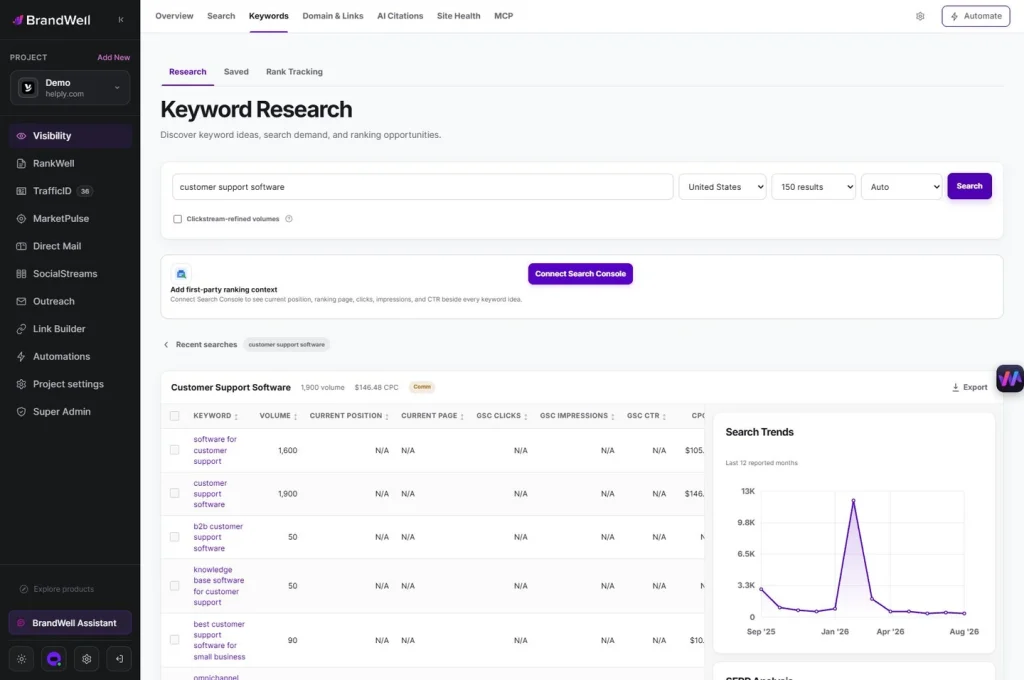
Organize validated questions in a brief. Use Keyword Research in the Visibility workspace to investigate related searches, then use RankWell to develop and review an article that answers the task. Add original examples, verify claims and check the final layout before publishing through your configured workflow.
AIMEE can help organize work through configured tools and approved tasks. Review the evidence behind its summaries. Start in the current BrandWell portal or explore RankWell’s content workflow.
Measure learning separately from leads
For research, track what useful questions you discovered and which assumptions you validated. For content, track search impressions, clicks and appropriate actions. For community participation, assess whether your contribution actually helped the conversation.
In Search Console, compare pages and queries over a consistent period. Impressions show that your result appeared, not that a forum audience became customers. Use source-tagged links only where sharing is permitted and relevant. Do not promise a ranking improvement from posting answers.
Common questions
Can forums help identify my target audience?
They can reveal questions and language within a particular community. Use them as exploratory evidence, then validate your audience definition with other sources. They do not provide a representative sample of every potential customer.
Should I add keywords to every reply?
Write a clear answer to the actual question. Repeated promotional phrases can make a response less useful. Follow the community’s rules and include a link only when it genuinely supports the answer and is permitted.
Can I use members’ details for outreach?
Do not treat public participation as consent. Use an appropriate, permission-based process for direct marketing. Research themes without building unnecessary personal contact records.
Can AI write my community responses?
Check the site’s current AI content rules first. You are responsible for accuracy, relevance and disclosure. Do not post automated responses across communities or claim expertise you do not have.
Reviewed and updated October 2, 2026.

Written by
Julia McCoy has contributed articles to BrandWell on content marketing, writing, and search engine optimization. This archive retains her original bylines; individual articles may be updated by the BrandWell editorial team.

