


On this page
- What buyer research tells us, and what it does not
- Audit identity, fit and research separately
- When topic research can change the starting point
- Review a market inside the current BrandWell app
- Choose the next action for the actual evidence
- Run a bounded test before expanding
- Frequently asked questions
- Inspect your market before choosing more capacity
A lead-generation strategy needs more than contact details. It needs a defined market, evidence worth reviewing, an approved next action and a way to measure the result. Topic research can add useful context before a prospect submits a form. It does not prove that someone is ready to buy, and it is not always the missing piece.
Start by finding the actual constraint. Do you lack relevant accounts, current research context, appropriate contacts, response capacity or reliable outcome data? Choose the input that addresses that gap, then test whether it changes the decision. MarketPulse supports topic research and audience review, starting at $500/mo.
What buyer research tells us, and what it does not
In Gartner’s March 2026 release, 67% of surveyed B2B buyers preferred a rep-free experience and 45% reported using AI in a recent purchase. The survey covered 646 buyers in August and September 2025.
A separate Gartner release from June 2025 reported that 73% avoided suppliers sending irrelevant outreach. That survey involved 632 B2B buyers in August and September 2024.
Forrester’s December 2024 report announcement reported that 86% of B2B purchases stalled and 81% of buyers expressed dissatisfaction with their chosen providers.
These findings describe the research populations and buying experiences studied. They do not measure MarketPulse results, establish a conversion forecast or show that intent data solves stalled purchases. The practical question is whether your team can offer useful context at an appropriate moment.
Audit identity, fit and research separately
| Input | Question | What it does not establish |
|---|---|---|
| Identity and contact information | Which person or company might this record concern, and which fields are available? | Current need, purchase readiness or permission for every channel. |
| ICP fit | Does the account or role match the market you can serve? | That the business is currently evaluating a purchase. |
| Topic or website research | What relevant activity was observed, at what identity level and time? | A specific buying commitment or a qualified sales opportunity. |
Swipe the table to see all columns.
Preserve the unit. An account-level research observation is not proof that every employee researched the topic. Adding stakeholder contacts does not turn those contacts into observed researchers. Keep confidence, source, timestamp and unresolved associations with the record.
When topic research can change the starting point
Research context can help your team decide which relevant accounts deserve a closer review, what problem to investigate or which educational resource might be useful. For example, a software company could review activity around a relevant implementation topic rather than assuming every person with a certain job title has the same need.
That hypothesis still needs testing. A broad topic, an old observation, weak identity or an account outside the serviceable market may not support an action. A topic missing from the catalog is a coverage gap, not proof that no buyers exist.
Lists, campaigns and modeled audiences can serve different jobs. A contact list may address an identity gap; a campaign can create awareness; topic research may provide context for prioritization. Do not assume one approach universally replaces the others or that combining them always improves results.
Review a market inside the current BrandWell app
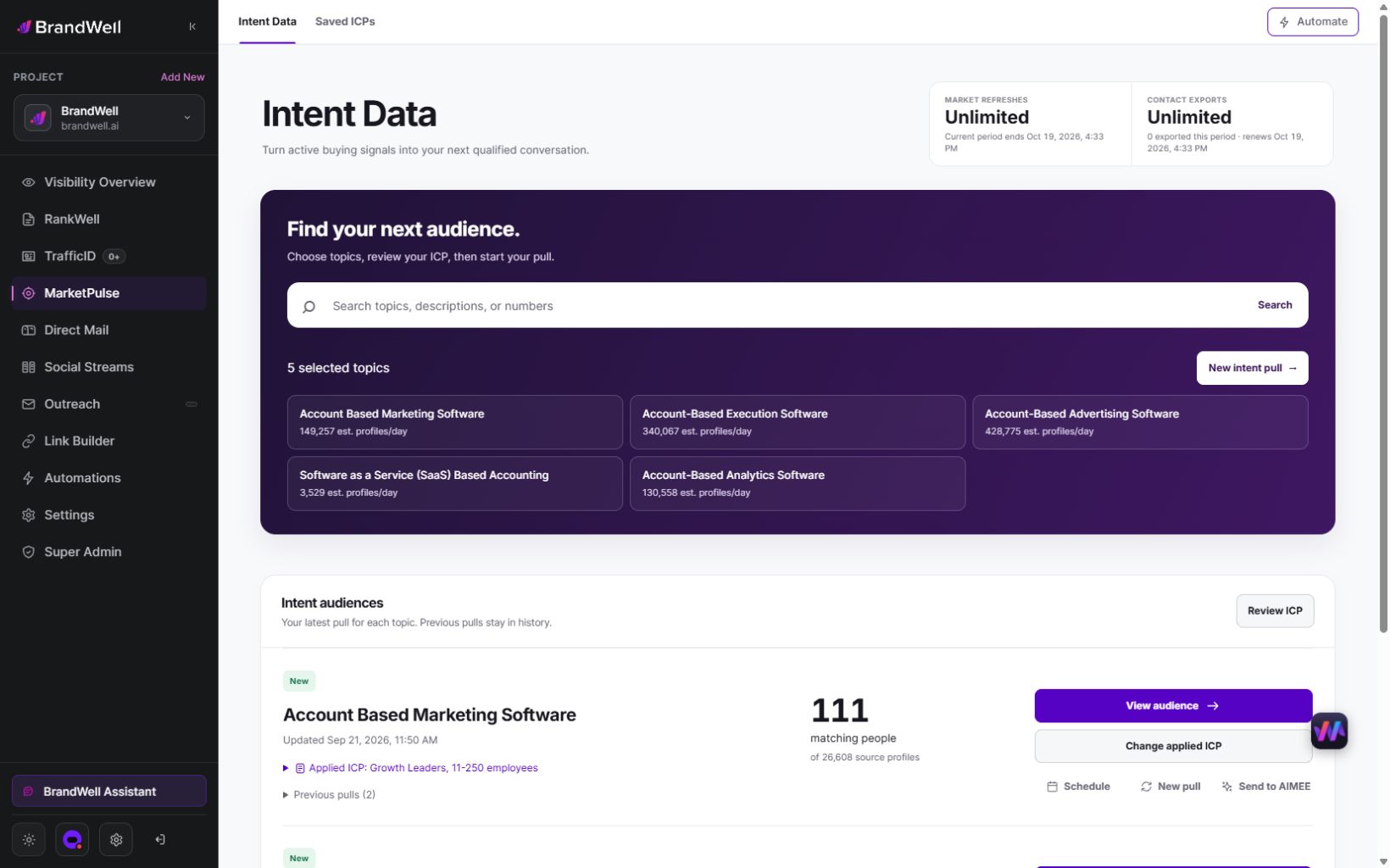
- Choose a relevant topic. Search the live MarketPulse catalog by the market, problem or category you sell into. Check that the available topic actually matches the planned use.
- Apply a saved ICP. Refine the audience using the relevant roles, industries, company sizes and locations. Keep exclusions visible.
- Review actual matches. Check source context, fit and available fields. A pull retrieves available data from the previous 24 hours; it is not one contact or a promise of a fixed audience size. Audiences can overlap.
- Approve an appropriate next step. Review an eligible export or configured Outreach, Direct Mail or AIMEE workflow. Connected tools, campaign usage and fulfillment may have separate scope and costs.
- Verify delivery and outcomes. Record ownership, acknowledgement, rejection reasons, replies and mature sales stages. A draft or workflow instruction is not proof of execution.
For activity on your own website, TrafficID has a different role. It brings identifiable visitors and submitted form identities into a working audience. Additional stakeholder contacts remain separate from the people observed visiting. Keep website observations and off-site topic research distinct when reviewing an account.
Choose the next action for the actual evidence
- Account research: prepare a brief when company fit is clear but person-level identity or contact permission is unresolved.
- Reviewed outreach: draft a useful message after the contact, purpose, channel and suppression checks pass. Avoid implying knowledge of a person’s private searches.
- Audience review: check actual platform source eligibility, permissions and destination requirements before an upload. An available contact is not automatically an eligible advertising seed.
- Hold or reject: stop when evidence is stale, identity is ambiguous, the account is excluded or a required permission is missing.
AIMEE can organize supplied context through configured tools and help prepare research or drafts. Confirm actual tool support, approval owners and destination acknowledgement. Do not assume a requested action ran or that a subscription includes every custom CRM integration.
Run a bounded test before expanding
Define the eligible market, research topic, review rule, approved action, owner, costs and outcome window before launch. Choose a comparison that addresses the question you are testing. Separate information added to the CRM from an improvement caused by using that information.
Random assignment, matched observational groups and a before/after baseline provide different evidence. Selection, existing relationships, timing, spillover and missing outcomes can affect the result. A higher observed opportunity rate in an intent-selected group does not alone isolate the effect of intent.
Fictional workflow example: 100 reviewed records produce 40 ICP-fit records, 30 approvals and 24 acknowledged actions. Report each stage separately: 40% fit among reviewed records, 75% approval among fit records and 80% acknowledged action among approvals. Six approvals remain unresolved. None of these counts is automatically a qualified opportunity or incremental revenue.
Track actual subscription, review, implementation and delivery costs for the same period. Label pipeline, attributed revenue, realized revenue and contribution separately. An immature opportunity estimate is not a closed-won return.
Frequently asked questions
Does this mean ads, lists or outbound do not work?
No. They address different parts of acquisition. Test whether topic context improves the specific decision and outcome you care about instead of declaring an entire channel obsolete.
Does a buyer need to know my brand to show relevant research?
No. Research can concern a category, problem, product or implementation topic. Verify actual coverage, source meaning and identity; relevance does not prove a purchase commitment.
What should happen after a relevant signal appears?
Review fit, source, freshness, identity, purpose, permissions and suppression. Approve a supported next step only when the required checks pass, then record its acknowledgement and outcome.
What if the website has little traffic?
TrafficID and MarketPulse answer different questions. MarketPulse reviews available topic research beyond your site, while TrafficID works with identifiable site activity. Check actual topic coverage and operating capacity before assuming either is useful.
How much does MarketPulse cost?
MarketPulse is starting at $500/mo. Check current plans and terms for topic coverage, refreshes, exports, any eligible personal offer and the conditions of the satisfaction guarantee.
Inspect your market before choosing more capacity
Start with a relevant topic, a defined ICP and one review decision. Measure useful actions, unresolved exceptions and actual effort before broadening the program. Watch the MarketPulse demo and review current plans, starting at $500/mo.
Reviewed and updated October 6, 2026.

Written by
Jeff Joyce has been helping brands grow online since the Myspace era, when custom HTML layouts were still a competitive advantage. What started in design quickly evolved into a career spanning social media, content strategy, video, agency ownership, and growth marketing. After building his own agency and testing countless AI tools, Jeff joined BrandWell with a clear focus: helping marketers understand how AI can actually improve the way they create, optimize, and scale content. Today, Jeff brings a CMO-level perspective to BrandWell's marketing strategy, blending brand positioning, content, video, customer education, and growth. His work centers on turning complex AI concepts into clear, practical marketing that helps brands move faster, create better content, and stay competitive without losing their voice.
 Farnaz Kia