A form fill is not the beginning of the buyer’s journey. It is usually the first moment your system can see.
Buyer intent often starts earlier, when people research categories, competitors, products, services, vendors, pricing, reviews, or implementation paths before they ever search your brand.
The Form Fill Is Not the Beginning
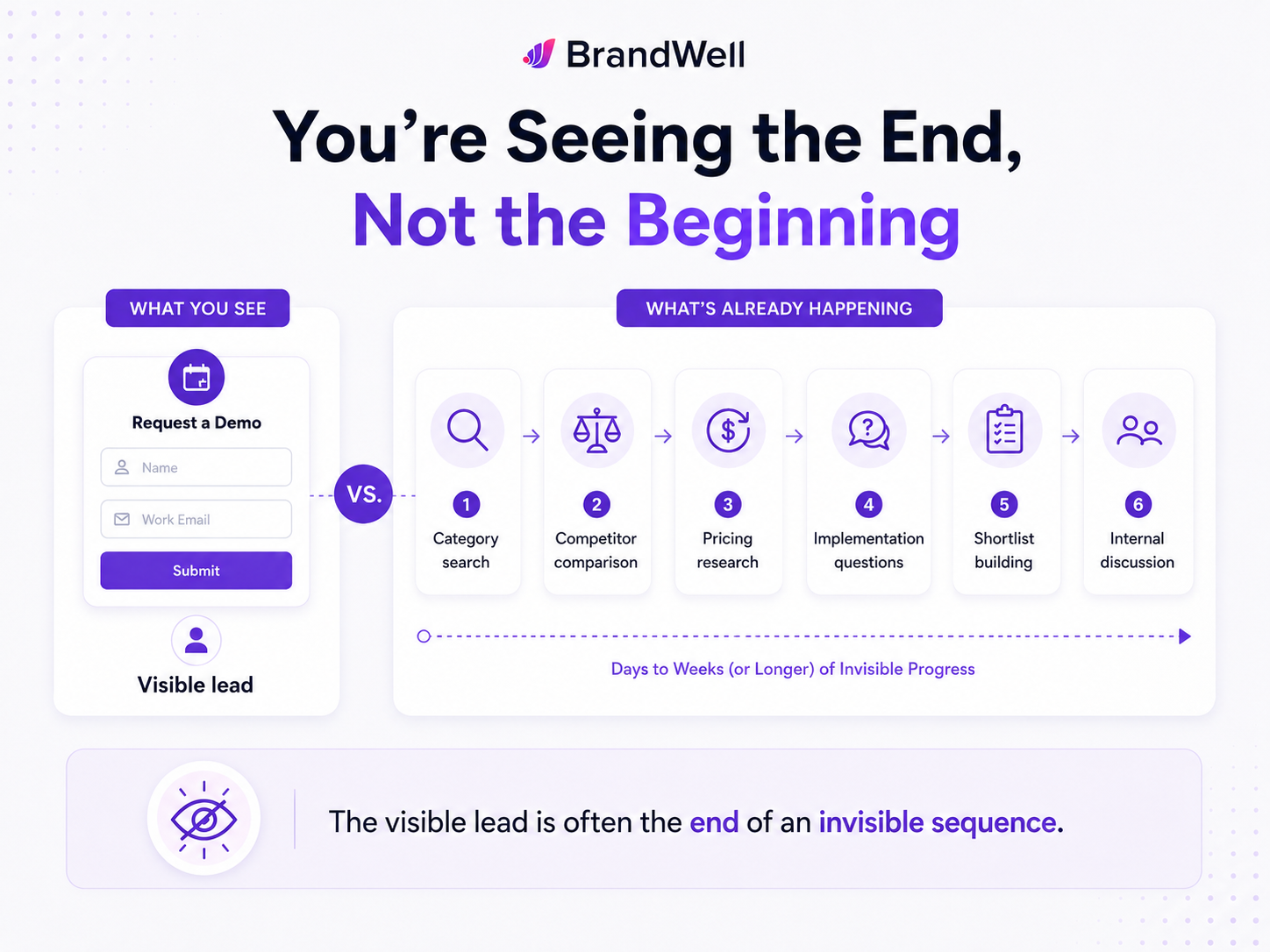
A form fill feels like the beginning because it is the first moment your system can see.
But the buyer did not start there.
Before they filled out the form, there was probably a trigger.
A problem. A deadline. A competitor. A broken workflow. A new project. A pricing question. A comparison. A search. A conversation. A moment of frustration.
The visible lead is often the end of an invisible sequence.
That is why inbound alone can be misleading.
It tells you who arrived.
It does not tell you everyone who is still researching.
BrandWell is built for that earlier window.
The category search.
The competitor comparison.
The provider research.
The product or service evaluation.
The point before the buyer knows your brand, but after they start moving.
The Belief to Challenge: If They Were Interested, They Would Come to Us
A lot of companies assume interested buyers will eventually show up.
They will click the ad. Visit the website. Fill out the form. Ask for pricing. Book a demo.
Some will.
Many will not.
Some will research your competitor and never find you. Some will build a shortlist before your brand appears. Some will ask AI for options and never scroll far enough to see you. Some will talk to peers and move straight to a vendor they already know.
Waiting for inbound means accepting that you only see the buyers who make it to your doorstep.
That is a narrow view of demand.
The market is bigger than your funnel.
Buyer behavior is already moving in that direction. Gartner’s 2026 B2B buyer research found that 67% of buyers prefer a rep-free experience, while 45% used AI during a recent purchase. In other words, interested buyers may be very active long before they enter your funnel or talk to sales.
The Hidden Research Window
Every market has a hidden research window.
It sits between:
“I might need something”
and
“I am ready to talk to this specific company.”
That window is where a lot of buying progress happens.
A B2B buyer may compare software categories, read implementation guides, ask for recommendations, review competitors, and build internal requirements before a salesperson is invited in.
A consumer may compare providers, check costs, read reviews, look at before-and-after examples, watch videos, and search “near me” terms before submitting a quote request.
Gartner’s buyer research supports this shift toward self-directed buying. Its 2026 survey found that 67% of B2B buyers prefer a rep-free experience, and its 2025 research found that buyers often prefer self-service for general learning.
For B2C, Google’s micro-moments research and McKinsey’s consumer decision journey both point to the same pattern: people decide through a series of research moments, not one clean funnel.
The hidden research window is not a side detail.
It is where preferences begin.
The same pattern shows up in consumer markets. Google described these decision points as “intent-rich moments”, and McKinsey’s consumer decision journey research shows that people evaluate options through a non-linear path. That is why this is not only a B2B idea. B2C buyers also move through research moments before they choose a brand.
Buyer Intent Starts Before Brand Awareness
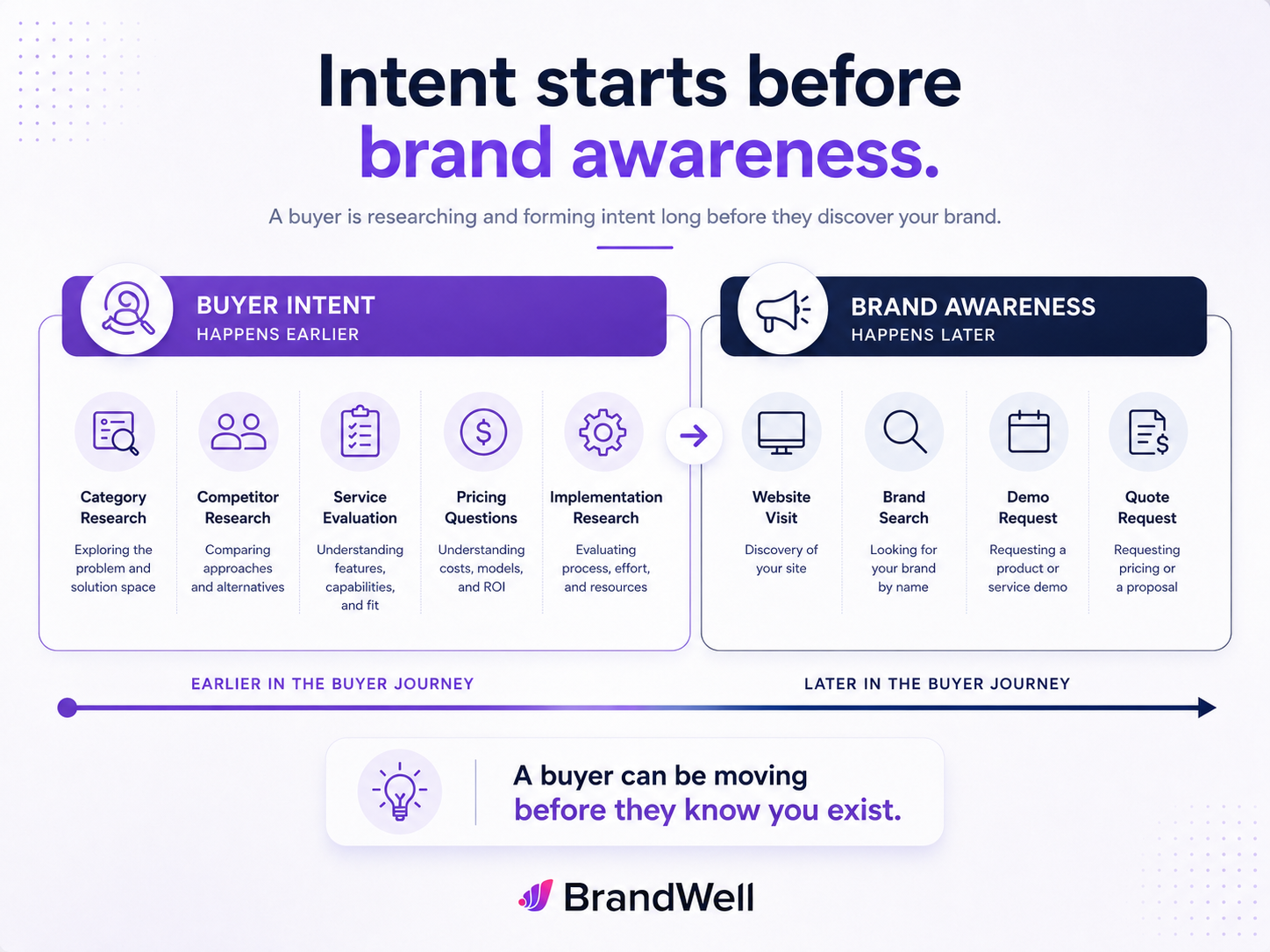
Brand awareness means the buyer knows your company.
Intent means the buyer is researching something connected to what you sell.
Those are different.
A buyer can search for your competitor without knowing you exist.
A buyer can compare service providers without knowing your brand.
A buyer can research a software category, implementation path, product type, or local service before they ever land on your website.
That is still intent.
This distinction matters because many teams define demand too narrowly.
They only count demand once it becomes visible inside their own funnel.
But demand does not begin when analytics can see it.
Research often starts outside your owned channels.
That is where BrandWell creates leverage.
How to Spot Earlier Signals
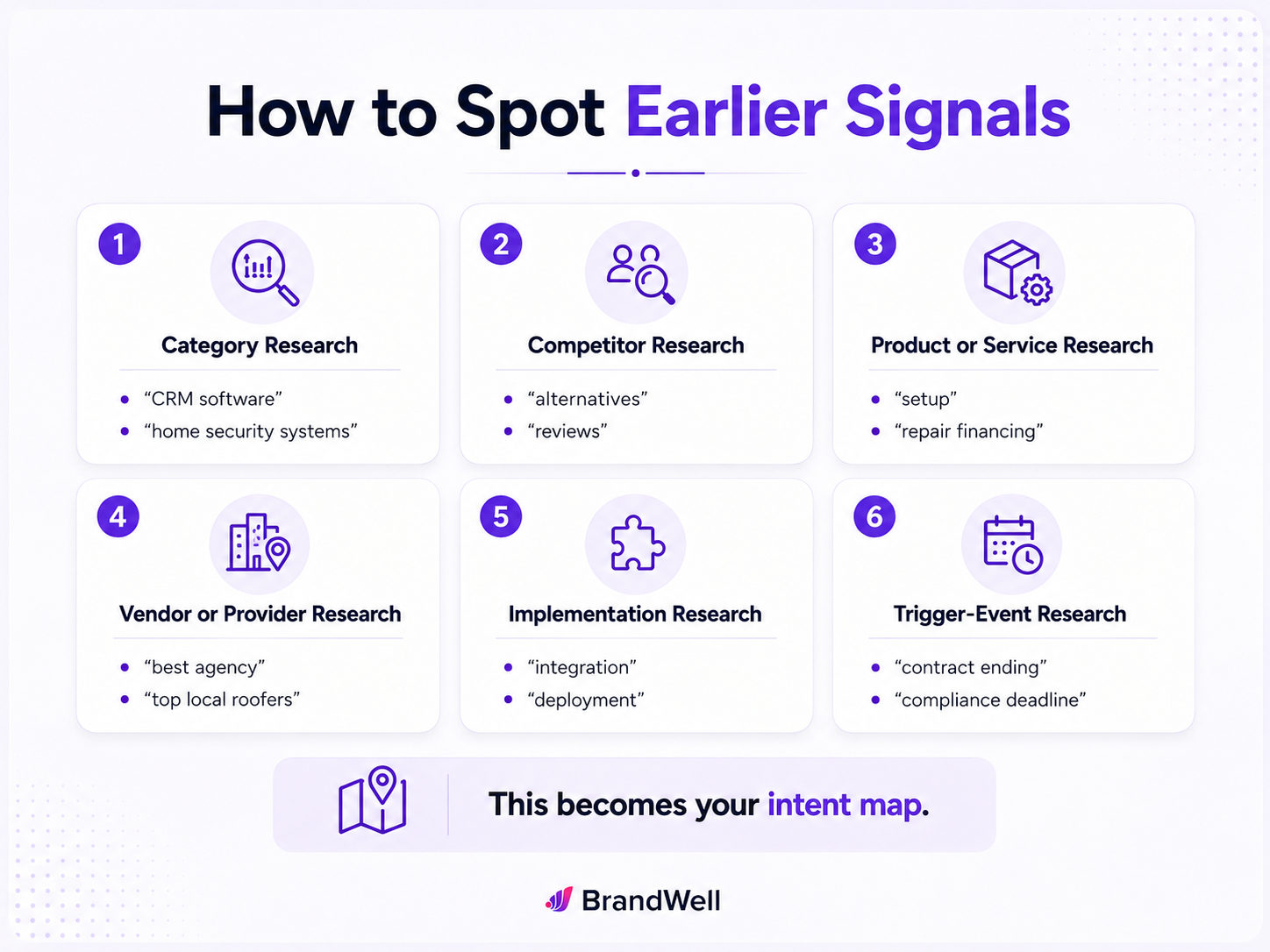
A useful exercise is to list the searches or topics that happen before someone searches your brand.
Start with six buckets.
1. Category research
What category would someone explore before choosing a vendor?
Examples:
- CRM software
- website visitor identification
- med spa marketing
- EV charger installation
- personal injury attorney
- home security systems
2. Competitor research
Which competitors, alternatives, or replacement options would they research?
Examples:
- competitor alternatives
- product comparisons
- reviews
- migration topics
- “best alternative to…”
3. Product or service research
What specific product or service terms suggest active evaluation?
Examples:
- sales automation setup
- roof repair financing
- customer data platform implementation
- IV therapy membership
- HVAC installation cost
4. Vendor or provider research
What provider terms suggest they are building a shortlist?
Examples:
- best agency for lead generation
- top local roofers
- CRM implementation consultant
- cybersecurity vendors
5. Implementation research
What would someone search when they are thinking about execution?
Examples:
- setup
- installation
- integration
- onboarding
- deployment
- migration
- cost
- timeline
6. Trigger-event research
What events make someone search?
Examples:
- contract ending
- tool not working
- seasonal demand
- compliance deadline
- emergency repair
- new business initiative
- budget approval
This list becomes the beginning of your intent map.
What to Do With Earlier Intent
Earlier intent is only useful if it leads to a next step.
Here is a practical routing model.
Route high-intent fit to SDR or sales
Examples:
- competitor alternatives
- vendor comparison
- implementation planning
- service pricing
- quote-related research
Sales can use the signal to prioritize outreach and tailor the angle.
The goal is not to say, “We saw you searched this.”
The goal is to understand the likely context and respond with relevance.
Route mid-intent signals to ads
Examples:
- category research
- general provider research
- early product comparison
- educational service queries
These signals may not be ready for direct outreach, but they can strengthen ad audiences.
Route broad signals to content and nurture
Examples:
- problem research
- high-level category education
- trend research
- early awareness topics
These signals can inform blog posts, videos, nurture sequences, and retargeting themes.
Route website behavior through TrafficID
If a visitor is already on your website, TrafficID can help identify and enrich anonymous traffic.
That gives your team another signal layer.
A visitor who does not fill out a form may still be showing commercial interest.
Route ambiguous signals into AI workflows
Some signals need interpretation.
AI tools like Claude, Codex, or Moxby can help:
- summarize account context
- create SDR briefs
- draft email angles
- recommend ad hooks
- generate follow-up tasks
- route the record based on rules
- build small workflow utilities around the signal
This is the key idea:
Do not just collect earlier intent.
Operationalize it.
This is where the role of sales changes. Gartner’s 2025 B2B buyer research found that buyers prefer self-service for general information, but seller input when they need contextual fit guidance. Earlier intent should not create generic outreach. It should help the team show up with more relevant context when the buyer is closer to needing judgment, comparison, or fit guidance.
Why This Changes the Sales Conversation
Earlier intent does not just change when you reach out.
It changes what you say.
A buyer researching a competitor does not need the same message as a buyer researching a broad category. A person looking at service pricing does not need the same message as someone reading early educational content. A company researching implementation does not need a generic “do you have 15 minutes?” email.
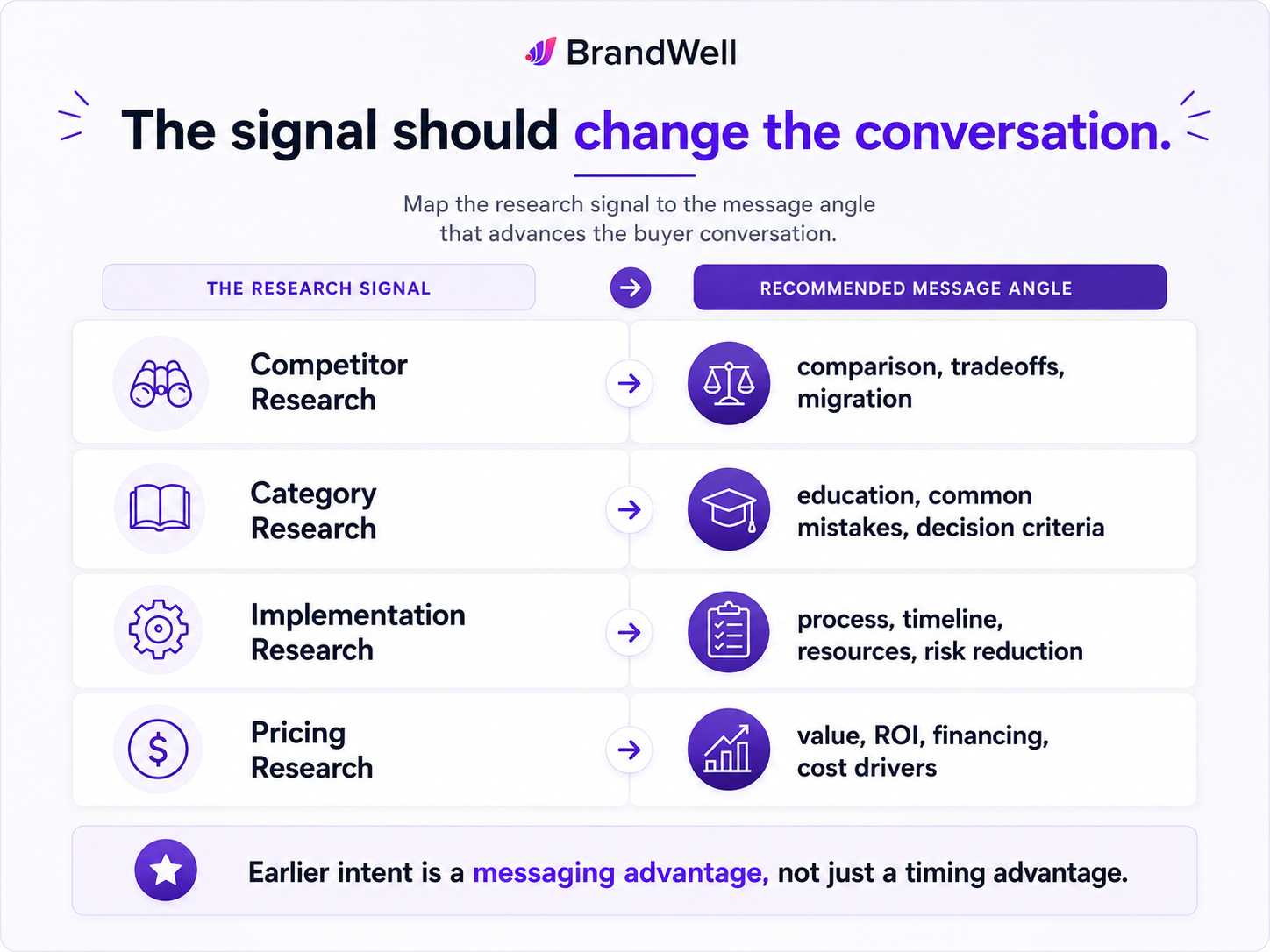
The signal should change the conversation.
Here are a few examples.
Competitor research
The message should focus on comparison, tradeoffs, migration, and why teams switch.
Category research
The message should focus on education, common mistakes, decision criteria, and how to evaluate options.
Implementation research
The message should focus on process, timeline, internal resources, integration, and risk reduction.
Pricing or cost research
The message should focus on value, ROI, financing, cost drivers, and what changes the final quote.
This is why earlier intent is more than a timing advantage.
It is a messaging advantage.
When you understand the research path, you can meet the buyer with the right context instead of sending the same generic pitch to everyone.
The Reader Exercise: Build a Pre-Funnel Map
Take one offer and map what a buyer may research before they ever search your brand.
Use this format:
- What problem or trigger starts the search?
- What category terms would they look up?
- Which competitors or alternatives would they compare?
- What pricing, cost, or ROI questions would they ask?
- What implementation or service questions would come up?
- What proof would they need before taking action?
- Which signals should go to ads?
- Which signals should go to sales?
- Which signals should go to nurture?
- Which signals should trigger AI research or summarization?
That map is useful even before you buy anything.
It forces the team to stop thinking only in terms of campaigns and start thinking in terms of buyer movement.
B2B Examples
A cybersecurity company may want to see companies researching:
- endpoint protection alternatives
- SIEM implementation
- SOC automation tools
- compliance-driven security workflows
- competing vendors
A marketing technology company may care about:
- website visitor identification
- customer data platform setup
- lead enrichment workflows
- HubSpot alternatives
- ABM intent data
An agency may care about:
- paid ads agency
- CRM setup
- lead generation services
- sales automation consulting
- niche marketing for a specific industry
In each case, the buyer may not know the brand.
But they are showing market movement.
B2C Examples
A home services company may care about:
- roof repair financing
- emergency plumber near me
- EV charger installation cost
- best HVAC installation company
- home security system comparison
A healthcare or wellness provider may care about:
- weight loss clinic near me
- med spa pricing
- IV therapy membership
- hair restoration consultation
A legal or financial services company may care about:
- personal injury lawyer consultation
- estate planning attorney
- tax relief options
- debt settlement services
These are not just topics.
They are buying moments.
The buyer is not necessarily brand-aware, but they are not random either. They are exploring a path that could lead to purchase.
How BrandWell Uses This Earlier Window
BrandWell starts by mapping the market.
That means identifying the categories, competitors, products, services, vendors, and implementation paths that signal movement.
Then the system looks for active research behavior tied to those areas.
From there, BrandWell can:
- enrich the record
- qualify the lead
- combine the signal with TrafficID when relevant
- route records into CRM
- build ad audiences
- trigger outbound workflows
- support AI workflows
- create exports
- show activity inside a custom local dashboard
The value is not just speed.
It is earlier visibility.
Speed to lead usually means responding quickly after someone raises their hand.
BrandWell expands the idea.
It helps you see relevant intent before the buyer reaches your funnel.
That creates a different kind of advantage.
You are not only reacting faster.
You are entering the research window earlier.
Practical Takeaway
Make a list of 25 searches or topics your buyer might research before they know your brand.
Group them into:
- category research
- competitor research
- product or service research
- vendor/provider research
- implementation research
- pricing or cost research
Then decide the next step for each group:
- ads
- SDR outreach
- CRM note
- AI research brief
- nurture
- content idea
- watchlist
If you can map both the signal and the next step, you are much closer to building an intent acquisition system.
This also changes how you evaluate the overall lead generation strategy, because the starting point is no longer only the audience you can target. It is the research behavior already happening in the market.
Next Step
Find buyers before they enter your funnel
If buyers in your market research before they become brand-aware, the next step is to map those pre-funnel signals and decide which ones should trigger ads, outbound, CRM updates, or AI workflows.
Map the pre-funnel signals in your market
FAQ
Can someone show intent before knowing our brand?
Yes. They can research a category, product, service, competitor, vendor, or implementation path before they become brand-aware.
Are form fills still useful?
Yes. They are useful, but they are often later than the first research signal.
Does this apply to consumer businesses?
Yes. Consumers research products, services, reviews, providers, costs, and alternatives before choosing a brand.
What should happen after earlier intent is detected?
The record should be enriched, qualified, and routed into the right next step: ads, SDR outreach, CRM, AI workflows, exports, or nurture.
What is buyer intent?
Buyer intent is a signal that someone is actively researching, comparing, or evaluating something connected to a possible purchase. It can show up as category research, competitor research, product/service research, vendor comparisons, or implementation questions.
Can buyer intent exist before brand awareness?
Yes. A buyer can research the category, competitor, product, service, or vendor space before they know your brand exists.
How do you identify buyer intent?
Start by mapping the topics buyers research before they search your brand: categories, competitors, products, services, vendors, implementation paths, pricing questions, and alternatives.
Turn buyer intent into your next acquisition workflow.
BrandWell helps teams identify active commercial research, enrich the records, and route qualified opportunities into ads, outbound, CRM, AI workflows, or exports.
Request a Quote