On this page
- 1. Check the purpose before polishing sentences
- 2. Verify names, dates, statistics and product claims
- 3. Add detail that comes from the work
- 4. Edit for clarity
- 5. Review quotations, reuse and media rights
- 6. Use the current RankWell review workflow
- 7. Inspect the live page and keep a change log
- Frequently asked questions
Refine AI-generated content by checking the answer against the brief, verifying factual claims, adding original detail and editing for the intended reader. Then review the published page’s formatting, images and next step. Treat a draft as material to evaluate, not proof that the research and editing are finished.
The goal is a useful, clear and supportable article. Start with what the reader needs to understand or do.
1. Check the purpose before polishing sentences
Compare the draft with its brief. Does it answer the main question? Is it written for the right audience? Does it use the current product and offer? A fluent introduction cannot repair an article about the wrong task.
- Reader: who needs the answer?
- Question: what should the page resolve?
- Scope: what belongs here and what belongs elsewhere?
- Evidence: what sources or examples support the answer?
- Action: what can the reader do next?
Remove sections that do not serve the brief. Add missing steps before spending time improving every sentence.
2. Verify names, dates, statistics and product claims
Make a claim checklist. For each number or specific factual statement, open the supporting source and check that it actually supports the wording. Record the source date, population or situation described and important limitations.
Prefer the original research, official documentation or the organization responsible for the information. A source link does not support a claim merely because it concerns the same topic.
For product instructions, use the current application and documentation. Test the relevant workflow where possible. Remove unsupported promises about speed, ranking, revenue or capabilities.
Here is an original hypothetical calculation: a campaign has 4,000 impressions and 60 clicks. Its click-through rate is 1.5%, not 15%. Check both the arithmetic and the label. A correct calculation still does not prove what caused the result.
3. Add detail that comes from the work
Replace generic claims with a useful example, a reviewed process or an authorized screenshot. Explain the conditions that change the answer and identify where the reader needs more information.
An original example: instead of saying “plan your IT transition carefully,” explain that the operations manager should identify the owners of the handoff tasks, gather the agreed information and resolve open responsibilities before scheduling the transition. Verify the actual requirements with the service owner before presenting them as instructions.
Do not invent a customer story, professional experience or survey to create apparent authority. Label hypothetical examples and keep real case details within their permissions.
4. Edit for clarity
Digital.gov’s writing for understanding guidance emphasizes language suited to the audience, short sections and active voice. Active wording helps make responsibility clear.
An original wording example:
- Vague: “The checklist should be reviewed prior to implementation.”
- Clearer: “The operations manager reviews the checklist before the handoff.”
Use the clearer version only if that responsibility is correct. Editing should preserve the meaning, not create a new fact.
Define specialist terms when needed. Remove repeated introductions, empty superlatives and sentences that add no information. Read the answer as a person trying to complete the task.
5. Review quotations, reuse and media rights
Check quotations against their originals and provide the appropriate attribution. Confirm permissions for images, screenshots and reused material. Source review and editorial judgment remain necessary even when software helps locate a possible match.
For an image, ask whether it explains the current process and whether its labels can be read at the displayed size. Replace obsolete application screenshots instead of leaving the reader to infer that the interface has changed.
6. Use the current RankWell review workflow
In the current BrandWell portal, use Visibility research to investigate topics and opportunities. Bring a clear brief, sources and original examples into RankWell for drafting and review.
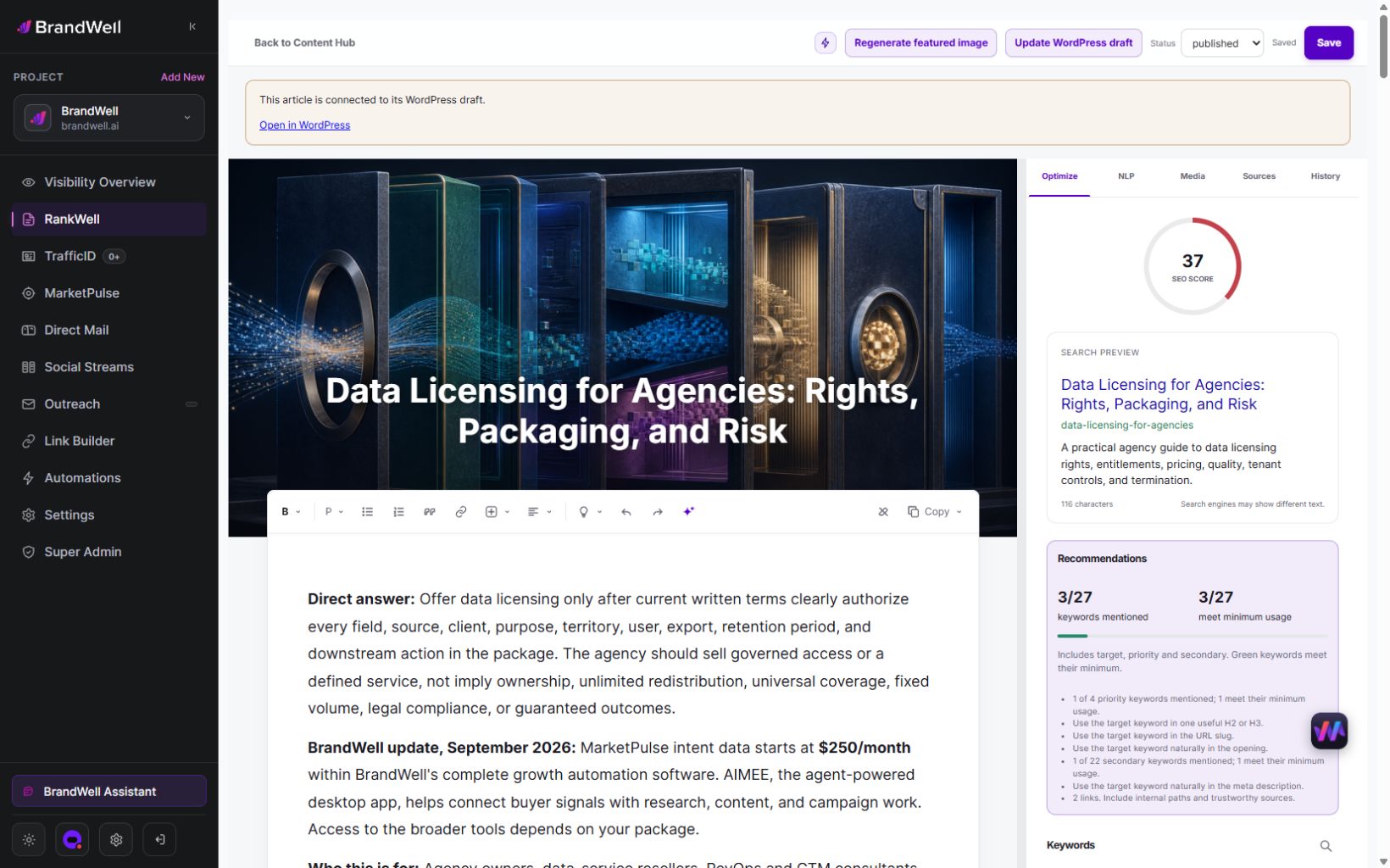
The Content Hub organizes strategy, articles, queue and calendar work. Keep a named reviewer for factual claims and product details. Use a configured publishing connection after approval, then check the actual live page.
Recommendations and scores can help organize review. They do not replace the evidence check or guarantee search performance.
7. Inspect the live page and keep a change log
Test the page on mobile as well as desktop. Check heading order, paragraph spacing, image loading, links, forms and horizontal overflow. Confirm that the search title and description accurately represent the article.
Record what changed and preserve the pre-edit search baseline. Use impressions, clicks, click-through rate, query fit and useful business actions to evaluate later results. Do not report an improvement merely because the new copy is live.
For AI-answer opportunities, make the main answer easy to locate and include traceable evidence and original examples. Observe references where possible without promising inclusion.
Frequently asked questions
Should I focus only on making the wording conversational?
No. First check purpose, completeness, facts and product details. Tone is one part of the review.
Does every statistic need a source?
Readers should be able to verify factual statistical claims. Label hypothetical calculations clearly and explain their assumptions.
Can I publish immediately after generating a draft?
Complete the required editorial and permission checks first. Then verify the published page.
What if I cannot verify a claim?
Remove it, narrow it to what the evidence establishes or leave it unresolved until the responsible reviewer can confirm it.
Explore RankWell for researched drafts and editorial review in the current BrandWell portal.
Reviewed and updated October 3, 2026.

Written by
Julia McCoy has contributed articles to BrandWell on content marketing, writing, and search engine optimization. This archive retains her original bylines; individual articles may be updated by the BrandWell editorial team.