


On this page
- 1. Choose the outcome and audience
- 2. Review existing pages and Search Console
- 3. Add the fields that make work actionable
- 4. Plan to the team’s capacity
- 5. Use a sample month to test the process
- 6. Prepare the brief in BrandWell
- 7. Give AI a bounded assignment
- 8. Schedule distribution and maintenance
- How do you know the calendar is working?
A content marketing calendar connects each planned piece to a reader, a purpose, an owner, and a realistic publication date. It should also show the work needed before publication and when the content will be reviewed afterward.
Start with the decisions your team needs to make, then choose a calendar format. A small, maintained plan is more useful than a year of titles with no sources, owners, or review time.
1. Choose the outcome and audience
Define what the content is intended to help someone do. Examples include evaluating a service, completing onboarding, understanding a problem, or using a product feature. Connect that task to a measurable business outcome.
For an IT services company, a laptop-return checklist might help an operations manager solve an immediate problem. A service comparison could support a later buying decision. They need different briefs and should not be measured only by the same traffic target.
2. Review existing pages and Search Console
Inventory the pages you already have before scheduling new ones. Look for useful articles that need updated facts, missing examples, clearer product steps, or a better match to the queries generating impressions.
In Search Console, filter a relevant page and review its queries over a consistent period. Record impressions, clicks, CTR, and position together. Google’s metric definitions explain why these figures should not be treated as interchangeable measures of demand or revenue.
A page with many impressions and few clicks might need work, but a low ranking or mismatched query can explain the result. Inspect the page and the search results before declaring that its title is the problem.
3. Add the fields that make work actionable
| Field | Example |
|---|---|
| Audience and question | Operations manager: how do we recover a departing employee’s laptop? |
| Content action | Update an existing checklist |
| Existing or planned URL | The approved destination, not a new page by default |
| Owner and reviewer | Writer plus a named subject expert |
| Evidence and assets | Current process, source links, annotated screenshot |
| Milestones | Brief, draft, factual review, approval, publication |
| Distribution | Relevant newsletter and social post |
| Outcome and review date | Checklist use and qualified enquiries; scheduled review |
Swipe the table to see all columns.
Use a status that describes the real bottleneck. “Waiting for expert review” is more useful than leaving a nearly finished article labeled “in progress” indefinitely.
4. Plan to the team’s capacity
Estimate the time for research, drafting, review, images, implementation, and final checks. Work backward from genuine deadlines such as a product launch. Leave room for corrections and time-sensitive updates.
If the team can review two pieces a week, generating ten drafts does not create capacity to publish ten reliable articles. Reduce the planned volume or change the process before the queue becomes a backlog.
Keep a separate idea bank for work that is not yet committed. Move an idea into the calendar only when its purpose, owner, and next step are clear.
5. Use a sample month to test the process
| Week | Main work | Supporting work | Completion check |
|---|---|---|---|
| 1 | Refresh a high-impression guide | Verify sources and product screenshots | Published page matches the approved brief |
| 2 | Create a practical checklist | Ask an expert to test each step | A reader can complete the task |
| 3 | Answer a recurring buying question | Prepare a relevant email excerpt | Pricing and scope are current |
| 4 | Review results and maintenance needs | Plan the next month | Decisions recorded with evidence |
Swipe the table to see all columns.
This is an illustrative schedule, not a recommended publishing quota. Adapt the mix to your audience, resources, and evidence. An update can deserve priority over a new post.
6. Prepare the brief in BrandWell
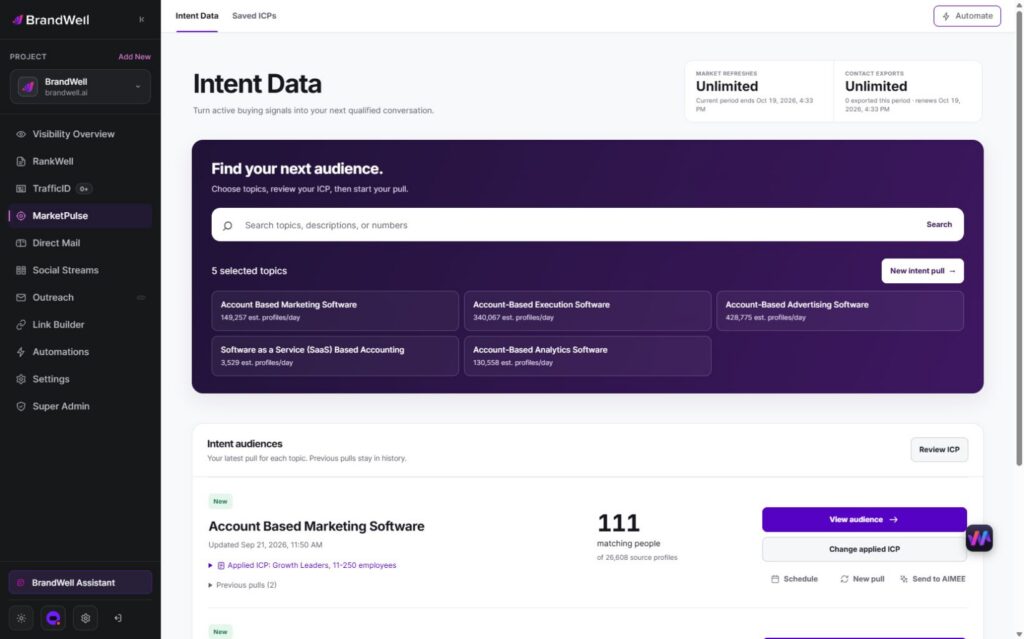
Use Visibility > Keywords > Research to explore the intended market and save relevant ideas. Then use RankWell > Articles > Plan before you write > Check opportunity to inform the content brief.
Include the reader’s task, existing URL, original examples, sources, required media, and acceptance criteria. Keep the publication date and owner in the planning system your team maintains. Do not assume a date in a planning view means the destination site has a scheduled post.
During editing, review the article, search preview, media, and sources. Ask the subject expert to check any instructions or claims that depend on real product behavior. Verify the final page after publication.
7. Give AI a bounded assignment
AI can organize notes, propose an outline, or draft material from an approved brief. It can also introduce unsupported claims or stale steps. Specify the sources and ask for uncertain details to be flagged instead of filled in.
A useful assignment is: “Draft the checklist for this audience using these approved steps. Identify missing information. Do not invent statistics, product controls, or customer results.” Review the output before moving it to approval.
8. Schedule distribution and maintenance
Link each supporting email or social post to the approved article. Reuse the relevant example or answer while adapting the format to the channel. Check campaign links and attribution before sending.
Add a maintenance trigger as well as a review date. A pricing change, renamed feature, retired tool, or revised source may require an earlier update. Preserve a record of the old version and the reason for significant changes.
How do you know the calendar is working?
Review completed work, time spent waiting for approvals, factual rework, and the outcomes appropriate to each piece. Compare search performance over equivalent periods, allowing for indexing and seasonal differences.
Publishing on time is an operational result. Useful visits, qualified enquiries, and successful customer tasks are different outcomes. A good calendar makes both visible and helps the team choose the next improvement.
Reviewed and updated October 2, 2026.

Written by
Julia McCoy has contributed articles to BrandWell on content marketing, writing, and search engine optimization. This archive retains her original bylines; individual articles may be updated by the BrandWell editorial team.

1 comments