On this page
Alex Johnson’s historical customer interview explores reducing handoffs in an agency’s content workflow. The practical lesson is to simplify repetitive preparation while preserving client requirements, factual review and publishing approval. It is not evidence that every agency can remove a fixed number of roles or achieve a particular margin.
The original story discussed Search Shack and Alex’s evaluation of the former Content at Scale product in 2023. Today, RankWell supports BrandWell’s content workflow. Historical prices, generation times, scores and publishing demonstrations do not establish current product terms or guaranteed results.
What the original workflow discussion covered
The interview discussed work across content briefing, writing and publication. Around 7:48, the conversation identifies those as three areas where the tool might reduce costs and effort. Later, Alex shows a detailed brief and discusses whether he can move more directly to a draft. Watch the original customer training interview.
This is an exploratory workflow discussion. We have removed the headline’s fixed claims about five eliminated steps and two removed roles, together with the assertion that profit margins would certainly rise. The available material does not provide an audited before-and-after record of staffing, completed output and total costs.
Consolidate handoffs without losing the brief
A separate document for every stage may be unnecessary, but the information in the brief still matters. A local service page, product tutorial and informational guide have different requirements. Keep the approved audience, location, offer, claims and intended destination available to whoever reviews the draft.
- Combine repetitive preparation: store the agreed requirements with the assignment.
- Keep a reviewer: make someone responsible for product and factual accuracy.
- Show changes: identify any departure from the client’s approved scope.
- Require publication evidence: check the live destination after the action.
- Measure total effort: include corrections and client review, not only drafting.
Removing a handoff should make accountability clearer. It should not mean that the client loses visibility into the work or that an unreviewed draft becomes a finished deliverable.
Use today’s RankWell editor
Develop a brief and draft in RankWell, then inspect the sources, structure, recommendations and search preview in the editor. Add verified client details and relevant examples. Review the actual article rather than treating its length or score as proof of usefulness.
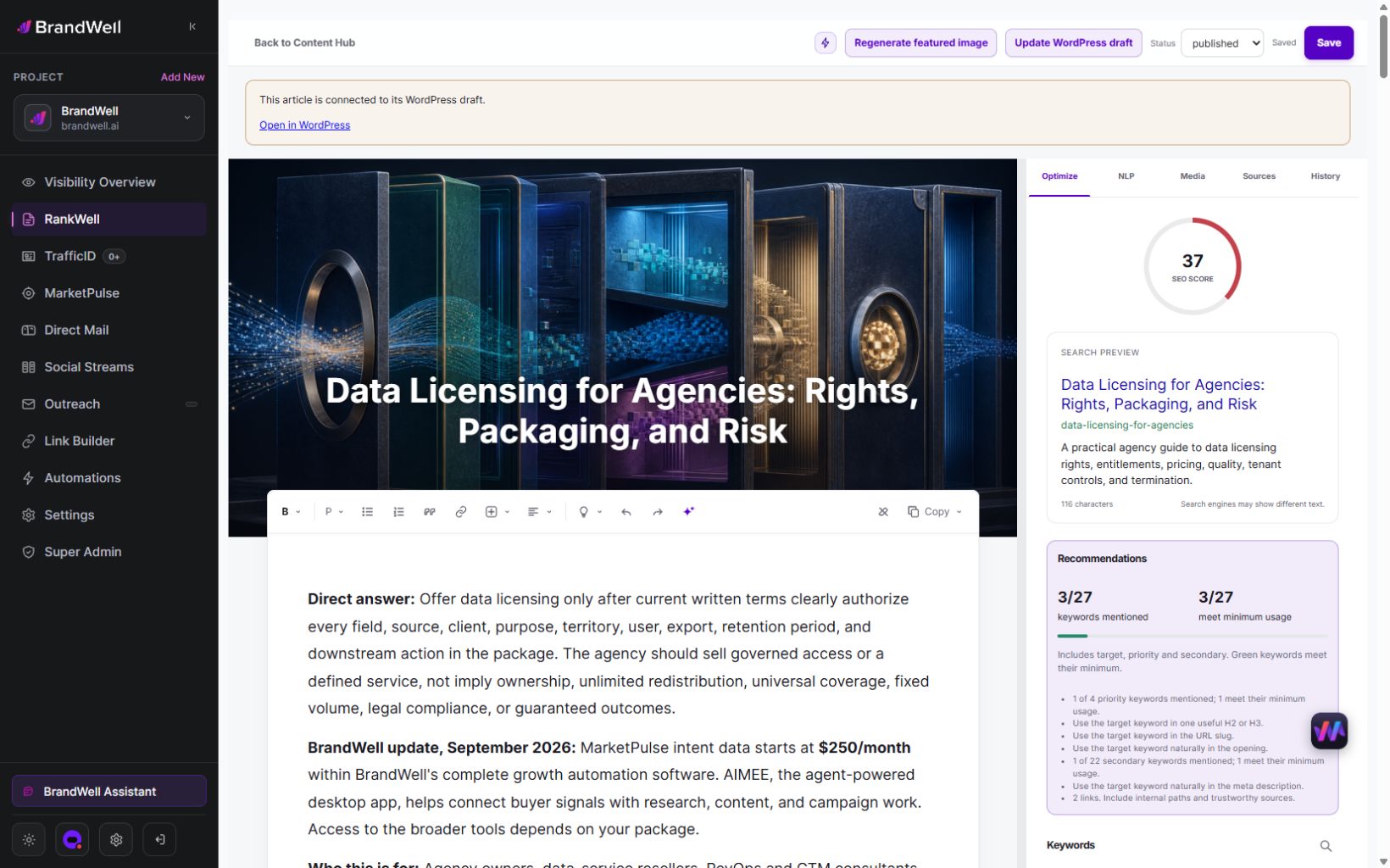
Publishing depends on your configured destination and connection. The older interview’s WordPress demonstration is not a promise of universal or two-way synchronization today. If AIMEE assists with an action, confirm its tools, permissions and approval requirements, then verify what completed.
Measure time saved across the whole assignment
Consider this hypothetical agency comparison, not an Alex Johnson result. A previous process takes two hours to brief, three to draft and one to review: six hours total. A revised process takes one hour to brief, one to draft and two to review: four hours total. Drafting becomes faster, while review becomes longer. The complete assignment saves two hours.
If publication or client corrections add another hour, record that too. Compare similar assignments and preserve the sample size. A short product update and a detailed technical guide should not be treated as interchangeable production units.
Evaluate outcomes separately
A faster workflow does not automatically improve search traffic or client revenue. Track approved content and publication first. Then review relevant search queries, clicks and qualified inquiries over a stated period. Do not infer a ranking improvement from an editorial score, or attribute every change to a tool when other work occurred at the same time.
For a pilot, select a bounded set of assignments and record the starting process. Note where the reviewer still has to correct sources, product details or examples. Those observations are more useful for improving the workflow than a fixed claim about replacing people.
Apply the lesson to your agency
Use AI-assisted drafting to test whether fewer handoffs can produce clearer, reviewed work. Keep the client brief, approval owner and destination checks. Explore RankWell for the current content process, or see BrandWell’s product overview to choose the tools relevant to your team’s task.
Reviewed and updated October 3, 2026.

Written by
Julia McCoy has contributed articles to BrandWell on content marketing, writing, and search engine optimization. This archive retains her original bylines; individual articles may be updated by the BrandWell editorial team.