On this page
- A prompt for a longer, more useful answer
- 1. Allocate the length before drafting
- 2. Draft one section at a time
- 3. Expand missing substance, not sentence length
- 4. Check the final word count and consistency
- ChatGPT settings are not API settings
- Turn the draft into a content workflow in BrandWell
- Frequently asked questions
To make ChatGPT write a longer answer, give it a clear outline, a target length, and instructions about the evidence and examples each section needs. For a long article, draft one section at a time, then edit the sections together. A word-count request alone is not a reliable way to get useful depth.
This guide includes prompts you can copy, a way to expand a short draft without filler, and a BrandWell workflow for turning that draft into a researched article.
A prompt for a longer, more useful answer
Write a practical guide about [topic] for [audience].
Goal: help the reader [specific task].
Target length: approximately [number] words.
First propose an outline with a word budget for each section.
Include a worked example, common mistakes, and an action checklist.
Use the sources and product facts I provide below. Flag missing evidence.
Do not invent statistics, customer quotations, or product features.
Wait for me to approve the outline before writing the first section.
The important additions are the reader, task and content requirements. OpenAI’s prompting documentation explains how instructions, goals and examples guide output. The prompts here are editorial templates, not a guarantee of an exact word count.
1. Allocate the length before drafting
For an illustrative 2,000-word guide, you might allocate 150 words to the introduction, 300 to definitions, 900 to the procedure, 350 to a worked example, and 300 to mistakes and next steps. These are editorial targets, not a guarantee that the model will produce an exact count.
Review the outline for missing questions and duplication. If two sections repeat the same point, combine them. If the topic only needs 800 words, do not force 2,000 simply because another page is longer.
2. Draft one section at a time
Write section 3 of the approved outline in approximately 500 words.
Explain each step, show an example input and output, and explain how to check the result.
Do not repeat the introduction or write the conclusion yet.
List any statements that still need verification after the draft.
Keep the approved outline and terminology in the conversation. When continuing in a new conversation, supply them again rather than assuming the earlier context is available. Ask for a specific next section instead of an open-ended “continue” that may repeat previous material.
3. Expand missing substance, not sentence length
If a draft is short, identify what a reader still could not do after reading it. Add a realistic example, a decision rule, a counterexample, troubleshooting instructions, or a limitation. Avoid asking the model to pad every paragraph.
Review this draft for gaps that prevent the reader from completing [task].
Suggest three useful additions. Do not rewrite it yet.
For each addition, explain what question it answers and what evidence it needs.
Choose the additions you can substantiate. Product screenshots should come from the actual application, and quoted results should come from a source you have checked.
4. Check the final word count and consistency
Use your editor’s word counter after assembling the draft. ChatGPT can estimate length incorrectly. If the article is still short, add a missing explanation; if it is too long, remove repetition and tangents. Check headings, definitions, links, dates, and the final call to action across all sections.
ChatGPT settings are not API settings
Do not look for a universal temperature or maximum-token slider in the ChatGPT conversation interface. Developer API controls and the ChatGPT app are different products, and available controls vary by model and interface. Increasing temperature is not a dependable method of increasing length. There is also no single fixed output limit that applies to every ChatGPT model and plan.
Turn the draft into a content workflow in BrandWell
For search content, start with the opportunity before writing more words. In the current BrandWell app:
- Research the reader’s question and inspect existing coverage before deciding to create, improve or merge.
- Supply approved sources, product context and brand voice in the RankWell content brief.
- Review the outline and draft. Add a useful demonstration where the reader needs one.
- Check evidence, media, wording and search preview before publishing through a configured destination.
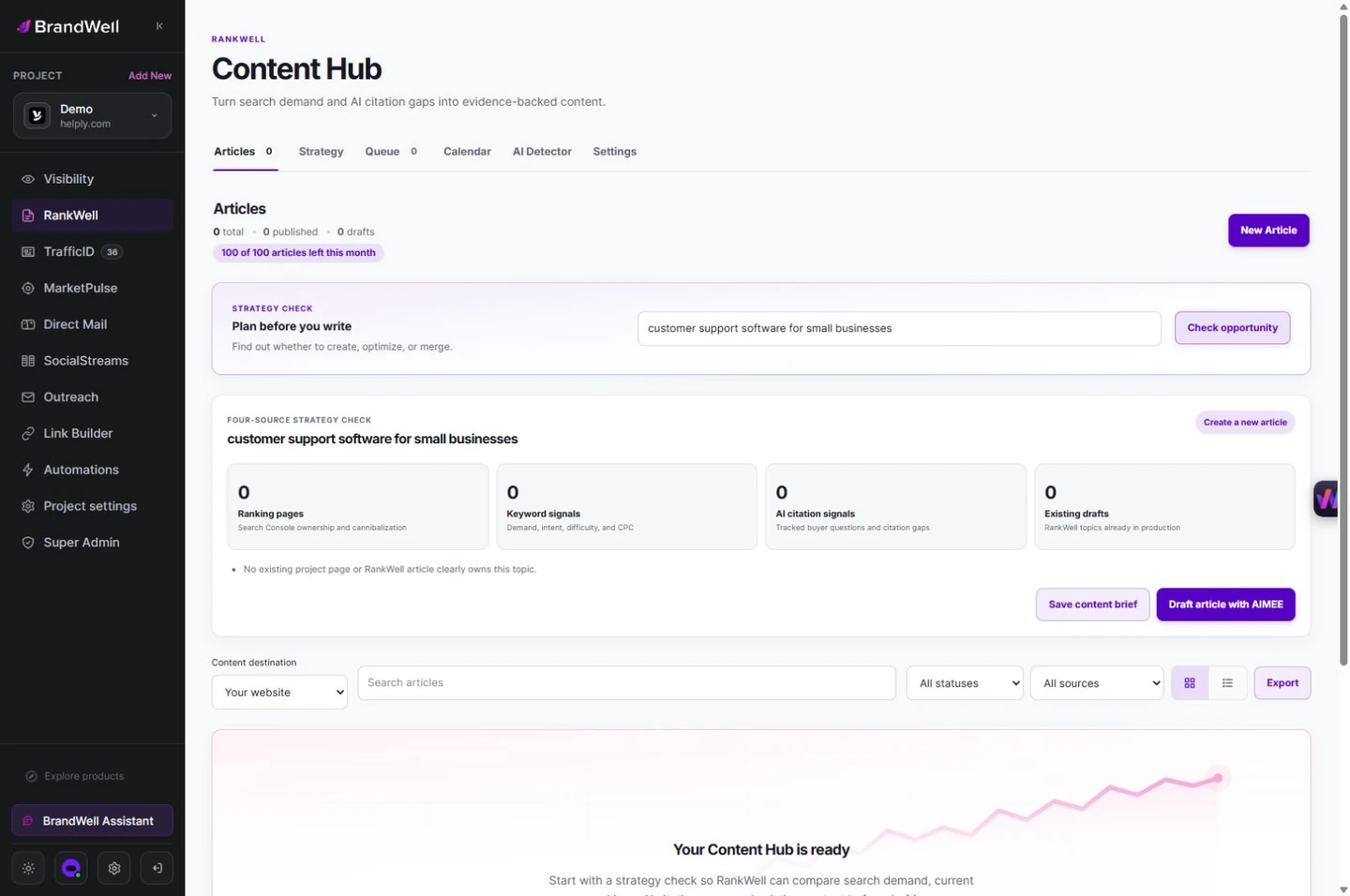
A longer draft is only useful if it answers the right question. Explore RankWell for the planning and content workflow, and use the checklist above to keep the final article specific and accurate.
Frequently asked questions
Can ChatGPT write exactly 2,000 words?
You can request that length, but verify it with an external word counter. Drafting to section budgets and editing afterward is more reliable than repeatedly asking for exactly the same total.
What should I do if the answer stops halfway through?
Ask it to continue from the last completed section, paste the final paragraph if needed, and specify which remaining sections to write. Check the join for repetition.
Does a longer article rank better?
Length alone does not establish usefulness. Match the reader’s task, provide original evidence where you have it, and remove material that does not help them.
Reviewed and updated October 6, 2026.

Written by
Julia McCoy has contributed articles to BrandWell on content marketing, writing, and search engine optimization. This archive retains her original bylines; individual articles may be updated by the BrandWell editorial team.

 Justin McGill