On this page
You can use ChatGPT to assist paid work, but customers pay for a useful result, not for generated text alone. Start with a service you can deliver, use AI for preparation and revision, and verify the work before handing it over. There is no guaranteed income, and creating drafts is only part of running a profitable business.
A practical starting point is one customer problem, one defined deliverable and one small paid pilot. Avoid treating an AI-generated business idea as evidence that people will buy it.
Choose a service you can verify
Begin with work where you understand the subject, the customer’s needs and the quality standard. AI assistance does not eliminate research, editing, client acquisition or responsibility for the result.
The following are service concepts to investigate, not earnings predictions or recommendations to enter a field without the necessary expertise.
1. Product-description preparation
Use approved specifications, dimensions, materials and care instructions to prepare clearer descriptions. Check every factual detail against the catalog and flag missing information. Do not invent sustainability claims, warranties, customer reviews or compatibility.
A defined pilot might cover five products, one brand style and one revision round. The client supplies the authoritative catalog and approves the final descriptions.
2. Content briefs and editorial updates
Organize supplied sources, customer questions and existing articles into a brief or update plan. Identify claims needing verification and explain what changed. An editorial service needs subject judgment and sourcing, not merely rewritten paragraphs.
For an existing business blog, a useful deliverable could be three reviewed updates with a change log, source list and corrected images. Do not promise ranking gains or an AI Overview citation.
3. Newsletter and campaign draft packages
Prepare copy from an approved offer, audience and factual brief. Include the subject, preview text, body, primary action and destination. Check eligibility, prices, deadlines and the tone before delivery.
Keep drafting separate from sending. A client must have an appropriate audience and sending configuration. Use the ecommerce newsletter workflow to plan content and measurement without promising sales.
4. Training and operating documentation
Turn approved process notes into a checklist, onboarding guide or question-and-answer resource. Have the person who owns the process verify the steps. Test whether a new user can follow the instructions without extra explanation.
A practical package can include a short guide, worked example and revision after a user test. Do not describe an untested workflow as production-ready.
5. Workflow preparation and implementation support
If you have the relevant technical and operating skills, help a client define inputs, actions, exceptions and verification for a supported workflow. Start in a controlled environment with appropriate access, and check the result at the destination.
Charge for the actual scope and maintenance needed. A working demonstration does not prove reliability under every real customer condition.
Validate demand before building a large offer
Talk to suitable businesses about a specific recurring problem. Ask how they handle it today, what a satisfactory result would look like and what would make them reject the deliverable.
Show a small original sample using public or fictional information. Avoid putting confidential client material into a tool before agreeing how it can be used. Define the paid pilot, deadline, acceptance criteria and revision limits in writing.
Track whether prospects are willing to pay, not just whether they like the idea. A list of suggested side hustles is not a customer-validation study.
An original prompt for a scoped product-copy task
Use an instruction that states the deliverable, source and boundaries. This is an original example to adapt to a permitted client workflow.
Prepare five product-description drafts for our homewares catalog using only the specifications supplied below.
For each item, write a short description and three factual feature bullets. Preserve dimensions, material composition and care instructions exactly. Do not add claims about durability, environmental benefit or customer results.
List missing or conflicting details separately. The drafts will be reviewed by the catalog owner before publication.
Review the response against the source rather than judging it only by how fluent it sounds. Ask for a targeted revision when a description is unclear or a boundary was missed. Keep the approved source and final version together.
Calculate the economics of the whole job
Include customer research, sales conversations, briefing, source checking, production, revisions, tools and administration. AI may shorten some steps while others still require the same attention.
For a fictional pilot, suppose the fee is $600, the total work takes eight hours and direct tool costs are $40. Revenue after those direct tool costs is $560, or $70 per hour before taxes, overhead and other business costs. If revisions add four hours, that becomes about $46.67 per hour.
This calculation is illustrative, not an earnings claim or a recommended price. Record actual time and costs before deciding whether to expand the offer.
Use the current BrandWell workflow for marketing deliverables
For content services, use Keyword Research in Visibility to investigate opportunities, then build and review the brief and article in RankWell. Add client-specific facts and sources rather than relying on a generic draft.
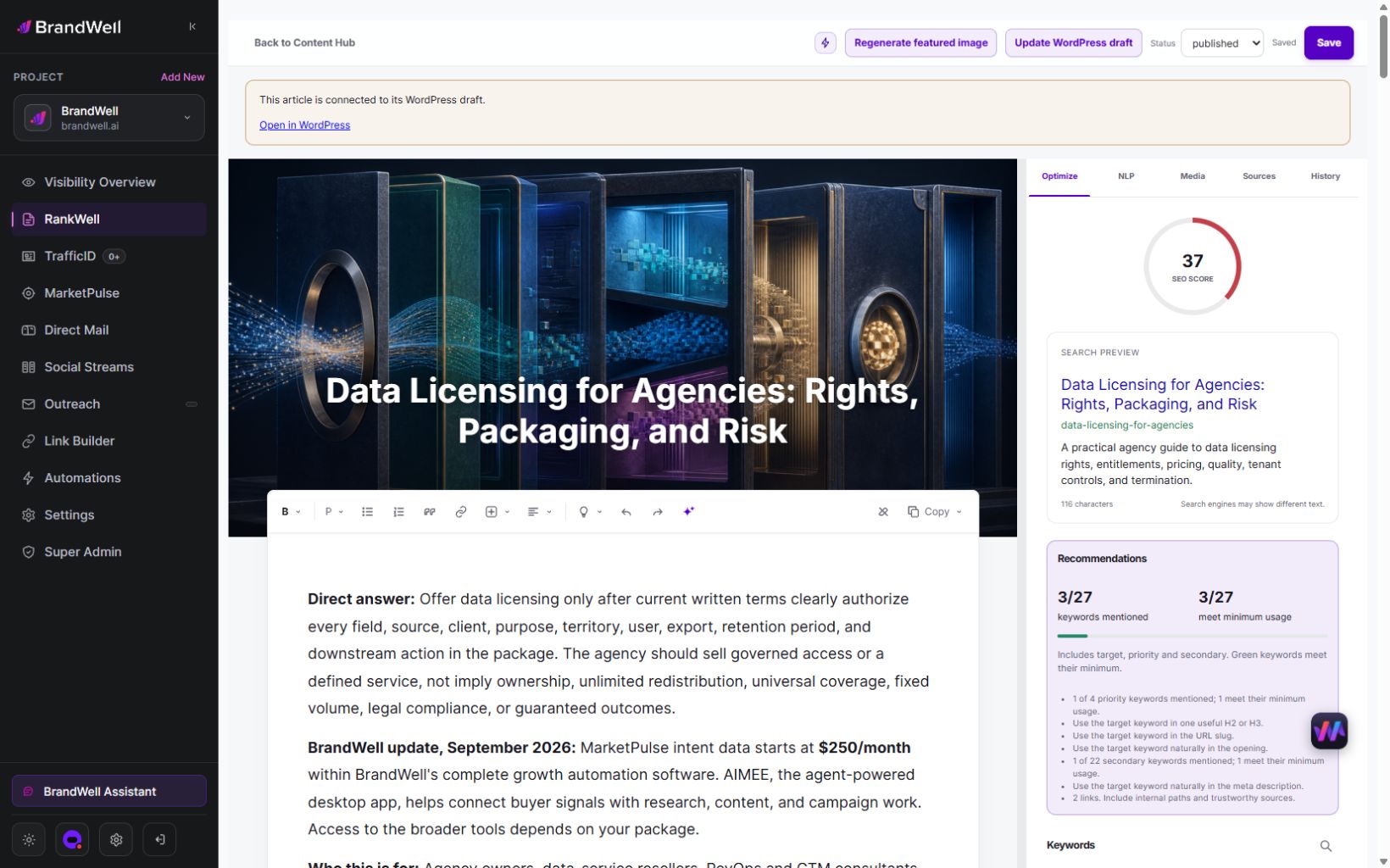
AIMEE can assist through configured tools and workflows, subject to the access and settings in your workspace. Use supported connections for the work you intend to deliver, and verify the result before promising an automated service.
If the offer includes researching relevant buyer audiences, MarketPulse plans are starting at $500/mo. Review available topics, ICP fit and export allowances. This is a data-plan starting price, not a blanket price for every BrandWell product or service package.
Make honest claims and protect the work
Show what you have actually done and what the package includes. Avoid invented testimonials, false credentials, guaranteed earnings and claims that every client will rank or sell more.
The FTC’s advertising guidance explains the need for truthful claims supported by evidence. A fluent draft or one successful example is not enough to substantiate a universal result.
Agree how AI assistance, source material and client information will be used. Confirm the relevant rights for images, quotations and other supplied material. A model’s response does not establish ownership, permission or a trademark clearance.
Keep a delivery checklist: source verification, client facts, spelling, links, image rights, formatting, mobile display and approval. Explain material limitations to the client rather than hiding them inside polished copy.
Frequently asked questions
Can I earn passive income just by generating articles?
Do not assume so. You still need useful content, distribution, customers or an audience, ongoing maintenance and a working revenue model. Generated output alone does not establish demand.
Do I need to sell prompts?
No. A prompt can support your process, but a customer may value a verified finished deliverable more. Test what the buyer actually needs before packaging a prompt collection.
Can I deliver work without reviewing it?
That is a poor basis for a professional service. Verify facts, instructions, rights and formatting against the agreed scope. You remain responsible for what you deliver.
What should I do first?
Choose one task you understand, produce a small original sample and discuss a scoped paid pilot with an appropriate customer. Measure the actual work and economics before scaling.
Reviewed and updated October 2, 2026.

Written by
Julia McCoy has contributed articles to BrandWell on content marketing, writing, and search engine optimization. This archive retains her original bylines; individual articles may be updated by the BrandWell editorial team.

 Justin McGill