On this page
This historical case study describes Kathleen Celmins’s effort to produce content for The Well-Paid Expert while running a small business. The original article reported a third-party domain score moving from 4 to 12. That is an eight-point increase, not eightfold growth, and it does not establish that the writing software caused the change.
The account concerns an earlier product period. Its interface, publication process and reported results are not current plan terms or an outcome promise. Today, RankWell supports the content workflow in the BrandWell portal.
The business problem: publishing with limited time
The original story introduced Kathleen as an author and entrepreneur behind The Well-Paid Expert. Her work focused on helping people organize and commercialize their expertise. This case study does not independently verify her income or promise that readers can reproduce her business results.
Her reported constraint was familiar to small teams: writing had to compete with book marketing, client support and other operating work. Producing more drafts would only help if the finished content remained useful and the editing workload was manageable.
The relevant decision was therefore broader than article volume. Could she create a sustainable process for selecting questions, preparing briefs, drafting, reviewing and publishing while preserving the expertise that made the business distinctive?
The historical approach
The original account described frustration with generic drafts and extensive editing. It then described a period using the earlier content product, including keywords, customized briefs and publication. Those details explain the reported experiment, but they are not instructions to publish unreviewed AI output.
It also described supplying writing samples to influence tone. A sample can help communicate editorial preferences; it does not supply the author’s lived experience, verify facts or establish that every generated article represents the author accurately. The old training screen is not a current interface guide.
What the reported score change means
The original article stated that a domain rating rose from 4 to 12 over roughly a month and referred to third-party SEO-tool screenshots. It also said backlinks increased and organic traffic began appearing, without presenting a complete traffic time series, acquisition breakdown or revenue analysis.
- Arithmetic: 12 minus 4 is eight points. The final value is three times the starting value, not eight times.
- Measurement: Different providers’ proprietary scores should not be treated as interchangeable or as a direct Google ranking metric.
- Evidence: The archived report lacks the controlled comparison needed to attribute the change to one tool.
- Business outcome: A score change alone does not establish qualified traffic, sales or profit.
The historic report is worth discussing as an example of workflow experimentation. It is not enough to promise a specific score increase, automatic backlinks or a search-ranking improvement. The competitor-tool images and obsolete interface screenshots have been removed from this updated article.
A current RankWell workflow for an expert-led business
- Select an actual reader question: Use customer conversations and available search data. Explain who the article helps and the decision it supports.
- Prepare the brief: Include the audience, scope, sources, voice preferences and claims requiring verification.
- Add original expertise: Supply examples, authorized client experiences, practical limitations and your own explanation.
- Review the draft: Check every important fact, quotation, link and product reference. Remove unsupported promises and generic passages.
- Inspect the finished page: Review headings, captions, image permissions and mobile readability before publishing through your supported workflow.
- Maintain the article: Correct outdated information and record what changed.
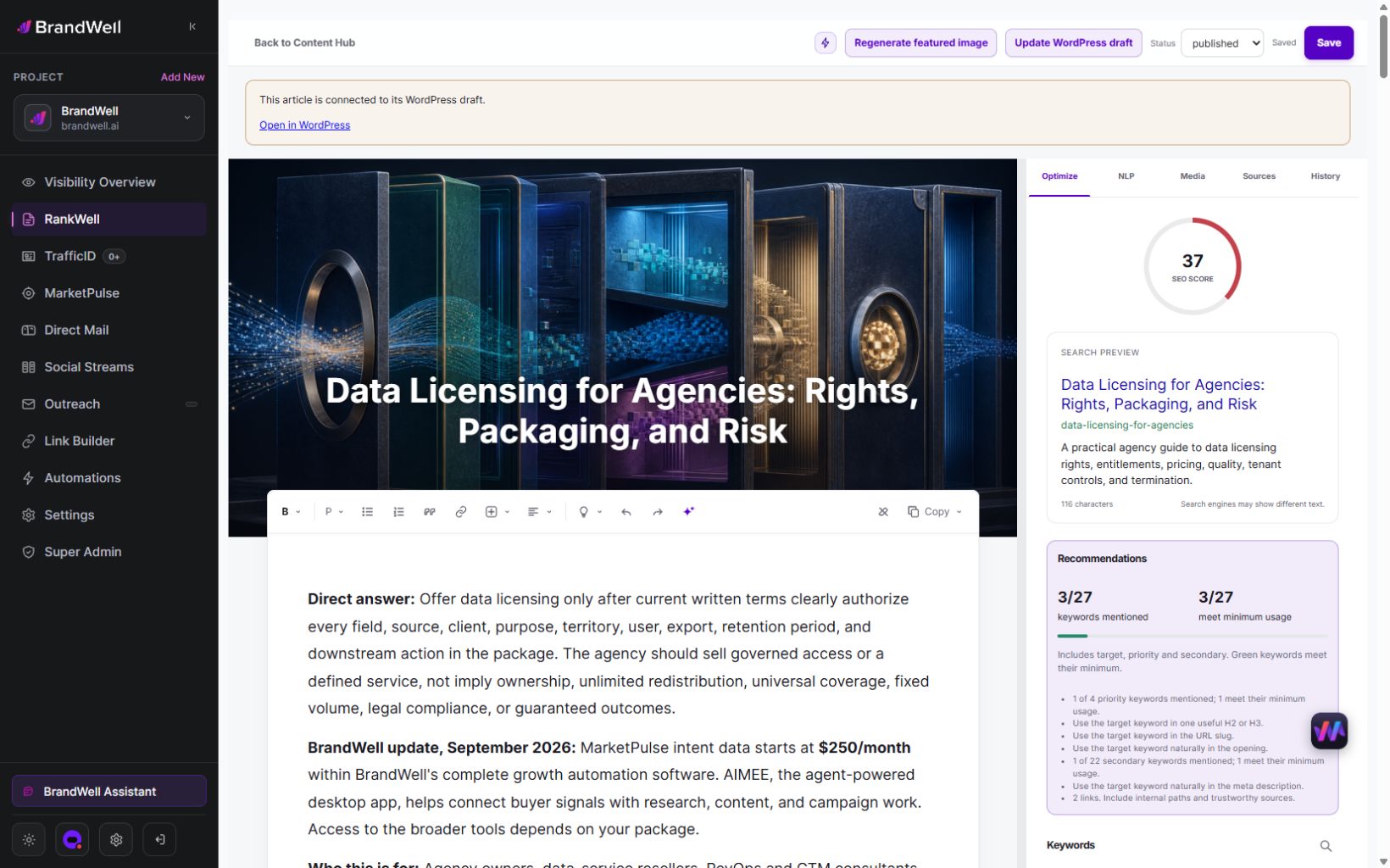
RankWell supports content preparation and review inside the BrandWell portal. The Content Hub organizes content work. Available features and publication connections depend on the selected package and configuration; confirm those before building a process around them.
Measure outcomes that fit the original problem
Track time spent selecting topics, drafting, reviewing and maintaining articles. Keep rejected drafts and correction time visible. A shorter drafting stage does not necessarily mean a shorter complete production process.
For published articles, record impressions, clicks, click-through rate and average position for the canonical URLs. Add qualified inquiries or purchases where available. Compare equivalent periods and document other changes, such as distribution or website work, before attributing an improvement to the writing process.
Separate reported historical results from newly measured outcomes. This update does not provide a current measurement of Kathleen’s website or a before-and-after performance result for the revised article.
Frequently asked questions
Did the reported domain score increase eightfold?
No. The original values of 4 and 12 represent eight additional points and a final value three times the starting value. That arithmetic does not prove business impact.
Should experts publish AI drafts without review?
No. Sources, factual claims, voice, examples and finished-page presentation need editorial review. Expertise should be supplied and checked rather than inferred from generated text.
Does the case study guarantee backlinks or rankings?
No. It records a historical customer account with limited measurement detail. Evaluate the current workflow against your own full costs and useful outcomes.
Explore the current RankWell workflow to plan an editorial process around your expertise and your readers’ questions.
Reviewed and updated October 3, 2026.

Written by
Julia McCoy has contributed articles to BrandWell on content marketing, writing, and search engine optimization. This archive retains her original bylines; individual articles may be updated by the BrandWell editorial team.