



On this page
- Start with the purpose of the link
- Understand Google’s link-spam boundary
- 1. Publish a resource with an original contribution
- 2. Offer relevant expertise to publishers
- 3. Use outreach that explains the reader benefit
- 4. Check broken links and changed resources carefully
- 5. Clarify brand mentions and image attribution
- 6. Strengthen relevant internal navigation
- 7. Participate in communities for the conversation
- 8. Review link data without overclaiming
- Do not routinely disavow links based on a score
- Use the current BrandWell workflow
- Common questions
A useful link-building strategy gives another publisher a genuine reason to reference your work. Create a resource that answers a real question, make it accessible, share it with relevant people and maintain it. Editorial links can support discovery and referral traffic, but no tactic guarantees rankings or an AI citation.
This guide focuses on original resources, relevant outreach, link maintenance and measurement. It avoids speculative ranking formulas, purchased ranking credit and claims that a longer article automatically deserves someone else’s links.
Start with the purpose of the link
A backlink points from another website to yours. An internal link connects pages on your own site. Both can help a reader find useful context, but they are different activities and should be measured separately.
Before pursuing a placement, ask what the publisher’s reader gains. A source citation, a worked example, a useful tool or a relevant official product reference can serve a real purpose. A link inserted merely to reach a quota does not establish value.
Do not infer a precise ranking formula from third-party correlation studies, a leaked document or a domain score. Those do not demonstrate how one particular link will affect your page. Similarly, a social share, unlinked mention and editorial hyperlink are different observations.
Understand Google’s link-spam boundary
Google’s spam policies describe links created primarily to manipulate rankings. Examples include buying ranking links, excessive exchanges, automated link creation and low-value content made mainly for linking signals. A relevant-looking page does not make a paid ranking arrangement compliant.
Advertising and sponsorship can be legitimate, but links need appropriate qualification. Google’s outbound-link guidance recommends rel="sponsored" for paid placements, accepts nofollow for that purpose and recommends ugc for user-generated links. These technical attributes do not replace disclosures readers need to understand a relationship.
1. Publish a resource with an original contribution
Begin with a task your audience needs help completing. A useful resource might contain a tested checklist, a clearly explained method, an original dataset, an interview or a worked calculation. Choose the format that helps the reader, not the one advertised as a universal link magnet.
- A guide: Show steps you have verified, including conditions and common failures.
- Research: Explain the sample, collection date, definitions and limitations.
- A calculator: Show assumptions and formulas rather than hiding them behind an optimistic result.
- A visual: Present genuine evidence or clarify a process, with accessible text and appropriate rights.
Link factual claims to their primary sources. If your resource depends on changing information, give it an owner and a review schedule. Being more detailed than another article does not by itself make the work original or better.
Example: an IT transition checklist
An illustrative IT service company could publish a checklist for changing providers: document account ownership, identify critical systems, assign handover responsibilities and verify access before the transition. Its original contribution could be a blank handover worksheet based on its reviewed process.
The worksheet should distinguish general planning from advice that requires a technical assessment. A relevant professional organization might choose to reference it because it helps members prepare. That is a possible use case, not a promised placement or measured customer result.
2. Offer relevant expertise to publishers
Look for publications covering a question where you can supply verified evidence or practical experience. Read the actual page and editorial guidance. A topical connection matters more than a blanket minimum domain-score threshold.
Propose a specific contribution, such as a documented method or an expert explanation within your qualifications. Do not invent experience, offer unsupported statistics or ask a journalist to reproduce promotional claims as fact. The publisher decides whether to use your contribution and whether to link.
If a contribution is paid or sponsored, make the relationship clear and follow the appropriate link qualification. Do not present a sponsored placement as independently earned coverage.
3. Use outreach that explains the reader benefit
Outreach should identify the exact context and why your resource helps. Avoid fabricated compliments and mass messages that claim you read pages you have not reviewed. Respect contact preferences and stop when someone declines or opts out.
Here is an original template to adapt only after checking the facts:
Subject: A handover worksheet for your provider-transition guide
Hello, I read your guide on changing IT providers. The section about account ownership may benefit from a blank handover worksheet. We published one that separates system owners, access checks and transition responsibilities. The resource is available at the relevant page on our site. If it helps your readers, you are welcome to consider it. I work for the company that created it.
The message names a useful contribution without requiring a link or making the recipient responsible for your promotion. Add the actual URL and accurate sender details before sending. Follow applicable email rules and your email provider’s current requirements; personalization alone does not ensure delivery.
4. Check broken links and changed resources carefully
A broken reference can be a reason to contact a publisher, but verify it first. A temporary error, access restriction or changed address is not always a permanently missing resource. Check what the original page covered.
Offer your page only if it satisfies the same reader need. Do not replace a research citation with a sales page or manufacture an equivalent study. Explain the broken reference and leave the editorial decision with the owner.
For your own moved resources, update internal links and use an appropriate redirect when a genuine replacement exists. Avoid redirecting unrelated retired content to a generic product page merely to preserve a signal. Test the actual destination and keep a record of changes.
5. Clarify brand mentions and image attribution
If a publisher refers to your company but readers cannot find the official information, you can suggest a relevant reference link. A mention does not entitle you to a backlink. Explain the destination and let the author decide.
For images, inspect the actual license and usage context. Attribution and permission are different questions. Do not assume every unlinked image use is infringement, and do not require an unqualified ranking link as the price of permission. Resolve rights questions using the applicable terms and appropriate expertise.
6. Strengthen relevant internal navigation
Link to related pages where the next step helps the reader. For the IT checklist, a link to an explanation of account ownership or transition planning may be useful. Linking to every product repeatedly is not a substitute for a clear content structure.
Google’s link best practices describe crawlable links and concise, descriptive anchor text. Use wording that sets an accurate expectation. Do not force every target keyword into a link or stack unrelated links together.
After editing, check links on mobile and verify that the destination is available. A technically valid URL can still be a poor destination if the page is unrelated or its key content is missing.
7. Participate in communities for the conversation
Answer the actual question and follow local rules before including a link. Your answer should remain useful without requiring the reader to leave. Disclose an affiliation when relevant, and do not automate promotional replies across communities.
A useful conversation may lead to discovery, but it is not a guaranteed source of backlinks. For a research workflow, see our guide to researching audience questions in forums.
8. Review link data without overclaiming
Record the source URL, destination, context, relationship, date checked and relevant outcome. Separate a publisher’s editorial choice from a paid campaign. Useful measurements can include referral visits, appropriate actions and whether a resource continues to be cited.
The Search Console Links report is a sample, not an exhaustive record of every link. Grouping and omitted URLs can affect comparisons. A difference between exports does not prove that a publisher removed a link; check the actual page.
Monitor search performance separately. If rankings or clicks change after outreach, do not assume the new links caused the whole change. Content updates, seasonality, reporting and other search factors may also be involved.
Do not routinely disavow links based on a score
Google says most sites do not need the disavow tool and warns that incorrect use can harm search performance. Its disavow guidance calls for both a considerable number of artificial or low-quality links and a manual action, or likely manual action, associated with them. Review that evidence before considering the tool.
A foreign-language site, low third-party score or unfamiliar domain alone is not a sufficient diagnosis. Keep records of any actual link schemes your business commissioned and seek an informed review where needed. Do not promise that removing links automatically improves rankings.
Use the current BrandWell workflow
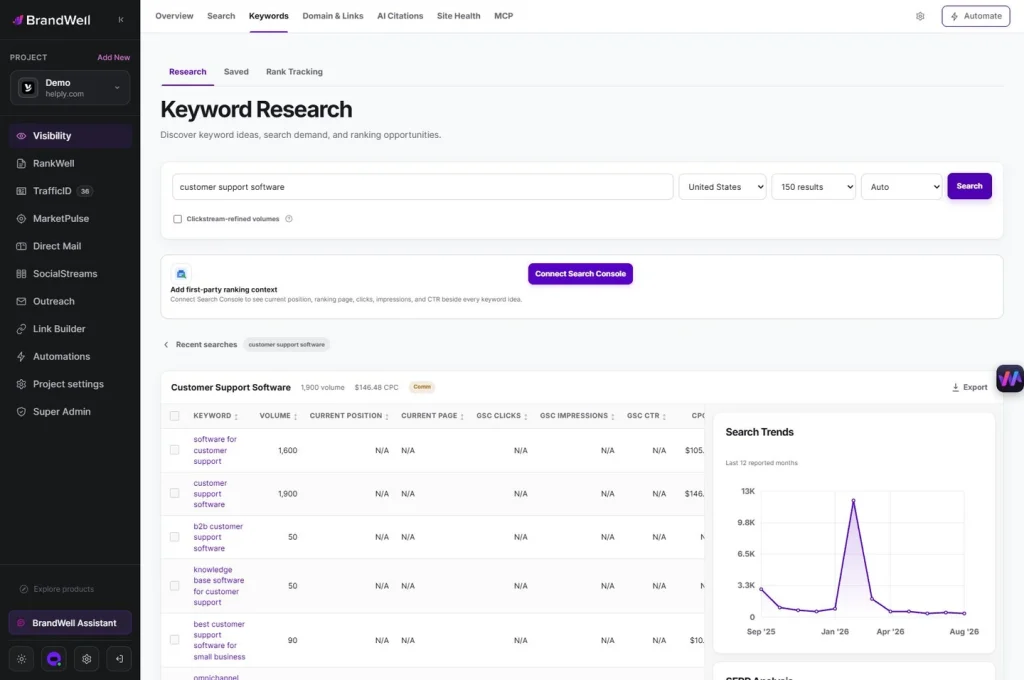
Investigate audience questions in Keyword Research within Visibility. Use RankWell to build a brief and review a draft with original evidence and appropriate sources. LinkBuilder can support research within the available package and configuration; verify the actual source page, context and suitability before taking action. Do not treat an opportunity list as a guaranteed placement.
AIMEE can help organize tasks through configured tools and approved access. Check proposed sources and messages before using them. Start in the BrandWell portal or learn about RankWell.
Common questions
Is link building dead?
Links still help people navigate and discover resources. Focus on genuine editorial value and maintain your own links. Avoid claims that a particular tactic guarantees a ranking effect.
Will a longer article earn more backlinks?
Length does not establish usefulness. An original worksheet or concise explanation can be more helpful than a long summary. Check what the intended reader and publisher need.
Can AI automatically create backlinks?
AI can help organize research or draft a message, but it cannot make another publisher choose your resource. Automated links created to manipulate rankings fall within Google’s link-spam concerns.
Does this guarantee inclusion in AI Overviews?
No. Useful, reliable content and accessible pages support discovery, but they do not guarantee an AI citation. Do not equate a backlink count with inclusion in a generated answer.
Reviewed and updated October 2, 2026.

Written by

