


On this page
- Choose the purpose before choosing a publisher
- Find and evaluate relevant opportunities
- Prepare a concise, honest pitch
- Agree on the scope before writing
- Write a contribution the editor can review
- Prepare and review the draft in RankWell
- Check the published article and measure useful outcomes
- Frequently asked questions
Guest post writing means preparing an article for another publisher’s audience. A useful guest contribution answers a real question, adds evidence or experience the publisher does not already have, and follows its editorial requirements. Publication, traffic, backlinks, and sales remain uncertain outcomes.
Start with reader and publication fit, then prepare a specific pitch and an accountable draft. This guide includes a pitch example, an outline, a submission checklist, and a current RankWell workflow for reviewing the article.
Choose the purpose before choosing a publisher
A guest article might introduce your expertise to a relevant audience, explain a technical process, or support an industry conversation. Define the reader’s task and the outcome you can actually measure. A publication credit and a qualified customer inquiry are different outcomes.
Google’s guidance on large-scale article campaigns distinguishes useful guest contributions from campaigns primarily intended to build links. It identifies excessive keyword-rich links, repeated articles, and large-scale placement as warning signs. Do not make a required ranking link the purpose of your contribution.
Find and evaluate relevant opportunities
Use industry publications you already read, professional communities, and published contributor guidelines. A focused search such as "guest post guidelines" "payroll" can help locate a relevant submission page. Verify the current rules on the actual publisher’s site before contacting anyone.
- Audience fit: Does the publication address the people and decisions your article serves?
- Editorial fit: Do recent articles use the depth, format, and evidence you can provide?
- Original contribution: Can you add a useful angle that is not already covered?
- Submission terms: Confirm compensation, rights, exclusivity, AI-use requirements, images, links, and revisions.
- Contact route: Use the designated submission channel rather than collecting unrelated personal contacts.
A third-party authority score is not proof that a publisher has a relevant audience or that its link will improve your rankings. Likewise, visible comments and shares are incomplete evidence of readership. Evaluate the editorial work and audience fit instead of making a score the sole decision.
Prepare a concise, honest pitch
Read the guidelines and recent coverage. Explain the reader question, your proposed answer, and the evidence you can provide. State relevant experience accurately. Do not invent a relationship, publication credit, or testimonial to make the email feel personal.
Fictional pitch example:
Subject: Guest article proposal: a payroll migration checklist
Hello Editorial Team,
Your recent coverage explains payroll reporting. I propose a practical article about preparing employee records before a payroll migration. It would cover an inventory worksheet, validation questions, and a sample handoff checklist.
I can provide a clearly labeled example and original process notes, with sources for technical claims. Please let me know whether this fits your contributor requirements and whether you would prefer an outline first.
Thank you,
Alex, payroll operations consultant
The example is a template for structure, not a real submission or a claim about a publisher. Replace every factual detail with your own verified information. Follow the publisher’s stated response process. If follow-up is permitted, keep it brief and respect a decline or request to stop.
Agree on the scope before writing
Confirm the topic, reader, angle, length, deadline, rights, disclosure, author bio, image requirements, and review process. Ask whether the editor wants an outline or a draft. An encouraging reply does not necessarily mean the article has been accepted for publication.
For the fictional payroll article, a useful outline might be:
- Who needs the checklist and what it covers.
- Which source records and owners to inventory.
- How to identify missing fields and conflicting values.
- A labeled example of a validation log.
- Who approves the handoff and how exceptions are resolved.
- What the checklist cannot establish, including legal or system-specific requirements.
This outline describes a task without inventing statistics or claiming that every payroll system works the same way.
Write a contribution the editor can review
Answer the question early. Use descriptive headings, short paragraphs, and examples that make the advice executable. Separate observed results from hypothetical illustrations. Cite the original source beside each research or policy claim and preserve the conditions that make the claim meaningful.
Use only images you have permission to submit. Label screenshots with their product and context, and check that the important detail is readable. Do not copy a publisher’s image or another writer’s argument without the required rights and attribution.
Links should help readers understand or complete the task. Follow the host’s link and disclosure rules, including its handling of commercial relationships. A bio can accurately explain your work and offer a relevant next step without promising outcomes you cannot establish.
Prepare and review the draft in RankWell
In today’s RankWell workflow, organize the article brief in BrandWell’s Content Hub. Bring the publisher’s requirements, your original examples, and supporting sources to the draft. Use the editor’s search preview, SEO recommendations, NLP, media, sources, and history to support your review.
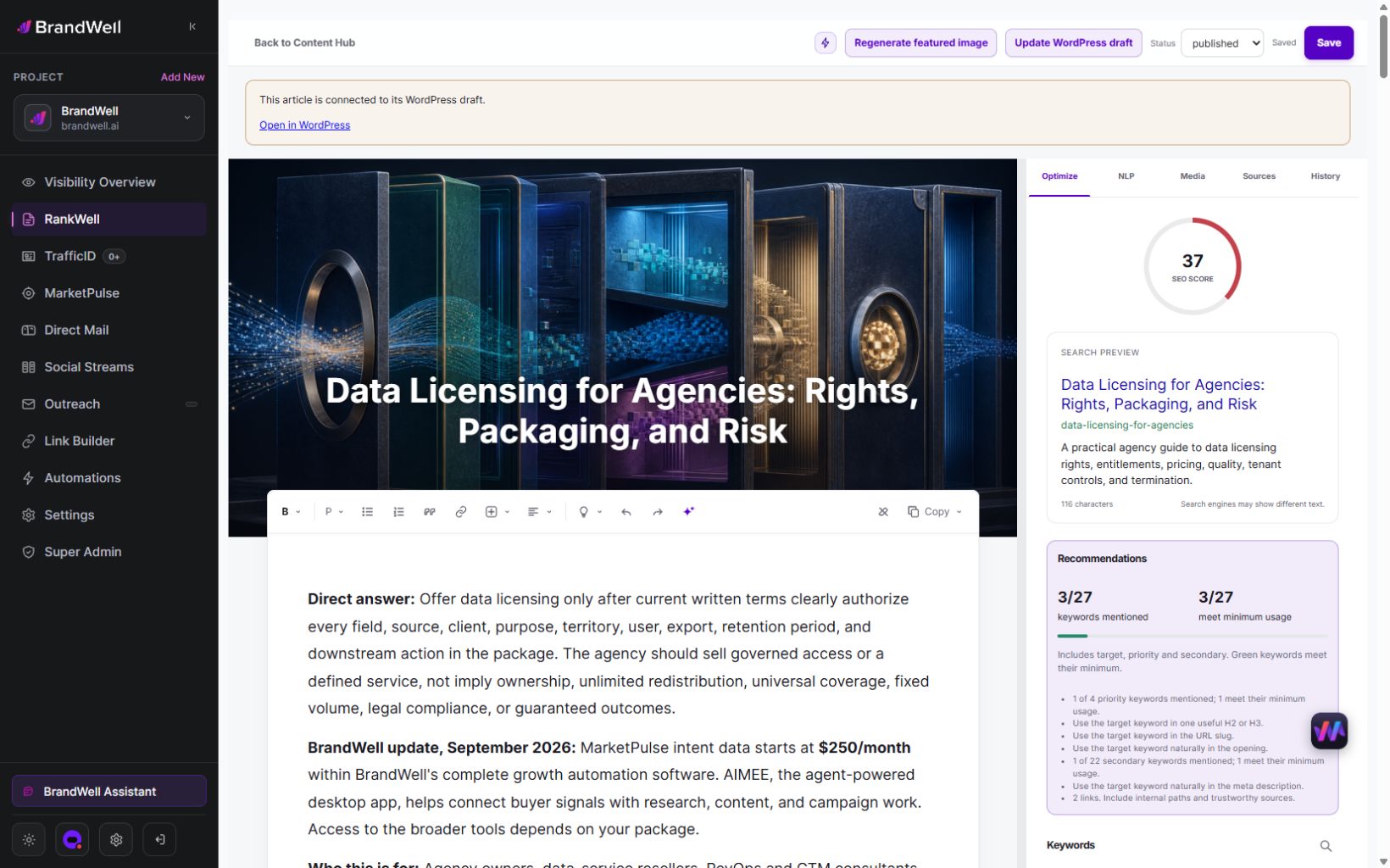
Confirm factual accuracy, attribution, current product details, and the host’s AI-use rules before submitting. A generated draft or recommendation score does not establish originality, editorial acceptance, or search performance. Submit through the agreed channel; do not assume a publishing integration provides access to someone else’s site.
Check the published article and measure useful outcomes
After publication, inspect the live title, formatting, image captions, bio, and links. Report factual errors through the editor’s correction process. Share the article where relevant and permitted, and answer reader questions without turning every response into a sales pitch.
Hypothetical example: An article sends 100 measured referral visits to your site and produces 4 inquiries, of which 2 meet your qualification criteria. That is a 4% inquiry rate and a 2% qualified-inquiry rate for those visits. It does not establish a sale or the guest post’s incremental effect on revenue.
Frequently asked questions
How do I start guest posting?
Choose a relevant publication, read its current guidelines, identify an unanswered reader question, and pitch an evidence-backed contribution through the requested channel.
Does every guest post include a backlink?
No. The host sets its editorial and link policy. Evaluate the value of the contribution without assuming a particular link or ranking benefit.
Can AI help write a guest post?
It can support preparation and drafting when the publisher permits that workflow. The author remains responsible for evidence, attribution, permissions, and the finished submission.
Explore RankWell to prepare and review articles with a clear brief, sources, and editorial ownership.
Reviewed and updated October 3, 2026.

Written by
Justin McGill is the founder of BrandWell, growth automation software for inbound and outbound teams. BrandWell brings together MarketPulse intent data, TrafficID website audiences, RankWell content workflows, Visibility research and AIMEE execution through configured tools.
 Farnaz Kia
1 comments