On this page
- What changed in the review approach
- 1. Check the reader’s question
- 2. Verify material claims
- 3. Separate original material from invented evidence
- 4. Match the current product and offer
- 5. Inspect formatting and media
- 6. Keep an explicit approval state
- 7. Verify publication and later outcomes
- Use a checklist without making it a shortcut
- Common questions
CRAFT and TAP were historical labels used in the Content at Scale archive to describe work around AI-generated content. The useful purpose is editorial review, not a promise that generated material can be published without reading or checking it.
This update replaces the old announcement’s production-time, minimal-editing, ranking and fixed-price promises with a current review process for RankWell. A generated draft is a starting point; the finished page still needs evidence, judgment and an owner.
What changed in the review approach
The earlier announcement positioned TAP as a quick final glance after automated content preparation. That is not an adequate description of the review needed for every article. The actual work depends on the subject, sources, product details and audience.
Keep the purpose of a checklist: identify what the reviewer must verify and what remains unresolved. Do not use a framework name, editor score or generated citation as a substitute for reading the complete draft.
1. Check the reader’s question
Read the title, opening and section headings together. Confirm that the article answers the intended question and makes the next step clear. Remove sections that repeat the introduction or broaden the topic without helping the reader.
For an original hypothetical office-furniture guide, the reader may need to compare a chair’s documented dimensions and available adjustments. A long history of office furniture does not necessarily help that decision. Keep the useful explanation and remove unrelated padding.
2. Verify material claims
Open the sources and compare the actual claim with the evidence. Check dates, quantities, units, attribution and the limits of the source. A linked page is not proof that the draft’s sentence is supported.
Original claim-correction example
A hypothetical draft says a chair warranty covers every kind of wear. The supplied warranty document excludes cosmetic wear. The reviewer removes the universal statement and describes only the documented coverage, with a link to the applicable terms.
This is an invented review example, not a claim about an actual product or a recommendation about a particular contract. It illustrates how a broad statement can exceed its source even when the source is real.
The NIST AI Risk Management Framework is a voluntary resource for evaluating and managing AI-related risk. It does not certify that a generated article is complete or supported.
3. Separate original material from invented evidence
Add useful explanation, firsthand expertise or a clearly labeled hypothetical example where it helps answer the question. Do not present an invented scenario as a customer interview or an imagined outcome as a measured result.
For a hypothetical comparison guide, explain which documented dimensions matter to the intended workspace and why. If the team has not tested a chair, do not write a first-person durability verdict or claim a hands-on benchmark.
4. Match the current product and offer
Check every feature, price, allowance, integration and CTA against the actual offer. Historical Content at Scale package names and old demonstrations should not be applied to current BrandWell.
Use Visibility for keyword investigation and RankWell for content work. Review current product details before describing how a workflow operates. A product label does not establish every possible action or entitlement.
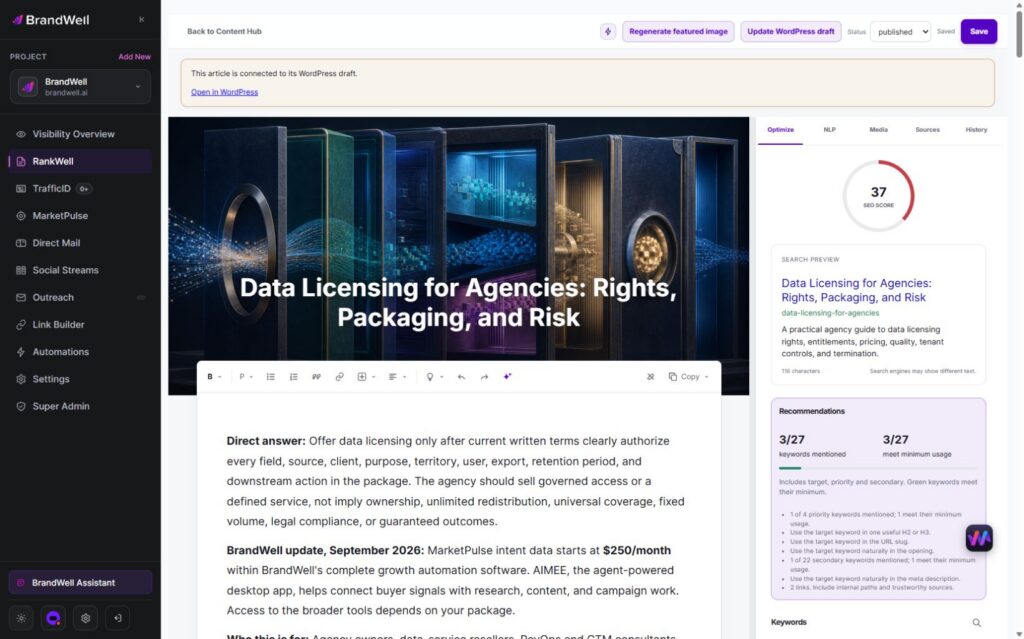
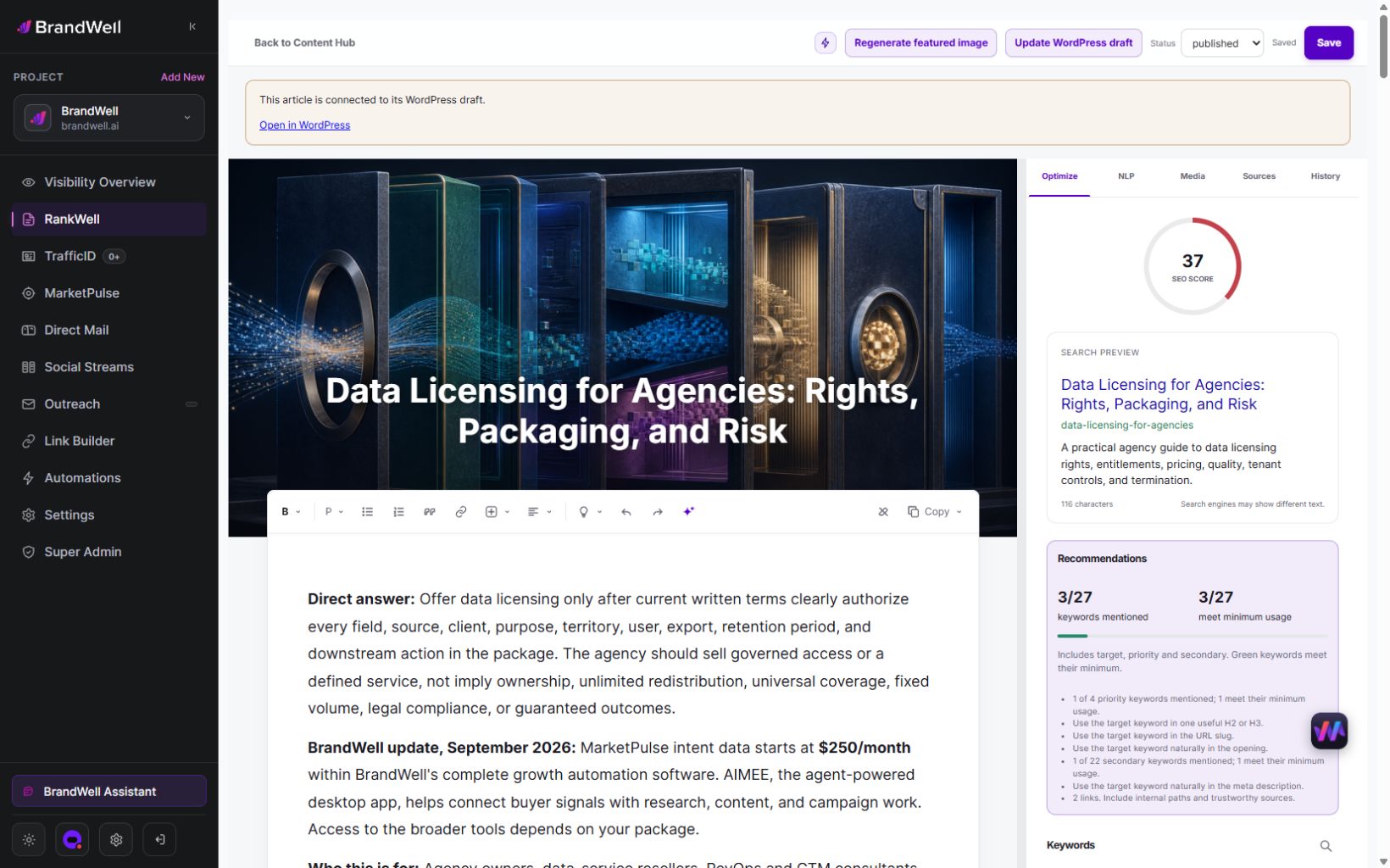
For BrandWell content, define the reader and evidence, then inspect the article alongside the search preview, recommendations, media and sources. Check the complete text before publication.
5. Inspect formatting and media
Check heading order, paragraphs, lists, captions and internal destinations. Review the page at mobile width for clipped content and oversized tables. Verify that informative images are relevant, permitted, legible and described appropriately.
For an example screenshot, identify the product and context. Do not use an old interface to imply a current feature or a stock photo to imply a real customer result. Confirm that the featured image and social preview match the page.
6. Keep an explicit approval state
Record the owner, unresolved questions and approved version. A queued article is not automatically publication-ready. Recheck time-sensitive facts and offers if there is a gap between drafting and release.
In an original hypothetical review queue, six articles have drafts: three are approved, two await sources and one needs new media. The ready queue is three articles, not six. These invented counts illustrate review states, not measured BrandWell performance.
7. Verify publication and later outcomes
Check the final text and configured destination before approving release. After publishing, inspect the actual page, links, media and metadata. AIMEE can help carry approved work through configured tools and permissions; confirm what completed at the destination.
Record the search baseline and the date of the change. Later impressions, clicks or conversions are outcomes to inspect separately from editor scores or draft volume. Do not infer that the checklist guarantees rankings or revenue.
Use a checklist without making it a shortcut
- Does the page answer the reader’s question?
- Can material claims be traced to appropriate evidence?
- Are hypothetical examples and historical reports labeled?
- Does the product description match the actual offer?
- Are formatting, images and links usable on mobile?
- Is the reviewed version approved by an owner?
- Has the published destination been checked?
Use the checks relevant to the actual article. The goal is a useful, supported page and a reviewable workflow, not accepting every generated paragraph.
Common questions
Does TAP mean a quick glance is enough?
No. Review the complete draft and the evidence required by the topic.
Does an editor score establish originality or factual support?
No. Review attribution, sources, claims and the actual content separately.
Where should current BrandWell content work begin?
Explore RankWell and review current product plans for your required workflow.
Reviewed and updated October 3, 2026.

Written by
Julia McCoy has contributed articles to BrandWell on content marketing, writing, and search engine optimization. This archive retains her original bylines; individual articles may be updated by the BrandWell editorial team.
 Justin McGill