

On this page
Keyword density is the frequency of a word or phrase compared with a page’s word count. It can reveal repetitive writing, but there is no universal percentage you need to reach for SEO. Write a complete answer, use the language your audience understands, and remove repetition that makes the page harder to read.
This guide explains the calculation, why different tools can report different values, and how to review an article without treating a keyword score as a publishing target.
How to calculate keyword density
A common calculation is exact phrase occurrences ÷ total words × 100. If an exact phrase appears 10 times in a 1,000-word article, its density under that convention is 1%. At 20 occurrences, it is 2%.
For a multiword phrase, some tools instead count the words occupied by the phrase or apply their own matching rules. Navigation, captions, headings, plurals, and related forms may also be included differently. Compare results only when the text scope and calculation are the same.
| Article words | Exact phrase occurrences | Occurrence-based density |
|---|---|---|
| 500 | 5 | 1% |
| 1,000 | 5 | 0.5% |
| 1,000 | 20 | 2% |
Swipe the table to see all columns.
These are arithmetic examples, not recommended targets. Twenty repetitions might be natural in a technical glossary and distracting in a short comparison. The percentage cannot make that editorial judgment.
Is 1% or 2% the ideal keyword density?
No fixed range establishes whether a page is useful or whether it will rank. Google’s keyword-stuffing policy addresses manipulative, unnatural repetition. It does not provide a safe density percentage or say that crossing 2% automatically creates a penalty.
Do not add ten extra mentions just to turn an optimization indicator green. Also avoid replacing every useful technical term with a vague synonym to reduce a score. A reader needs clear references to the actual subject.
What to check instead of a keyword quota
- Intent: Does the page solve the task implied by the query? A definition, checklist, product comparison, and purchase page serve different needs.
- Coverage: Are the important steps, constraints, examples, and exceptions explained? Add information because it helps the reader.
- Clarity: Can someone identify the subject from the title, heading, and opening paragraph?
- Evidence: Are facts supported by current sources and examples labeled accurately?
- Readability: Does the text sound natural when read aloud? Remove sentences that repeat an earlier point without adding detail.
A before-and-after example
Repetitive: “Our payroll software is payroll software for teams needing payroll software. Choose payroll software for your payroll software needs.”
Useful: “The payroll checklist helps your team collect employee details, confirm the pay schedule, and review the first payment before processing.”
The revised example explains a task. It does not imply a specific BrandWell payroll feature, and it does not need a percentage to be more useful.
Where should the main phrase appear?
Use a descriptive title and main heading. Introduce the topic early, then use appropriate terminology in the explanation. Link to supporting pages with meaningful anchor text. There is no requirement to repeat the exact phrase in every subheading or within a prescribed first 100 words.
Image alternative text should describe the image’s meaning in context. Do not insert an unrelated target keyword into every image. A screenshot might need “Keyword research results filtered to the selected market,” while a purely decorative image may need empty alternative text.
Review the draft in BrandWell
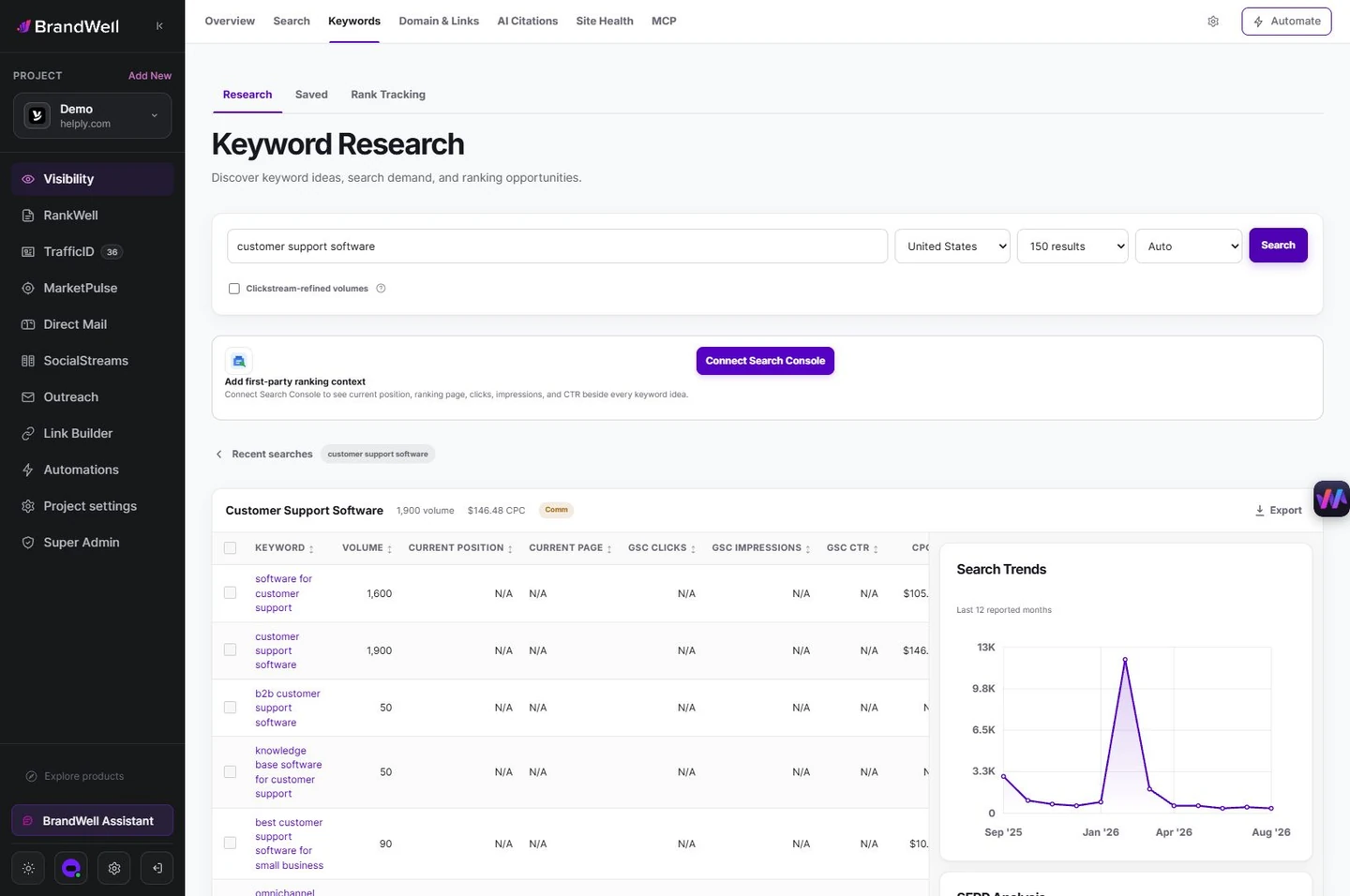
Start in Visibility > Keywords > Research to investigate customer language and the intended market. Then open RankWell > Articles > Plan before you write > Check opportunity to plan the answer before drafting.
In the RankWell editor, review the article, search preview, SEO recommendations, media, and sources together. Treat recommendations as prompts for inspection. A draft still needs your product knowledge, factual review, and original examples before publication.
If the page already receives impressions, use Search Console to identify the queries and sections worth improving. Measure qualified visits and actions after an update, rather than reporting a better density score as an SEO result.
Quick answers
How many keywords should a 1,000-word article contain?
There is no prescribed number of exact mentions. Use the terms needed to explain the subject clearly. Five, ten, or twenty occurrences alone cannot establish quality.
Can a density checker detect keyword stuffing?
It can flag repetition for review. It cannot determine intent, usefulness, or policy compliance from a percentage alone.
Should every article target a different keyword variation?
No. Closely related searches may belong in one strong article. Check existing pages and search intent before creating another URL. Our keyword opportunity checklist explains that decision.
Reviewed and updated October 2, 2026.

Written by
Justin McGill is the founder of <a href="https://brandwell.ai/">BrandWell</a>, an intent-led marketing platform that identifies anonymous website visitors, uncovers companies actively researching competitors, and puts your ads in front of their entire buying committee — before anyone fills out a form. Justin has been building B2B sales and marketing software since 2008. When he's not working, he's spending time with his wife and their two kids in Arizona.

 Farnaz Kia