On this page
Reviewed and updated by the BrandWell team on October 1, 2026.
“LSI keywords” is an outdated label often used for words related to a topic. You do not need an LSI keyword list, a density target, or a special quota to write a useful search page. Research the reader’s question, cover the relevant concepts, and use natural language.
This article replaces our earlier advice about sprinkling LSI terms into content. The practical goal is topic coverage and clarity, not satisfying an assumed LSI ranking formula.
What does LSI mean?
Latent semantic indexing is an information-retrieval technique. In SEO discussions, people often use its name loosely to describe related words, synonyms, or supporting topics. Those are different concepts, and calling all of them “LSI keywords” makes the writing task less clear.
Google’s SEO Starter Guide advises creating helpful, well-organized content and considering the terms readers might use. It also explains that its language-matching systems can relate pages to queries without every exact variation appearing on the page.
Related concepts are more useful than a keyword quota
Suppose you are writing a guide to customer support software. Relevant questions might include how tickets are assigned, what happens during a handoff, how reporting works, and which channels the team needs. Those concepts deserve space because they help the reader choose and use a product.
Repeating synonyms such as “support platform” and “service software” does not automatically answer those questions. Conversely, adding unrelated technical terms because a tool suggests them can make the page harder to understand.
| Term | Practical meaning | How to use it |
|---|---|---|
| Primary keyword | The main search question or subject | Keep the page focused on that task. |
| Secondary keyword | A related query the same page can answer | Include it when the intent fits. |
| Related concept | A detail needed to explain the subject | Explain it accurately with an example. |
| Synonym | Another expression for a similar idea | Use it naturally where it improves readability. |
Swipe the table to see all columns.
Find useful supporting topics in BrandWell
- Open Visibility → Keywords → Research and enter your main topic.
- Choose your market and review related queries and intent.
- Group the questions one page can answer well. Keep separate tasks in separate briefs.
- In RankWell → Articles, enter the topic in Plan before you write and select Check opportunity.
- Review existing pages and drafts before saving the brief or drafting with AIMEE.
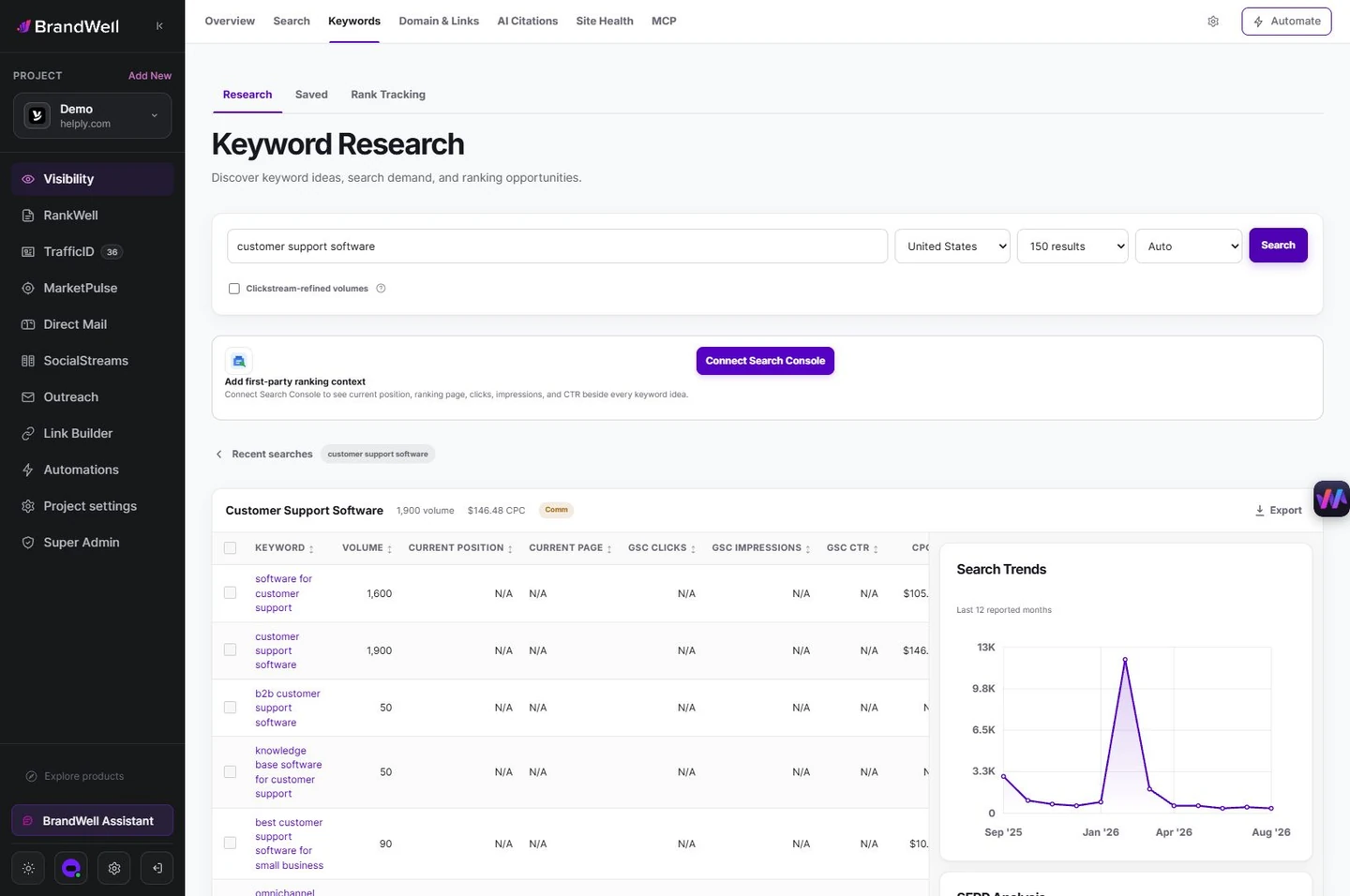
Research estimates help prioritize work; they do not prescribe how often to repeat a phrase. Add product screenshots, examples, and explanations that make the answer easier to apply.
What to change in an old article
- Remove claims that a specific LSI score or density is necessary to rank.
- Replace repetitive keyword lists with answers to genuine reader questions.
- Correct definitions and verify technical claims against current sources.
- Use a descriptive title and headings that accurately represent the content.
- Link to useful related pages without forcing exact-match anchor text everywhere.
How to measure an improvement
Record the update date and the page’s baseline clicks, impressions, queries, and relevant conversions. Compare equivalent periods after search engines have had time to recrawl the page. Consider seasonality, position changes, and changes in the queries receiving impressions. A higher keyword count is not a business outcome.
Frequently asked questions
How many related keywords should I include?
There is no universal quota. Include the language and concepts needed to answer the question clearly, and remove repetition that does not help the reader.
Should I use every phrase a keyword tool returns?
No. Filter for relevance and shared intent. A tool’s list is research input, not a mandatory outline.
Do I need to replace every use of the phrase LSI keywords?
You can explain the phrase when that is what the reader searched for. The important correction is to stop presenting it as a required optimization technique.
Use RankWell to plan useful content, with research from Visibility and human review before publishing.

Written by
Julia McCoy has contributed articles to BrandWell on content marketing, writing, and search engine optimization. This archive retains her original bylines; individual articles may be updated by the BrandWell editorial team.