


On this page
- Define the result before choosing the creative
- Research a real audience problem
- Make one accurate promise
- Choose media that explains the offer
- Match the landing page to the advertisement
- Original example: a research-data offer
- Prepare a supported campaign in BrandWell
- Test a hypothesis rather than changing everything
- Interpret performance in context
A successful advertisement connects a relevant audience with a clear, supported offer and produces the outcome you defined before launch. That outcome might be a qualified inquiry, purchase or another useful action. Attention and memorable imagery can help, but clicks alone do not establish business success.
Define the result before choosing the creative
Write down the audience, offer, desired action, budget and measurement window. Decide what makes an inquiry qualified. A campaign optimized for visits and one optimized for purchases have different success criteria.
Record the baseline and the costs you will include. Avoid selecting a favorable metric after the campaign runs while ignoring the original objective.
Research a real audience problem
Use customer questions, actual conversations and relevant search research to understand the task. Separate verified needs from assumptions. Demographic labels alone do not tell you why someone would choose the product.
Consider the reader’s context: what information is needed to evaluate the offer, what constraints exist and what a useful next step looks like. Do not manufacture anxiety or imply knowledge of someone’s private behavior.
Make one accurate promise
The headline should explain the offer in language the intended reader understands. The supporting copy should show the relevant benefit, evidence and conditions. A memorable slogan is optional; a clear and truthful promise is essential.
The FTC’s advertising guidance explains that claims need to be truthful and supported. Do not invent customer results or bury a condition that changes the meaning of the headline.
Choose media that explains the offer
Use an actual product view, useful demonstration or clearly identified conceptual image. Keep text readable on mobile and check the final crop. A decorative image can attract attention without helping the reader understand the product.
There is no universal rule that every ad needs exactly one or two images. Match the format to the information needed and the platform’s current specifications. Provide accessible text or captions where appropriate.
Match the landing page to the advertisement
The page should continue the same promise, show the actual offer and make the next action easy to complete. Check price, availability, conditions and links. A visitor should not discover an unrelated product after clicking.
Test on mobile with a realistic connection. Check loading behavior, form labels, keyboard access and error messages. Keep relevant terms near the decision rather than asking the reader to infer them.
Original example: a research-data offer
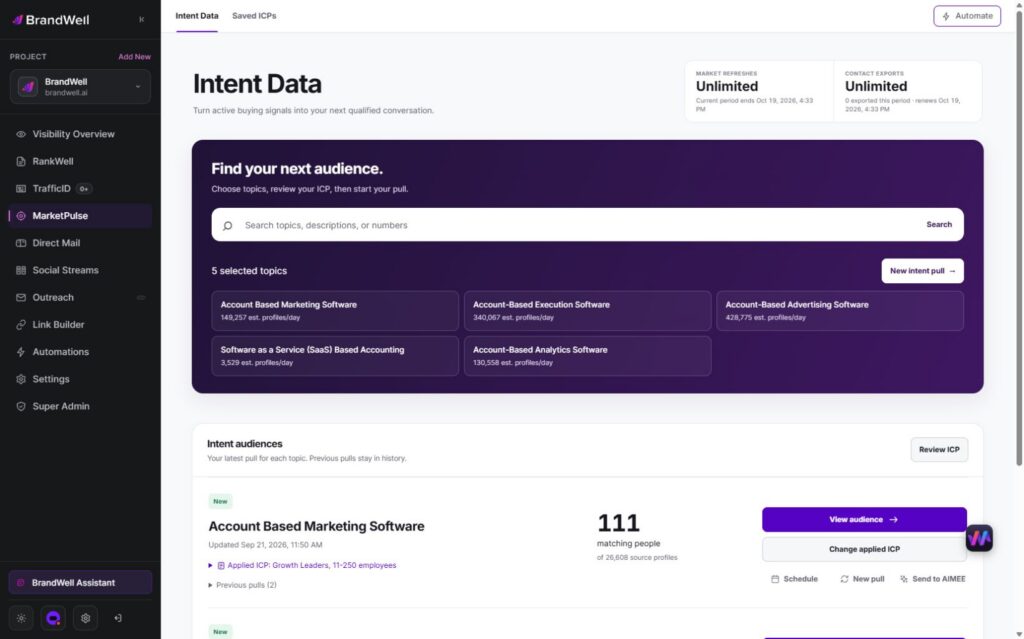
An ad for MarketPulse could explain that plans are starting at $500/mo and invite a business to explore relevant topics. The destination should show the actual plan limits and how available data works.
Avoid rewriting that as “guaranteed buyers for $250.” Topic research signals do not establish purchase readiness, and available contact fields and counts vary. This example demonstrates offer consistency, not a measured winning advertisement.
Prepare a supported campaign in BrandWell
Use keyword research in BrandWell’s Visibility workspace to understand relevant questions. In RankWell, review the supporting content, search preview, media and sources. Check that the page actually supports the proposed ad.
AIMEE can help prepare approved work through configured tools. Provide the facts, audience, destination and constraints. Review the final creative and campaign settings before publication; a generated draft is not substantiation.

Test a hypothesis rather than changing everything
Google’s experiments guide recommends a clear hypothesis, a defined success metric and testing one variable at a time. Changing the headline, targeting and bidding together makes the result harder to interpret.
Record the test period, traffic allocation and other changes. Allow enough observations for a useful comparison. An early fluctuation is not proof of a durable improvement.
Interpret performance in context
Calculate click-through rate as clicks divided by impressions. Calculate cost per qualified inquiry using the actual qualifying inquiries, not all form submissions. Compare outcomes within a consistent attribution window.
Return on ad spend is attributed revenue divided by ad spend. It is not profit: delivery costs, refunds, fees and other expenses matter. Distinguish attributed revenue from incremental revenue caused by the campaign.
If clicks rise but qualified outcomes do not, review the promise, audience and landing-page friction. Improve from the evidence rather than assuming brighter imagery or stronger emotion will solve every problem.
Reviewed and updated October 2, 2026.

Written by
Justin McGill is the founder of BrandWell, growth automation software for inbound and outbound teams. BrandWell brings together MarketPulse intent data, TrafficID website audiences, RankWell content workflows, Visibility research and AIMEE execution through configured tools.
 Farnaz Kia
