On this page
- Understand cost, differentiation, and focus
- 1. Lower delivery cost through repeatable operations
- 2. Differentiate through specialist expertise
- 3. Focus on a specific buyer and use case
- 4. Make the customer handoff more reliable
- 5. Build credibility with useful, evidenced content
- 6. Research relevant demand before choosing an action
- 7. Improve coordination across the workflow
- Turn an advantage claim into a testable statement
- Common questions about competitive advantage
A competitive advantage is a meaningful difference that helps a business deliver value more effectively than the alternatives its customers consider. It can come from lower operating costs, distinctive expertise, a reliable customer experience, or an activity system that is difficult to reproduce. A slogan or a new tool alone does not establish it.
The seven examples below are fictional planning scenarios for service and product businesses. They show what to build, what trade-off to accept, and what evidence to measure. They are not audited results or claims that a particular technology guarantees market leadership.
Understand cost, differentiation, and focus
Harvard Business School’s Institute for Strategy and Competitiveness explains strategic positioning through distinctive customer value and relative cost. Lower cost and differentiation can coexist, but a business still needs coherent choices about how it serves its market.
- Cost advantage: perform the work at a lower economic cost while maintaining the service customers need. Charging less without reducing costs is a discount, not necessarily an advantage.
- Differentiation: provide something the chosen customer values enough to prefer your offer.
- Focus: serve a defined segment particularly well. Specialization still needs demand and viable economics.
Brand, technology, capital, and relationships can support a strategy. They are not automatically separate proof of an advantage, and owning the same software as everyone else does not make an offer unique.
1. Lower delivery cost through repeatable operations
Scenario: an IT services firm standardizes onboarding for businesses with a defined software environment. A clear checklist, reusable configuration, and assigned reviewer reduce avoidable rework.
Trade-off: the firm declines installations outside that scope rather than offering every customer a custom process at the same price.
Evidence: compare labor hours, corrections, completion time, and direct delivery cost. In a fictional example, reducing six labor hours to four at $50 per hour saves $100 of labor per onboarding before other costs. It does not prove a lower total cost than every alternative.
2. Differentiate through specialist expertise
Scenario: a payroll software company provides implementation guidance for a defined type of employer, with reviewed examples of the problems those teams actually encounter.
Trade-off: specialization requires maintaining accurate examples and being clear about requirements the product does not support.
Evidence: track whether qualified customers understand the offer, complete onboarding, and need fewer corrections. Do not describe general payroll content as professional advice or a compliance guarantee.
3. Focus on a specific buyer and use case
Scenario: an agency serves regional home-service companies that need a coordinated content and lead-review process. Its reports use those clients’ language and separate relevant opportunities from raw activity.
Trade-off: the agency turns down unrelated work that would stretch its process and subject expertise.
Evidence: compare accepted inquiries, client retention, delivery workload, and contribution for the selected segment. A narrow market is not automatically underserved or profitable; test it before expanding the team.
4. Make the customer handoff more reliable
Scenario: a service business assigns every reviewed inquiry to an owner with the relevant source, customer question, and next action. Staff can see whether someone already responded.
Trade-off: the team maintains clear ownership and coverage rather than promising instant responses it cannot provide.
Evidence: measure missed inquiries, duplicate replies, time to an appropriate response, and customer feedback. Faster handling is useful only when the answer is accurate and the communication is appropriate.
5. Build credibility with useful, evidenced content
Scenario: a manufacturer publishes reviewed selection and maintenance guides based on its real product documentation. Readers can find limitations, examples, and the right product specification without contacting sales for every question.
Trade-off: subject-matter review and updates require ongoing time. A high publishing volume does not replace that work.
Evidence: examine relevant search queries, article-to-product visits, qualified questions, and corrections. Keep observed outcomes separate from promises of ranking or sales.
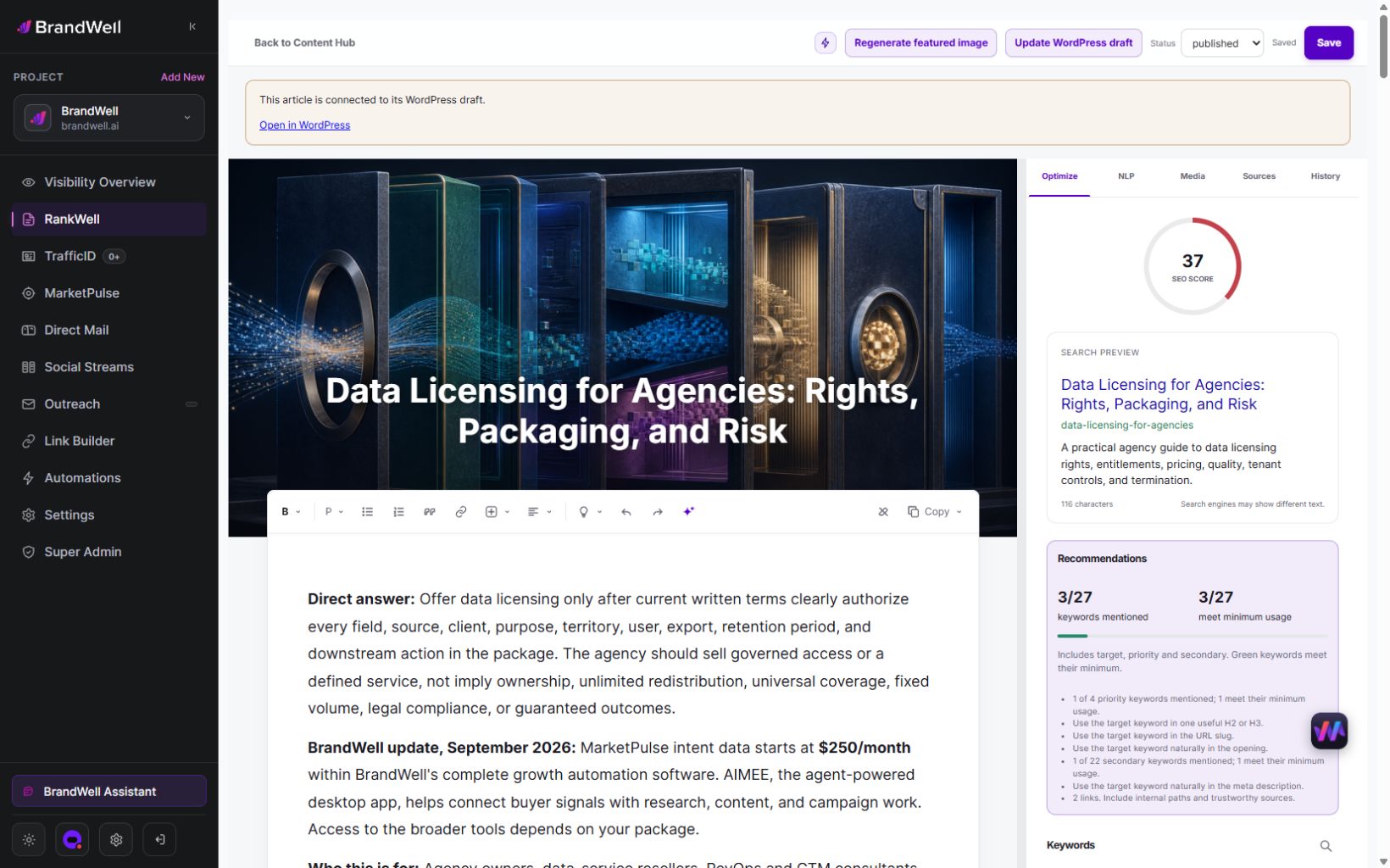
In RankWell, prepare the brief and draft, review sources and product claims, inspect search presentation, and use the publishing route supported by your account. Have the product owner approve instructions and limitations before publication. The tool supports the workflow; it does not verify every statement automatically.
6. Research relevant demand before choosing an action
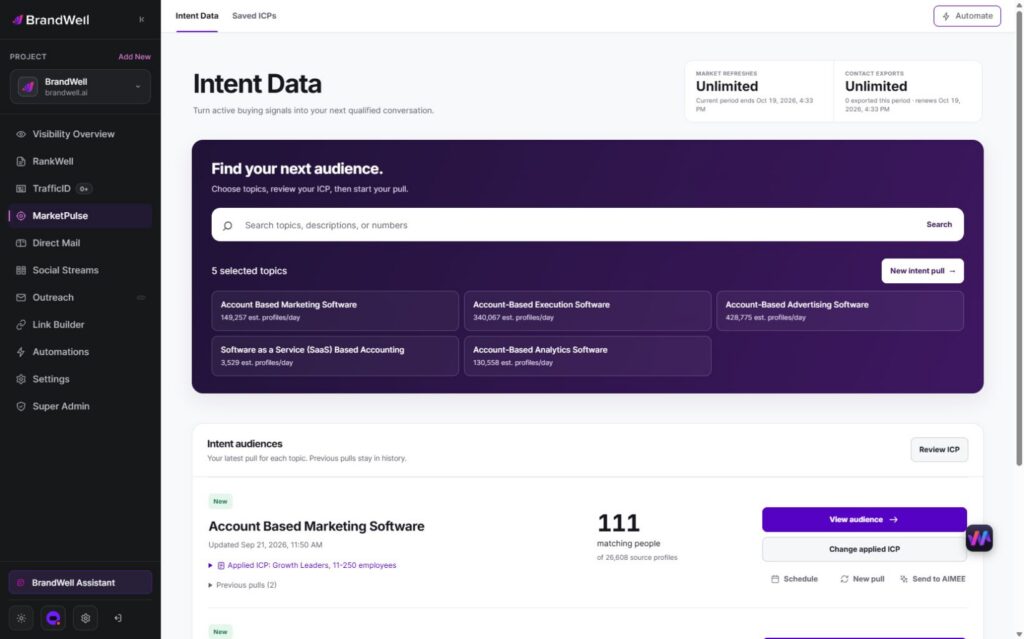
Scenario: a B2B business uses topic research to identify a relevant market, applies its ICP, and gives the account owner a reviewed brief. It keeps research evidence separate from a submitted buying request.
Trade-off: not every available record fits. The team spends time checking source, freshness, role, suppression, and channel eligibility before follow-up.
Evidence: measure accepted records, appropriate actions, replies, qualified opportunities, and confirmed sales separately. The same research tool may be available to others; the advantage, if demonstrated, lies in the team’s useful application of it.
MarketPulse supports topic research and available people and company data, with standard plans starting at $250/month. It does not prove that a topic match intends to purchase or grant permission for every channel. Own-site activity from TrafficID is a different source and should stay labeled separately.
7. Improve coordination across the workflow
Scenario: an agency connects a reviewed audience, content brief, campaign preparation, and client reporting through a defined process. Each stage has an owner, approval point, and recovery path.
Trade-off: it maintains the configuration and refuses unsupported shortcuts. A broken connection or incomplete record pauses the relevant action rather than creating a misleading report.
Evidence: count successful handoffs, rework, unassigned tasks, time spent on coordination, and client outcomes. A workflow that merely moves more records faster may not improve the service.
AIMEE can help research and prepare assigned work through configured tools and approvals. Document which actions can run, which require review, and which capabilities are included in the selected products. Do not infer universal execution from a connected-workflow description.
Turn an advantage claim into a testable statement
Replace “we are better” with a defined customer, activity, benefit, and proof. For example: “For this onboarding scope, our standard process reduced direct labor in the measured sample while maintaining the review checklist.” Explain the sample and exclusions. Do not turn one internal observation into a universal comparison.
- Define the customer and problem.
- Identify the activity that creates value or reduces cost.
- State the trade-off and operating requirements.
- Choose a relevant baseline and consistent measurement period.
- Review costs, outcomes, errors, and customer feedback together.
- Recheck whether the difference persists as the market or process changes.
Separate revenue, gross margin, contribution, and net profit. A cost saving can improve contribution while extra support or overhead offsets it elsewhere. Greater visibility can produce traffic without qualified demand.
Common questions about competitive advantage
Is a low price a competitive advantage?
It can appeal to a customer, but a sustainable cost advantage requires viable delivery economics. Cutting price without controlling cost may weaken the business.
Does using AI create an advantage?
It may support a useful process. The advantage needs evidence from your expertise, configuration, review, delivery, or customer outcomes rather than simply access to a tool.
Can a small company differentiate?
Yes. A defined segment, specific expertise, reliable delivery, and useful evidence can provide a credible basis for preference. Test the demand and cost of maintaining that difference.
How does BrandWell fit?
Review BrandWell’s current products against your actual workflow. Use relevant research, content, and configured execution to support the service you can deliver, then measure whether that process creates a meaningful customer benefit.
Reviewed and updated October 3, 2026.

Written by
Julia McCoy has contributed articles to BrandWell on content marketing, writing, and search engine optimization. This archive retains her original bylines; individual articles may be updated by the BrandWell editorial team.