On this page
- What can you outsource?
- In-house, outsourced or hybrid?
- Potential benefits and the checks they require
- Five outsourcing risks to address before launch
- Seven questions for evaluating a lead generation partner
- How much does lead generation outsourcing cost?
- Use BrandWell to keep research and execution reviewable
- Run a bounded pilot before expanding
- Measure results without mixing stages
- Frequently asked questions
Lead generation outsourcing means assigning defined prospecting, content, campaign or qualification work to an external provider. It can add capacity or specialist skills, but you still need an offer, clear acceptance criteria, appropriate data permissions and someone responsible for following up.
Decide what problem you need solved before buying a list or meeting quota. Outsourcing does not automatically produce better leads, lower costs or faster revenue. Compare the actual work, risks and economics with an internal or mixed delivery model.
What can you outsource?
| Work | Possible deliverable | Keep under your review |
|---|---|---|
| Audience research | Documented account and stakeholder research. | Source, fit, freshness and permitted use. |
| Content and search | Approved briefs, articles and page improvements. | Product facts, evidence and publishing approval. |
| Campaign preparation | Reviewed segments, copy and proposed sequences. | Eligibility, channel permissions and stop rules. |
| Appointment setting | Conversations or meetings meeting agreed criteria. | Attendance, fit, expectations and next-step ownership. |
| Lead qualification | Reviewed inquiries with documented acceptance reasons. | Definition, exclusions and opportunity handoff. |
Swipe the table to see all columns.
A contact record, scheduled meeting, attended meeting, accepted lead and opportunity are different deliverables. Specify which one you are buying. Data enrichment can fill available fields; it does not establish buying readiness or consent for every channel.
In-house, outsourced or hybrid?
Keep work in-house when context and control dominate
Internal delivery can suit a complex offer, sensitive relationships or a process still being defined. Your team may have the best product knowledge and fastest access to subject experts. Include hiring, management, tools and nonproductive time in the cost comparison.
Do not outsource a process solely because nobody internally knows what success looks like. An external specialist can help design a process, but that is a separate discovery deliverable from promising a certain number of sales-ready leads.
Outsource a bounded capacity or expertise gap
External support can make sense when you have a clear offer and need research, writing, campaign operations or qualification capacity. Ask for evidence of relevant work and inspect a sample before committing to volume.
Allow time for product training, access, data review, approvals and handoffs. Existing tools and staff do not eliminate onboarding. Agree what can scale and which constraints, such as reviewer capacity or audience size, remain.
Use a hybrid model when ownership must stay close
Your team can own positioning, eligibility and sales conversations while a provider prepares research and content. Define the boundary between preparation, approval and execution. One named owner should resolve ambiguous records and failed handoffs.
The UK government’s Sourcing Playbook supports comparing delivery models and testing uncertain services. It is public-sector guidance, not a private-business requirement; the useful planning principle is to test your assumptions before committing to a delivery model.
Potential benefits and the checks they require
- Capacity: confirm available staff, training time and maximum throughput.
- Specialist knowledge: inspect relevant examples and ask who will actually do the work.
- Operational consistency: review the checklist, approval process and exception handling.
- Flexible scope: agree change requests, minimum commitments and notice periods.
- More internal focus: account for the management and review work you still need to provide.
Treat these as possibilities to validate, not guaranteed outcomes. A provider’s case study can illustrate its work without predicting your conversion rate.
Five outsourcing risks to address before launch
1. Loss of messaging control
Approve the offer, claims, examples and follow-up before activation. Give the provider a current product brief and an escalation path for questions. Avoid unsupported claims made in your name.
2. Mismatched lead definitions
Write eligibility, exclusions, required evidence and duplicate rules. Define how you reject a record or meeting, how quickly disputes are reviewed and whether replacements or credits apply.
3. Communication and handoff failures
Agree working hours, owners and response expectations. Check that the destination acknowledges a handoff. A file being sent is not proof that sales received and accepted it.
4. Data and access problems
Review sources, permitted uses, suppression, access controls, retention and deletion arrangements for your actual audience and channels. Use qualified advice for applicable legal obligations. A provider’s generic compliance statement does not establish that your campaign is eligible.
5. Dependency and exit difficulty
Agree ownership of work and accounts, usable exports, transition support and access removal. Preserve the information needed to continue eligible activity without depending on one person’s inbox or an inaccessible tool.
Seven questions for evaluating a lead generation partner
- What exactly will you deliver? Ask for a sample showing sources, acceptance evidence and exclusions.
- Who will do the work? Confirm roles, relevant experience, review capacity and subcontractor arrangements.
- How are prospects selected? Inspect audience criteria, freshness, deduplication and channel eligibility.
- What claims and messages will be used? Require approval for material changes and a record of what was sent.
- How are outcomes verified? Separate delivered records, attended meetings, accepted opportunities and purchases.
- What does the full price include? Clarify setup, data, media, software, revisions, management and performance charges.
- How do we stop or transition? Confirm notice, exports, open work, permissions and deletion responsibilities.
Review references and cases for comparable audience, offer and sales cycle. Ask about starting conditions, dates, costs, exclusions and the provider’s actual contribution. A large percentage with no denominator is not enough to compare suppliers.
How much does lead generation outsourcing cost?
There is no universal price for a qualified lead or outsourced team. Scope, audience, channels, research depth, geography, review requirements and commercial terms change the cost. Request comparable quotes for the same deliverable instead of relying on broad industry price bands.
| Model | What to clarify |
|---|---|
| Fixed project | Deliverables, acceptance, revisions and change requests. |
| Monthly retainer | Included capacity, priorities, unused capacity and termination. |
| Per accepted lead or meeting | Definition, duplicates, no-shows, disputes and replacement terms. |
| Performance or revenue share | Attribution, eligible revenue, refunds, timing, auditability and applicable restrictions. |
| Hybrid | How setup, recurring and performance fees combine without double counting. |
Swipe the table to see all columns.
Fictional quote example: an $8,000 retainer plus $150 for each of 40 accepted leads totals $14,000. If internal review and follow-up cost another $2,000, the total is $16,000, or $400 per accepted lead. This is an illustration, not a market rate. Rejected records and duplicate deliveries should not silently inflate the accepted-lead denominator.
Compare software and service costs separately. MarketPulse intent data plans are starting at $500/mo; this does not include an external provider’s labor or guarantee accepted leads. Confirm package allowances and the complete service quote.
Use BrandWell to keep research and execution reviewable
BrandWell can support work shared between your team and a provider. Confirm access, package and configured connections; do not assume a custom client portal, exclusive dataset or automatic CRM process is included.
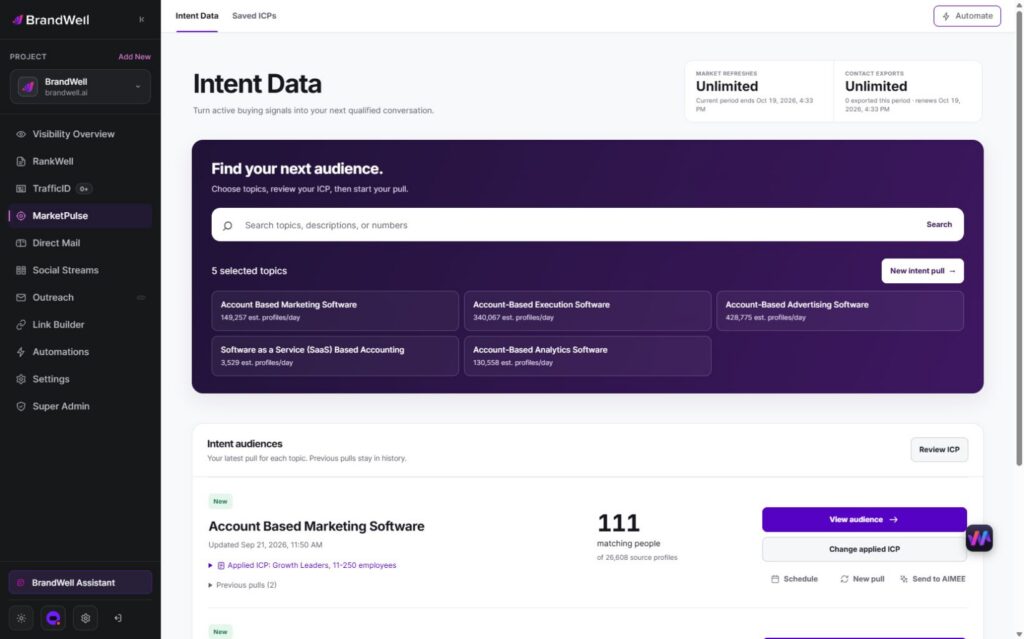
- MarketPulse: research available topics, apply ICP filters and review records before using them.
- TrafficID: review identifiable activity on your own website, keeping form submissions and added stakeholders distinct.
- RankWell: organize opportunities, briefs, sources, drafts and approved content.
- AIMEE and configured workflows: assist with research and approved next steps while keeping an owner responsible for eligibility and destination checks.
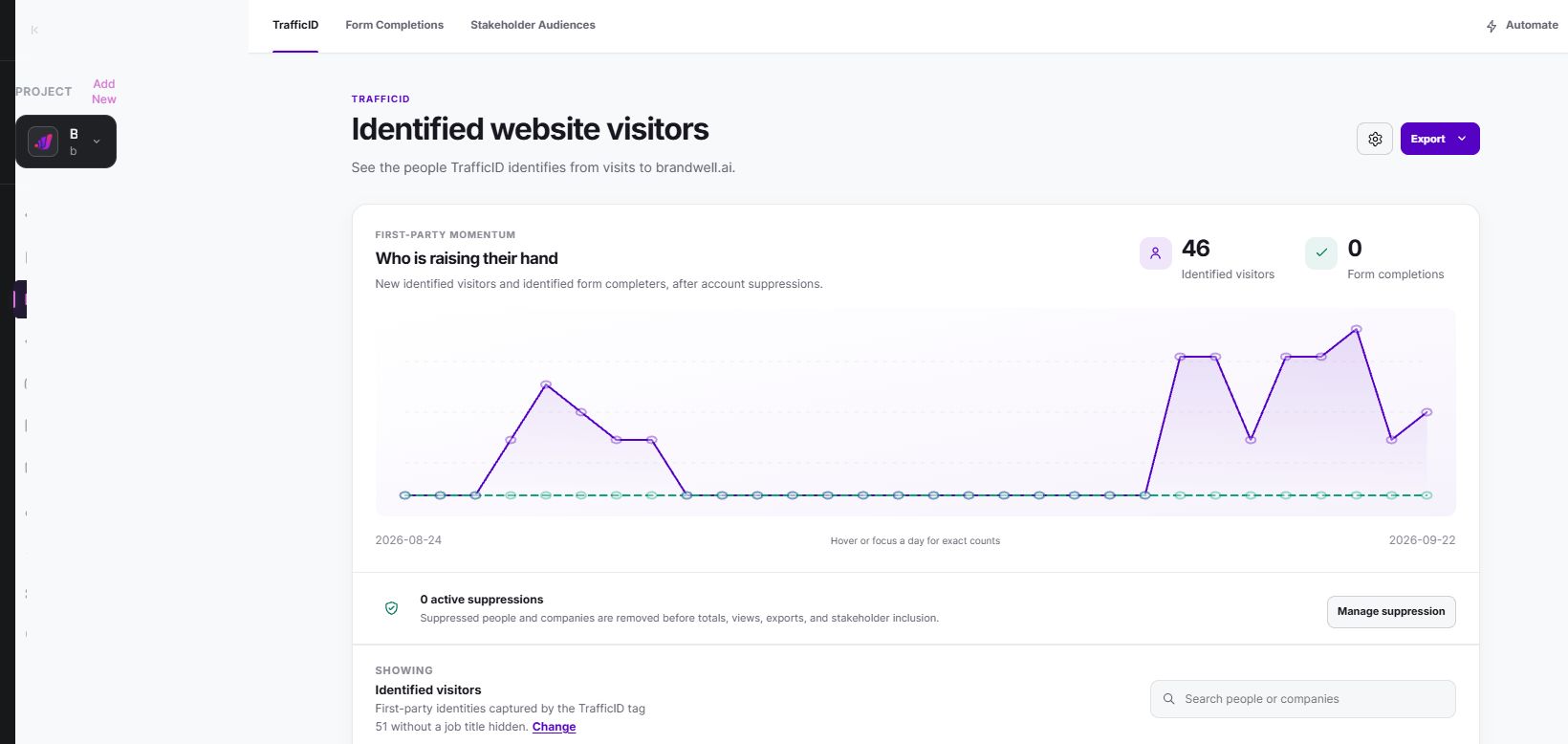
A reviewed TrafficID handoff
- Select the intended project and check the website tag and exclusions.
- Review identifiable visitors and available page context. Coverage varies.
- Keep form completions separate from observed activity and additional stakeholders.
- Apply fit, suppression and channel-eligibility checks.
- Approve the relevant export or configured follow-up with a named owner.
- Confirm destination receipt and record actual replies and outcomes.
An enriched mobile number is not evidence of SMS opt-in. Likewise, a topic match does not establish that every employee at an account researched the topic. Preserve source and permission distinctions throughout the handoff.
Run a bounded pilot before expanding
- Write the question. For example: can this provider consistently deliver records our team accepts for this offer?
- Define scope. Set the audience, channel, sample, budget, dates and required evidence.
- Review a sample. Resolve incorrect fit, stale data, duplicate records and unsupported messaging before activation.
- Test the handoff. Include a failed delivery, opt-out, duplicate and stop request in the operational checks.
- Collect outcomes. Record acceptance reasons, attendance, responses, opportunities and unknown statuses.
- Decide. Expand, revise or stop based on the agreed criteria, actual costs and unresolved risks.
A small pilot can test feasibility and process quality. It may not establish a reliable purchase conversion rate, especially with a long sales cycle or few outcomes. Do not call a short pilot a causal ROI study.
Measure results without mixing stages
- Acceptance rate: accepted unique leads divided by unique leads reviewed.
- Cost per accepted lead: defined full campaign cost divided by accepted unique leads.
- Meeting attendance: attended meetings divided by scheduled meetings for the same cohort.
- Opportunity rate: accepted opportunities divided by the stated eligible lead cohort.
- Time to next stage: elapsed time between defined stages, including unresolved cases separately.
- Qualified-lead growth: change in comparable monthly qualified-lead counts, not the time a lead takes to close.
- Economic outcome: realized contribution after fulfillment costs compared with the defined acquisition investment.
Fictional outcome example: 100 unique records are reviewed, 60 accepted, 20 meetings scheduled, 15 attended and three customers acquired. Acceptance is 60%; attendance is 75% of scheduled meetings; purchase conversion is 5% of accepted leads. Each rate answers a different question.
If the defined acquisition investment is $6,000 and those purchases produce $9,000 in contribution after fulfillment costs, the contribution-based return is ($9,000 – $6,000) / $6,000 = 50%. Using gross revenue instead would answer a different question. State the cost boundary, timing and assumptions; do not count forecast lifetime value as cash already received.
A before/after increase can reflect other campaigns, sales changes or seasonality. Keep attribution rules consistent, deduplicate customers and record missing information. A low cost per record can still produce poor economics if few records are accepted or purchased.
Frequently asked questions
Should a small business outsource lead generation?
Consider a bounded task when your offer and acceptance criteria are clear but capacity or expertise is missing. Include internal management and follow-up in the comparison.
Is pay-per-lead safer than a retainer?
Neither is automatically safer. Define the deliverable, acceptance, disputes and total fees. Incentives can encourage volume unless quality and eligibility are explicit.
Can a provider guarantee sales?
A provider can commit to agreed work and contractual remedies. It cannot control every factor in a customer’s purchase decision. Examine any guarantee’s definitions, exclusions and evidence.
Does software replace an outsourced team?
Software can support research, content and configured execution, but someone must own decisions, review and follow-up. Compare the actual workflow rather than assuming either model is complete.
Where should we start?
Define one audience, one offer and one accepted deliverable. Test a sample and the handoff, then evaluate actual outcomes. Request a BrandWell demand scan and demo to assess the available research workflow.
Reviewed and updated October 6, 2026.

Written by