
On this page
- BrandWell: MarketPulse intent data and connected growth automation
- Shortlist six intent-service add-ons by the job they perform
- How should an agency approach intent service upsells to protect growth and gross margin?
- What inputs, rules, approval limits, and review cadence are required for intent service upsells?
- Which calculators, templates, benchmarks, or systems are most useful for intent service upsells?
- How do the main options for intent service upsells compare across risk, simplicity, and margin?
- What pricing assumptions and cost drivers should an agency use for intent service upsells?
- Which metrics show whether intent service upsells are improving revenue quality and profitability?
- Which client profiles, contract types, or delivery models are the best fit for intent service upsells?
- Which signal sources, identity checks, activation workflows, and outcome evidence matter most for intent service upsells?
- What margin, scope, billing, data-use, and client-trust risks affect intent service upsells?
- How should intent service upsells change when the agency sells a recurring buyer-intent service?
- Screen an add-on with Claude, ChatGPT, or AIMEE
- Expand one proven constraint at a time
- Put buyer intent to work with MarketPulse
Direct answer: Offer an intent-service upsell only when the current service exposes a repeated, valuable gap that the client wants solved and the agency can deliver with defined rights, owners, evidence, and margin. Package one module around one next decision. Do not use unused data, a crowded dashboard, or a sales quota as the reason to expand.
Current MarketPulse offer: intent-data plans start at $250/month. See the product, demo, and current plans. Updated October 1, 2026.
A responsible upsell improves the client’s operating system. It does not guarantee a commitment, cost recovery, profit, pipeline, revenue, sales, data volume, a search ranking, or an AI citation.
Who this is for: Agency owners, GTM and RevOps consultants, and demand generation leaders expanding a recurring buyer-intent service without uncontrolled scope.
BrandWell: MarketPulse intent data and connected growth automation
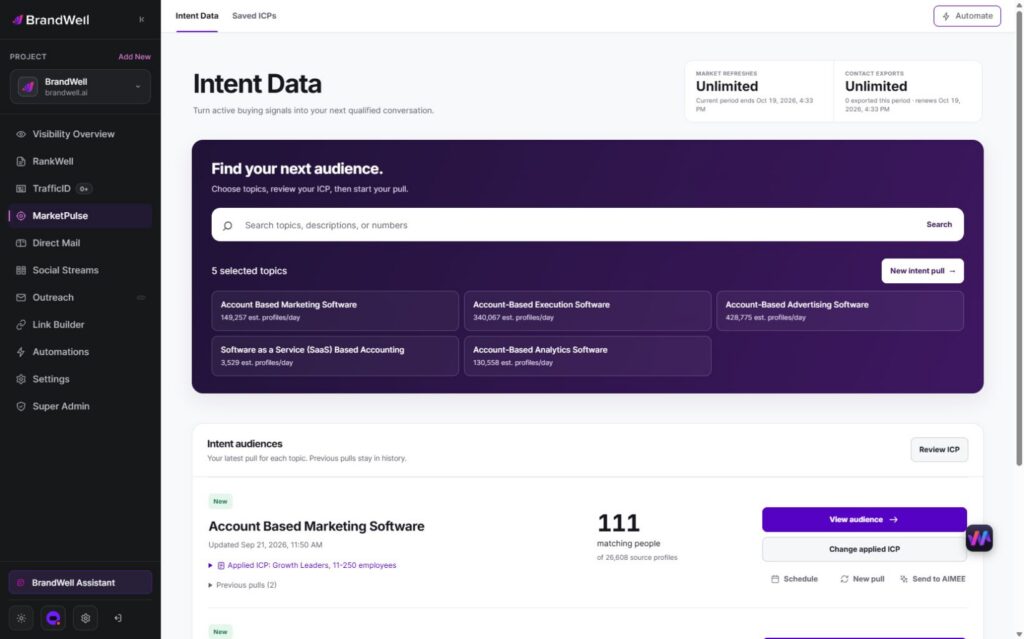
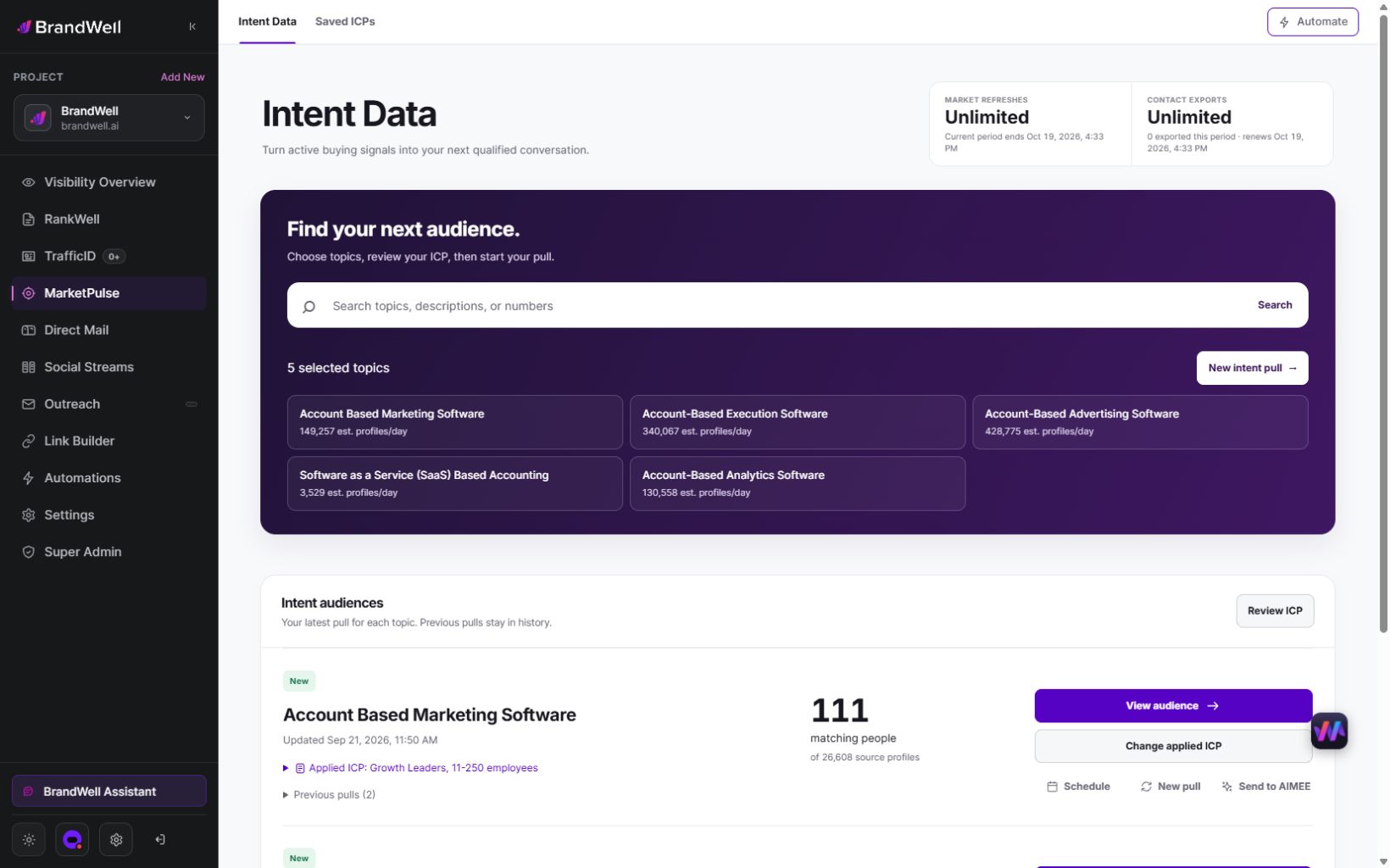
BrandWell MarketPulse: intent data from $250/month. Find people researching topics relevant to what you sell, apply saved ICP filters, and review available contact details before taking action.
| Plan | Price | Topics and refreshes | Monthly exports |
|---|---|---|---|
| Starter | $250/month | 1 topic, weekly | 25,000 contacts |
| Growth | $500/month | 3 topics, daily | 100,000 contacts |
| Scale | $1,000/month | 10 topics, daily | Unlimited contacts |
Swipe the table to see all columns.
A pull retrieves available data from the previous 24 hours for one topic. Daily use across all included topics provides 90 Growth pulls or 300 Scale pulls in a 30-day month. Weekly Starter pulls vary by calendar month. Available audience size and contact fields vary, and audiences may overlap. Refreshes stop at the plan limit without overage charges.
- Find and qualify: search the topic catalog, save your ICP, and review the people and companies that match.
- Act on the research: export qualified contacts or prepare an Outreach or Direct Mail workflow. Connected products, channel usage, and fulfillment may cost extra.
- Get help from AIMEE: Growth and Scale include AIMEE for the initial user to research accounts and prepare the next step through connected tools.
Agencies and other service businesses can build client deliverables around their available topic pulls and exports. Keep each client’s scope, permissions, and service fees clear. A subscription is not a promise of a white-label platform or exclusive access to a market.
Explore MarketPulse and watch the demo or compare plans starting at $250/month. Any early-access discount is a separate, time-limited offer shown to an eligible recipient.
Shortlist six intent-service add-ons by the job they perform
The best add-on is not the one with the most features. It is the smallest new module that removes the constraint visible in the current workflow.
| Add-on | Use it when | Do not sell it when |
|---|---|---|
| Topic expansion and governance | The client has proven a narrow topic set and needs a controlled adjacent market | The current taxonomy is noisy or nobody reviews it |
| Contact enrichment and validation | Accepted company signals need usable, permitted contacts and verification | The client has no qualification or outreach process |
| Website visitor identification | On-site behavior is strategically useful and privacy, traffic, and activation checks pass | The buyer expects every visitor to be identified or lacks a lawful operating plan |
| Intent-led outbound | Sales owners can act quickly with approved messaging and suppression rules | Deliverability, ownership, or follow-up capacity is unresolved |
| Audience and paid-media activation | The client has budget, creative, destinations, and an agreed audience decision process | The client expects the signal feed to replace media strategy |
| Reporting and RevOps operations | Work is happening but decisions, routing, and outcome evidence are fragmented | The client wants cosmetic dashboards without fixing source records |
Swipe the table to see all columns.
The order matters. Topic quality and operating adoption usually need to work before more destinations add value. A module that increases volume while the client is ignoring accepted signals can deepen the problem the agency should solve first.
Run the expansion conversation as a working session, not a reveal. Show the client the observed constraint, ask whether it still matters, and confirm who would own the additional action. Then walk through the smallest module, what would stay unchanged, what new work each party would accept, and what evidence would support a continue-or-stop decision. Send the written card after the meeting and allow the client to correct assumptions before pricing. This extra step is useful because an enthusiastic stakeholder may describe a need that another team cannot staff, fund, or approve. A documented correction before signature costs less than a custom workflow discovered after handoff.
How should an agency approach intent service upsells to protect growth and gross margin?
Use an expansion gate with five tests: need, evidence, capacity, rights, and economics. Need means the client has a recurring constraint, not a passing request. Evidence means the current workflow shows where the constraint appears. Capacity means both parties have named owners and time. Rights means the source, purpose, destination, contract, and jurisdiction have been reviewed. Economics means the incremental fee covers the module, usage, labor, support, risk, and sales cost.
Require all five tests to pass. A strong need without client capacity becomes shelfware. Good economics without rights create unacceptable exposure. Clear rights without evidence produce a feature pitch. The gate protects growth by keeping expansion tied to client value, while protecting margin by stopping unpaid experimentation from entering delivery.
Separate discovery from commitment. The account team may explore an add-on, but only an approved scope should reach delivery. Record who can approve custom fields, topics, destinations, reporting, credits, and changes to client-facing claims.
What inputs, rules, approval limits, and review cadence are required for intent service upsells?
Before proposing an add-on, document the current workflow, observed gap, client decision, expected users, data inputs, identity state, destination, permitted action, owner, service level, acceptance test, price, cost range, dependencies, exclusions, and stop condition. Tie the new module to the existing scope through a written change order or new order document.
Approval limits should reflect risk. The account lead may recommend a standard module. Operations should confirm capacity and workflow. Finance should approve discount and contribution. A privacy or security reviewer should evaluate new data sources, purposes, exports, destinations, and retention. Executive or counsel review belongs on exceptional outcome language, uncapped remedies, sensitive use cases, or contract-right questions.
- Observe the repeated gap in at least one normal review cycle.
- Confirm that fixing it matters to a named client decision.
- Run the five-test expansion gate with actual evidence.
- Prototype the handoff using a bounded sample or paid scope.
- Price and approve the module before production work.
- Review adoption and stop, redesign, or expand based on the agreed test.
Which calculators, templates, benchmarks, or systems are most useful for intent service upsells?
Use a module catalog, expansion scorecard, change-order template, capacity planner, unit-economics model, acceptance checklist, rights review, and outcome ledger. A CRM opportunity can track the commercial motion, but it should link to the operating evidence. Otherwise sales records enthusiasm while delivery discovers the missing dependencies later.
Copyable add-on qualification card
- Repeated client need: What decision is blocked, and where is that visible?
- Current evidence: Which records show the gap without overstating causation?
- Required capacity: Who acts, how often, and in which system?
- Data and contract rights: Which source, purpose, region, destination, and retention rule apply?
- Incremental economics: What are wholesale, usage, labor, support, and change costs?
- Acceptance and stop test: What proves usable delivery, and when will the parties stop?
Benchmarks should inform questions, not determine the sale. Use the agency’s own delivery history where definitions are consistent. Label small samples and avoid presenting a best-case client as a typical result.
How do the main options for intent service upsells compare across risk, simplicity, and margin?
A bundled tier is simple to sell and administer, but clients may pay for modules they do not use and the agency may hide cross-subsidies. Modular add-ons make value and cost clearer, but require entitlements, change control, and separate adoption reporting. Usage-based expansion aligns fees to an observable unit, but creates forecasting volatility and can reward quantity over quality. A custom project handles unusual needs, but carries the highest estimation, handoff, and support risk.
For most agencies, a defined base service plus a short catalog of modular add-ons creates the clearest operating model. Each module should have a target job, prerequisite, included unit, service level, evidence, exclusions, client responsibility, and change rule. Keep custom work outside the recurring package until it proves repeatable.
Agencies considering outbound as an add-on can use the intent-led outbound service guide to evaluate ownership, activation, and delivery requirements before quoting.
What pricing assumptions and cost drivers should an agency use for intent service upsells?
Price the incremental system, not just the vendor line item. Count module and usage charges, setup, analysis, client training, workflow design, integration, reporting, quality control, support, account management, rework, security review, and the sales effort required to explain the add-on. Include a capacity constraint: a profitable-looking module can still harm the agency if scarce specialists become the bottleneck.
Choose a value metric the client can predict and the agency can audit, such as contracted topic set, destination, account band, report package, activation module, or service tier. Avoid a unit that creates an incentive to deliver more low-quality records. Use caps, overage rules, and change control where usage varies.
Which metrics show whether intent service upsells are improving revenue quality and profitability?
Track the expansion funnel from qualified need to paid, adopted module. Useful measures include eligible-account rate, proposal acceptance, time to activate, named-user adoption, accepted output, destination acceptance, exception rate, support time, module contribution, payment status, retention, and whether the original gap changed. An expansion that increases contracted revenue but produces no adoption and heavy support is not healthy growth.
Downstream meetings, opportunities, pipeline, and revenue belong in the evidence view with clear attribution labels. They do not become guaranteed because the client bought another module. Compare the add-on against the agreed baseline and note other changes such as budget, messaging, market, staffing, or sales follow-up.
Also track contraction signals. Repeated skipped reviews, unused destinations, stale topics, delayed client approvals, and growing exception work should trigger a redesign before another upsell is offered.
Which client profiles, contract types, or delivery models are the best fit for intent service upsells?
The best-fit client already uses the base service, resolves dependencies, gives specific feedback, and has a named owner for the proposed next action. Its market and purpose are clear enough to define the module. It accepts a written scope and can provide the destination access or internal coordination required for activation.
Do not upsell a client that treats every signal as buying certainty, cannot staff follow-up, refuses an updated rights review, has unresolved payment or scope disputes, or wants the agency to guarantee revenue while controlling the decisive variables. A client may still be a good fit for a smaller operating repair, training session, or topic reset.
Contract fit improves when modules can be added or removed cleanly. An agreement should identify the current module, effective scope, fees, dependencies, acceptance, service level, and handling of existing data when the module ends.
Which signal sources, identity checks, activation workflows, and outcome evidence matter most for intent service upsells?
Every add-on should extend a documented signal chain. Topic expansion changes the monitored research set. Enrichment changes the identity and contact fields. Visitor identification adds an on-site source and new privacy questions. Outbound and paid media add destinations, messages, suppression logic, approvals, and platform policies. Reporting and RevOps add systems of record and transformation rules.
Label account-level, person-level, inferred, validated, and unresolved states. Define duplicate handling, exclusions, verification, failure routing, and retention. An add-on should not erase uncertainty. It should make the next action and its evidence clearer.
For outbound specifically, connect accepted signals to a researched message, a permitted channel, a human approval, and a logged response. The guide to cross-selling intent data and outbound explains how to keep prioritization separate from automatic outreach.
What margin, scope, billing, data-use, and client-trust risks affect intent service upsells?
Scope creep is the obvious risk, but silent operational coupling is often worse. A “simple” destination may require field mapping, permissions, retries, exception handling, reporting, training, and support. A new identity source may change data handling, access, retention, and client communication. Price the dependencies and document what is not included.
Billing needs a defined start point, included unit, overage rule, change process, suspension logic, and end-of-module handling. Avoid retroactive charges or vague markups. Make client-facing performance claims match the evidence. The FTC’s advertising guidance is a useful reminder that both express and implied claims need support.
For data governance, minimize unnecessary collection, control access, oversee service providers, and protect data through its lifecycle. Those themes appear in the FTC’s Start with Security guide. Use qualified reviewers for privacy, security, contract, and jurisdiction-specific conclusions.
How should intent service upsells change when the agency sells a recurring buyer-intent service?
Treat expansion as an entitlement change in a maintained service, not a one-time feature sale. Update the module record, topics, users, destinations, service level, report, client responsibilities, unit economics, and stop rule. The monthly review should show the add-on’s delivery and adoption separately from the base service.
AIMEE is the agent-powered desktop app in BrandWell’s growth workflow. Assign work through the tools connected to your workspace and choose which actions can run automatically or require approval. Desktop availability, account permissions, and the configured workflow determine what can execute.
Start with MarketPulse intent data from $250/month. Review a topic and its matching audience, then use BrandWell’s connected growth tools and AIMEE desktop assistance to prepare the next action. Agency packaging and services can be scoped around the client workflow.
When paid-media activation is the next module, review the full delivery system in the managed intent-based paid media guide before promising an audience or campaign outcome.
Screen an add-on with Claude, ChatGPT, or AIMEE
Use approved operational data and remove unnecessary personal information. The agent can organize the decision, but human owners must approve the offer, price, data use, client message, and production action.
Evaluate this proposed intent-service add-on using the five expansion gates.
Inputs:
- current contracted service and client decision
- repeated gap and supporting records
- proposed module, data source, identity state, and destination
- agency and client owners
- rights, purpose, retention, and approval notes
- wholesale, usage, labor, support, and sales costs
- acceptance test, review cadence, and stop condition
Return:
1. need, evidence, capacity, rights, and economics status
2. missing facts and conflicting assumptions
3. standard module, custom project, redesign, defer, or reject recommendation
4. minimum viable scope and explicit exclusions
5. a unit-economics worksheet using only supplied numbers
6. human approvals required before proposal and activation
Do not invent benchmarks, legal conclusions, client intent, performance, or revenue.
Expand one proven constraint at a time
Choose one client with reliable base-service adoption. Complete the qualification card, model the full incremental cost, and define the acceptance and stop tests. If any gate fails, fix the base operation before selling more.
Evaluate MarketPulse with a representative topic and a defined ICP. Review the matching audience, prepare one useful action with BrandWell’s connected tools and AIMEE, and measure the operating effort. MarketPulse plans start at $250/month; agree on the package, evaluation period, and success criteria before expanding.

Written by