On this page
- Current MarketPulse workflow
- Define one prioritization decision
- Assign owners and handoff requirements
- Choose tools that preserve the rules
- Build, resell, refer or narrow the project
- Price setup and ongoing maintenance
- Verify operation before attributing outcomes
- Check data and client readiness
- Keep feature families and identity separate
- Monitor data, workflow and expectation risks
- Maintain and version the scoring service
- A priority score is not a purchase probability
- Worked example: make the rule reproducible
- Frequently asked questions
Direct answer: An agency signal scoring setup should turn separate observations into a reviewable priority, not label a person as a certain buyer. Keep every source and identity state visible. Document weights, thresholds, missing data, suppressions, overrides, feedback, drift, and version ownership. The score should help a named team decide what to review or do next, while a human remains accountable for consequential action.
Current MarketPulse offer: intent-data plans start at $500/mo. See the product, demo, and current plans. Updated October 3, 2026.
Who this is for: Agencies delivering recurring GTM and data services for clients that have multiple signals, inconsistent routing, and a real owner for sales or marketing follow-up.
The practical goal is not a clever formula. It is consistent prioritization with an audit trail. A useful setup lets an operator reconstruct why an account received a score, what evidence was missing, which rule applied, and who approved the current model. It also makes abstention possible when data is insufficient.
Before discovery, ask the client to bring the current routing rules, a source inventory, recent examples of good and bad prioritization, field definitions, suppression policies, and a list of people who can approve changes. These artifacts expose whether scoring is truly the next constraint. Sometimes the better first project is identity cleanup, topic redesign, or follow-up ownership. A readiness finding is valuable because it prevents the agency from automating confusion.
Current MarketPulse workflow
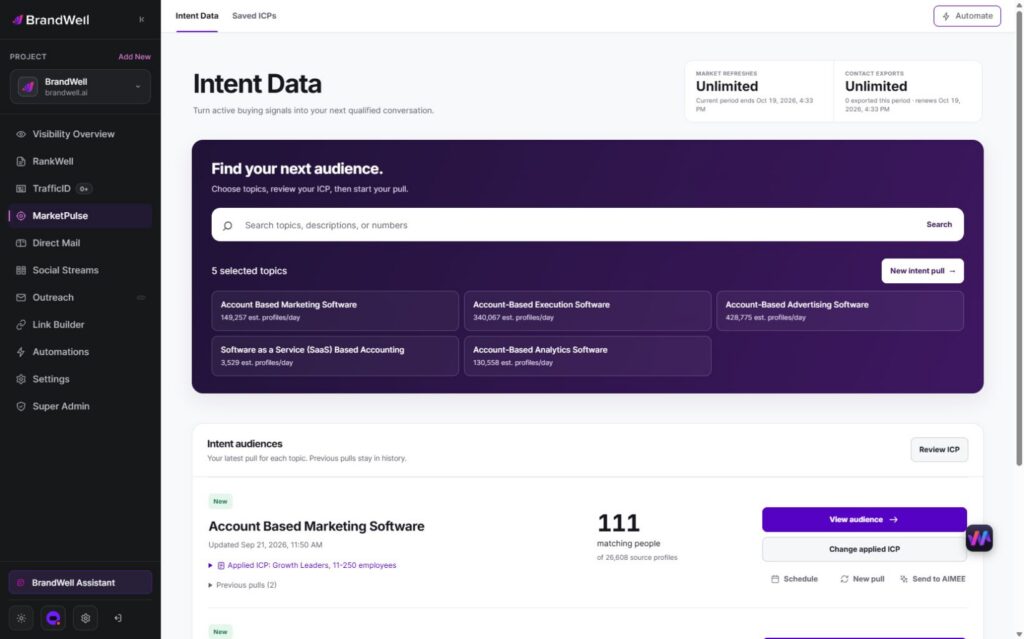
BrandWell MarketPulse: intent data starting at $500/mo. Find people researching topics relevant to what you sell, apply saved ICP filters, and review available contact details before taking action.
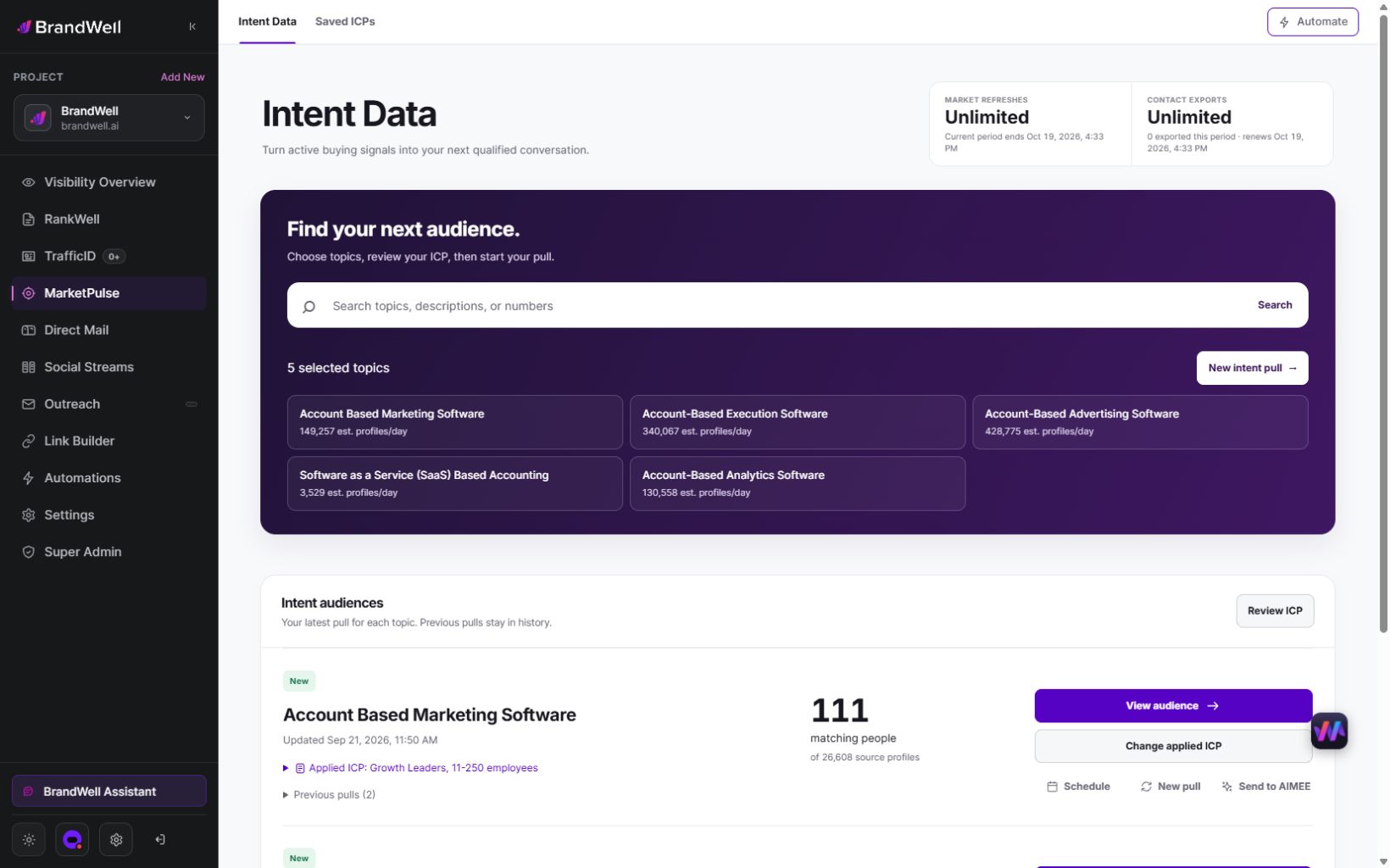
MarketPulse plans are starting at $500/mo. Verify current package scope and offers on the product page.
| Plan | Topics and refreshes | Monthly exports |
|---|---|---|
| Starter | 1 topic, weekly | 25,000 contacts |
| Growth | 3 topics, daily | 100,000 contacts |
| Scale | 10 topics, daily | Unlimited contacts |
Swipe the table to see all columns.
A pull retrieves available data from the previous 24 hours for one topic. Daily use across all included topics provides 90 Growth pulls or 300 Scale pulls in a 30-day month. Weekly Starter pulls vary by calendar month. Available audience size and contact fields vary, and audiences may overlap. Refreshes stop at the plan limit without overage charges.
- Find and qualify: search the topic catalog, save your ICP, and review the people and companies that match.
- Act on the research: export qualified contacts or prepare an Outreach or Direct Mail workflow. Connected products, channel usage, and fulfillment may cost extra.
- Get help from AIMEE: Growth and Scale include AIMEE for the initial user to research accounts and prepare the next step through connected tools.
Agencies and other service businesses can build client deliverables around their available Intent Scans and exports. Keep each client’s scope, permissions, and service fees clear. A subscription is not a promise of a white-label platform or exclusive access to a market.
Explore MarketPulse and watch the demo or compare plans starting at $500/mo. Any early-access discount is a separate, time-limited offer shown to an eligible recipient.
Define one prioritization decision
Offer it when the client has more observable activity than its team can evaluate consistently. Promise an operating outcome: a documented, testable prioritization workflow that helps the client review accounts in a repeatable order. Do not promise that the score identifies buyers, reveals intent with certainty, proves authority, or causes pipeline. A high score is a routing aid based on defined inputs.
Begin with one decision. Examples include which accounts enter a research queue, which records receive human validation, or which existing accounts receive a service review. Avoid a universal score that tries to serve marketing, sales, customer success, and executive reporting simultaneously. Different decisions often require different inputs, time windows, and consequences.
The agency signal scoring setup strategy should also state when no score will be issued. Missing identifiers, stale activity, conflicting entity matches, suppression status, or insufficient observations can all justify an abstain state. That makes the service more trustworthy than forcing every record into a numeric rank.
Assign owners and handoff requirements
Assign a model owner, data steward, client process owner, activation owner, and approver. One person may fill multiple roles in a small engagement, but the responsibilities should remain distinct. The model owner controls definitions and versions. The data steward checks source and identity quality. The client process owner confirms the decision. The activation owner operates the next step. The approver accepts risk and release.
The workflow starts with decision definition and source inventory. It then covers entity resolution, feature design, missing-data rules, weights, time decay, thresholds, suppression, overrides, testing, launch, monitoring, and revision. The SLA should describe input freshness, review cadence, exception response, correction handling, and escalation. It should not imply that the agency controls client follow-up or downstream outcomes.
Handoff requires more than a score field. Deliver a data dictionary, source map, formula or rule record, version log, test cases, queue definitions, operating instructions, approval history, correction procedure, and owner matrix. Include a rollback path. The client should be able to pause activation without losing the evidence needed to diagnose the issue.
Define service levels around work the agency controls. Examples include the time to acknowledge an exception, review a correction request, publish an approved version, or notify the client of a source change. Do not promise the time to a meeting or opportunity. The client owns its review capacity and downstream response unless the agreement specifically assigns that work to the agency. Record dependencies beside each service level so a missed client approval is not mistaken for an agency delivery failure.
Choose tools that preserve the rules
The best stack is the one that preserves provenance, supports explicit rules, exposes identity state, logs changes, and routes only approved outputs. Capability categories matter more than a generic company ranking. Evaluate signal collection, identity and enrichment, transformation, scoring, workflow orchestration, CRM delivery, reporting, access control, audit history, and monitoring.
A spreadsheet is useful for an early model because assumptions remain visible. A database or transformation layer is helpful when sources and versions multiply. A CRM can hold the operational score, but it should not become the only record of how the score was produced. White-label delivery matters when the agency needs branded reports, client partitions, permissions, and repeatable account configuration.
MarketPulse supplies topic audiences and saved ICP filtering. AIMEE can help organize supplied evidence through configured tools. An agency-specific score, client portal, CRM transformation and routing rule require a separately supported implementation and written scope; they are not automatically native MarketPulse features.
Build, resell, refer or narrow the project
Build when the agency has a differentiated decision model, engineering capacity, version discipline, and ongoing support budget. Resell when a contracted platform supplies the repeatable data and portal layer while the agency owns configuration, governance, and client delivery. Refer when the client’s environment requires specialized implementation the agency cannot responsibly support. Avoid the project when the intended action is unclear, the data cannot be lawfully or contractually used, or the client demands certainty.
Compare choices across control, speed, maintenance, evidence, client portability, data access, and support. A custom build offers control but creates long-term maintenance and key-person risk. A reseller route can accelerate delivery but requires careful entitlement and dependency documentation. Referral reduces delivery exposure but also limits the agency’s ownership of the recurring workflow.
Use a decision gate rather than enthusiasm. Ask whether the agency can reconstruct a score, correct a record, suppress an entity, explain a threshold, test a revision, and support the client after launch. If any critical answer is no, narrow the engagement to discovery or refer it.
Price setup and ongoing maintenance
Price from actual implementation and recurring inputs. Setup can include decision workshops, source inventory, identity mapping, feature definitions, rule design, test cases, integration, documentation, training, and approval. Recurring work can include quality review, drift monitoring, exception handling, version changes, reporting, and client governance. Add contracted module and usage costs, labor, tooling, support, overhead, capacity, and contingency.
Do not quote a universal setup fee or gross margin. Two clients with the same number of records can require very different identity resolution, integrations, approvals, and exception handling. Use the agency’s accounting definition consistently and model low, expected, and high delivery scenarios. Show which assumption changes the economics.
A paid discovery or configuration phase can reduce uncertainty before a recurring package. Discounts should reduce scope, term flexibility, or service level rather than silently erode review and quality control. Use the lead intent data quality assurance framework to estimate the review work that belongs in delivery rather than treating QA as free.
Verify operation before attributing outcomes
Prove operation first. Record source observations, entity state, score version, queue entry, reviewer decision, approved action, client completion, and observed outcome. Compare scored queues with an agreed baseline or holdout only when the design is feasible and ethically approved. Preserve the denominator and time window. Report missing follow-up rather than treating silence as a negative result.
Measure queue acceptance, completed reviews, review time, suppression failures, corrections, stale records, overrides, action completion and outcome coverage. Define the denominator and test scope for each measure. Keep pipeline and revenue as separate downstream observations with stated attribution limits.
Maintain an evidence ledger with one row per evaluated entity. That ledger should connect the score to its inputs and the client action to its outcome. It supports case studies and renewal discussions without turning a correlation into a promise. No score, tool, benchmark, or implementation guarantees pipeline, revenue, sales, profit, or cost recovery.
Check data and client readiness
Good-fit clients have a defined market, multiple observable signals, stable entity keys, enough review capacity, a named workflow owner, and willingness to document decisions. They understand that prioritization supports judgment rather than replacing it. The service is especially useful when teams already receive data but lack consistent triage and feedback.
Exclude or pause clients that want automated outreach solely because a score crosses a threshold, cannot identify the permitted purpose for data use, have no suppression process, or refuse correction. Poor source quality, unresolved CRM duplication, and absent follow-up ownership are reasons to run a readiness project before scoring.
Fit also depends on consequence. A low-risk research queue can tolerate a different evidence threshold than a high-impact customer action. The agency should apply stricter review, approval, and abstention as consequence rises. Document these boundaries in the proposal and client handoff.
Keep feature families and identity separate
Keep buyer-intent signals, website behavior, identity resolution, and enrichment as separate feature families before combining them. Record source, event definition, time window, entity level, confidence, validation state, and permitted use. Company-level research should not be described as a named person’s behavior. An enriched job title does not prove authority or current interest.
Use time decay where older observations should matter less, but document the rule. Treat missing data as missing rather than zero unless the decision explicitly supports that choice. Prevent one prolific source from overwhelming the model by accident. Apply suppressions before activation, not after a message is sent.
Test feature behavior across segments rather than relying on an overall average. A rule may appear stable while over-prioritizing one company size, geography, source, or client-owned list. Compare score distribution, abstention, overrides, corrections, and action completion across relevant groups. Investigation does not prove fairness or fitness, but it can reveal concentration that deserves human review before the model controls a workflow.
For topic design, the topic selection and maintenance guide helps separate a meaningful research hypothesis from a broad keyword pile. For delivery, the intent data integration workflow helps keep source fields, identity state, and routing evidence intact through the client’s stack.
Monitor data, workflow and expectation risks
Data-quality risks include stale events, duplicate entities, wrong company matches, source outages, inconsistent definitions, missing fields, and silent schema changes. Delivery risks include unowned queues, threshold drift, undocumented overrides, brittle integrations, and version confusion. Monitor both the input distribution and operating behavior rather than watching only the final score.
Privacy and contractual risk depend on source, purpose, jurisdiction, channel, and client instructions. Record authorization, access, retention, suppression, correction, and escalation. Require qualified privacy, legal, and security review for applicable requirements. An agency checklist is not a universal compliance finding.
Expectation risk is often the largest. Sales may call the score intent, while operators understand it as a blend of observations. Use one approved definition everywhere. State what the score can support, what it cannot prove, when it abstains, and who must review it. Never present it as certainty, buying authority, a causal outcome, or an instruction to contact a person.
Maintain and version the scoring service
A recurring package should include source and identity monitoring, model health review, threshold and suppression checks, exception handling, correction, version control, feedback analysis, client reporting, and an approval-based revision cycle. Define standard, configurable, custom, and out-of-scope changes. Include ownership, service levels, dependency notices, and a pause mechanism.
The nine-step TRACE scoring operating model
- Target: Name one decision and the accountable client owner.
- Record: Inventory sources, entity levels, identity states, and usage rights.
- Abstain: Define missing-data, conflict, suppression, and low-confidence states.
- Construct: Document features, weights, time windows, decay, and caps.
- Evaluate: Test cases, edge cases, queue behavior, and unintended concentration.
- Authorize: Obtain human approval for thresholds, actions, and release.
- Capture: Log score version, review, action, outcome, and correction.
- Examine: Monitor drift, overrides, errors, client use, and feedback.
- Revise: Version changes, retest, approve, communicate, and preserve rollback.
MarketPulse supplies topic audiences and saved ICP filtering. AIMEE can help organize supplied evidence through configured tools. An agency-specific score, client portal, CRM transformation and routing rule require a separately supported implementation and written scope; they are not automatically native MarketPulse features.
AIMEE can help reconstruct written scoring rules from approved inputs and flag contradictions. A model owner verifies the calculation and release; the client owner approves the intended action and workflow.
Copyable agent-ready scoring review
PURPOSE: Draft and test one client scoring specification.
INPUTS: Decision, sources, entity states, identity confidence, features, missing-data rules, weights, time windows, thresholds, suppressions, overrides, actions, owners, and evidence fields.
TASK FOR Claude, ChatGPT, OR AIMEE:
1. Build a source-to-feature matrix without merging identity states.
2. List conflicts, missing inputs, and abstention cases.
3. Reconstruct sample scores from the written rules.
4. Propose edge tests, drift checks, and rollback triggers.
5. Draft the client handoff and change log.
OUTPUT: Specification, test table, exception queue, governance checklist, and unresolved questions.
HUMAN APPROVAL REQUIRED: The model owner approves rules; the data steward approves source handling; the client process owner approves the decision; authorized reviewers approve applicable privacy and legal use; a human approves activation.
STOP CONDITIONS: Stop if the decision, source authorization, entity level, identity state, suppression rule, score owner, or activation owner is unclear. Never infer certainty or authority.
An agent can organize and challenge the specification. It cannot accept the model risk, approve a data use, or authorize a client action.
A priority score is not a purchase probability
Probability calibration checks whether predicted probabilities correspond to observed outcome frequencies. A points rubric does not establish that relationship. Do not label an 85-point account as having an 85% chance of buying.
Define the intended decision and target independently. “Useful for analyst review” is different from “will purchase within 30 days.” If a predictive model is used, document training and evaluation data, the observation window, calibration and the conditions where the estimate is unreliable. A custom score should not be presented as an endorsed BrandWell predictive feature.
Worked example: make the rule reproducible
For an invented account-research rubric, allow up to 40 points for ICP fit, 30 for topic relevance, 20 for freshness and 10 for evidence completeness. The owner defines each scoring band in writing. One record receives 40 + 20 + 20 + 5 = 85 points. A proposed threshold of 70 routes it to human research, provided no exclusion or missing required identifier prevents review.
A suppressed record stays ineligible even at 100 points. A record with an unresolved company identifier abstains rather than silently receiving zero fit points. Repeated observations from the same source follow the documented cap; they do not create independent corroboration. Record the version, inputs and reason for the route.
Match the threshold to review capacity
Suppose 40 records cross the threshold and each needs 15 minutes of review. That is 600 minutes, or ten hours. A reviewer with eight available hours can process at most 32 at that assumed pace, before additional interruptions or exceptions. Define a queue limit, priority rule, delay notice and stale-record treatment instead of quietly skipping eight records.
In a fictional pilot, six review hours at $90 plus $200 in setup support totals $740. If 12 records are accepted for further research, cost is $61.67 per accepted record under that defined scope. This excludes additional software, maintenance, client follow-up and overhead. It is not a product quote, buyer-acquisition cost or demonstrated ROI.
Use topic data as an explicit input
Review a relevant MarketPulse topic and apply the saved ICP. Preserve the actual topic, audience criteria and observation window when preparing a separate scoring sheet. AIMEE can help check supplied calculations through configured tools. Validate missing and conflicting states before routing; do not infer individual website visits from topic-audience membership.
Frequently asked questions
Does 85 out of 100 mean an 85% purchase chance?
No. A weighted priority score is not a calibrated probability.
Can a high score override suppression?
No. Eligibility rules and stop conditions must be checked independently of numeric rank.
What happens to missing evidence?
Apply the written missing-data rule. Required missing or conflicting fields may require abstention or manual review.
Does MarketPulse supply the custom score engine?
MarketPulse supplies topic audiences and ICP filtering. Agency scoring and routing require separately supported implementation and evaluation.
Review the topic-data input: explore MarketPulse and current plans.
Reviewed and updated October 3, 2026.

Written by