On this page
- Current MarketPulse workflow
- Choose one expensive client decision
- Assign the operating capabilities
- Select tools around the delivery method
- Compare three positioning approaches
- Model the cost of the promise
- Measure response, sales and delivery
- Check whether the market fits
- Build the evidence-to-action chain
- Keep claims within available proof
- Package a maintained client service
- Replace a broad promise with an inspectable method
- Worked example: price the operating method
- Frequently asked questions
Direct answer: Use buyer intent as the operating lens behind a narrow agency position: one expensive buyer problem, a defined signal set, a repeatable interpretation and activation method, and evidence that shows what the agency actually did. Access to data alone is not differentiation.
Current MarketPulse offer: intent-data plans start at $500/mo. See the product, demo, and current plans. Updated October 3, 2026.
Who this is for: B2B agency owners, founders, managing partners, GTM consultants, and growth leaders deciding how to escape generic full-service positioning without making inflated claims.
A positioning statement becomes credible when buyers can see a distinct operating choice. “We use intent data” is easy to copy. “We help a defined client type interpret three agreed signals, qualify accounts within one business day, and run approved plays with an evidence ledger” is a testable service design.
Make the position specific enough to inspect: a client type, a decision, a repeatable method and the evidence that supports it. The promise must fit what the team can actually deliver.
Current MarketPulse workflow
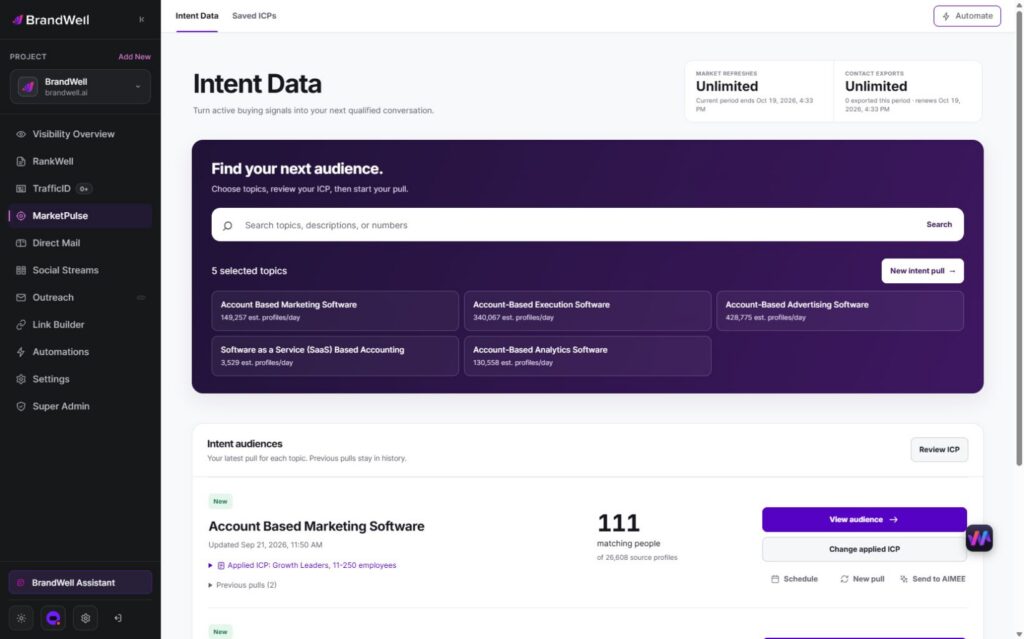
BrandWell MarketPulse: intent data starting at $500/mo. Find people researching topics relevant to what you sell, apply saved ICP filters, and review available contact details before taking action.
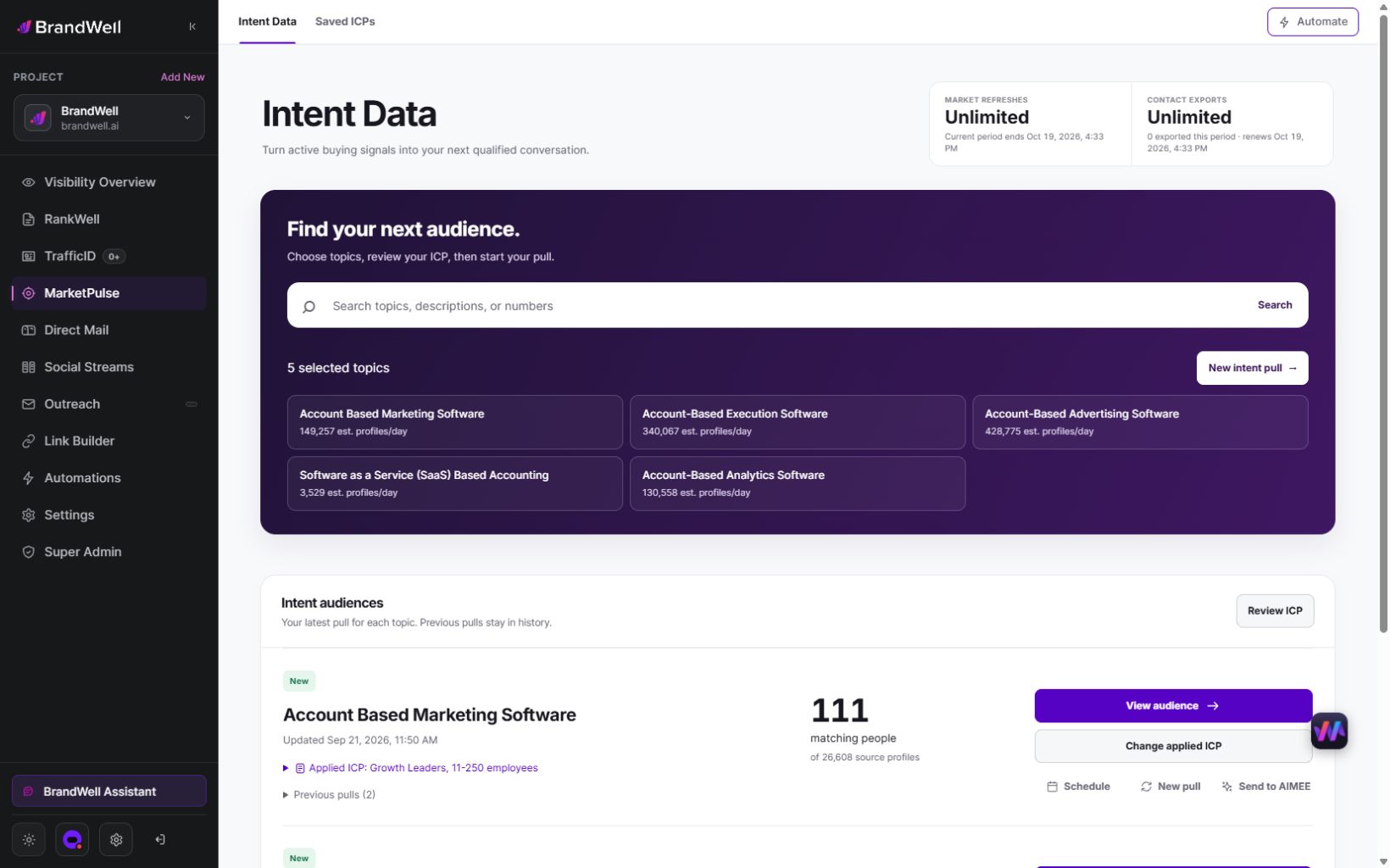
MarketPulse plans are starting at $500/mo. Verify current package scope and offers on the product page.
| Plan | Topics and refreshes | Monthly exports |
|---|---|---|
| Starter | 1 topic, weekly | 25,000 contacts |
| Growth | 3 topics, daily | 100,000 contacts |
| Scale | 10 topics, daily | Unlimited contacts |
Swipe the table to see all columns.
A pull retrieves available data from the previous 24 hours for one topic. Daily use across all included topics provides 90 Growth pulls or 300 Scale pulls in a 30-day month. Weekly Starter pulls vary by calendar month. Available audience size and contact fields vary, and audiences may overlap. Refreshes stop at the plan limit without overage charges.
- Find and qualify: search the topic catalog, save your ICP, and review the people and companies that match.
- Act on the research: export qualified contacts or prepare an Outreach or Direct Mail workflow. Connected products, channel usage, and fulfillment may cost extra.
- Get help from AIMEE: Growth and Scale include AIMEE for the initial user to research accounts and prepare the next step through connected tools.
Agencies and other service businesses can build client deliverables around their available Intent Scans and exports. Keep each client’s scope, permissions, and service fees clear. A subscription is not a promise of a white-label platform or exclusive access to a market.
Explore MarketPulse and watch the demo or compare plans starting at $500/mo. Any early-access discount is a separate, time-limited offer shown to an eligible recipient.
Choose one expensive client decision
Start with a costly buyer decision, not a technology label. Identify a client segment that loses time or opportunity because it cannot tell which accounts deserve attention. Then define the observable signals, the interpretation rules, the response method, and the evidence the agency will maintain.
A strong position names whom the agency helps, which decision it improves, how the method works, and what it refuses to claim. It can support better-fit sales conversations because prospects can assess operating fit rather than compare a generic channel menu. It can reduce commodity pressure only if delivery consistently supports the claim.
The practical goal is not to sound novel. It is to make the agency easier to choose for a specific problem. Use the intent-data service positioning guide to turn this thesis into a bounded offer statement.
Assign the operating capabilities
Assign four capabilities: signal operations, interpretation, activation, and evidence governance. One person may cover several roles at first, but ownership must be explicit. Signal operations maintains sources, taxonomy, freshness, and data quality. A strategist translates observations into hypotheses. An activation owner coordinates client action. An evidence owner maintains definitions, decisions, and outcomes.
The operating cadence should include daily or scheduled ingestion, a defined review SLA, a client-facing delivery rhythm, a weekly exception review, and a monthly positioning and evidence review. Systems need separate fields for observation, identity state, fit, interpretation, action, approval, and outcome.
Document the method in a service blueprint, claim-evidence ledger, qualification rubric, action library, rejection-code list, and client review template. The differentiation is the consistency of those artifacts and decisions, not the number of apps in the stack.
Select tools around the delivery method
Choose tools by operating job: source collection, identity and enrichment, workflow, client presentation, CRM activation, evidence logging, and QA. A spreadsheet may be enough to prove the first method. A portal becomes useful when multiple clients need branded access, permissions, audit history, and consistent reporting. Automation is valuable only after definitions and approvals are stable.
Useful templates include an ICP and exclusion sheet, signal dictionary, accepted-signal rubric, claim-evidence table, action card, client SLA, change log, and monthly learning review. Evaluate each tool for exportability, tenant separation, permissions, error visibility, and the ability to preserve why a decision was made.
Evaluate the current capability, permission model, exports, integration limits and charges against the delivery contract. A proposed portal or branded workflow needs a separately supported implementation; buying data does not create that capability.
Compare three positioning approaches
Generic full-service positioning offers breadth, channel-only positioning offers specialized execution, and buyer-intent-led positioning offers a decision system tied to observable market behavior. Use full-service positioning when the buyer wants one accountable partner across channels. Use channel specialization when performance within one channel is the dominant job. Use intent-led positioning when account timing, prioritization, and cross-channel activation are the central problem.
Intent-led positioning adds data-use, interpretation, and evidence obligations. It is not automatically superior. An agency with weak data operations, unclear ICPs, or no client action owner will be more credible with a narrower channel promise. A broad agency can also use intent as an internal method without making it the headline.
A buyer-intent position should explain how observations become reviewed client decisions, rather than relying on a general claim of analytics maturity.
Model the cost of the promise
Invest in the minimum operating system that can prove the service, then scale from observed demand and delivery load. Budget for source or wholesale access, setup, taxonomy, analyst time, enrichment, integrations, portal or reporting, client enablement, evidence review, compliance work, sales assets, and support.
Track software, usage, analyst minutes, client review, support, exceptions, maintenance and acquisition separately. Define which costs your contribution or margin measure includes. Reserve capacity for low-volume and noisy topics, and update the model from actual delivery rather than headline markup.
Evaluate MarketPulse with a representative topic and a defined ICP. Review the matching audience, prepare one useful action with BrandWell’s connected tools and AIMEE, and measure the operating effort. MarketPulse plans are starting at $500/mo; agree on the package, evaluation period, and success criteria before expanding.
Measure response, sales and delivery
Measure positioning at three levels: market response, sales quality, and service economics. Market measures include relevant inbound conversations, target-account engagement, and message comprehension. Sales measures include ICP-qualified opportunities, stage progression, win and loss reasons, and sales-cycle movement. Service measures include accepted-signal rate, time to action, client adoption, retention, gross contribution, and expansion.
Use comparable periods and cohorts where possible. Record other changes in price, sales capacity, channel mix, or market conditions. Monitoring outcomes can show a pattern, but it does not establish that positioning caused revenue, margin, or retention. Strong attribution needs a suitable comparison design.
Maintain a decision log showing when the position changed, which proof assets were introduced, and what definitions were used. That protects the agency from rewriting the story after the outcome is known.
Check whether the market fits
The best fits are specialist B2B agencies and consultants serving high-consideration markets where account timing and coordinated action matter. This includes agencies with a clear vertical, a repeatable service, an established ICP, and clients that can act on account intelligence. New service lines can also benefit if the agency has subject expertise and disciplined delivery.
Poor fits include broad consumer work, clients without accountable sales follow-up, agencies that cannot explain the signal source or identity state, and firms seeking differentiation only as a new label. An intent claim will magnify operational inconsistency rather than hide it.
Readiness comes from specificity: one target segment, one painful decision, one signal taxonomy, one action path, and one evidence standard. Expand only after that system holds across clients.
Build the evidence-to-action chain
Use signal sources that relate directly to the chosen buyer problem and preserve identity confidence throughout activation. Relevant inputs may include third-party topic research, authorized website behavior, company changes, engagement, and client-owned first-party events. Each source needs rights, freshness, coverage, and limitation notes.
Company identity, possible-person identity, validated contact, and qualified stakeholder are distinct states. Enrichment adds context but does not prove authority, budget, need, or timing. Activation should route a play appropriate to the evidence, such as analyst research, account prioritization, content personalization, sales preparation, or approved outreach.
Outcome evidence should show the chain from observation through interpretation, acceptance, action, response, opportunity association, and client learning. Build a point of view around in-market demand from these patterns without turning correlations into universal claims.
Keep claims within available proof
Risks include vague positioning, data access presented as expertise, overstated buying certainty, inconsistent delivery, poor access controls and cherry-picked proof. Maintain an evidence record for each objective claim, with the period, population, definitions, exclusions and responsible reviewer.
Operationally, watch for source drift, taxonomy changes, stale identity, automation that bypasses approval, cross-client leakage, unsupported benchmarks, and reports that show only successes. Strategically, avoid making the entire agency dependent on one source or one platform capability that can change.
Trust grows when the agency exposes limitations, rejection reasons, and decision rules. Put qualifications next to the claim and make evidence available to the people approving its use.
Package a maintained client service
Package the differentiation as a recurring buyer-intent operating service with a clear topic scope, cadence, branded evidence, activation support, and learning loop. The recurring value comes from maintaining the signal definitions, triaging observations, improving plays, supporting client users, and documenting what happened. Data access is one input.
AIMEE can help organize approved observations and draft a research brief through configured connected tools. Verify facts, unknowns and the proposed action. Product availability and supported integrations determine what can execute.
MarketPulse supplies topic audiences and ICP filtering starting at $500/mo. It can be an input to an agency service, alongside analyst work and reviewed client action. Custom client portals, source monitors, branded reports and routing require separately supported delivery and scope.
Six-part intent-positioning proof stack
- 1. Choose one costly buyer problem: Name the decision delay or wasted motion for one client type, plus the cases the agency excludes.
- 2. Define the observable signal set: List sources, rights, freshness, identity states, and what each observation cannot establish.
- 3. Codify interpretation and qualification: Use a rubric that separates fit, relevance, confidence, and required human judgment.
- 4. Name the repeatable activation capability: Show the owner, SLA, play, approval, and stop condition that turn evidence into action.
- 5. Publish an evidence hierarchy: Separate method evidence, operational metrics, associated outcomes, and any properly designed causal evidence.
- 6. Package a bounded recurring service: Define topics, cadence, deliverables, usage, client responsibilities, change control, and written terms.
Copyable agent workflow for Claude, ChatGPT, or AIMEE
Paste the following into Claude, ChatGPT, or AIMEE after supplying only approved client inputs.
ROLE: You are an evidence-led agency positioning strategist.
INPUTS: ICP, costly buyer problem, usable signals, delivery capability, proof assets, exclusions, and commercial constraints.
1. Generate three narrow positioning hypotheses in the form: We help [specific buyer] improve [specific decision] through [repeatable intent capability].
2. For each hypothesis, list the operating method, evidence already available, missing proof, and likely buyer objection.
3. Reject any hypothesis based only on access to data, a vague AI claim, or an unsupported outcome.
4. Draft a claim-evidence table with explicit qualifications beside each material claim.
5. Recommend one proof asset and one sales test for the strongest hypothesis.
6. STOP if the claim implies confirmed demand, budget, timing, pipeline, revenue, or defensibility without evidence.
7. A human selects the position and approves all public claims.
Approval boundary: An agent may research, classify, summarize, draft, and recommend. A human must approve identity use, CRM writes, external outreach, spend, client-facing delivery, legal interpretations, and irreversible actions.
Positioning worksheet: Complete six sentences before writing a headline. Our best-fit client is ____. The expensive decision they struggle with is ____. We observe ____ but cannot conclude ____. Our repeatable operating method is ____. The evidence a buyer can inspect is ____. We exclude ____ because the method would be unreliable or inappropriate. If the team cannot fill every blank with concrete language, the position is not ready for promotion.
Next, run a message-to-delivery audit. Give the proposed claim to sales, strategy, operations, and client success separately. Ask each team to explain what the agency would do in the first week, what the client must provide, and which result is not promised. Contradictory answers expose a category claim that is ahead of the operating system. Revise the claim or the method before buying more traffic for it.
Proof-asset sequence for a credible market position
Build proof from the inside out. First publish the method internally: inputs, decisions, roles, limits, and controls. Second create a de-identified sample evidence card that shows how an observation becomes a qualified action. Third show an operational dashboard with stable definitions, including rejections and exceptions. Fourth create a case narrative only after the facts, permissions, and outcome language have been verified. This sequence prevents the headline from outrunning delivery.
A planning guide should also define claim maintenance. Assign an owner to review public positioning, sales decks, proposals, marketplace listings, and onboarding language whenever a source, workflow, offer term, or evidence definition changes. Retire stale screenshots and examples. Preserve the date and reason for each claim revision privately, even though the public article does not need a visible verification date.
Distribution should demonstrate the capability rather than repeat a slogan. Useful artifacts include a decision rubric, a qualification worksheet, an anonymized evidence-card example, and a controlled teardown of a common workflow mistake. Share the artifact where the target buyer already evaluates the problem, then measure qualified conversations and comprehension. Do not promise search ranking, AI citation, or a guaranteed share of demand.
Sales enablement check: Give sellers a two-minute explanation, three diagnostic questions, one evidence sample, and a written list of non-promises. Review call notes for whether the position attracted the intended problem or merely curiosity about data. Feed repeated objections into the service design. Do not solve a weak position by making its outcome claim louder.
Quarterly position review: Compare the words buyers repeat, the problems qualified prospects bring, the delivery exceptions the team sees, and the evidence the agency can still support. Keep, narrow, or retire each claim deliberately. A position becomes durable when market language, operating capability, and inspectable proof stay aligned as the service changes.
Replace a broad promise with an inspectable method
Weak: “We find buyers ready to purchase and grow your pipeline.” The statement asserts buying status and an outcome that access to topic data alone cannot support.
More specific: “We help B2B software teams prioritize account research using relevant topic audiences, a written ICP and a reviewed weekly decision queue.” Show an example brief, acceptance criteria, owner and handoff. Any promised response target should match the contract and demonstrated capacity; it is not a standard MarketPulse SLA.
The FTC’s advertising substantiation policy requires a reasonable basis before objective advertising claims are published, including implied claims. Review the actual wording and supporting evidence with an appropriate adviser. A process screenshot does not establish revenue lift.
Build one proof artifact in the current workflow
Search MarketPulse’s catalog for a relevant topic and apply the client’s saved ICP. Prepare a reviewed brief with the topic, source date, company fit, available fields, uncertainty and suggested research step. AIMEE can help draft from the supplied evidence through configured tools. Keep the client’s observations distinct from the agency’s interpretation and any later CRM outcome.
Worked example: price the operating method
A fictional agency charges $1,500 monthly for a defined research and review package. Its modeled costs are $250 in software, $600 in analyst work, $150 in support and $100 in integration maintenance: $1,100 total. The remaining $400 is 26.7% of the fee before excluded acquisition, general overhead, tax and financing costs.
Looking only at software would suggest $1,250 remaining, or 83.3%, and omit most delivery costs. If exceptions add $300 in labor, defined costs become $1,400 and the remaining amount falls to $100, or 6.7%. These invented figures are not typical agency margins or a complete BrandWell service quote.
For a message test, suppose the old period produced five qualified inquiries from 100 visits and the new period eight from 100: 5% and 8%, a three-percentage-point difference. Without a suitable comparison and uncertainty analysis, this is a descriptive result, not proof that positioning caused an increase. Traffic source, offer, capacity and seasonality may also have changed.
Frequently asked questions
Is using intent data enough to differentiate an agency?
No. The client needs to understand the decision, repeatable method, responsible owner and evidence they can inspect.
Can an agency promise confirmed buyers from a topic audience?
No. Topic data supports research and prioritization; buying status still needs qualification.
What is the simplest proof asset?
A reviewed sample decision brief showing the observed evidence, fit, uncertainty, next step and approval.
Does a better inquiry rate prove the new position worked?
It describes the observed periods. A causal claim requires a suitable evaluation, stable definitions and attention to other changes.
Evaluate the topic-data input: explore MarketPulse and current plans starting at $500/mo.
Reviewed and updated October 3, 2026.

Written by