On this page
- Current MarketPulse workflow
- Define fit before interpreting activity
- Build the source-to-owner handoff
- Choose a traceable research stack
- Compare signals, triggers and referrals
- Budget research and outreach work
- Measure each stage with a denominator
- Check market and team readiness
- Separate topic research from site visits
- Control data and outreach risks
- Maintain the recurring research system
- Work through a service-need hypothesis
- Worked example: account and message metrics
- Frequently asked questions
Direct answer: Find companies that may need agency help by combining permitted intent and change signals with ICP fit, service-need research, identity confidence, contact validation, exclusions, and human qualification. Treat activity as a prioritization clue, never as confirmation that a company is shopping for an agency.
Current MarketPulse offer: intent-data plans start at $500/mo. See the product, demo, and current plans. Updated October 3, 2026.
Who this is for: Agency founders, SDR leaders, business-development teams, and GTM consultants building a defensible in-market account research motion.
The phrase “actively looking” is attractive because it promises timing. In practice, agencies observe fragments: a topic being researched, a pricing-page visit, a hiring change, a technology shift, engagement with content, or a referral. Each fragment may improve prioritization, but the buying situation still needs investigation.
A reliable motion creates an evidence-to-conversation path. It preserves where the observation came from, when it occurred, how the account fits, what problem may exist, who could be relevant, what the outreach policy allows, and what the researcher still does not know.
Current MarketPulse workflow
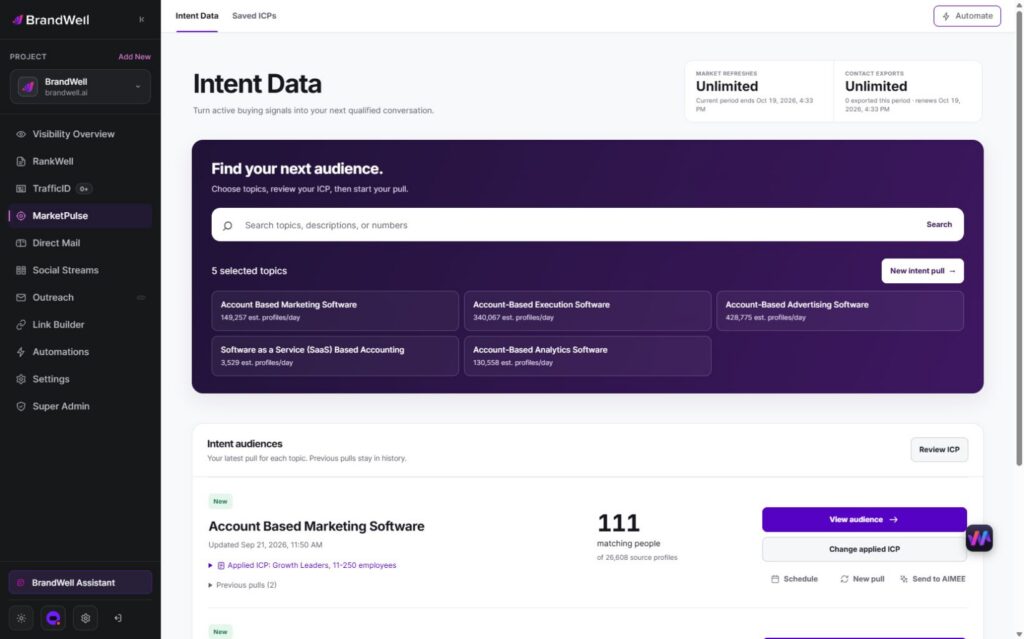
BrandWell MarketPulse: intent data starting at $500/mo. Find people researching topics relevant to what you sell, apply saved ICP filters, and review available contact details before taking action.
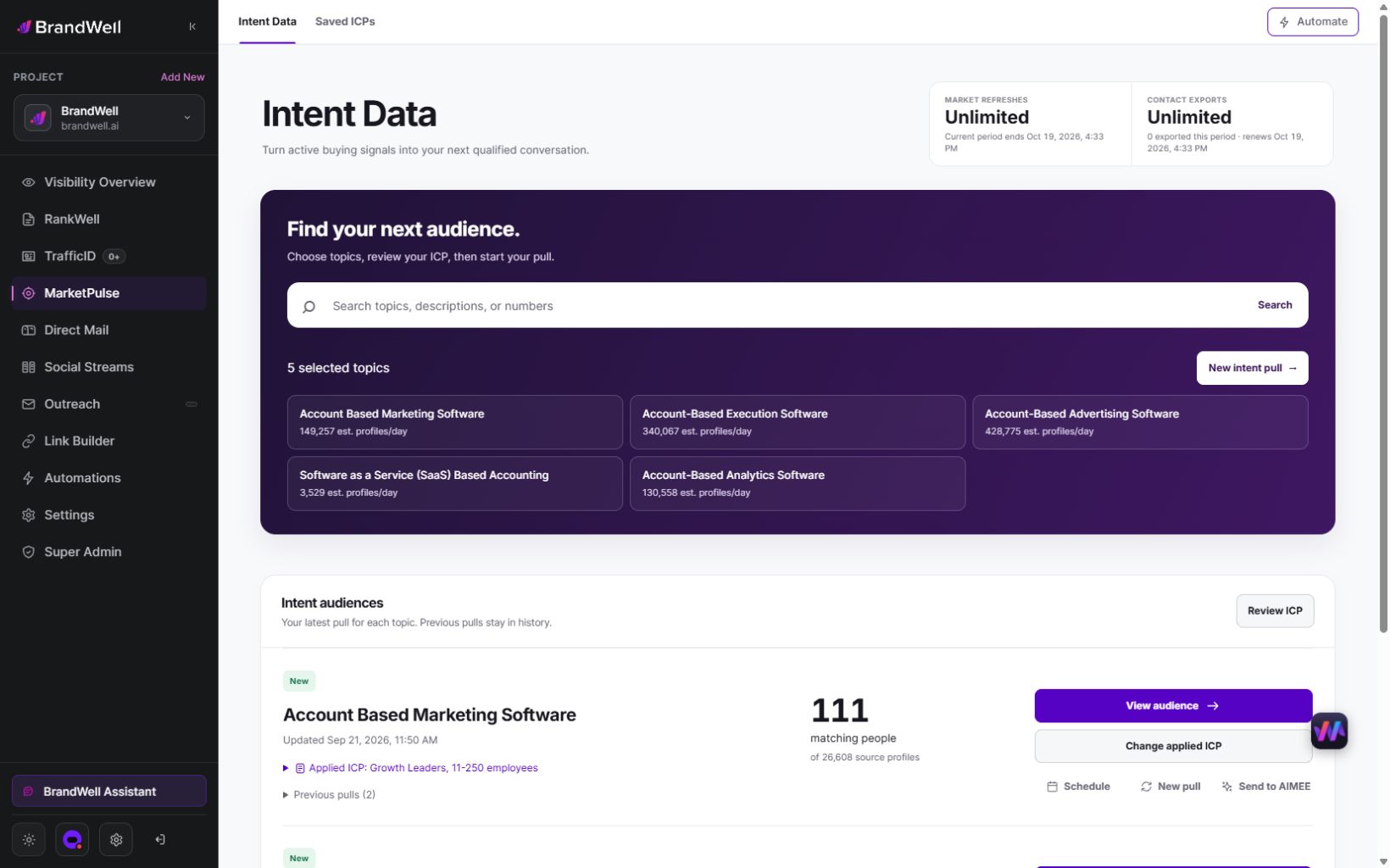
MarketPulse plans are starting at $500/mo. Verify current package scope and offers on the product page.
| Plan | Topics and refreshes | Monthly exports |
|---|---|---|
| Starter | 1 topic, weekly | 25,000 contacts |
| Growth | 3 topics, daily | 100,000 contacts |
| Scale | 10 topics, daily | Unlimited contacts |
Swipe the table to see all columns.
A pull retrieves available data from the previous 24 hours for one topic. Daily use across all included topics provides 90 Growth pulls or 300 Scale pulls in a 30-day month. Weekly Starter pulls vary by calendar month. Available audience size and contact fields vary, and audiences may overlap. Refreshes stop at the plan limit without overage charges.
- Find and qualify: search the topic catalog, save your ICP, and review the people and companies that match.
- Act on the research: export qualified contacts or prepare an Outreach or Direct Mail workflow. Connected products, channel usage, and fulfillment may cost extra.
- Get help from AIMEE: Growth and Scale include AIMEE for the initial user to research accounts and prepare the next step through connected tools.
Agencies and other service businesses can build client deliverables around their available Intent Scans and exports. Keep each client’s scope, permissions, and service fees clear. A subscription is not a promise of a white-label platform or exclusive access to a market.
Explore MarketPulse and watch the demo or compare plans starting at $500/mo. Any early-access discount is a separate, time-limited offer shown to an eligible recipient.
Define fit before interpreting activity
Start with a defined ICP and a library of observable business situations that could create a service need. Examples include relevant topic research, repeat visits to high-consideration pages, leadership changes, hiring patterns, funding or expansion, technology changes, and engagement with an agency point of view. None confirms a purchase decision.
Use a fit reason and a separate timing or need hypothesis as a proposed queue rule. Two fields copied from the same source are not independent corroboration. Research whether the observation connects to your capability, and record an alternative explanation. This is a prioritization rubric, not proof of purchase intent.
The agency should optimize for qualified research and respectful conversation, not the largest possible list. Better evidence reduces irrelevant contact and gives the sales team something useful to discuss.
Build the source-to-owner handoff
Build a documented chain from source to owner to handoff. Start with permitted sources and timestamps. Normalize the company. Score ICP fit, event relevance, freshness, and identity confidence separately. Apply exclusions and suppression. Research the likely business problem. Validate the contact channel. Send an evidence card to a human owner for approval.
The evidence card should contain the source URL or system reference, observed fact, timestamp, fit fields, possible implication, confidence, missing facts, contact basis, suppression result, approved message angle, and final decision. Keep research notes apart from CRM facts so hypotheses do not silently become truth.
The handoff is complete only when the sales owner accepts or rejects the account with a reason code. That feedback should update the scoring rubric rather than disappear into a private inbox.
Choose a traceable research stack
Use tools that preserve evidence and judgment: source monitoring, enrichment and validation, a research workspace, suppression, CRM, workflow automation, and a decision checklist. The most important feature is traceability from observation to proposed action.
A practical checklist asks: Is the source permitted? Is the event current? Does the company fit? What need could this indicate? What contradicts the hypothesis? Is the contact role relevant? Is the channel valid? Is the account suppressed? What human approved the message? What will stop follow-up?
Choose the minimum stack that preserves the source, company fit, uncertainty, suppression and responsible owner. Verify current capabilities, permitted uses, actual coverage and written charges rather than assuming a universal vendor ranking.
Compare signals, triggers and referrals
Intent-led research helps prioritize accounts by topic or behavior; trigger-led research uses observable business changes; referrals transfer trust; manual prospecting builds context when signals are sparse. A blended approach is usually stronger because each method answers a different question.
Use intent when the topic-to-service relationship is specific. Use triggers when an event plausibly changes need or capacity. Use referrals when trusted relationships can create access. Use manual work for narrow markets, strategic accounts, and verification. Do not let a weak intent observation outrank a strong referral or a well-researched account.
Document the source type in every record so response and progression can be compared fairly. A channel mix without source labels cannot teach the agency which evidence improves conversations.
Budget research and outreach work
Budget for data access, monitoring, enrichment, validation, analyst research, list QA, CRM administration, message review, outreach, suppression, training, and management time. Also count the opportunity cost of researching accounts that never become relevant and the trust cost of poorly grounded outreach.
Model cost per reviewed account and cost per accepted account before cost per meeting. Those earlier denominators show whether noise, labor, or client fit is the real constraint. Separate fixed stack costs from variable credits and human time. Measure how long exception handling and manual verification take.
Set a workload ceiling for each researcher and a minimum evidence threshold. More records can reduce quality if the team cannot verify them or personalize a useful reason for contact.
Measure each stage with a denominator
Track the full progression while limiting what each metric proves. Count sourced accounts, eligible accounts, researched accounts, accepted accounts, attempted contacts, delivered messages, responses, positive responses, meetings, qualified opportunities, pipeline association, and closed revenue. Keep a denominator and timestamp for each stage.
A response proves that a recipient responded. A meeting proves that a meeting was booked or held under the agency definition. An opportunity proves the CRM stage was created. None proves that the original signal caused the outcome. Outcome monitoring alone cannot establish causality; stronger attribution needs a suitable comparison or counterfactual.
Use cohorts by source, event type, freshness, ICP tier, identity confidence, message approach, and owner. Show rejection reasons and suppressed records. For discovery calls, use buying-intent discovery questions to verify the situation rather than restating the signal as fact.
Check market and team readiness
The model fits B2B agencies with a narrow ICP, high-consideration services, enough contract value to support research, and disciplined sales follow-up. It is strongest in markets where observable company changes or research topics connect plausibly to the agency service.
Readiness requires a written ICP, service-problem map, source rights, research rubric, relevant contact roles, suppression process, CRM definitions, human owner, and an outreach policy. The agency should already be able to explain why an account fits without mentioning the signal.
Avoid the motion for broad consumer targeting, sensitive or prohibited uses, undifferentiated offers, teams measured only on list volume, and markets where the agency cannot verify a contact or provide useful context.
Separate topic research from site visits
Topic audiences and visits to your own website answer different research questions. Keep the source and identity state visible. Protect identifying fields, limit their use to the documented purpose and review applicable requirements for the actual client, jurisdiction and channel.
Maintain an identity ladder: unknown visitor, resolved company, possible person, validated contact, relevant stakeholder, and human-qualified prospect. Movement between states requires evidence. Do not promote a record because an enrichment field exists.
Activation should match confidence. Low-confidence company activity may inform account research. A relevant company with clear service context may enter discovery planning. A validated stakeholder and approved lawful channel may receive a respectful message. Use the prospect-intent discovery-call guide once a conversation begins.
Control data and outreach risks
Risks include stale events, wrong companies, ambiguous identity, overbroad enrichment, missing suppression, unlawful or inappropriate outreach, vendor-use restrictions, biased scoring, and claims that overstate need. Build controls before scale.
Before outreach, review applicable commercial messaging requirements with a qualified adviser. Document sender identity, contact basis, suppression, opt-out handling, message approval and responsibility for vendors. Requirements vary by channel and jurisdiction; an account research score does not establish permission.
Protect client trust with source rights, purpose limits, minimum necessary fields, role-based access, retention, deletion, frequency caps, do-not-contact synchronization, incident handling, and random QA. Stop when a person asks not to be contacted or the evidence no longer supports the message.
Maintain the recurring research system
A recurring system should include ICP and topic maintenance, permitted signal collection, account research, identity and contact checks, suppression, human-approved outreach preparation, evidence reporting, and a monthly learning loop. Package a defined account volume or analyst capacity, delivery cadence, SLA, client responsibilities, routing destinations, and change control.
AIMEE can help summarize supplied evidence and prepare a proposed research brief through configured connected tools. Verify facts, unknowns and the appropriate next step before an external action.
MarketPulse supplies topic audiences and saved ICP filtering starting at $500/mo. A custom source monitor, CRM connection, branded client portal or managed prospecting service needs its own supported implementation and written scope. A topic match is not a request to hire your agency.
Eight-stage evidence-to-conversation prospecting system
- 1. Define ICP and explicit exclusions: Lock firmographic, service-need, geography, sensitivity, conflict, and do-not-contact rules.
- 2. Select permitted intent and trigger sources: Document source rights, refresh, timestamp, limitations, and the business situation each source might indicate.
- 3. Score relevance and freshness: Keep topic or event relevance separate from age and from company fit.
- 4. Resolve company and possible contact identity: Maintain distinct identity states and the evidence needed to advance each one.
- 5. Validate contactability and suppress exclusions: Check the selected channel, role relevance, client suppression, and global do-not-contact state.
- 6. Research likely service need: Write a conditional hypothesis, find supporting and contradicting facts, and list unknowns.
- 7. Approve contextual outreach: A human decides whether the account, person, channel, message, and cadence are appropriate.
- 8. Track progression without causal claims: Log decisions, responses, opportunities, associated outcomes, rejection reasons, and changes to the rubric.
Copyable agent workflow for Claude, ChatGPT, or AIMEE
Paste the following into Claude, ChatGPT, or AIMEE after supplying only approved client inputs.
ROLE: You are an evidence-to-conversation research assistant for an agency.
INPUTS: ICP, service-problem map, permitted sources, signal definitions, exclusions, suppression policy, relevant roles, and outreach rules.
1. Summarize only the observed evidence and timestamp. Do not state or imply confirmed buying intent.
2. Score company fit, signal relevance, freshness, identity confidence, and contact validity separately.
3. Write one conditional service-need hypothesis and one plausible contradiction.
4. Draft one respectful research-led outreach angle without a fabricated personal detail.
5. STOP on low confidence, stale evidence, suppression, prohibited source, legal uncertainty, or missing human owner.
6. A human approves contact selection, channel, message, cadence, CRM write, and sending.
OUTPUT: Evidence card, scores, unknowns, suggested discovery question, draft angle, and approval state.
Approval boundary: An agent may research, classify, summarize, draft, and recommend. A human must approve identity use, CRM writes, external outreach, spend, client-facing delivery, legal interpretations, and irreversible actions.
Research worksheet: For every proposed account, require five short fields before outreach: observed fact, why the company fits, possible service need, alternate explanation, and one discovery question. Add source, timestamp, identity state, contact-validation state, and suppression result as structured evidence. This keeps the message grounded while making uncertainty visible to the sender.
Calibrate the queue with a blind review. Give a sample of accepted and rejected accounts to a second researcher without the original decision. Compare fit, timing, identity, and action ratings. Large disagreement signals vague definitions, not necessarily poor people. Tighten examples and reason codes, then repeat. Keep a holdout of accounts that receive ordinary manual research so the team can compare quality and effort without pretending the comparison proves causality.
Weekly calibration and maintenance loop
Begin each week by reconciling sources, duplicates, suppression, and owner capacity. Pull a balanced sample of new, accepted, rejected, and stalled accounts. Review whether the observed evidence was represented accurately, whether the service-need hypothesis was proportionate, and whether the contact and message matched the confidence. Correct CRM facts when a hypothesis was stored as if it were verified.
Use the review to improve the checklist, not to manufacture a benchmark. Add examples of borderline fit, misleading triggers, stale pages, role mismatches, and respectful stop decisions. Track agreement between reviewers, research time, acceptance, and reason-code distribution. If acceptance rises while response quality falls, investigate whether reviewers lowered the standard or outreach lost relevance. If research time rises, isolate which fields or sources create friction.
Maintain a rescan queue for accounts whose evidence could become relevant later. A rescan needs a reason, eligible date, and stop date. Do not recycle suppressed contacts or repeat the same weak message. Refresh the underlying event and company context before any new action. These controls make the recurring system more defensible because they show what the agency chose not to contact, how decisions changed, and which assumptions were corrected.
Client-ready output: Deliver a decision queue rather than a contact dump. Each row should show the observed event, source and time, company-fit reason, conditional need hypothesis, identity and validation state, proposed discovery question, owner, and approval. Rejected and monitored rows remain useful because they reveal exclusions and timing. Preserve them within the agreed retention period instead of silently deleting inconvenient evidence.
Maintenance note: Revalidate the ICP, exclusions, source permissions, role map, suppression sync, and outreach policy whenever the agency adds a market, service, channel, or data source. Sample CRM records for unsupported inferences. Archive obsolete rules with their reason and effective period so later reporting can explain why account eligibility changed.
Work through a service-need hypothesis
Suppose a company fits your agency’s sector, size and geography, and a relevant marketing role appears on its careers page. Record the posting and observation date. A possible need is additional campaign capacity; alternatives include replacing an employee or bringing agency work in-house. Ask a neutral discovery question about how the team plans to resource the work.
BLS distinguishes job openings from hires. That distinction reinforces a limit on the example: a listing is not a verified payroll addition. It also does not establish that a company wants an agency. The buying hypothesis is your inference and must remain separate from the observed record.
Topic research can add a different question. Search MarketPulse’s catalog for a topic relevant to your service, apply the ICP, and review the available audience. Preserve source differences instead of combining a job post, a topic match and a website visit into one unexplained score. Only describe a visit to your website when that is what the source actually reports.
Worked example: account and message metrics
A fictional team starts with 200 sourced accounts. After deduplication, exclusions and initial fit review, 120 enter research. Reviewers accept 60 for the next step: 50% of researched accounts or 30% of sourced accounts. The team sends 80 messages to relevant contacts at 40 of those accounts. Seventy-two messages are delivered and nine receive a reply: 90% delivery and 12.5% reply rate among delivered messages.
Those nine replies are contact-level events, not necessarily nine distinct accounts, positive replies or qualified opportunities. Record each separately. If six accounts later reach a defined qualified opportunity stage, that is 6 / 60 = 10% of accepted accounts; this association does not prove the original signal caused the opportunity.
Assume $250 in software, $600 in research and $150 in message review and administration. Defined cost is $1,000, or $16.67 per accepted account. Outreach usage and sales follow-up excluded from this example would increase total cost. These are invented inputs, not typical performance, a promised result or an all-inclusive product quote.
Frequently asked questions
Can intent data confirm that a company is shopping for an agency?
No. It can support prioritization and research; the situation still needs qualification.
Are two signals necessarily independent evidence?
No. They may originate from the same observation or copied source. Record their origins and check for duplication.
What should the first message reference?
A truthful, relevant business question or useful resource. Avoid asserting a private research activity, fabricated need or confidential purchase plan.
What does MarketPulse add?
Topic audiences and saved ICP filtering. Combine them with reviewed company context and an appropriate next step, while preserving uncertainty.
Build a more relevant research queue: explore MarketPulse, with plans starting at $500/mo.
Reviewed and updated October 3, 2026.

Written by