On this page
- Current MarketPulse workflow
- Define a useful monitoring outcome
- Assign owners and delivery targets
- Evaluate sources and monitoring tools
- Build, resell, refer or decline
- Price source and analyst work
- Measure the evidence chain
- Choose suitable client use cases
- Keep hiring and topic evidence separate
- Manage source and interpretation risks
- Define the recurring package
- Distinguish listings from hires
- Worked example: deduplicate before measuring usefulness
- Frequently asked questions
Direct answer: Offer hiring-signal monitoring when your agency can translate current, permitted job and workforce changes into qualified business hypotheses, client-ready alerts, and approved action. Promise relevant monitoring and faster research, not proof of budget, urgency, purchase intent, or permission to contact.
Current MarketPulse offer: intent-data plans start at $500/mo. See the product, demo, and current plans. Updated October 3, 2026.
Who this is for: Agency owners and productized-service operators considering a recurring monitoring service around job openings, role changes, team expansion, or workforce shifts.
A job posting is an observable event with useful context: company, role, location, skills, seniority, and time. It can suggest a project, capacity gap, capability build, or strategic shift. It can also reflect routine replacement, a stale requisition, exploratory hiring, or a role unrelated to the client offer.
The service becomes credible when it classifies the event, preserves the source and timestamp, explains the possible implication as a hypothesis, applies ICP and disqualifier rules, and gives a human a bounded decision. That is a monitoring product. A feed of scraped job titles is not.
Current MarketPulse workflow
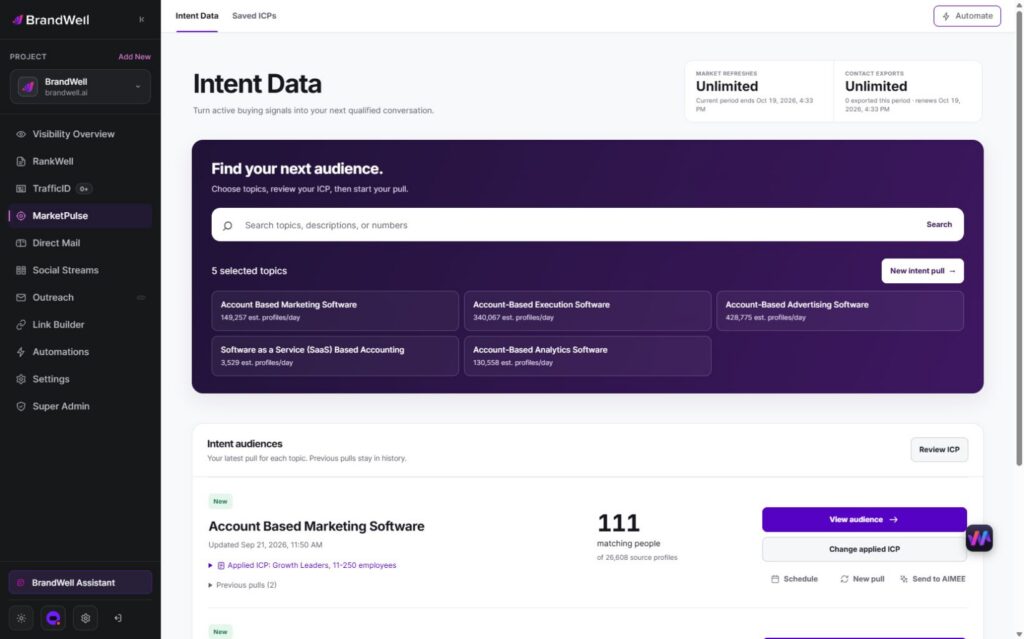
BrandWell MarketPulse: intent data starting at $500/mo. Find people researching topics relevant to what you sell, apply saved ICP filters, and review available contact details before taking action.
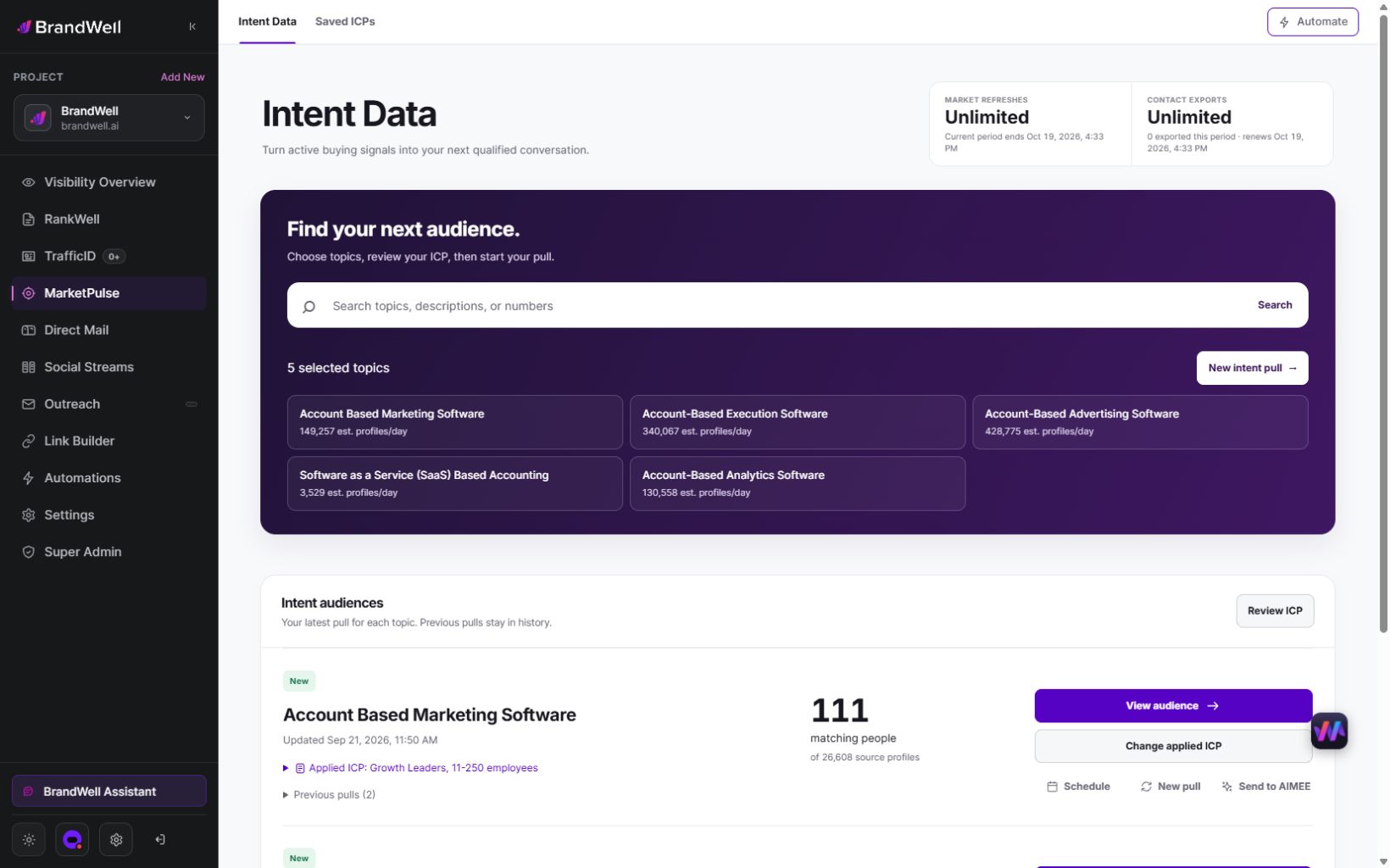
MarketPulse plans are starting at $500/mo. Verify current package scope and offers on the product page.
| Plan | Topics and refreshes | Monthly exports |
|---|---|---|
| Starter | 1 topic, weekly | 25,000 contacts |
| Growth | 3 topics, daily | 100,000 contacts |
| Scale | 10 topics, daily | Unlimited contacts |
Swipe the table to see all columns.
A pull retrieves available data from the previous 24 hours for one topic. Daily use across all included topics provides 90 Growth pulls or 300 Scale pulls in a 30-day month. Weekly Starter pulls vary by calendar month. Available audience size and contact fields vary, and audiences may overlap. Refreshes stop at the plan limit without overage charges.
- Find and qualify: search the topic catalog, save your ICP, and review the people and companies that match.
- Act on the research: export qualified contacts or prepare an Outreach or Direct Mail workflow. Connected products, channel usage, and fulfillment may cost extra.
- Get help from AIMEE: Growth and Scale include AIMEE for the initial user to research accounts and prepare the next step through connected tools.
Agencies and other service businesses can build client deliverables around their available Intent Scans and exports. Keep each client’s scope, permissions, and service fees clear. A subscription is not a promise of a white-label platform or exclusive access to a market.
Explore MarketPulse and watch the demo or compare plans starting at $500/mo. Any early-access discount is a separate, time-limited offer shown to an eligible recipient.
Define a useful monitoring outcome
Yes, when hiring activity maps clearly to the client problem and the agency can maintain source, freshness, interpretation, and review controls. Promise a recurring queue of qualified hiring changes with context, confidence, and suggested research. Do not promise a complete labor-market view or that an open role means the company has budget for the client service.
The strongest outcome is decision speed. A client can see which accounts changed, why the change may matter, what evidence supports that view, and whether to research, prioritize, monitor, or stop. Keep the observed event separate from the inferred need.
The offer should start with a narrow role taxonomy, such as the positions that often accompany a known operational challenge. Broad monitoring creates noise and encourages generic outreach.
Assign owners and delivery targets
Use a seven-step operating loop with source, analyst, client, and service owners. A source owner maintains permitted feeds and timestamps. An analyst normalizes company and role, applies the taxonomy, researches context, and records uncertainty. A client owner accepts or rejects the alert. A service owner manages QA, incidents, and monthly rule changes.
Set SLAs for new-event ingestion, analyst review, client delivery, urgent corrections, and client feedback. The handoff should include source, first-seen and last-seen timestamps, role and location, change type, company fit, possible implication, contradictory evidence, confidence, disqualifiers, recommended research, and approval state.
Run duplicate and stale-posting controls before sending an alert. A relisted job, evergreen requisition, or duplicated location should not automatically look like new demand.
Evaluate sources and monitoring tools
The best stack covers permitted job or workforce sources, change detection, company normalization, role taxonomy, enrichment, validation, workflow, client reporting, and evidence history. Evaluate source licensing and acceptable use before features.
A white-label provider should also support per-client topics, branding, permissions, usage visibility, exports, exception handling, and source traceability. Test whether it preserves first-seen and last-seen dates, distinguishes new from edited postings, and lets reviewers correct company or role matches.
Verify source rights, coverage, refresh behavior, costs and contract terms using current primary material. The appropriate workflow depends on the client decision and available evidence; a generic provider ranking cannot replace that review.
Build, resell, refer or decline
Build when the taxonomy, source processing, and change logic are strategically core; resell when speed and multi-client delivery matter; refer when the client only needs software; avoid when source rights or interpretation cannot be governed.
Building requires licensed sources, parsers or APIs, entity resolution, deduplication, change history, taxonomy, QA, monitoring, integrations, and support. Reselling can reduce that burden while allowing the agency to own interpretation and client service. Referring reduces delivery responsibility but gives up the recurring analyst layer.
Avoid the offer for a client that treats every job as a sales trigger, lacks an approved action path, or expects a fixed alert volume. A low-volume topic can still be useful if the underlying event is material and the client knows how to act.
Price source and analyst work
Price from role breadth, source costs, refresh cadence, review, enrichment, reports, integration, support and exceptions. Use actual delivered hours and written charges. Specify included and excluded costs before calculating a service margin; no universal benchmark fits every program.
Separate setup work: defining roles, companies, locations, synonyms, change types, exclusions, source rights, actions, client users, and reporting. Recurring work includes monitoring, normalization, review, client delivery, support, taxonomy updates, and false-positive analysis.
Use an analyst-capacity or topic-based boundary instead of promising a data volume. For broader service economics, use the intent-service pricing guide and substitute the hiring-specific cost stack.
Measure the evidence chain
Track operational progression and associated business outcomes without claiming the hiring alert caused them. Count source events, unique eligible changes, reviewed alerts, accepted alerts, client actions, responses, meetings, opportunities, and revenue associations under stable definitions.
Show alert freshness, duplicate rate, rejection reasons, time to review, acceptance, action completion, and client response. Cohort by role taxonomy, change type, company tier, source, and confidence. These measures reveal whether the service improves prioritization even when downstream samples are small.
Outcome monitoring can describe change but does not establish attribution. A strong pipeline or revenue impact claim needs a comparison or counterfactual appropriate to the question. In routine reporting, use “observed after,” “associated with,” or “progressed from,” not “caused by.”
Choose suitable client use cases
Best-fit clients sell to companies where specific hiring changes plausibly precede a need they understand well. They have a focused ICP, meaningful contract value, relevant role expertise, an owner for alert review, and a respectful action library.
Examples of fit are service firms that can explain how a new department leader, specialist role, location expansion, or cluster of technical hires might alter operational priorities. The explanation must remain a hypothesis until discovery confirms it.
Exclude clients in sensitive contexts the agency cannot govern, broad markets with no role-to-problem logic, teams demanding large volumes, and sales motions that will contact anyone attached to a posting. Readiness also requires a maintained topic list, which can follow the intent-topic selection and maintenance process.
Keep hiring and topic evidence separate
Buyer-intent and website behavior can add independent context; identity and enrichment can connect the company and relevant roles; none changes a job posting into proof of a purchase. A company researching a closely related topic and hiring for a relevant function may deserve higher research priority than either observation alone.
Use evidence lanes: hiring event, topic research, authorized site behavior, company fit, possible stakeholder, and validated contact. Score each separately. Enrichment should confirm company attributes or role relevance, not fabricate a buying committee.
Activation can range from monitoring to account research, discovery preparation, content selection, or approved outreach. Match the action to confidence and client policy. Run hiring records through the same lead and intent-data QA controls used for other signal types.
Manage source and interpretation risks
Risks include prohibited collection, source-term changes, stale or duplicate jobs, entity errors, ambiguous role taxonomies, biased interpretation, excessive personal data, insecure delivery, and inflated client expectations.
A posting may change or disappear for many reasons. Preserve what was observed and what remains unknown. Do not infer confidential plans, individual employee decisions or guaranteed spend. Limit unnecessary personal fields, apply access and retention controls, and review source terms and applicable requirements for the actual service.
A posting may change or disappear for many reasons. Never infer confidential plans, protected characteristics, an individual employee decision, or guaranteed spend. Limit fields, control access, set retention, honor suppression, and obtain qualified review for relevant laws and contract terms.
Define the recurring package
A recurring package should define monitored roles and companies, permitted sources, freshness, analyst review, alert format, client cadence, accepted-alert criteria, action support, QA, support, and monthly taxonomy maintenance. Include usage assumptions and a change process because source availability and client priorities can move.
AIMEE can help organize supplied evidence and prepare a proposed account brief through configured connected tools. Verify the source, inference and supported next action. It does not supply unrestricted execution or replace the responsible reviewer.
MarketPulse provides topic audiences and saved ICP filtering. Topic research can be separate context alongside an approved hiring record. Job-source access, change detection, custom monitoring, branded alerts and agency delivery need their own supported implementation and service scope.
Seven-control hiring-signal monitoring loop
- 1. Define role and change taxonomy: Specify roles, seniority, skills, locations, new versus edited events, and exclusions tied to a client problem.
- 2. Confirm licensed source and timestamp: Record source rights, capture method, first seen, last seen, refresh, and any source limitation.
- 3. Normalize company and role context: Resolve the employer, parent, geography, function, seniority, and duplicate or evergreen posting state.
- 4. Infer possible need with explicit uncertainty: Write a conditional implication plus alternate explanations and facts still needed.
- 5. Apply ICP and disqualifier rules: Score company fit, event relevance, freshness, conflicts, sensitivity, and client exclusions separately.
- 6. Human-review alert and action: A named reviewer accepts, rejects, monitors, researches, or proposes an approved play with a reason code.
- 7. Log outcomes and retune thresholds: Track decisions and associated progression, audit false positives, version the taxonomy, and notify clients of changes.
Copyable agent workflow for Claude, ChatGPT, or AIMEE
Paste the following into Claude, ChatGPT, or AIMEE after supplying only approved client inputs.
ROLE: You are an evidence-disciplined hiring-signal analyst.
INPUTS: Target accounts, role taxonomy, change types, source rights, freshness window, ICP, disqualifiers, allowed actions, and client SLA.
1. Classify the observed hiring event and preserve its source and timestamps.
2. Normalize company, role, function, seniority, location, and duplicate state.
3. Describe possible business implications only as hypotheses. Include at least one alternate explanation.
4. Score fit, relevance, freshness, source confidence, and interpretation confidence separately.
5. Draft a client alert with evidence, unknowns, and one recommended research step.
6. STOP on stale, duplicate, ambiguous, prohibited-source, sensitive, suppressed, or low-confidence records.
7. A human approves enrichment, client delivery, CRM writes, and outreach.
OUTPUT: Alert, evidence fields, confidence scores, alternate explanation, reason code, proposed action, and maintenance note.
Approval boundary: An agent may research, classify, summarize, draft, and recommend. A human must approve identity use, CRM writes, external outreach, spend, client-facing delivery, legal interpretations, and irreversible actions.
Taxonomy worksheet: For each monitored role family, list common titles, seniority, functions, skills, locations, excluded meanings, and the client problem it may relate to. Then add at least two alternate explanations. A “demand generation” role could indicate team expansion, routine replacement, an internal capability build, or experimentation. The alert should not choose among those without more evidence.
Create a freshness and change policy. Define when a posting is new, edited, relisted, duplicated, closed, or unknown. Preserve first-seen and last-seen times, not only the most recent crawl. When a source disappears, do not state that the role was filled or cancelled. Mark it unavailable and keep the last confirmed observation. Review a fixed sample of alerts every month for company match, role class, duplication, inference quality, and client usefulness.
Alert evidence card and client review worksheet
Each alert should begin with the observable record: company, normalized role, location, source, first seen, last seen, and detected change. Then add the taxonomy classification, company fit, possible business implication, alternate explanations, confidence, disqualifiers, and recommended research. Put the source event above the interpretation so the reviewer can challenge the logic.
Ask the client to choose accept, reject, monitor, or investigate. Require a reason such as wrong company, irrelevant role, routine replacement, stale event, low fit, duplicate, known account, existing opportunity, or useful timing. Track the decision by role family and event type. A high rejection rate can reveal a poor taxonomy, but it can also reveal a valuable exclusion. Inspect the reasons before changing a threshold.
Maintain sources and concepts separately. A source change may alter volume without changing market behavior. A taxonomy change may reclassify old events. A client strategy change may make a previously useful role irrelevant. Version all three so trend reports do not silently compare different definitions. If historical data is restated, label the change and preserve the original result privately.
Plan a quarterly retirement review. Remove roles that no longer connect to a client decision, sources whose rights or reliability are unclear, alerts with no accountable action, and fields the client does not use. A smaller maintained monitor is often more useful than a growing topic catalog with no decision owner.
Client-ready output: Deliver an alert queue with the original event, normalized role and company, source timestamps, change state, fit, hypothesis, alternate explanation, confidence, and suggested research. Include monitored and rejected alerts in the review summary so clients can see the filter at work. Do not turn a job description into an invented executive priority or contact a listed employee merely because the role exists.
Maintenance note: Recheck title synonyms, seniority mappings, locations, client exclusions, and alternate explanations whenever the monitored market changes. Audit a cross-section of accepted and rejected events against the original posting evidence. If source timestamps, edit history, or rights are no longer reliable, pause the affected monitor and tell the client what changed before resuming delivery.
Decision rule: An event must remain in monitor status when the role-to-problem link depends on facts the agency has not verified. Ask a targeted research question, set a review date, and avoid outreach until evidence improves. A documented wait decision protects client trust and helps the taxonomy learn which patterns need more context.
Distinguish listings from hires
BLS JOLTS definitions distinguish unfilled job openings from additions to payroll counted as hires. A public listing observed by an agency is neither a verified payroll addition nor automatically an observation meeting every survey criterion. Preserve the listing, source and observation date.
First seen means first observed by your monitor, not necessarily first published. Last seen means last confirmed observation, not proof the role remains open now. A missing page does not establish that the employer filled the job. Mark unknown closure reasons rather than inventing them.
Worked example: deduplicate before measuring usefulness
A fictional source returns 300 listing rows. After identifying repeats and location variants, the agency has 180 distinct observed events. Eighty meet the client’s role and company criteria; the client accepts 40 for research. Fit is 80 / 180 = 44.4% of distinct events. Acceptance is 40 / 80 = 50% of fitting events, or 40 / 180 = 22.2% of distinct events.
Assume $200 for source access, $600 in review labor and $200 in reporting and support. Defined cost is $1,000, or $25 per accepted research event. These inputs are invented, not product prices or typical results. Events are not necessarily distinct accounts, and an accepted event is not a confirmed buyer or meeting.
Example interpretation
Observed: a company lists a demand-generation role. Possible explanation: it may be expanding capacity. Alternatives: replacement, internal capability building or exploratory hiring. Next research: verify the current listing and relevant public company context before deciding whether a useful, appropriate next step exists.
Do not convert an internal prioritization rubric into a probability of purchase unless that probability has been separately established. Keep the evidence and uncertainty visible to the reviewer.
Frequently asked questions
Does a new listing prove new spending?
No. It supports a research question, with alternatives and missing facts recorded.
Does a disappeared posting mean the role was filled?
No. Record that it is no longer confirmed at that source unless independent evidence establishes the reason.
Is hiring monitoring a native MarketPulse feed?
MarketPulse supplies topic audiences and ICP filtering. A job-source monitor requires its own permitted source, implementation and maintenance.
What should a client receive?
The original observation, normalized company and role, source dates, fit, conditional interpretation, alternatives and a reviewed research step.
Add topic research when it answers a separate question: explore MarketPulse and keep it distinct from the hiring-source evidence.
Reviewed and updated October 3, 2026.

Written by