


On this page
- How affiliate marketing works
- 1. Choose a narrow audience and a real problem
- 2. Evaluate the product and the program separately
- 3. Choose one publishing channel
- 4. Create evidence readers can use
- 5. Disclose the relationship and qualify links
- 6. Calculate the economics before buying traffic
- 7. Use BrandWell to build and maintain the content
- 8. Review performance and keep recommendations current
- Frequently asked questions
To start affiliate marketing, choose an audience you can help, evaluate a relevant product and its referral terms, publish useful content with a clear commission disclosure, and measure approved earnings against your costs. An affiliate link is the tracking mechanism, not the business strategy.
You do not need to manufacture a product, but you do need a reason for people to trust your recommendation. This guide builds a practical first project around that responsibility rather than promising a particular income or timeline.
How affiliate marketing works
A merchant offers compensation for a qualifying referral. An approved affiliate uses the program’s designated link or code. The program records the activity, applies its attribution and eligibility rules, and pays approved commissions according to its terms.
The qualifying action might be a purchase or an accepted lead. Do not assume every click earns money, every subscription pays a recurring commission, or every recorded order becomes a payout. Refunds, exclusions, attribution rules, and approval periods can affect the result.
1. Choose a narrow audience and a real problem
Start with something you can explain well. “Home offices for people in small apartments” is more actionable than “technology.” You can investigate dimensions, storage, noise, assembly, and the compromises readers face.
Write down three questions that audience asks before buying. For example:
- Will this desk fit the available space when both open and folded?
- Can one person assemble and move it?
- What equipment can it support safely?
Those questions give the content a purpose. A commission rate alone does not tell you whether the product solves them or whether you can evaluate it credibly.
2. Evaluate the product and the program separately
A useful product can have unsuitable referral terms, and a generous commission can accompany an unsuitable product. Keep two review notes: one for the reader’s buying decision and one for your commercial decision.
For the product, record fit, limitations, total cost, support, and what you have personally verified. For the program, read the current written terms and record:
- The precise event that earns a commission
- The current rate and eligible products or customers
- Attribution rules and any referral window
- Refunds, reversals, approval periods, and payout thresholds
- Allowed publishing channels and restrictions on paid advertising
- Rules for brand names, images, coupons, and product claims
- What happens if the program changes or the relationship ends
A quoted referral window is not an unconditional promise that every later sale will be credited to you. Read how the program handles other referrals and qualifying actions. Save the terms you relied on and recheck them before launching a new promotion.
A direct program and a network are ways to administer the relationship. Neither structure guarantees better support, higher commissions, or approval. This is why a dated list of “highest-paying programs” is a weak foundation for a business plan.
3. Choose one publishing channel
Use a channel where you can demonstrate the product clearly and comply with the program’s rules. A website supports detailed reference content. A video can show assembly or a workflow. An email can help subscribers revisit a decision, provided the program permits that use and recipients have the appropriate permission relationship.
Start with one channel you can maintain. Avoid treating a link-in-bio page or a redirect as a workaround for a platform or program restriction. Verify the rules for the actual placement.
4. Create evidence readers can use
A useful review explains the decision criteria and shows what supports the recommendation. Google’s review guidance emphasizes evidence, original analysis, and meaningful comparisons rather than summaries of manufacturer copy.
For the small-apartment desk example, an original review could show:
- A photograph with measured dimensions and the surrounding clearance
- Assembly notes, including tools and steps that were difficult
- The conditions of any stability test, without overstating what it proves
- Who the desk suits and who should choose another approach
- A dated price check and a link to current purchase terms
Only describe tests you actually performed. If the article is based on specifications and research, label it that way. Do not put “tested for six months” in a headline because it sounds persuasive. A generated image is an illustration, not evidence that a product performed as claimed.
5. Disclose the relationship and qualify links
The FTC’s endorsement guidance explains that a material connection should be clear to the audience. Make the commission relationship easy to notice near the recommendation. A disclosure hidden in a footer or behind a vague link is not a substitute.
An illustrative plain-language disclosure is: “If you buy through a referral link on this page, we may earn a commission.” Add other relevant connections, such as a free review sample, when applicable. The wording must describe the actual arrangement and work in the format where the recommendation appears.
For search engines, Google recommends marking paid links with rel="sponsored" in its outbound-link guidance. That HTML attribute and a visible reader disclosure do different jobs; one does not replace the other.
6. Calculate the economics before buying traffic
Use approved commission revenue, not the merchant’s order value, to assess your earnings. Here is an original hypothetical example:
- 1,000 visits reach an article.
- 100 readers click its referral link.
- Five qualifying purchases earn $20 each.
- Approved commission revenue is $100 before your expenses.
Those numbers are assumptions, not typical results. If producing and distributing the article costs $150, that first period has not recovered the cost. If one purchase is reversed, approved revenue becomes $80. Hosting, tools, testing, and your time also belong in the business calculation.
Before using ads, confirm that the referral program permits the proposed campaign. Set a test limit you can afford and measure downstream approvals. A campaign producing clicks but no approved commissions is not successful merely because traffic increased.
7. Use BrandWell to build and maintain the content
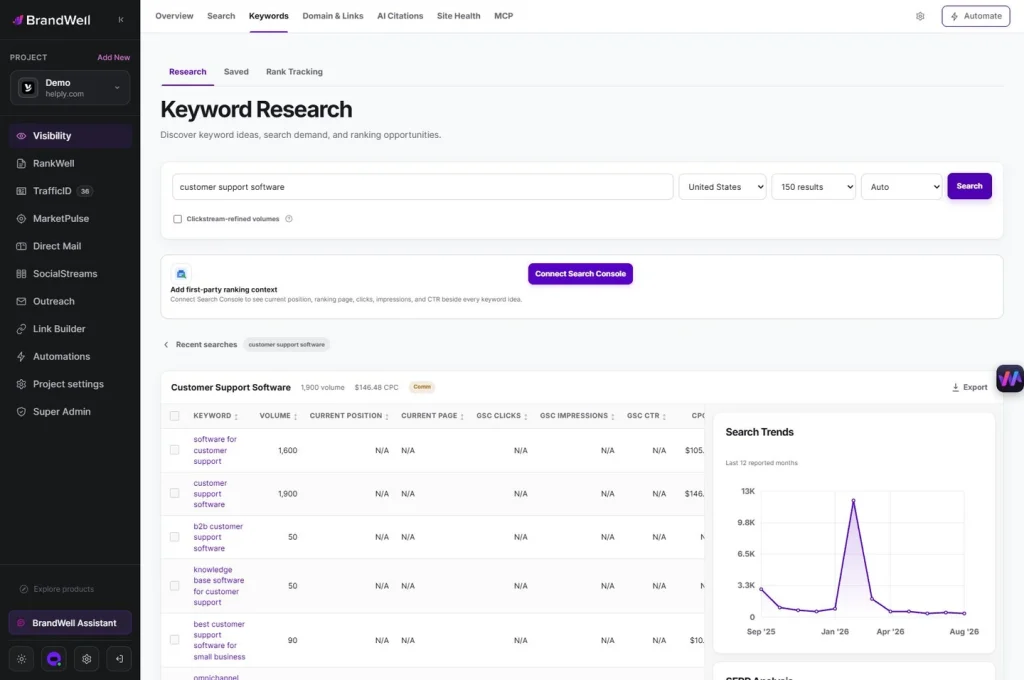
In BrandWell Visibility, open Keywords and Research to investigate the questions around your chosen audience. Use that research to identify a specific task, not to promise that an estimated search volume will become sales.
In RankWell, review the existing article opportunity before creating another page on the same task. Prepare a brief with the audience, decision criteria, test notes, sources, and disclosure requirements. Review the draft against those materials before publishing.
AIMEE can help organize research and draft a maintenance checklist. Keep unsupported claims and invented personal experience out of the output. The content workflow supports your editorial judgment; it does not supply product testing you have not done.
8. Review performance and keep recommendations current
Track the article, channel, referral clicks, approved commissions, reversals, and costs. Keep merchant reporting separate from your site’s analytics so you do not mistake an outbound click for a purchase.
For search traffic, review the page’s impressions, queries, clicks, and CTR in Google Search Console. If impressions rise but clicks remain weak, check whether the title answers the actual search and whether the page offers a useful reason to choose it. A new title should describe the content honestly.
Schedule checks for product availability, material feature changes, broken links, expired offers, and changed program terms. Update the relevant recommendation when the evidence changes. More posts are not automatically better than maintaining the pages readers already use.
Frequently asked questions
Can I start without a website?
Possibly, if the program accepts your publishing channel. Verify the channel and disclosure requirements before applying or posting links.
How long until I earn money?
There is no reliable universal timeline. Audience fit, distribution, product demand, attribution, and approval rules all matter. Plan for the possibility of no commission and set a limit on the time and money you invest.
Is affiliate marketing passive income?
Previously published content can continue generating referrals, but recommendations, links, disclosures, and program terms need maintenance. Treat it as an ongoing publishing business.
Should I recommend the product with the highest commission?
Only if it is also the right recommendation on the evidence. Explain fit and limitations first; compensation should not replace the reader’s decision criteria.
Reviewed and updated October 2, 2026.

Written by
Justin McGill is the founder of BrandWell, growth automation software for inbound and outbound teams. BrandWell brings together MarketPulse intent data, TrafficID website audiences, RankWell content workflows, Visibility research and AIMEE execution through configured tools.
 Farnaz Kia