On this page
You can earn money around pay-per-click advertising in three different roles: an advertiser selling an offer, a publisher selling ad space, or a specialist managing campaigns for clients. The money flows differently in each. An advertiser pays for traffic; a publisher receives revenue under an ad program’s terms; a specialist earns service fees.
None provides guaranteed income. Start by choosing the business model and calculating what must happen for it to cover its costs.
1. Advertisers: turn paid visits into profitable customers
For an advertiser, clicks are a cost. Revenue comes from the product or service sold after those visits. A campaign can have an attractive click-through rate and still lose money.
In an illustrative example, 500 clicks at $2 each cost $1,000. If 20 customers buy a $100 offer, revenue is $2,000 and ROAS is 2x. That is not automatically a 200% profit or ROI. Subtract the cost of delivering the offer, refunds, fees, and other relevant expenses before assessing profit.
If contribution before advertising is $40 per sale, those 20 sales contribute $800 toward a $1,000 ad bill. The campaign is $200 short before other overhead. This example shows why revenue alone can be misleading.
Plan the first test
- Define the offer. Know the price, delivery cost, customer fit, and buying action.
- Choose relevant intent. Match the ad to a task your business can actually serve.
- Prepare the landing page. Make the promise, terms, and next step clear on mobile.
- Verify measurement. Check that purchases or qualified leads are recorded correctly without duplicate events.
- Set a bounded test budget. Decide what evidence would justify continuing, changing, or stopping.
- Review outcomes. Evaluate customer quality and economics, not only clicks.
Google Ads uses average daily budgets, so an individual day’s spend can differ from the average. Read the selected campaign’s spending rules instead of treating the number as a universal hard daily cap.
2. Publishers: earn from advertising on a site
A publisher provides content and an audience, then uses an eligible advertising program or direct sponsorship to monetize placements. This is different from creating a Google Ads campaign to buy traffic.
Do not assume every publisher payment is tied to a click. Google announced AdSense’s move to per-impression payments for publishers. Evaluate the current program terms and reporting rather than relying on older “earn per click” descriptions.
A practical publisher plan includes useful original content, appropriate rights, a readable mobile layout, acceptable page speed, and policy-compliant ad placement. Review whether the ads interfere with the purpose readers came to accomplish.
For an illustrative revenue estimate, 100,000 pageviews at a $10 page RPM would produce $1,000. The RPM is an assumption, not a benchmark or promise. Actual revenue depends on your audience, inventory, demand, and program conditions, and content production still has a cost.
Avoid invalid traffic
Do not click your own ads, ask visitors to click them to support the site, or design accidental-click traps. Google’s invalid-traffic guidance explains that artificially generated clicks and impressions are prohibited. Buying low-quality traffic is not a reliable monetization strategy.
3. Specialists: provide campaign-management services
A PPC specialist earns fees for agreed work such as research, setup, creative coordination, reporting, and optimization. The client normally funds media separately. Define the scope so neither party mistakes a service fee for the advertising budget.
Document account ownership, access, approval responsibilities, reporting definitions, and what happens when the engagement ends. Avoid guaranteeing a number of customers when the offer, sales process, market, and tracking are not all under your control.
Evaluate your own economics too. An engagement that requires more research, creative, and reporting time than the fee supports is not sustainable simply because the campaign spends heavily.
Use BrandWell for the research and content work
Open Visibility, then Keywords and Research, to investigate how customers describe a problem. Use the results to inform the brief; estimates are not a forecast of advertising profit.
In RankWell, review existing content opportunities before creating a supporting article. A useful destination should answer the question promised by the ad.
AIMEE can help prepare copy variations and reporting summaries from the approved facts and tools you provide. Review those outputs and the live campaign settings. Drafting ad copy does not mean the campaign can safely run without oversight.
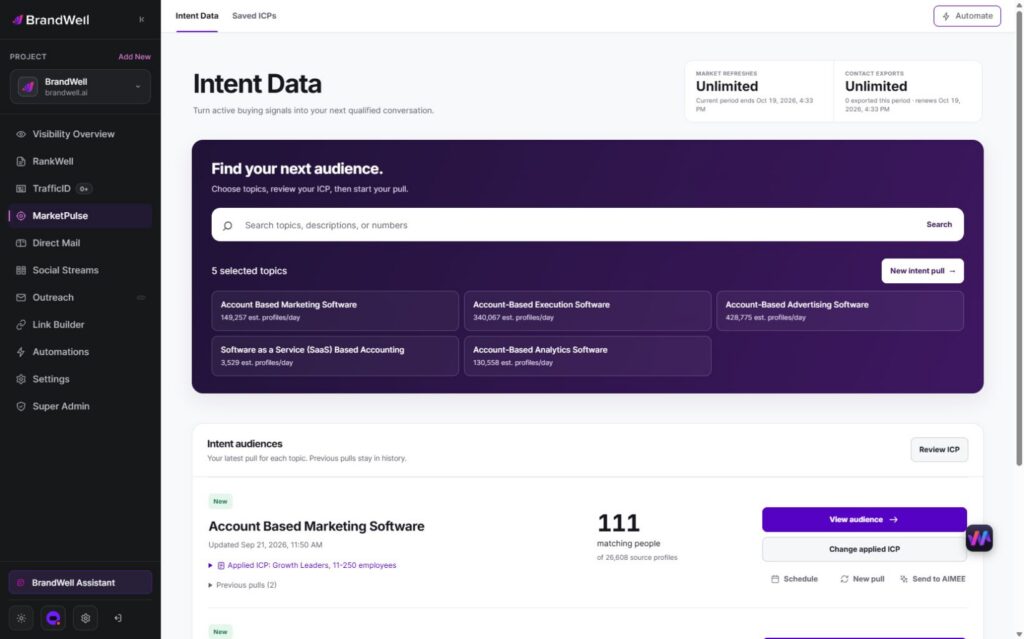
For audience research, MarketPulse is starting at $500/mo. Its available topic signals are separate from ad spend, publisher revenue, and proof of a completed purchase.
Questions to answer before spending
- Am I buying traffic, monetizing an audience, or selling a service?
- What is the actual source of revenue?
- Which costs are excluded from the headline number?
- How will refunds and delayed conversions be handled?
- What would make the experiment unsuccessful?
- Do the data, placements, and content follow the applicable program rules?
Frequently asked questions
Does Google pay me when someone clicks my search ad?
No. As an advertiser, you pay for the advertising under the campaign’s billing model. Your business earns from the customer action that follows.
Is AdSense the same as Google Ads?
No. AdSense is a publisher monetization program. Google Ads is used by advertisers to buy distribution.
Can PPC produce passive income?
A system can automate parts of delivery or reporting, but revenue still depends on ongoing content, audience quality, policy compliance, customer economics, and maintenance. Treat passive-income promises cautiously.
Reviewed and updated October 2, 2026.

Written by
Julia McCoy has contributed articles to BrandWell on content marketing, writing, and search engine optimization. This archive retains her original bylines; individual articles may be updated by the BrandWell editorial team.