On this page
- MarketPulse supplies the topic research
- Who is this for?
- Define the assessment framework
- Map the workflow and approval record
- Seven useful records
- Compare less intrusive approaches
- Budget for assessment and remediation
- Test and report controls
- Assign jurisdiction and channel questions
- Separate observations and inferences
- Find failure modes and alternatives
- Document the agency service
- Example review packet
- Before approving a workflow
A privacy impact assessment for B2B intent data reviews a specific workflow: its purpose, data sources, identity joins, recipients, actions, retention and potential effects on people. Prepare it before activation and reconsider it when the workflow changes. A completed form does not automatically establish compliance.
The workflow and worksheets below are a proposed editorial operating model. They help make facts reviewable; they are not a substitute for jurisdiction-specific legal analysis. Assign the legal questions to qualified counsel and the control tests to their accountable owners.
MarketPulse supplies the topic research
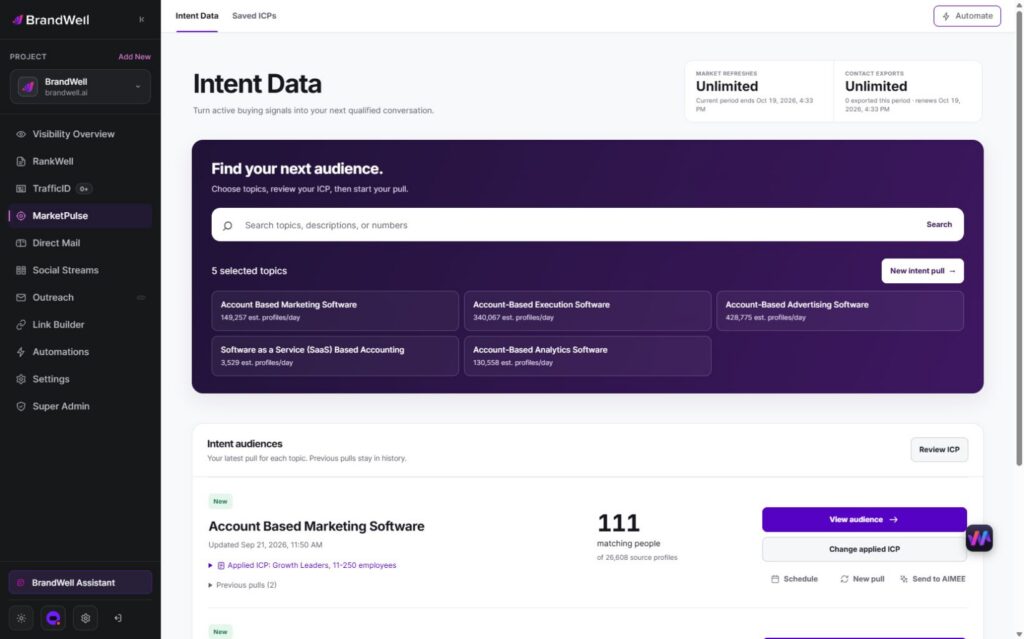
MarketPulse helps you review people researching relevant topics with saved ICP filters and available contact details. Keep the source and entity level attached to the record. A topic match is not a confirmed project, buying role or permission to contact someone.
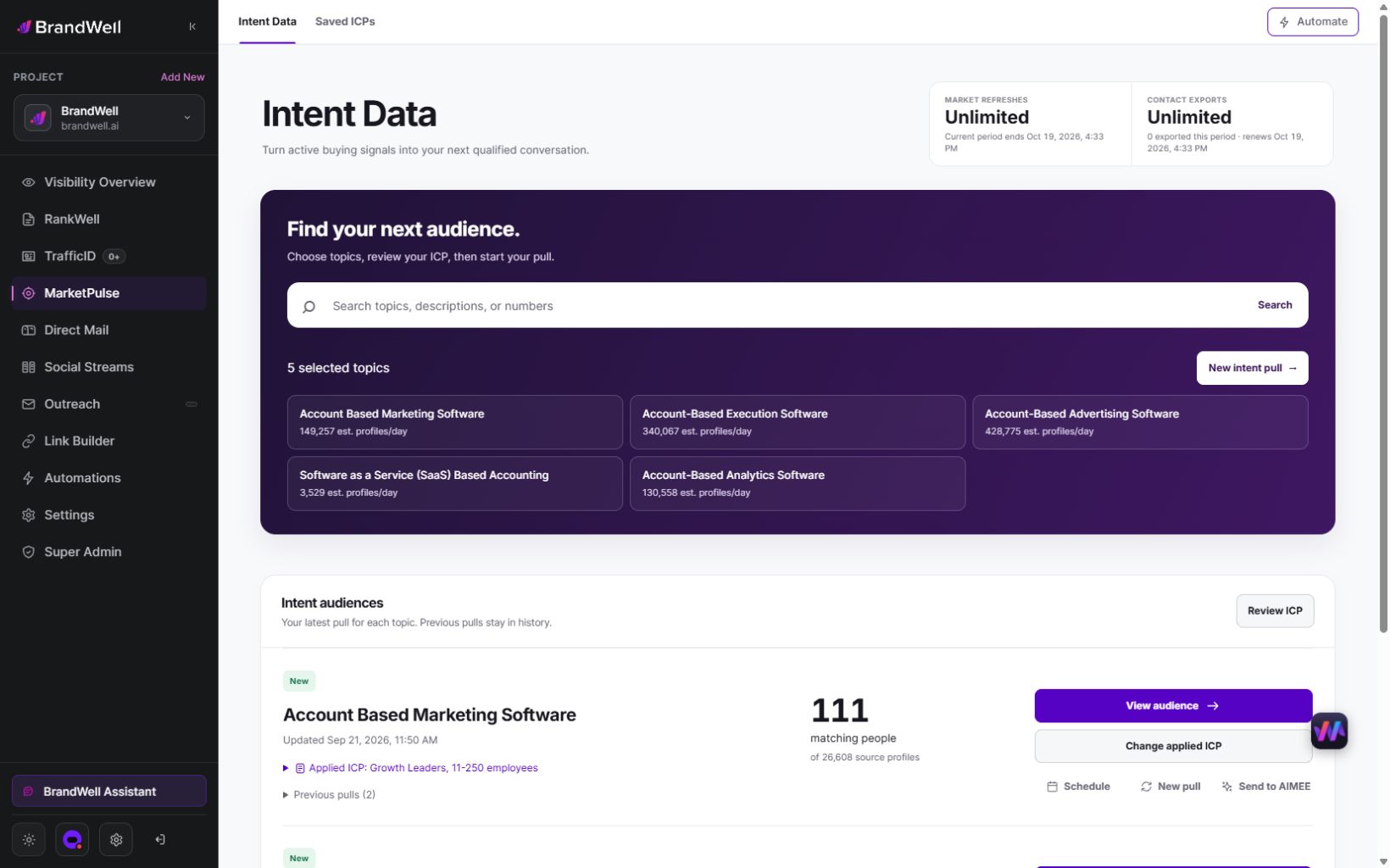
Standard monthly plans are Starter includes one weekly topic and 25,000 contact exports, Growth includes three daily topics and 100,000 exports, and Scale includes ten daily topics and unlimited exports. Daily use gives 90 or 300 pulls in a 30-day month. Fields, audience size and overlap vary. Review current plan scope; any eligible early-access offer is separate.
Who is this for?
This intent data privacy impact assessment playbook is for privacy leaders, legal counsel, security leaders, RevOps, marketing operations, and agencies planning buyer-intent, enrichment, visitor-identification, audience, or outreach workflows. It is designed to make operational facts reviewable. It does not replace a jurisdiction-specific legal analysis, a security assessment, a vendor contract review, or an advertising-platform policy review.
Define the assessment framework
The UK ICO’s DPIA overview treats assessment as a proportionate process for identifying and reducing risks to people. It should inform the project and remain under review. The ICO currently marks this guidance as under review following the Data (Use and Access) Act. Check its current guidance and the applicable jurisdiction before relying on a legal interpretation.
For an intent workflow, build the governance record around seven questions:
- What legitimate business outcome is the workflow intended to support?
- Which data elements, sources, entities, and joins are necessary?
- What privacy roles and legal bases apply in each relevant jurisdiction?
- What could happen to a person if the data or inference is wrong, unexpected, exposed, or overused?
- Which less intrusive design could achieve the outcome?
- Which technical, contractual, and operational controls reduce risk?
- Who accepts residual risk, and what change triggers reassessment?
The output is an approval record with assumptions, open issues, decisions and owners. Preserve the method and uncertainty for each source. A signal does not establish a purchase decision or permission to contact someone; not every identity observation uses the same matching method.
Map the workflow and approval record
Australia’s OAIC PIA guide recommends an early threshold assessment for projects handling personal information. Its guidance considers complexity and privacy scope, encourages assessment early enough to influence design, and calls for revisiting it as the project changes. This is an Australian reference, not a universal legal requirement for every business.
The operational sequence is:
- Define the unit of review. Name one workflow, owner, purpose, start condition, destination, and consequential action.
- Map information flows. Record collection source, intent topic, timestamp, company/person resolution, enrichment, storage, access, activation, onward disclosure, retention, correction, suppression, and deletion.
- Document roles and authority. Identify controller, processor, service-provider, seller, or other roles as counsel defines them; record contracts and cross-border transfers.
- Assess necessity and proportionality. Remove fields, identity precision, or retention that are not required for the stated purpose.
- Build a risk register. Score likelihood, severity to individuals, affected population, uncertainty, existing controls, residual risk, and owner.
- Approve controls. Require access limits, encryption where appropriate, data-quality thresholds, notices, consent or opt-out handling where applicable, suppression, audit logs, and human review.
- Record the decision. Approve, approve with conditions, redesign, pause, or reject.
- Monitor and reopen. Track control failures, complaints, match errors, policy changes, vendors, purposes, and jurisdictions.
Seven useful records
1. Threshold assessment form
Capture purpose, personal-information involvement, affected people, new technology or matching, scale, sensitivity, and potential consequences. Decide whether a brief review or full assessment is required. Limitation: a short form can miss hidden joins when completed without engineers, vendors, and operators.
2. Data-flow map
Diagram every handoff from signal collection to identity resolution, enrichment, qualification, activation, storage, and deletion. Mark vendors, regions, roles, and human decisions. Limitation: the map becomes unreliable when undocumented exports and manual workarounds exist.
3. Purpose-and-authority register
For each field and action, record purpose, necessity, authority or legal-basis question, notice, choice mechanism, allowed recipients, and incompatible uses. Limitation: a register does not establish the correct legal basis; counsel must make that determination.
4. Risk register for individuals
Describe concrete harms such as unwanted contact, unfair exclusion, sensitive inference, mistaken identity, reputational impact, loss of control, or unexpected disclosure. Assign control owners and residual-risk decisions. Limitation: scoring scales create false precision unless the narrative and uncertainty remain visible.
5. Control evidence packet
Attach configurations, access reviews, retention settings, suppression tests, incident paths, vendor commitments, training records, and sample audit logs. Limitation: a policy document is not evidence that a control works in production.
6. Approval and exception record
Record approvers, conditions, unresolved questions, expiry, prohibited actions, and an exception process. Limitation: approvals can become stale; material changes require reassessment rather than silent reuse.
7. Agent-ready review packet
Prepare a draft-only packet with the workflow map, evidence links, unresolved questions, proposed controls, owners and reassessment triggers. AIMEE can help organize research through connected tools. Do not give an agent authority to determine legal compliance or approve its own unresolved risk.
Compare less intrusive approaches
A manual lead list can still create privacy, accuracy, retention, and outreach risks. An intent workflow adds temporal behavioral inferences, identity matching, cross-source linkage, scoring, and automated routing. Those additions can improve prioritization, but they also expand the ways a person may be misclassified or treated unexpectedly. The comparison is therefore not “intent equals risky, manual equals safe.” Compare the actual data flows and decisions.
Useful alternatives include account-only aggregates, contextual activation without identity resolution, first-party declared preferences, form fills, cohort reporting, or human research without automated action. Choose the least intrusive method that can achieve the stated outcome. If the workflow needs person-level identity only to produce a dashboard count, remove it. If outreach requires a contact, separately assess contact-source rights, channel rules, suppression, and review.
An intent data privacy impact assessment software comparison should focus on workflow mapping, version control, evidence attachments, role assignments, control testing, exception handling, and change triggers – not how many questionnaires a platform ships.
Budget for assessment and remediation
There is no universal privacy impact assessment for intent data pricing benchmark. Cost depends on jurisdiction count, data types, identity resolution, number of vendors, automation depth, cross-border transfers, sensitivity, historical documentation, and whether counsel or external specialists are required. Budget both assessment work and remediation; the expensive part is often redesigning a poorly documented flow, not writing the report.
Estimate hours for the workflow owner, privacy lead, counsel, security engineer, data engineer, marketing operations, vendor management, and approver. Add contract review, configuration changes, notices, rights-request handling, training, audit evidence, monitoring, and reassessment. Treat “ROI” as avoided unmanaged risk and better design discipline, not a promised financial return.
Test and report controls
Audit whether controls operate, not whether a checklist was signed. For each high or material risk, define a control owner, test procedure, evidence source, frequency, failure threshold, remediation time, and escalation path. Examples include sampling match accuracy, testing suppression propagation, reconciling active users with access approvals, verifying deletion, reviewing stale signals, and tracing a routed record back to its permitted source and purpose.
- Coverage metrics: percentage of in-scope flows mapped, vendors reviewed, fields with documented purpose, and risks with owners.
- Operating metrics: access exceptions, stale-signal activations, suppression failures, unmatched deletions, complaints, and unauthorized exports.
- Quality metrics: sampled match errors, untraceable sources, missing timestamps, and disagreements between system and contract records.
- Decision metrics: conditions overdue, high residual risks, exceptions open, and workflows paused or redesigned.
Report counts, denominators, test methods, evidence links, caveats, and owner actions. Do not publish a compliance percentage that hides high-severity failures. The ICO calls the DPIA a living process; a change register and reassessment trigger are therefore part of the operating control, not administrative overhead.
Assign jurisdiction and channel questions
Requirements may change with the location of the person, organization, processing, vendor, or recipient; the type and sensitivity of data; the entity’s regulatory status; and whether the workflow involves sale, sharing, targeted advertising, automated decisions, electronic communications, cookies, or cross-border transfers. Controller/processor or analogous roles, contract terms, and agency/client instructions also matter. Only qualified counsel can map the specific facts to current law.
Escalate workflows that use sensitive or inferred sensitive themes, precise location, health or financial context, employment or housing opportunities, minors, large-scale monitoring, data matching, identity graphs, or consequential automated decisions. Advertising channels add their own policy layer. Google, for example, restricts personalized targeting in sensitive and access-to-opportunity categories and prohibits certain PII combinations and overly narrow audiences; review its personalized advertising policy.
Separate observations and inferences
Separate observations from inferences. The record may show that a source associated activity with a topic at a time. It may then estimate an account or person match and produce a score. None of those fields establishes consent, motive, accuracy, or a purchase decision. Document the confidence and permitted action for each evidence class.
Use an action ladder: aggregate reporting may require less identity; account-level prioritization requires fit and company confidence; audience activation adds platform and consent/policy questions; person-level outreach adds contact-source, channel, suppression, and human-review requirements. Block any action whose required evidence is missing. Do not use a high intent score to override a suppression, restricted theme, low-confidence identity, or expired signal.
MarketPulse supplies relevant topic research, while TrafficID concerns eligible visitors to your own website. Map them as separate sources. An enriched stakeholder is not automatically the person observed. Assess the actual account configuration, downstream destinations and agreed use rather than relying on a general product description.
Find failure modes and alternatives
The highest-risk failures are an incomplete map, purpose drift, undocumented onward disclosure, sensitive inference, mistaken identity, data retained past usefulness, inaccessible suppression, automated consequential action, and a rubber-stamp assessment completed after launch. Other common mistakes include copying a generic DPIA template, describing vendor marketing rather than actual configuration, and scoring organizational risk while ignoring harm to individuals.
Reduce risk by minimizing fields and retention, using coarse cohorts where possible, separating raw behavior from activation views, applying identity-confidence thresholds, limiting access, preserving lineage, testing rights and suppression flows, and requiring human approval. Freeze or roll back the workflow when a high-risk control fails. Document alternatives rejected and why. If residual risk remains unacceptable or required authority is unclear, pause rather than optimize.
Document the agency service
An agency needs a client-specific scope, instructions and roles, source inventory, data-flow map, subprocessor list, jurisdiction questions, permitted topics, identity level, retention, rights and suppression procedure, security responsibilities, incident route, approval matrix, change process, and claims boundary. The contract should distinguish what the agency configures, what the client controls, and what each vendor supplies. Never sell “compliance” as an automatic product feature.
Example review packet
Fictional workflow: A company wants a weekly account-research queue for a non-sensitive business topic. Its draft map records the topic source, observation date, company match, saved fit rules, analyst, CRM destination and proposed expiry. It compares that design with aggregate topic planning, which needs no named contact.
The reviewer discovers that a manual export goes to a shared drive outside the documented access group. The packet stays open while the owner inventories recipients, changes access and tests the correction. A signed template would not resolve that operating defect.
If eight of ten mapped routes have evidence-tested controls, report 8/10, or 80% control-test coverage. Do not call that “80% compliant.” The two untested routes and the severity of their unresolved issues still matter.
Before approving a workflow
- Can each data source and recipient be traced in the actual configuration?
- Are purposes, unresolved legal questions and less intrusive alternatives recorded?
- Have access, suppression, correction and deletion paths been tested where applicable?
- Does each material issue have an owner, decision and review date?
- Is the approval limited to the mapped scope, with change triggers?
Explore MarketPulse’s current topic-research workflow and compare plans starting at $500/mo. Review the selected scope and actual use before activating an audience or outreach route.
Reviewed and updated October 3, 2026.

Written by