On this page
- Current TrafficID visitor workflow
- Separate five visitor and identity layers
- Define the service promise you can deliver
- Assign installation and follow-up owners
- Evaluate the supported delivery stack
- Choose build, service or referral scope
- Price defined costs and contribution
- Measure outcomes without promising causality
- Qualify traffic, rights and client readiness
- Preserve visitor and stakeholder states
- Review identity and expectation risks
- Maintain the scoped visitor service
- Copyable assistant package model
- Price the actual operation first
- Worked example: plan price is not agency service cost
- Frequently asked questions
Direct answer: Price a website visitor identification service as a governed operating system, not as access to a pixel or a promise to reveal every visitor. Add wholesale and usage costs, implementation, analysis, validation, activation, reporting, account management, support, compliance work, and risk capacity. Sell a predictable tier with documented limits, then use a written overage or change rule.
Review current TrafficID plans, eligible identified-visitor volume and the selected fixed or dynamic billing mode before budgeting. TrafficID and MarketPulse have separate product scope. Verify current allowances and included tools on the product page.
Promise a controlled workflow and evidence. Do not guarantee identity coverage, data volume, a client commitment, cost recovery, profit, pipeline, revenue, sales, search ranking, or AI citation.
Who this is for: Agency owners and finance-minded operators evaluating a white-label or managed website visitor identification service.
Current TrafficID visitor workflow
TrafficID addresses identifiable visitors to your own authorized site. Its views keep observed visitors, submitted form identities and added company stakeholders distinct. It does not identify every visitor or make an added stakeholder the person who visited.
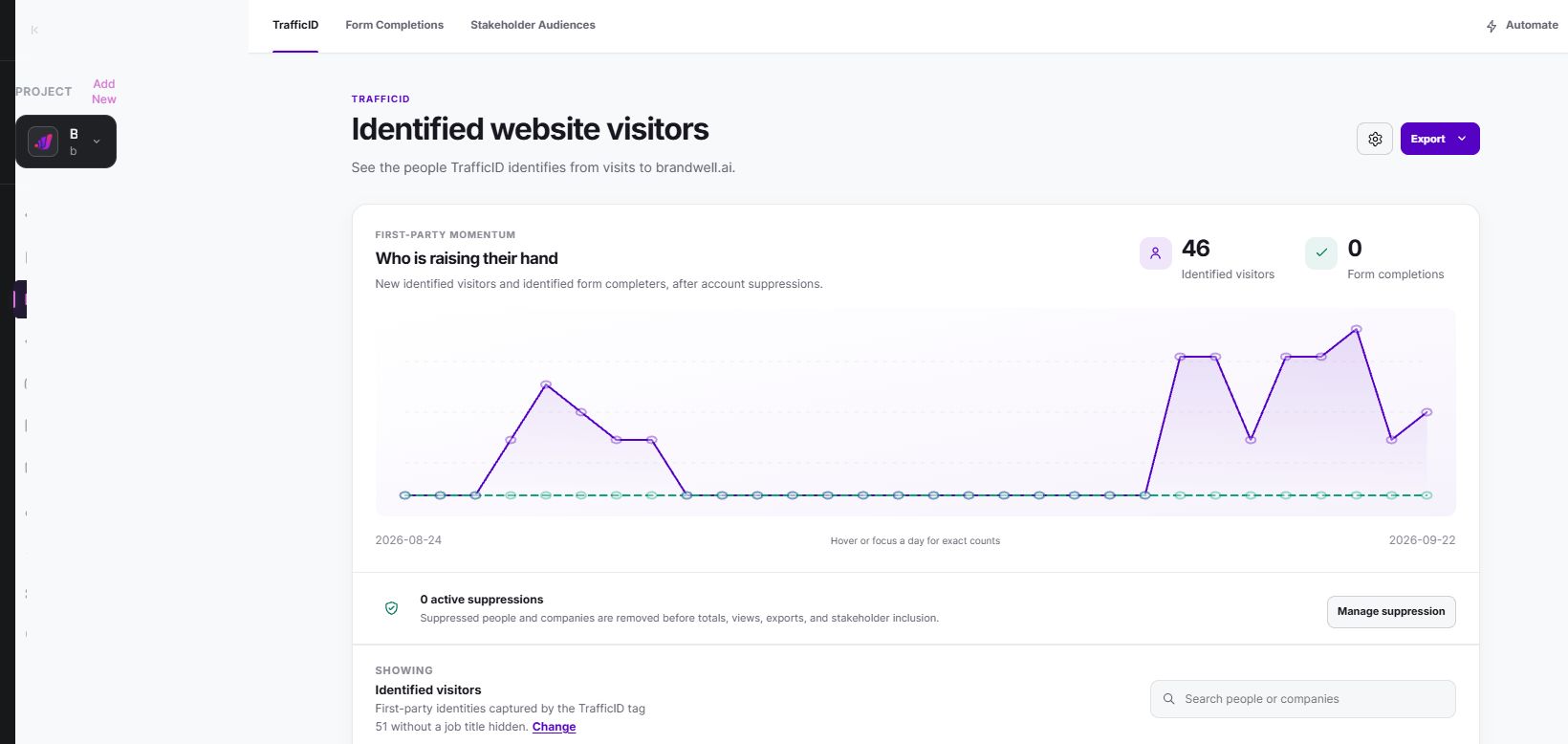
Review current TrafficID plans, eligible identified-visitor volume and the selected fixed or dynamic billing mode before budgeting. TrafficID and MarketPulse have separate product scope. Verify current allowances and included tools on the product page.
MarketPulse is separate external topic research starting at $500/mo. Topic audiences do not establish a visit to the client’s site. Agency setup, analysis, reporting, custom portals and integrations need separate scope and fees.
Separate five visitor and identity layers
Pricing becomes confusing when unlike outputs share one label. Define the service before naming a fee.
| Layer | What it can contribute | What it does not prove |
|---|---|---|
| Traffic analytics | Visits, pages, sources, events, and aggregate behavior | The identity or buying readiness of a specific visitor |
| Company identification | A possible organization associated with traffic under the provider’s method | Which person visited or why the visit occurred |
| Person-level resolution | A possible person or contact state when rights, method, and jurisdiction support it | That the resolved person personally performed every observed action |
| Enrichment and validation | Additional company or contact fields and a separate validation state | That the account is qualified or ready for outreach |
| Activation and evidence | Routing, review, approved action, suppression, and downstream records | That the signal alone caused a meeting, opportunity, or revenue |
Swipe the table to see all columns.
An agency can charge more for a complete, well-governed workflow than for raw access because it is delivering decisions, controls, and support. It also carries more responsibility. Scope identity depth, permitted uses, destinations, and reporting explicitly.
Define the service promise you can deliver
Offer the service when the client has meaningful B2B traffic, a defined market, a practical activation motion, named owners, and a reason to prioritize accounts or known contacts. The responsible promise is that the agency will configure the agreed source, apply qualification and exclusion rules, label identity states, route approved outputs, and report what happened next. The promise should be observable in the delivery record.
Do not promise that every visitor will resolve, that a resolved account is shopping, that a person-level match is certain, or that outreach will create pipeline. Results vary with traffic composition, consent and privacy choices, technical configuration, provider method, geography, identity state, market fit, client response, and other factors. Those are planning variables, not sales fine print.
The service is a poor fit when the client wants a list without an activation plan, expects consumer surveillance, serves sensitive use cases without qualified review, or lacks enough relevant activity to justify a recurring operation.
Assign installation and follow-up owners
The workflow begins before installation. Confirm the client’s purpose, site ownership, permitted collection, notices and choices, audience, exclusions, regions, data fields, identity level, destinations, retention, access, and incident path. Technical installation should use approved credentials and a change record. Validate that the configuration sends only expected information and that removal or suspension is possible.
After collection starts, classify outputs before action. Apply account fit, page or behavior context, duplicate handling, suppression, validation, and confidence labels. Send only approved records to the destination. Assign an owner and record whether the client accepted, rejected, held, or acted. The handoff needs field definitions and examples, not just a CSV.
Staffing usually spans an account owner, implementation owner, analyst or operations owner, client activation owner, and privacy or security reviewer. Define service levels for installation response, scheduled delivery, exception handling, and support. Avoid “real-time everything” unless the entire chain, staffing, and contract support that commitment.
Evaluate the supported delivery stack
There is no universal best provider. Shortlist options by operating model and apply identical criteria. An agency-owned white-label platform fits teams that want branded delivery, configurable retail pricing, and multiple client accounts. A direct visitor-identification point solution can fit a single client or focused use case. An enterprise ABM suite may fit a mature internal team that wants broad orchestration and accepts enterprise implementation. A custom stack offers control but shifts engineering, maintenance, identity, security, and client-isolation work to the builder. Analytics alone remains useful when identity is unnecessary or inappropriate.
1. White-label agency platform
Evaluate client separation, branding, rights, usage, reporting, retail control, support, and module economics.
2. Direct point solution
Evaluate identity level, method, regions, export rights, destinations, limits, notices, and support.
3. Enterprise suite
Evaluate required modules, implementation, users, workflow adoption, contract term, and total cost.
4. Custom stack
Evaluate build time, monitoring, tenant isolation, vendor dependencies, maintenance, deletion, and incident response.
5. Analytics-first approach
Use aggregate behavior and explicit conversions when identification adds more risk than decision value.
Do not rank providers from a vendor’s headline match rate. Ask for the definition, population, identity state, geography, denominator, validation method, exclusions, and test process. Use a client-specific sample where terms permit, and do not convert the sample into a guarantee.
Choose build, service or referral scope
Build when visitor identification is strategically central, the agency has engineering and governance capacity, and control is worth the ongoing maintenance. Resell when the agency wants recurring ownership and branded delivery but prefers contracted infrastructure. Refer when the client needs the tool but the agency does not want data handling, implementation, support, or billing responsibility. Avoid when fit, rights, trust, economics, or activation capacity fail.
Compare the four paths across time to launch, cash requirement, data and contract rights, client billing, tenant isolation, implementation, support, margin, technical dependency, and exit plan. A referral fee may produce less revenue but more attractive risk-adjusted economics. A reseller model may create durable recurring value, but only if the agency can operate the service rather than pass through records.
Use the build, resell, or refer guide to evaluate the wider intent-platform choice with the same decision logic.
Price defined costs and contribution
There is no responsible universal retail price or gross-margin benchmark. Calculate the account’s cost floor, choose a target contribution that supports the agency, and test sensitivity to usage, traffic, support, and custom work. Use a predictable base with a clear included band. If the value metric is usage, define the measured event, reporting source, caps, overages, and what happens when traffic spikes.
Copyable visitor identification pricing worksheet
Wholesale base = contracted platform and enabled modules
Variable data cost = measured usage x contracted unit cost
Service cost = implementation allocation + analysis + validation + activation + reporting + account management + support
Risk and overhead = security, privacy review, tooling, sales, finance, and contingency allocation
Monthly cost floor = wholesale base + variable data cost + service cost + risk and overhead
For a target contribution rate, client fee = defined cost / (1 - target rate). Alternatively add a specified dollar contribution once. Test low, expected and high usage with the same cost boundary.
Measure outcomes without promising causality
Begin with a traceable funnel: eligible site activity, resolved state, accepted account or contact, qualified record, assigned owner, action, response, meeting, opportunity, pipeline, and revenue. Preserve timestamps and reasons for rejection. A report should show how many records reached each stage and where evidence is missing.
Use explicit attribution labels. “Sourced” requires a written rule for what began the opportunity. “Influenced” requires a defined touch and window. “Associated” means the records overlap but causation is not established. “Unknown” is a valid answer when systems or identity do not support more. Keep the baseline and note simultaneous changes in traffic, media, content, offer, staffing, or sales follow-up.
A client may still value faster account research, better routing, or reduced manual review even when revenue attribution is incomplete. State that operational benefit separately. Do not translate it into invented pipeline or return.
Qualify traffic, rights and client readiness
A good-fit client sells a considered B2B offer, attracts relevant site activity, knows its target market, can act on prioritized records, and has a CRM or decision record. It names a business owner, accepts identity limitations, and participates in data-use, security, and implementation review. Existing demand generation, ABM, outbound, RevOps, and sales-enablement clients may have a natural activation path.
Exclude or defer clients with negligible relevant traffic, consumer or sensitive use cases that have not passed qualified review, no site authority, no activation owner, no system of record, a demand to identify every visitor, or an expectation of guaranteed revenue. Also defer when the platform agreement does not clearly support the proposed region, purpose, resale, client access, or destination.
Run a readiness sample without using it as a forecast. Validate installation, identity states, relevance, client workflow, and cost. A low-volume but high-value site may still fit, while a high-traffic site full of irrelevant visitors may not.
Preserve visitor and stakeholder states
The source record should identify first-party on-site behavior, the visitor-identification method supplied under contract, any account-level topic signal, enrichment, validation, and destination response. Keep each layer distinct. Record whether the output is company-level, person-level, inferred, validated, unresolved, or suppressed.
Identity checks should include expected domain or company fit, duplicate and conflict handling, recency, required fields, provider method documentation, and a human review rule for consequential action. Activation should include qualification, permitted purpose, suppression, owner assignment, channel approval, message review, and outcome logging. Never send every resolved record directly into outreach without a policy.
Evidence for pricing includes actual usage, analyst time, support load, destination acceptance, and client adoption. Evidence for value includes decisions and downstream records with attribution limits. Keeping those ledgers separate prevents the agency from confusing an expensive data month with a valuable one.
Review identity and expectation risks
Data quality can fail through incorrect identity, unresolved visitors, stale enrichment, duplicates, wrong account fit, missing context, or inconsistent denominators. Delivery can fail through installation errors, destination rejection, access changes, weak handoffs, or unowned exceptions. Put correction and suppression paths in the workflow and price the review work.
Review actual site authority, source rights, purpose, notices and choices, fields, access, retention and destination approvals. A visitor match does not establish permission for every follow-up. Qualified reviewers assess the actual regions and use case.
Expectation risk begins in sales language. Avoid “know every visitor,” “real-time buyer,” or similar phrases unless the exact claim can be supported and appropriately qualified. The agency should review both explicit and implied claims. Maintain a shared definition sheet so sellers, analysts, and clients use “visitor,” “account,” “person,” “match,” and “qualified” consistently.
For a broader program, use the intent-data compliance program guide to connect vendor, client, security, and workflow reviews.
Maintain the scoped visitor service
Package the recurring operation around a defined identity layer, included usage band, qualification rules, destinations, review cadence, service levels, client responsibilities, support, reporting, privacy and security controls, change process, and end-of-service handling. Show the client what is delivered, how uncertainty is labeled, what the client must do, and how overages or new use cases are approved.
AIMEE can help organize an approved visitor brief through configured connected tools. Preserve the observed visitor, separate added stakeholders and missing evidence. Human owners approve source use, exports and actual follow-up.
Use TrafficID for supported own-site visitor review. MarketPulse supplies separate topic research and cannot replace the site-tag setup. Agency setup, analysis, reporting and custom integration work have separately agreed deliverables and fees.
Copyable assistant package model
Use aggregate or synthetic examples for planning where possible. Do not paste unneeded visitor records, credentials, or sensitive client data. A human must approve pricing, provider terms, privacy and security controls, and activation.
Build a website visitor identification service pricing model from these approved inputs.

Inputs:
- client market, traffic bands, regions, and approved purpose
- proposed identity layer and known limitations
- contracted platform, module, and usage costs
- implementation, analysis, validation, activation, reporting, support, and account-management hours
- included destinations and service levels
- access, retention, suppression, deletion, and incident controls
- low, expected, and high usage scenarios

Return:
1. missing assumptions and questions
2. monthly cost floor for each scenario using only supplied numbers
3. three package options with included units, exclusions, and change rules
4. capacity and downside stress tests
5. claims the sales team must not make
6. approvals required from operations, finance, privacy, security, legal, and the client

Do not invent match rates, margins, traffic, identities, legal conclusions, pipeline, or revenue.
Price the actual operation first
Select one qualified client profile, model low and high usage, and write the included workflow in plain language. If the agency cannot explain identity limits and the next action, it is not ready to sell the service.
Evaluate TrafficID on an authorized client site and verify its actual connection state. Review observed visitors separately from forms and added stakeholders, inspect the permitted fields and record real operator effort. Agree on the agency service scope before expanding.
Worked example: plan price is not agency service cost
Suppose a fictional client uses the current $99 TrafficID band. The agency budgets five monthly review hours at $75, $100 for reporting and $100 for support: $674 in defined recurring cost. For a chosen 40% delivery contribution, the required fee is $674 / 0.60 = $1,123.33, leaving $449.33 before acquisition, general overhead, tax and financing. This is an invented agency model, not a BrandWell service price or market benchmark.
If the actual configured dynamic plan moves to the $299 band, while service work remains unchanged, cost becomes $874. At the same $1,123.33 fee, the remainder falls to $249.33, or about 22.2%. Four additional exception hours at $75 make cost $1,174 and produce a $50.67 delivery loss. Scope how plan changes and added service work are handled before committing to a fixed retail fee. Do not assume a fixed plan silently changes or invent per-record overage pricing.
If the team reviews 100 observed identified visitors, accepts 30 for further account research and later adds 60 company stakeholders, report those as distinct populations. Do not report 160 site visitors. Accepted research is not authorization to contact every person. Preserve source, identity, suppression, review and approved action separately.
Run the first review in TrafficID
Authorize the client site, establish the supported Company Project tag and inspect its reported setup state. Review identifiable visitors and available page context separately from submitted forms and added stakeholders. Apply people and company suppressions before an approved export or follow-up. AIMEE can help prepare account research through configured tools, with the owner’s approvals.
Frequently asked questions
Does $99 include the agency’s managed service?
No. Scope agency labor and delivery separately.
Are added stakeholders site visitors?
Do not assume that. They are separate from observed visitors.
Does a fixed plan automatically move up with volume?
Check the actual settings. Fixed and dynamic pricing behave differently.
Can MarketPulse replace own-site tracking?
No. External topic research and visitor events have different origins.
Review the actual visitor product: explore TrafficID and current plans.
Reviewed and updated October 3, 2026.

Written by